









O.Carm
New Book on Elijah and Elisha in the Latin Middle Ages

New from Edizioni Carmelitane | Author: Sr. Éliane Poirot, OCD
Les prophètes Élie et Élisée au Moyen Âge Latin:
Tome 1, 2, 3 et 4
In the preamble to the Constitutions of the London Chapter in 1281, for the first time in a Carmelite document preserved to this day, mention is made of the two prophets Elijah and Elisha. In this Rubrica prima, which answers the question of the origins of the Order, we find a statement that would be constantly repeated and developed in the centuries that followed: the Order of Carmel goes back to the prophets Elijah and Elisha, and Carmelites are the successors of all those who led a monastic life on Mount Carmel.
What was the background to this assertion? In an attempt to answer this question, we looked at Christian literature as a whole, and saw how the patristic tradition saw the prophet Elijah as an archetypal monk, with Elisha as the disciple par excellence. We now turn our attention to written sources from the Carolingian period to the 13th century, mainly through biblical commentaries on the Elijah and Elisha cycles, on the Transfiguration of Christ recounted in the Synoptic Gospels and on the two witnesses of the Apocalypse (Rev 11), as well as sermons. Most of these texts have been translated into French for the first time.
About the Author:
Sr Éliane Poirot, O.C.D., entered the Carmel de Nancy in 1965, and made solemn profession in 1970. She co-founded the Byzantine-rite Carmel of Saint-Remy in 1974, the Fraternité Saint-Élie in 1991, and the Romanian skite of Stânceni in 1994.
She holds a doctorate in Catholic theology and a university diploma in medieval Latin from the University of Strasbourg, as well as a diploma from the Saint-Serge Institute of Orthodox Theology in Paris.
She is the author of over a hundred articles and a dozen books, including several on the prophets Elijah and Elisha.
Tome 1: Vllle-IXe siècles. L'époque carolingienne
For more information
Tome 2: Xe-début-XIIe siècle. Des commentaires carolingiens à la Glossa ordinaria
For more information
Tome 3: La renaissance et le tournant du XIIe siècle
For more information
Tome 4: XIIIe siècle. L'essor des universités
For more information
Purchase a boxed set all four volumes (€150.00 value)
For more information
Vitam Coelo Reddiderunt

|
04-04-24 |
|
|
|
|
|
29-04-24 |
|
|
|
|
|
11-04-24 |
|
|
|
|
|
20-04-24 |
|
|
|
|
|
25-04-24 |
|
|
|
|
|
25-04-24 |
|
|
|
|
Memorial of Bl. Àngel Prat Hostench and 16 Companions

May 4, 2024 | Optional Memorial | Obligatory Memorial in Spain
PRAYER
Almighty God, you who gave your blessed Ángel Maria Prat Hostench, Lucas de San José Tristany Pujol, presbyters, and companions, the grace to confront death so to confess your word and bear witness to Jesus, grant us the power of the Holy Spirit, to remain steadfast in faith and strong in the confession of your name. Through our Lord Jesus Christ, your Son, who lives and reigns with you and the Holy Spirit, God, for ever and ever.
International Workshop on John Baconthorpe

Despite his importance in the history of the Carmelite Order, John Baconthorpe (c. 1290 – c. 1350) is still relatively unknown to modern scholars of medieval thought. Active in the Universities of Oxford, Paris, and Cambridge, Baconthorpe was later chosen by his order as a doctrinal guide, which resulted in multiple printings (from the late 15th to the mid-18th centuries) of his Parisian questions on I-III Sentences, a later version of his IV Sentences, and his Quodlibeta. Although only a handful of experts have delved into his works, whether in print or in manuscript, Baconthorpe’s intellectual project was ambitious and fascinating in the context of fourteenth-century philosophy and theology, with surviving commentaries on Matthew (in a Cambridge manuscript) and (in Paris, BnF, lat. 9540) on Augustine’s De Trinitate and De civitate Dei and on Anselm’s De incarnatione and Cur Deus homo. In his writings, the Doctor Resolutus employed an impressive variety of sources and engaged in dialogue with towering contemporary figures, such as Peter Auriol, Thomas Bradwardine, and some of his Carmelite confrères, while he was critically independent of the leading mendicants and seculars of previous generations, such as Thomas Aquinas, Henry of Ghent, Giles of Rome, Godfrey of Fontaines, and John Duns Scotus. In addition, Baconthorpe was sensitive to Averroes’s thinking but also to ideas from Jewish sources.
Sponsored by INSTITUTUM CARMELITANUM
Taking place: CISA, Rome, MAY 9-11 2024
THURSDAY 9 May 2024
16:00 – 17:30
16:00 – 16:30
WELCOME
16:30 – 17:00
Monica BRINZEI:
(IRHT, Paris)
Presentation of the Project
17:00 – 17:30
Stephen METZGER
(Biblioteca Apostolica Vaticana)
The Manuscripts of John Baconthorpe in the Vatican Apostolic Library
FRIDAY, 10 May 2024
9:45 - 17:00
9:45 – 10:30
Christopher SCHABEL
(IRHT, ERC Debate n° 771589, Paris)
The Carmelite John Baconthorpe's Parisian Questions on the Sentences
10:30 – 11:15
Wouter GORIS
(Bonn University, Bonn)
Baconthorpe on the First Adequate Object of the Intellect
Coffee Break: 11:15 – 11:30
11:30 – 12:15
Maria SOROKINA
(IRHT, Paris)
John Baconthorpe on Celestial Causality: A Dialogue with Henry of Ghent
12:15 – 13:00
Monica BRINZEI
(IRHT, ERC Debate n° 771589, Paris)
Seduction, Blasphemy, Heresy and the Danger of Exercitatio Sophistica according to John Baconthorpe
LUNCH
14:30 – 15:15
Ioana CURUT
(Babes-Bolyai University, RABY-MSCA
Seal of Excellence Project, PNRR-III-C9-2022-I9, No° 760130, Cluj-Napoca)
Jewish Authorities in John of Baconthorpe's Questio determinata in Ms. Paris, BnF, lat. 16 523
15:15 – 16:00
Andrei MARINCA
(Babes-Bolyai University, ERC Nota n°948152, Cluj-Napoca)
John Baconthorpe and Avicenna
Coffee Break: 16:00 – 16:15
16:15-17:00
Sylvain ROUDAUT
(KU Leuven, Leuven)
John Baconthorpe on the Intension of Forms
SATURDAY 11 May 2024
10:00 - 15:45
10:00 – 10:45
Niccolò BONETTI
(Università degli Studi di Udine)
Essence and Being in Baconthorpe
Coffee Break: 11:00 – 11:15
11:15 – 12:00
Mădălina PANTEA
(Babes-Bolyai University, ERC Nota n°948152, Cluj-Napoca)
The Definition of Vestigium Trinitatis in John Baconthorpe’s Commentary on Augustine’s De Trinitate
LUNCH
14:00 – 14:45
Matteo ESU
(EPHE-PSL, LabEx-Hastec, Paris)
The Theologian’s Pigeon. Baconthorpe’s Discussion of a Feudal Matter in Quodlibet III, question 4
14:45 – 15:30
Alfredo STORCK
(Universidade Federal do Rio Grande do Sul, Porto Alegre)
Bartolomeu do Pilar and the Reception of Baconthorpe in Colonial Brazil
Coffee Break: 15:30 – 15:45
Conclusions
Organized by: Monica BRINZEI
Mario ALFARANO, O. Carm.
Giovanni GROSSO, O. Carm.
Connexion Zoom: contact Esta dirección de correo electrónico está siendo protegida contra los robots de spam. Necesita tener JavaScript habilitado para poder verlo.
May Schedule of the Prior General

May 2024
1-3: completion of the canonical visitation in the DR Congo
7-8: plenary meeting of the General Council
10-12: centenary celebrations of the foundation of the Hermanas Carmelitas del Sagrado Corazón de Jesús, by Madre Asunción Soler Gimeno, 13th of May, 1924, in Malaga.
13-17 plenary meeting of the General council
15: celebration of the second centenary of the birth of Madre Teresa Scrilli,15th of May, 1825, Montevarchi, Florence, Foundress of the Institute of Nostra Signora del Monte Carmelo.
20 - 23 provincial chapter of the Polish Province, Krakow.
26 - 31 canonical visitation in the Province of Rio de Janeiro, second part.
Celebrating At Home - Sixth Sunday of Easter

Love Among Us, Love Within Us (John 15:9-17)
As we approach the coming feasts of the Ascension and Pentecost, the Gospel today helps us understand that Jesus is our bond of love with the Father and with one another.
Jesus shows us the way to live full and happy lives by living in love: “I have told you this so that my own joy may be in you and your joy be complete.” The commandments of Jesus are always about love - love of God and love of neighbour. Those who live by these commandments of Jesus abide with him, others and the Father in love.
Jesus is the reign of God in person. He is both the image of God and the model of the redeemed human being that each of us is called to be.
When Jesus says he has told the disciples everything he has learned from the Father it reminds us that Jesus was human as well as divine; that his life was a journey of learning, too; a path of facing choices and challenges. Jesus tells his disciples that they are his friends. They have become his friends because he has shared his knowledge and understanding and love of the Father with them.
We remain in Christ by remaining in his love and loving one another just as Christ has loved us. We are no longer servants but friends of Jesus because he has made known to us everything he learnt from God.
Jesus has chosen us and commissioned us to be love and to do love in the heart of the world.
- pdf Celebrating At Home - Sixth Sunday of Easter [PDF](2.89 MB)
- default Celebrating At Home - Sixth Sunday of Easter [ePub](2.56 MB)
- pdf Celebrando en Familia - Sexto Domingo de Pascua(453 KB)
- pdf Celebrando in Casa - Sesta Domenica di Pasqua(458 KB)
- pdf Celebrando em família - Sexto Domingo da Páscoa(452 KB)
Meeting of the General Economic Commission
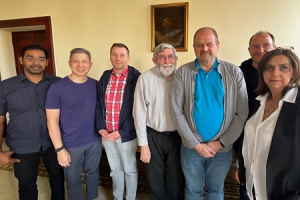
From April 8-12, 2024, the General Economic Commission met in Rome, whose members are: Javier Domingo Garmón i Calvo (Cat), Günter Benker (Ger), Shiju Njaralampuzha (Ind), Nixon Jacobus Silfanus (Indo-laica), and Christian Körner, General Economist. Anna De Giglio (Neap-laica) was unable to attend. Also present were Elisabetta Berardi (Curia) and as translator Tobias Kraus (Curia).
The meeting began with the review of the Curia's Economic Report 2023 and continued with the discussion of the following items: the submission of economic reports and payment of the contribution by some provinces, the revision of the Economic Directory, the criteria of investments, and the reconsideration of the percentages to be presented at the bursars' meeting and discussed together. The Commission also continued to prepare for the 'meeting of all bursars of the Order to be held, from November 11 (arrivals) to November 16 (departures) 2024 at the Casa São Nuno Hotel in Fatima.
The next meeting will be held during the bursars' meeting in Fatima.
World Press Freedom Day

May 3
A day observed to raise awareness of the importance of freedom of the press and to celebrate the fundamental principles of press freedom enshrined under Article 19 of the 1948 Universal Declaration of Human Rights and marking the anniversary of the Windhoek Declaration, a statement of free press principles put together by African newspaper journalists in 1991.
From an open letter from Catholic journalists to Pope Francis on the occasion of the canonization of Carmelite Titus Brandsma, May 15, 2022.
Your Holiness,
In 2018 you asked us, journalists, loud and clear, “to promote a journalism of peace”, a “journalism that is truthful and opposed to falsehoods, rhetorical slogans, and sensational headlines. A journalism created by people for people, one that is at the service of all, (…) a journalism committed to pointing out alternatives to the escalation of shouting matches and verbal violence” (“The truth will set you free” (Jn. 8:32), Fake news and journalism for peace. Message of His Holiness Pope Francis for World Communications Day, 24 January 2018).
We wholeheartedly endorse your call to action and in it we recognize a mission statement for the whole of the journalistic enterprise: for old and new media, for editors of newspapers, magazines, radio and television stations, and internet platforms - and not only for journalists of Catholic origin, but for all journalists of good will.
Titus Brandsma has meant a lot to the Catholic community in the Low Countries, but his journalistic work stands out among all his other activities. He was editor-in-chief of a newspaper, devoted himself to the modernization and professionalization of the Catholic daily press in the Netherlands, and strove for better working conditions and the establishment of a professional training for journalists.
Father Brandsma did his work in the context of the rise of fascism and Nazism in Europe. In word and deed he opposed the language of hatred and division that was becoming common at the time. In his view, what we now describe as ‘fake news' was not to be tolerated in the Catholic press; he successfully argued for an episcopal ban on the printing of National Socialist propaganda in Catholic newspapers.
[St. Titus Brandsma] paid with his life for his courageous actions.
According to the Committee to Protect Journalists (CPJ), 99 journalists were killed in 2023, 72 in the Palestinian-Israeli conflict alone.
Link to Article 19 of the 1948 Universal Declaration of Human Rights (1948)
Link to the Windhoek Declaration (1991)
Link to full letter of the Catholic journalists to Pope Francis (May 2022)
Publications by or about St. Titus Brandsma, include the Collected Works of Titus Brandsma in English (4 of 7 volumes completed); Un Frate Pericoloso, a play in Italian; biographies in English, Spanish, and Italian; a RAI Radiotelevisione Italiana-Tiber Cinematografica produced movie, Le Due Croci (DVD, in Italian with subtitles available in English and Spanish); and many other excellent offerings.
Lectio Divina May 2024
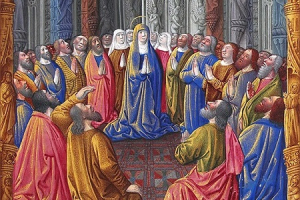
Opening Prayer
Lord, You are! And this is sufficient for us, to live by, to go on hoping every day, to walk in this world, not to choose the wrong road of being closed and lonely. Yes, You are forever and from all time; You are constant, O Jesus! Your being is our constant gift; it is an ever ripe fruit that feeds and strengthens us in You, in Your presence. Lord, open our heart, open our being to Your being; open us to life with the mysterious power of Your Word. Help us to listen, to eat and savor this food for our souls, which is indispensable for us! Send us the good fruit of Your Spirit so that He may bring about in us that which we read and meditate about You.
30th Anniversary of the Beatification of Isidore Bakanja

From the Vice-Postulator of the Cause of Isidore Bakanja
Carmelite Family Celebrates 30th Anniversary of the Beatification of Blessed Isidore Bakanja
On April 24, 1994, Blessed Isidore Bakanja, layman and martyr of the Scapular of the Virgin Mary of Mount Carmel, was beatified by Pope John Paul II. Today the Order comes together to celebrate the 30th anniversary of the Church's recognition of the holiness of this Congolese Catholic who would not give up his scapular.
Isidore Bakanja was born in Bokendela (Democratic Republic of Congo) around 1885. Leaving his village, he moved to Mbandaka, where he was baptized on May 6, 1906 and confirmed a few months later, on November 25, 1906. He was heavily influenced by the witness of the Trappist missionaries, cultivating a special devotion to Jesus and the Blessed Virgin Mary.
Despite the difficulties he encountered at work because of his fidelity to Christ, he remained steadfast in his faith. On February 2, 1909, he suffered an atrocious scourging because he refused to get rid of the scapular of the Virgin Mary of Mount Carmel which he wore over his shoulders. Following a terrible beating and sensing his impending death, he received the anointing of the sick on July 24, 1909. Just as Christ died having forgiven his wrongdoers, so Bakanja died having forgiven his executioner: “The white man hit me; that's his business. It's up to him and God. When I get to heaven, I'll pray a lot for him and ask God to forgive him.”
Bakanja died on the Feast of the Assumption, August 15, 1909, at the age of 24. In imitation of Christ, whom he had followed from the moment of his baptism, Isidore Bakanja lived in his own way, like Saint Paul, who wrote: “For me, to live is Christ.” (Philippians 1, 21). "For me, to live is to be a Christian."
On June 7, 1917, his remains were exhumed and buried at the Immaculate Conception Parish in Bokote. He was proclaimed Blessed on April 24, 1994. His cause for canonization is now underway. Popes Benedict XVI and Francis have recognized and proposed Blessed Isidore Bakanja as an authentic witness and example of faith for all Christians in the world. In his post-synodal Apostolic Exhortation Christus vivit, Pope Francis named Blessed Isidore Bakanja among the young saints who today mobilize Christians in their quest for holiness and inspire new conversions. In short, Blessed Isidore Bakanja is a spiritual and ecclesial heritage for the world.


