










O.Carm
Celebrating At Home - 5th Sunday in Lent

Freedom & Forgiveness
(John 8:1-11)
The scribes and Pharisees, out to trap Jesus, parade a hapless woman before the crowd gathered to hear Jesus teaching. We can only imagine her embarrassment as they publicly accuse her of adultery. Noting that the law of Moses says that they should stone the woman to death, they ask what Jesus thinks.
Jesus, already seated, bends lower and writes on the ground. What he writes we do not know, but from his ‘lowly’ position Jesus quietly manages to turn the whole situation around.
At first he says nothing. When the scribes and Pharisees persist with their question, Jesus simply says, ‘Let the one without sin be the first to throw a stone at her’, and goes back to his writing.
We sense that an awkward silence followed before the once threatening scribes and Pharisees seem to just melt away. Jesus’ words seem to touch them deeply and melt away both their harsh attitude towards the woman and their desire to entrap him.
Like the woman, they are not condemned by Jesus but restored to right relationship with him and the woman – they no longer want to trap Jesus or harm the woman. They quietly leave. Jesus pronounces forgiveness for the woman and tells her not to sin anymore.
The Gospels of the last two Sundays were parables about God’s forgiveness and tender care in nurturing us back to life. In today’s Gospel we see God’s lavish forgiveness in action as Jesus deals with a concrete human situation of life-threatening judgement and condemnation.
We are called, not to be judges over others, but practitioners of God’s lavish compassion and mercy.
- pdf Celebrating At Home - 5th Sunday in Lent [PDF](2.83 MB)
- default Celebrating At Home - 5th Sunday in Lent [ePub](2.61 MB)
- pdf Celebrando en Familia - Quinto Domingo del Tiempo de Cuaresma(241 KB)
- pdf Celebrando in Casa - V Domenica di Quaresima(247 KB)
- pdf Celebrando em família - Quinto Domingo Da Quaresma(248 KB)
Prior General's Schedule for April 2025

Fr. Míċeál O'Neill, the prior general, has the following schedule planned for the month of April 2025:
April 1-8: Canonical visitation of the Dutch Province
April 9: Celebrate the Eucharist at the Assembly of the Italian Federation of Nuns
April 13-19: Canonical visitation of the Province of Betica
April 22-30: Australia—Fraternal visit and Provincial Chapter
Lectio Divina April 2025

Opening Prayer
Lord our God,
You have quenched our thirst for life with the water of baptism.
Keep turning the desert of our arid lives into a paradise of joy and peace, that we may bear fruits of holiness, justice, and love.
Lord, hear our prayer through Jesus Christ, our Lord.
The Eastern Indonesian Province Formed

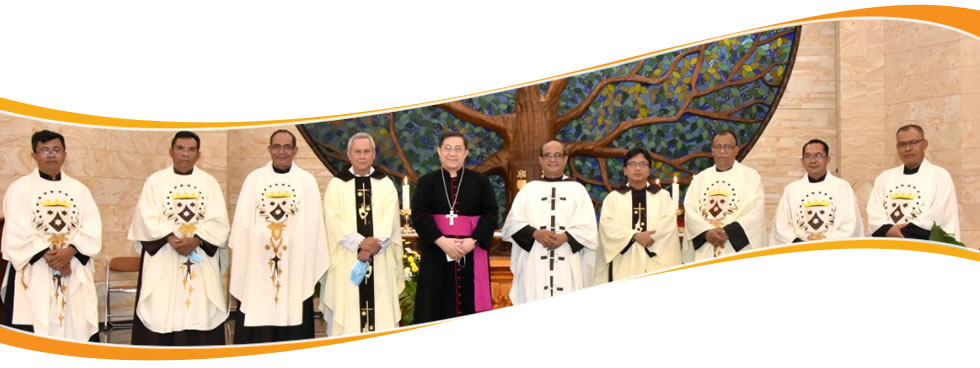
The Eastern Indonesian Province Established on March 25, 2025
The Eastern Indonesian Province of the Order of Carmelites has been established, separating from the Province of Indonesia. The Province of Indonesia is currently the largest province in the Order, having been established by the Dutch Province in 1923. Even after the division it will remain the largest province in the Order.
The new province will be under the patronage of St. Titus Brandsma. It comes into existence on the Solemnity of the Annunciation of the Lord, March 25, 2025. The General Council of the Order named Marselinus Barus, O. Carm., as the first prior provincial. They also named Dominikus Dinong, O. Carm., Ferdinandus Tay, O. Carm., Aloysius Roja, O. Carm., and Innosensius Inno, O. Carm., as the members of the first provincial council. The first Provincial Chapter will be held within the year.
Fr. Marselinus, the new provincial, reflected on the new reality saying, “"As a new province, of course, we Indonesian Carmelites, especially Eastern Indonesian Carmelites, are very happy with the establishment of a new province considering the large area of Indonesian territory. With this new province, it is hoped that the work of the Carmelites in eastern Indonesia will grow. My hope is that the Eastern Indonesian Province of the Carmelite Order will continue to build fraternity and cooperation with the mother province and with other provinces around the world."
The new province will consist of one hundred and seventeen (117) friars of solemn profession and sixty-five (65) friars of simple profession who choose to be members. The area of the new province covers the ecclesial provinces of Makasar, Ende, Kupang and Merauke.
The process of becoming a province officially began during the Provincial Chapter of 2009. The provincial council and the commissary council were tasked with studying the possibility of the Eastern Indonesian Commissariat becoming a General Commissariat by 2025. However, taking into consideration the new development in the commissariat, the Provincial Chapter in 2022 voted in favor of the erection of a new province in Eastern Indonesia. For 10 days in August 2023, the prior general, Míċeál O’Neill, and the general councilor for Asia, Australia, and Oceania, Robert Puthussery, conducted a canonical visitation of the Eastern Indonesian Commissariat.
The formation of the first group of postulants in Eastern Indonesia started on the Feast of the Prophet Elijah (July 20th). A year later, on July 12th, those students began their novitiate receiving their habits from then prior general, John Malley. In 2006, the East Indonesian region was upgraded to a provincial commissariat.
The new province will have four canonically erected houses and three formation houses.
Celebrating At Home - 4th Sunday in Lent

The Forgiving Father
(Luke 15:1-3, 11-32)
A wealthy father has two sons. Very cheekily, the younger son asks for his share of the estate which would come to him on his father’s death. This is a young man who has places to go and things to see!
Remarkably, the father gives him half of his estate, not the one-third to which the son was entitled. No wonder the older son is put out. The younger son goes off and has a great time until the money runs out.
Financially ruined he has to earn his keep feeding pigs. He decides to return home, beg forgiveness and ask to be only a servant in his father’s household.
The father is anxiously waiting for the son when he returns. He runs to embrace him. The son begins his confession, but the father takes no notice. He does not chastise or lecture. He refuses to treat his son as a servant and immediately sets about restoring him to his rightful place in the household with the ring, the robe and sandals. He orders a feast to celebrate the fact that his son is alive and has returned. No wonder the older son is angry and resentful. But the father sets about reassuring him that his place in the household and in the father’s affection is secure and urging him to be reconciled with his brother. We are left wondering about what eventually happened.
The Gospel offers not just the hope of God’s forgiveness but the certainty of it.
The message today is: Rejoice in God’s abiding mercy!
- pdf Celebrating At Home - 4th Sunday in Lent [PDF](3.97 MB)
- default Celebrating At Home - 4th Sunday in Lent [ePub](6.97 MB)
- pdf Celebrando en Familia - Cuarto Domingo del Tiempo de Cuaresma(516 KB)
- pdf Celebrando in Casa - IV Domenica di Quaresima(510 KB)
- pdf Celebrando em família - Quarto Domingo Da Quaresma(509 KB)
Carmelites Discuss Challenges of Communication

Carmelites Gather to Discuss the Status of Communications Programs in the Order
The directors of the Order’s communication offices around the world gathered on Monday, January 27, in person as well as via zoom to participate in a discussion of the status of the various communications programs in the Order and the provinces. Each participant was asked to share three things they felt everyone should know about their ministry of communications.
They were also asked to complete a one-page survey which will be summarized to give a more complete picture of the state of our communications. There was quite a bit of enthusiasm generated during this meeting and future gatherings are being planned.
The Director of Communications for the Order, William J. Harry, spoke on the challenges and the opportunities we have to evangelize in today’s world with our new technologies. pdf That talk is available here in the three languages.(243 KB)
A second meeting via zoom is scheduled for May 21, 2025. The meeting will be in two parts, better accommodating the different time zones within the Order.
+ Asia/Australia/Oceania (09.00-12.00 Rome time)
+ Africa/Europe/Americas (17.00-20.00 Rome time)
The meetings are primarily conducted in English. So those who will be attending and require translation into Spanish or Italian, please contact the office by May 15th, if you will be attending and require a translator.
Santa Croce Conference Focused on Evangelization

Santa Croce Offers Professional Development Focused on Evangelization
For six days, communications directors from various parts of the Order met in Rome to participate in three events related to communications. The first was a three-day conference at the Pontifical University of Santa Croce entitled Communication and Evangelization: Context, Attitudes and Experiences. One of the university’s focuses is communications. This was the 14th professional seminar for Church communications offices.
The goal of the conference was to explore the Church’s evangelizing. This is something present in each diocese as well as religious order on various levels. The form of dialogue used brings together characteristics such as the primacy of charity, love of truth, respect for the person and his or her freedom, and the promotion of pluralism. In addition, the various dimensions of the Church's communication refer to the horizon of evangelization: internal communication, relations with journalists, creation of media and channels, presence on social networks, listening, dissemination of content, and institutional relations. When put together and used appropriately, these activities make the Church capable of proclaiming Christ, the Good News.
To explore the theme a number of presentations as well as panels of experts from various parts of the world were provided. Presentations were in English, Spanish, and Italian (with simultaneous translations for the large gatherings). The breaks provided the opportunity to connect with fellow workers in this particular vineyard.
The full program can be found at en.pusc.it/csi/ucc2025/progr
The Commission for the Protection of Minors Meets
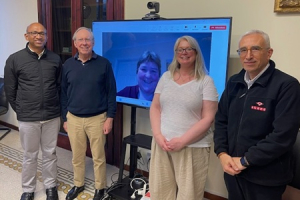
Meeting of the General Commission for the Protection of Minors and Vulnerable Persons Held in Rome
The members of the General Commission for the Protection of Minors and Vulnerable Persons held their third meeting at the General Curia in Rome on March 3-7, 2025. Members of the Commission are Fr. Michael Farrugia O. Carm., President and General Procurator of the Order; Ms. Julie McCullough (Hib-lay); Ms. Julie Courtney (Brit-lay) (Zoom on-line); Fr. Quinn Conners, O. Carm., (PCM); and Fr. Babu Payikkattu, O. Carm., (Ind)
The members would like to thank everyone who responded to the feedback from the Commission’s analysis of the original Safeguarding questionnaire (second phase). The Commission was impressed that many of the respondents had applied the recommendations made by the Safeguarding Commission. Presently over 70% of realties have an adequately appointed Safeguarding Delegate and almost 50% of realities have a sufficient local Safeguarding Policy.
Analysis of the safeguarding practices implemented locally throughout the Order provided the foundation for the development of a proposed universal Carmelite Safeguarding Policy with specific standards which will be presented to General Council later this year for their consideration and approval.
Causa Nostrae Laetitiae

INITIUM NOVITIATUS
31-01-25 Ansbert Ananta Malik (STSA) Kerala, India
31-01-25 Justin Sajan Nayak (STSA) Kerala, India
31-01-25 Gabriel Abhilash Naya (STSA) Kerala, India
31-01-25 Pius Prasanta Toppo (STSA) Kerala, India
02-02-25 Hannah Maria vom Wort Gottes (Sieg)
PROFESSIO TEMPORANEA
25-01-25 Mary Ann Nzilani Muia of the Passion of Christ
02-02-25 Aquinas Sumanth (STSA) Kerala, India
02-02-25 Lawrence Lazar Paltasing (STSA) Kerala, India
02-02-25 Sameer Simon Baliar Singh (STSA) Kerala, India
02-02-25 James Naik (STSA) Kerala, India
ORDINATIO DIACONALIS
14-02-25 Rolando Mamites (Phil) Quezon City, Philippines
14-02-25 Dave Malinao (Phil) Quezon City, Philippines
14-02-25 Adrian Vergel Ballares (Phil) Quezon City, Philippines
14-02-25 Jaynor Mike Gomez (Phil) Quezon City, Philippines
ORDINATIO SACERDOTALIS
14-02-25 Romualdo De Los Reyes (Phil) Quezon City, Philippines
14-02-25 Alexander Martinez (Phil) Quezon City, Philippines
Celebrating At Home - 3rd Sunday in Lent

The Patient Gardener
(Luke 13:1-9)
How do we get from temptation to transfiguration? Only with repentance and God’s forgiveness. That’s the road map for our Christian journey.
Oh, how we love a good story about disaster befalling someone else! The strength of Jesus reply to those who told him about the crucified Galileans seems to indicate that they shared this news with some delight.
Jesus reply tells us not to assume that bad things happen only to bad people and not to think that disasters are some kind of punishment for sin; stop thinking about the guilt of others and put your energy into repentance – turning back towards God.
The parable of the Fig Tree which follows answers the question, ‘If we do repent, what sort of reception will we get from God?’ God will work with us like the gardener in the parable. He will treat us with kindness and tenderness and nurture us back to life so that we can produce good fruit.
- pdf Celebrating At Home - 3rd Sunday in Lent [PDF](3.07 MB)
- default Celebrating At Home - 3rd Sunday in Lent [ePub](6.09 MB)
- pdf Celebrando en Familia - Tercer Domingo del Tiempo de Cuaresma(466 KB)
- pdf Celebrando in Casa - III Domenica di Quaresima(467 KB)
- pdf Celebrando em família - Terceiro Domingo Da Quaresma(466 KB)


