








O.Carm
St. Titus Celebrated in Australia
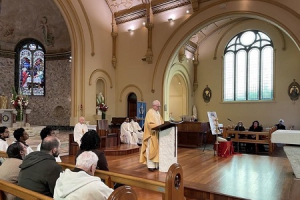
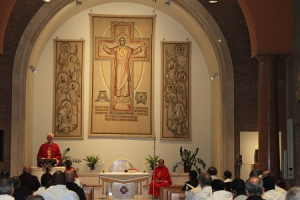
Carmelites, Lay Carmelites, parishioners, students, parents, and staff from Whitefriars College, and those for whom Titus Brandsma holds a special place in their lives, gathered at the National Shrine of Our Lady of Mount Carmel, Middle Park (VIC), on July 31 for a Thanksgiving Mass celebrating his canonization.
Students from Brandsma House at Whitefriars College joined the Entrance Procession carrying the relic of Titus Brandsma, the Brandsma House banner and a typewriter and camera. One of the students welcomed the assembly and gave a personal reflection on Titus Brandsma at the beginning of Mass. Students, staff and parishioners shared the readings and Prayers of the Faithful. Fr Paul Cahill, the prior provincial presided.
In his homily, Fr Paul called Titus Brandsma, “a gift to the world, the Church and the Carmelite Order.” He added, “Throughout his life, whilst exercising and sharing his intellectual gifts through his studies and his teaching, preaching and writing, he was also down to earth, connected with people in their everyday struggles, and keen to assist them in whatever practical ways that he could.”
Stressing the relevance of Titus for us today, Fr. Paul quoted the words of Pope Francis during his homily at the Mass of canonization when the pope observed that we have “turned holiness into an unattainable goal. We have separated it from everyday life, instead of looking for it and embracing it in our daily routines, in the dust of the streets, in the trials of real life and, in the words of (another great Carmelite Saint) Teresa of Avila to her Sisters, “among the pots and pans.”
He also quoted the Cardinal Archbishop of Utrecht in Titus’ native Netherlands, during his homily in the first Mass of Thanksgiving, celebrated in St. Peter’s Basilica the day after the canonization. “Titus didn’t become a saint because he was a martyr, but he became a martyr because he was already a saint”.
Celebrating 600 Years of Carmine in Florence
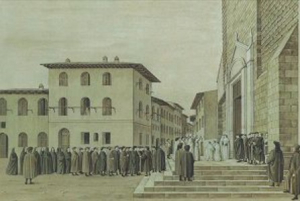
1422-2022
The Carmelite Community celebrates 600 Years of the Dedication of the Basilica of the Carmine in Florence, Italy, on Sunday, September 18.
The celebration will include a greeting of the Carmelite prior general, Míceál O’Neill at 9:30 AM. At 9:45 the Mayor of Florence, Dario Nardella; the Prefect, Valerio Valenti; and the Superintendent of Florence Andrea Pessina will speak. This will be followed at 11AM with Eucharist celebrated by Cardinal Giuseppe Betori, the Archbishop of Florence. A reception follows.
Through a donation from the will of Cione Tifa Vernaccia, the Carmelites became the seventh and final mendicant community to establish themselves in Florence, which by the end of the thirteenth century was becoming the financial and cultural capital of Europe. While the Carmelites alone did not profoundly alter the history of the city, together the mendicant communities played key part in shaping the religious and social life of Florence.
The church the Carmelites from Pisa established in the Oltramo district of the city of Florence was named in honor of the Blessed Virgin Mary of Mount Carmel (Beatæ Virginis Mariæ de monte Carmelo). Construction began in 1268 creating a church in the form of a Latin cross. By the 14th century, the church was the seat of a number of lay fraternities.
The church and adjacent convent grew dramatically over the years. By 1400 there was a new novitiate wing, a prison, a granary, sheds, and stalls for animals, and a stable for horses. Building continued in the fifteenth century with the construction of the second cloister (1469), a new infirmary, a guest house with its own kitchen (1440), and a novitiate, capitular hall and refectory (1464).
The church structure contains the Corsini family chapel containing the remains of the 14th century Carmelite, St. Andrea Corsini. The church is also home to the famous frescoes by Masaccio and Masolino, considered the first masterwork of the Italian Renaissance. Masolino, commissioned by a wealthy merchant, Felice Brancacci, began work on the chapel in 1425. His pupil, Masaccio soon joined him in the project. The cycle of scenes by Masolino were completed by Filippino Lippi, son a a member of the Carmelite community in Florence.
A fire in 1771 left little more than the shell of the gothic church building. It was rebuilt in the eighteenth-century style.
“While the Carmine of Florence did not compare in size or wealth to some churches of that city, its position in the economic and cultural hub of Western Europe made the Carmine one of the cardinal houses of the Order. Its history gives us a fascinating window into the life and structure of a friars' convent and enables us to see how the mendicant orders evolved from their original inspiration to become part of the ecclesiastical and social establishment against which they had originally rebelled,” according to a study of the Florentine foundation entitled Servants of Two Masters: The Carmelites of Florence 1267-1400.
To appreciate the role that the Carmine played in Florence it is necessary to examine the three major purposes which the church and convent served. The Carmine was the Carmelite community in the city of Florence, the residence of the Carmelite provincial of Tuscany, and a studium generale of the Carmelite Order.
The church was consecrated on April 19, 1422, substantially finished, but still awaiting much of the internal decoration.
∗∗∗
Pictures and captions
Masaccio painting the Sagra recalls the Consecration of the Basilica del Carmine, which took place on April 19, 1422, and was attended by an "infinite number of citizens in cloaks and hoods, who go behind the procession." (Vacari, Le Vite, 1550)
XX General Chapter of the Carmelites Sisters in Málaga
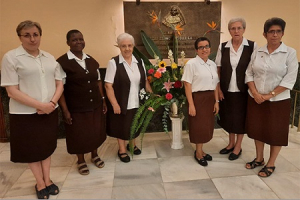
From August 8-29, the XX Ordinary General Chapter of the Hermanas Carmelitas del Sagrado Corazón de Jesús was held at their motherhouse in Limonar, Málaga, Spain.
This Institute was founded by Servant of God Asunción Soler Gimeno (1882-1959) on May 13, 1924 in Spain. Her goal is to live, according to the spirit of Carmel, in and with the people. She was particularly interested in helping the poor and needy.
While diocesan approval was granted in 1938, the Institute was affiliated to the Carmelite Order on June 7, 1947.
The sisters commit themselves to the education of the youth, social action, and to the sick, as well as to the needs of the Church. Their presence has greatly increased in Spain, Portugal, the Dominican Republic, Cuba, Venezuela, and Mozambique.
The following sisters serve on the new General Council:
General Superior | Superiora General | Superiora Generale:
Hna María Teresa Delgado Aguado, HCSCJ
Councilor-Secretary | Consejera-Secretario | Consigliera-Segretario:
Hna Luz Marina Materano Perozo HCSCJ
Councilor | Consejera | Consigliera:
Hna María Lopes Nivurucha, HCSCJ
Councilor | Consejera | Consigliera:
Hna Mercedes Espinal de Jesús, HCSCJ
Councilor | Consejera | Consigliera:
Hna María del Rosario González Domínguez, HCSCJ
Councilor-Treasurer | Consejera-Ecónoma | Consigliera-Economa:
Hna María Dolores Calvo López, HCSCJ
Update on the General Congregation
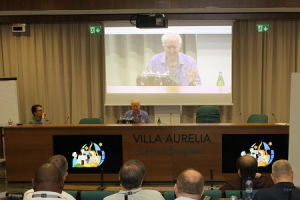
Fr. Timothy Radcliffe has been speaking to the members of the General Congregation, giving them some ideas to be discussed together regarding the core of the gathering’s theme: The Radical Witness of Consecrated Carmelites in the World of Today.
The General Congregation began on Monday, September 5 and continues through next week.
Fr. Radcliffe was the master general (superior) of the Dominican Order from 1992-2001. He is a member of the English Province. He taught scripture at Oxford and has become a popular speaker and author. He addressed the 2007 General Chapter of the Carmelite Order.
Here we summarize what he has been speaking about during his presentations:
These meetings [General Congregations, Chapters, etc] are a time, in my experience, for us to rediscover together just how liberating is our mad way of life. It really is a way to happiness and freedom. I also believe that religious life speaks to our world. We are friars, fratres, brothers, and we have sisters too. The world is desperately in need of living symbols of fraternity.
Pope Francis wrote Fratelli Tutti, ‘All brothers’, because our world is in danger of losing the old dream of universal brother and sisterhood. Now we see war in Ukraine, and China flexing its muscles. For the first time for sixty years, there is the threat of nuclear war. Millions of people are on the move trying to escape violence and poverty. Everywhere walls are going up to keep strangers at bay. The world order into which I was born seems to be crumbling. Many fear that we are entering a time of chaos.
In the face of this disintegration, we friars embody something wonderful and desperately needed: brotherhood. These are the oldest Christian titles and the only important ones: brother and sister. Not just brothers and sisters of each other in the Order, but as living symbols of the human family, children of Our Father, gathered into Christ’s kinship.
It is also of immense importance for the Church. Pope Francis is summoning us to leave behind stifling clericalism. Most Carmelites are priests. But how can we be priests without being clericalist? We friars can embody just what the Church is looking for, a brotherly way of being a priest. It was in hearing confessions that I began to embrace priesthood. Here I was beside people in their sorrow, one of them. If I had not committed their sins, I had probably thought of doing so. I was their brother.
But what about the brethren who aren’t priests? When I became a Dominican, a third of the brethren were lay brothers. Now they are a tiny minority. In recent chapters we have constantly sought to recover the vocation of the lay brother as an intrinsic part of our life. We have endlessly discussed their identity. What does it mean to be a brother in a clerical institute? I have always argued that the real question is the other way around: What does it mean to be a priest in an order of brothers? What does it mean to a priest in “the Brothers of the Blessed Virgin Mary of Mount Carmel.”
So I wish to open up a discussion of the pillars of our religious life, our vows, and search for how they may be live with joy and freedom. I will begin with obedience, then look at chastity, how we live our sexuality. Then leadership. I will not devote a special lecture to poverty. This is because religious orders have such deeply different ideas of poverty. I confess that I have no idea as to what is a Carmelite understanding of poverty!
But I think that the other vows each imply a profound poverty. The vow of obedience invites us to a more radical form of poverty than not just owning things. We do not own our lives. With chastity we learn not to own other people. And leadership is a sort of dispossession of oppressive power. So I hope that we shall see how poverty certainly includes a simplicity of life, but it is also much more radical than. It is a poverty of spirit. ‘Blessed are the poor in spirit, for theirs is the Kingdom of heaven’. (Matthew 5.3).
Celebrating At Home - 24th Sunday in Ordinary Time

Loss, recovery & celebration
(Luke 15:1-32)
The three parables which form the Gospel this week share a common pattern: loss, finding, celebration.
Jesus tells these parables in the context of a shared meal with the ‘tax collectors and sinners’. The scribes and Pharisees complain about Jesus welcoming sinners and eating with them. Jesus tells these parables to explain his actions and to invite the scribes and Pharisees into a new understanding of God’s love and mercy.
The parables of the lost sheep, the lost coin and the lost sons share a common theme: that the mercy of God breaks through all human and religious restrictions about how God should act toward sinners.
They are stories of lavish and undeserved love and mercy. What shepherd in his right mind will abandon ninety-nine healthy sheep to go after a lost one? What woman will spend all day turning the house upside down to find a coin of little value? What father will joyfully welcome home a wasteful and disrespectful son? What brother will do the same? Scribes, Pharisees and we ourselves may not, but God will.
The Gospel offers not just the hope of God’s mercy and forgiveness but the certainty of it.
These three parables are also an invitation to the scribes and Pharisees, and to us, to join in Jesus’ mission of mercy; to behave as God behaves towards our brothers and sisters – with mercy and forgiveness – and welcoming all to the Great Feast.
- pdf Celebrating At Home - 24th Sunday in Ordinary Time [PDF](2.80 MB)
-
default
Celebrating At Home - 24th Sunday in Ordinary Time [ePub](2.25 MB)
- pdf Celebrando en Familia - 24 Domingo del Tiempo Ordinario(431 KB)
- pdf Celebrando in Casa - XXIV Domenica del Tempo Ordinario(427 KB)
- pdf Celebrando em Família - 24 Domingo do Tempo Comum(269 KB)
122/2022: Vitam Coelo Reddiderunt

|
First Day of General Congregation Opens in Rome
The General Congregation of the Order began on Monday, September 5 at the Villa Aurelia, a retreat/conference center near the Vatican. The theme of this year’s meeting is Gift and Mission: The Radical Witness of Consecrated Carmelites in the World of Today. “By This Everyone Will Know that You Are My Disciples” (Jn 13: 35).
These meetings are held three years before a General Chapter. Forty-three members plus “experts” are participating in the meeting. The priors provincial and those provincial commissaries and general delegates who have at least twenty voting members (solemn vows) in their reality have the right to vote.
In an interview before the start of the meeting, the prior general, Fr. Míceál O’Neill, expressed his hope for the two-week gathering. “My principal interest is for this to be a kind of extended general council in which we get a chance to share leadership, information, and responsibility with those who are leaders in the various provinces.”
The first week is dedicated to the topic of the consecrated life. The former master (superior general) of the Dominican Order, Fr. Timothy Radcliffe, OP, will address the group of the topic of consecrated life. Fr. Timothy, a noted speaker and author, had previously addressed the 2007 General Chapter of the Order. These first days will also be facilitated by Mr. Danny Curtin who will help guide the work of the participants.
Topics to be covered in the second week include reports from each geographical area of the Order as well as the various entities that are the responsibility of the general council (there is a commission or a delegate responsible to the general council) including CISA; the Carmelite nuns; the Institutum Carmelitanum; the archives; aggregated congregations; communications; Lay Carmelites; postulation; Carmelite youth; Justice, Peace, and the Integration of Creation; new foundations; and liturgy and prayer.
Other topics to be discussed include the Carmelite NGO, which affiliates the Carmelite Family to the United Nations; synodality; financial self-sustainability; integral ecology; safeguarding minors and vulnerable adults; and formation.
The congregation will conclude with a message to the Carmelite Family, discussed and approved by the gathering in its final days.
The gathering officially opened with a Eucharist on Monday, September 5, celebrated by the prior general of the Order. This was followed by an opening address from Fr. Míceál to set the tone for the meeting. He offered a reflection on leadership and mission. In the second part of his address, the prior general highlighted areas of concern, the issues the general council is dealing with and have been shared with the provinces. The third part was an overview of the four geographical areas (the individual general councilors will give a more in-depth report of each area in the second week). The prior general concluded his remarks with some indications of areas the group might focus on going forward as leadership.
The General Congregation will conclude on Friday, September 16.
General Congregation Held September 5-16

The General Congregation of the Order will take place from Monday, September 5th until Friday, September 16. This year the meeting will be held at Villa Aurelia, near the Vatican in Rome. The theme of the gathering is Gift and Mission: The Radical Witness of Consecrated Carmelites in the World of Today. “By This Everyone will Know that Your are My Disciples” (Jn 13: 35).
a) assisting the prior general and his council in their task of governing and animating the Order;b) fostering communication and contact between the General Curia and the various areas of the Order;c) ensuring the implementation of the decisions and decrees of the previous General Chapter; to assess the effectiveness of the directions proposed; to make decisions and issue decrees, which shall be valid only until the following Chapter;d) assisting in the preparation of the next General Chapter, and to advise the prior general concerning the venue of the Chapter;e) to discuss the financial matters of the Order.
Memorial of St. Teresa Margaret Redi (OCD), Virgin

1 September Optional Memorial
Saint Teresa Margaret Redi was born in Arezzo on 1st September 1747 into the noble family of Redi. In 1764, she entered the monastery of the Discalced Carmelites in Florence, changing her baptismal name of Anna Maria to that of Teresa Margaret of the Sacred Heart of Jesus.
Celebrating At Home - 23rd Sunday in Ordinary Time

Real reality
(Luke 14:25-33)
There is very little that is real in so-called ‘reality TV’.
We know that, in fact, situations and circumstances are highly contrived and rather artificial. People are deliberately set up to fail, tensions are fuelled and contestants often exploited emotionally and physically.
Today’s Gospel contains a rather heavy dose of real reality about what is required in order to be a disciple of Jesus.
The words of Jesus have to be read against the background of the Kingdom life God is inviting us into and the central message of Jesus that we need to place God in the centre of our hearts.
The language about hating family members and even our own lives comes from a Semitic idiom which expresses preference. If you prefer one person or thing over another you are said to ‘love’ the first and ‘hate’ the second. The Gospel is not calling us to hate either our relatives or ourselves.
When we let the presence of God flood our hearts and minds all other aspects of our lives, including our relationships, find their proper place. Relationships become more genuine and less exploitive; possessions have less hold over us and we begin to share them more generously, our need for power and status fades.
To do this, however, is no easy thing. It requires many daily decisions, choosing to see with God’s eyes, to feel with God’s heart and to act according to God’s vision for human life: to choose love over hate, generosity over hoarding, to let go of power and status and be of real service to our sisters and brothers. That is what ‘carrying the cross’ is all about.
Jesus warns that this is a difficult and demanding way, and that a disciple needs to be clear-eyed and ready to take up the task.
- pdf Celebrating At Home - 23rd Sunday in Ordinary Time [PDF](5.82 MB)
-
default
Celebrating At Home - 23rd Sunday in Ordinary Time [ePub](4.90 MB)
- pdf Celebrando en Familia - 23 Domingo del Tiempo Ordinario(539 KB)
- pdf Celebrando in Casa - XXIII Domenica del Tempo Ordinario(538 KB)
- pdf Celebrando em Família - 23 Domingo do Tempo Comum(540 KB)


