











O.Carm
Titus Brandsma: Lessons for Living with Illness?
 Not for a minute would I dare to compare myself to Titus Brandsma, Carmelite, about to be canonized a Saint.
10. Clash of Ideas
 As a University Professor with a specialty in Philosophy, Titus Brandsma would have been acutely aware of the ideas and propaganda circulating in neighboring Germany during the 1930s. The Nazi party promoted a broad spectrum of basic principles which enshrined raw power and violence, especially at the expense of the weak. Friedrich Nietzsche’s celebration of the “superman” glorified the violent exploitation of others as the only path to survival and success. One can only rise to the top of a struggle by stepping on those inferior people below. In such a mindset, Christianity was ridiculed for its care and attention to the poor, sick, elderly, and handicapped. In Brandsma’s own Netherlands, the Dutch Nazi party (the NSB) reflected the same toxic views, although in a somewhat milder form before the war broke out.
In December 1935, following the harsh anti-Jewish Nuremberg Laws, Titus contributed an essay to a collective work by Dutch intellectuals. His contribution, The Delusion of Weakness, suggested that the root of discrimination was envy. The Nazi myth of the Superman grew out of an imagined feeling of inferiority because of success and accomplishments within the Jewish community in Germany. He proposed instead that anyone who was uncomfortable with Jewish contributions should see them as a motivation to create his own success without rancor. In a quick response, Nazi writers in Germany called him a crafty professor, a Jew lover, and even a Communist.
Even though Titus did not respond or hit back at these accusers, he continued to deliver carefully crafted lectures criticizing Nazi ideology. It was enough for him to speak the truth and allow it to be accepted by serious listeners. He spoke frequently about the Nazi distortion of the Aryan race, the Volk, as a near substitute for God. Any sort of criminal activity could be justified if it was rooted in the advancement of the perfect racial purity, with Adolf Hitler as its prophet.
On July 16, 1939, he delivered a sermon honoring the Saints Boniface and Willibrord. He pointed out that the old Germanic paganism which was based on powerful forces was not as serious as the Neo-paganism of the Nazis. Pretending that smashing one’s enemies was a form of high civilization had nothing to do with Nordic culture or centuries of Christian tradition and spirituality. The value of the human person was paramount in the eyes of God. “See how these Christians love one another.”
At each step of his truth-telling, Titus was recorded by meticulous agents of the Security Service of Hitler’s SS.
Even before the outbreak of war or the invasion of the Netherlands, Titus was well known to agents who added their reports to a thickening dossier of his activity. Titus told his friends that there were 2 young men who attended his classes at the University, but were not registered as students. They took detailed notes on whatever he said, but never asked questions or took exams.
After Holland was invaded in May 1940, Nazi administrators took over the civil government and slowly molded the details of Dutch life to reflect Nazi ideology. The points of conflict between Titus and the occupation forces became clear. As the NSB worked to tighten their hold on ordinary life, Titus laid plans to protect Jewish students, maintain the freedom of Catholic schools, and strengthen the Catholic press.
It was his tireless work on behalf of the bishops to defend the Catholic journalists that finally got him into conflict with the Nazis. His ironclad refusal to allow “fake news” to contaminate the integrity of Catholic newspapers marked a point of no return. His fate had already been decided in Berlin. Titus was too intelligent and methodical to be convinced to accept propaganda. He was too courageous and stubborn to be swayed by threats and intimidation.
Nothing remained to the authorities except his arrest and ultimate death. And so it was.
Download the Leaflet 10. Clash of Ideas pdf here(4.97 MB)
10. Clash of Ideas

As a University Professor with a specialty in Philosophy, Titus Brandsma would have been acutely aware of the ideas and propaganda circulating in neighboring Germany during the 1930s.
9. Mary, the Mother of God
 To Jesus with Mary
Our Lady held a special importance for Titus Brandsma throughout his life. As a young boy Titus became familiar with various Marian practices including the rosary which the Brandsma family prayed on a daily basis. This Marian devotion would last a lifetime for Titus who even in prison organised several rosaries for himself when his one was taken from him.
In addition, Titus became familiar with the idea that we find Jesus by going through Mary. With Mary as a mother and as a sister, he followed Jesus on his way to the heavenly father.
My soul magnifies the Lord
Titus entered the Carmelite novitiate out of his desire for a more intense prayer life and because of the Order's great devotion to Our Lady. Later, Titus places on the picture for his ordination the words of Mary in her Magnificat: My soul magnifies the Lord. He who is mighty has done great things to me. (Luke 1: 46, 49) During his Roman years (1905-1909) Titus visited the catacombs, where an ancient image of Our Lady, called the Orante, impressed him. This he refers to as the image of the praying Church and to the image of Mary who sings her Magnificat. In a Marian magazine, Carmelrozen, which he co-founded, Titus wrote dozens of articles so as to foster love for Mary through an increased knowledge about the different forms of veneration of Mary, her feast days, Christian art work and the teaching of the church and councils on Mary.
Mary’s divine motherhood
Of special importance to Titus was the Council of Ephesus (431) which had declared the dogma of Mary as Theotokos (God-bearer). Titus reflected on the divine motherhood of Mary writing:
In Mary we see the most beautiful image of our union with God. She, the bride of the Holy Spirit, teaches us how we also, though not in the fullness of grace but in a wider sense, must be brides of God, in order that he be born in us, united – also in us – with human nature, our human nature. Under the beneficent influence of the Holy Spirit we must be born to a new life with God, who lives in us more than we live of ourselves.
Increasing our devotion to Mary means learning to imitate the attitudes she has in her life. And so, we too are called to become like Mary: bearers of the divine life.
By following her example, we should obviously be other Marys. We ought to let Mary live in us. Mary should not stand outside the Carmelite, but the Carmelite should live a life so similar to Mary’s that the Carmelite should live with, in, through, and for Mary.
Mary, Hope of all Carmelites
In 1939, Titus wrote a Way of the Cross for a pilgrimage. At the ninth station, when Jesus falls under the Cross for the third time, he prays:
O Mary, who has observed with admiration and motherly compassion the final efforts of your Son, help me to remember this when the fulfilling of my task in life becomes too heavy.
Perhaps this prayer was with him when he was arrested in January 1942 and sent initially to the prison of Scheveningen. There Titus transforms his prison cell into a Carmelite cell with a picture of Christ and a picture of Mary:
In the part of the breviary we are using now and which was luckily left to me, is the beautiful picture of Our Lady of Mount Carmel. So now my breviary is standing wide open on the topmost of the two corner shelves, to the left of the bed. When sitting at my table I only have to look a bit to the right and I can see her beautiful picture; while laying in bed my eye is firstly caught by that star-bearing Madonna, Hope of all Carmelites.
With the eyes of his heart fixed on Mary and with Jesus at his side Titus continued his own way of the cross from Scheveningen to Dachau. There he died on July 26th 1942. May his example inspire us to live a Christian and Marian life.
Download the Leaflet 9. Mary, the Mother of God pdf here(4.26 MB)
9. Mary, the Mother of God
Our Lady held a special importance for Titus Brandsma throughout his life. With Mary as a mother and as a sister, he followed Jesus on his way to the heavenly father.
8. O Jesus when I gaze on you
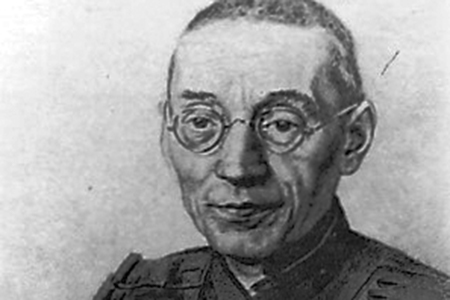 ‘O Jesus, when I gaze on You’
The poem ‘O Jesus’, which Titus Brandsma wrote – and which was smuggled out of the prison – is for many people a comfort.
The Inscription
Titus wrote the poem in two days, 12 and 13 February 1942, in the convict prison of Scheveningen – established for political prisoners. The poem places itself ‘Before the image of Jesus’. In his cell, Titus has fixed three small illustrations from his breviary on his small folding table: the image of Christ on the cross, with the wounds of the Sacred Heart; St Teresa with her saying Mori aut pati (to die or to suffer); and St John of the Cross with his Pati et contemni (to suffer and to be scorned).
The Opening Line
The opening line evokes the atmosphere of contemplative attention. Seated silently ‘before the image of Jesus’, Titus Brandsma keeps his loving gaze directed to Jesus on the cross. The lament ‘O Jesus’ expresses the intimacy of his attention.
Once more alive, That… That…
Titus prayerfully explains what is happening whilst he gazes: ‘Once more alive…’ Devotion causes us to ‘rise up out of tepidity’ and ‘awakens love’. In his description of the movement of love coming from Titus and the counter movement coming from Jesus, Titus describes not only the reciprocal love he experiences but, more than that, a special friendship.
Good friends should mutually care for each other so that the value of friendship is not lost. In ‘O, Jesus’ the special nature of the friendship arises out of the mutually shared suffering.
Suffering shared in Friendship
A friend asks for the courage to suffer, a ‘special friend’ asks for ‘the courage to suffer more’, certainly when it concerns the friendship with Jesus who bears the suffering of humanity. Whoever suffers with his friend is like him. Thus, the disciples of Jesus ‘resemble’ Him who had gone before them on the way of ‘suffering’ in solidarity in suffering which leads into his Kingdom of peace. Friends desire to ‘resemble’ each other, they do not wish to see their friend standing there all alone, they wish to share the lot of their friend. In this spirit Titus says: ‘Oh, for me all suffering is good’. Friends bear each other’s suffering, through which ‘all suffering’, which in itself is evil, is ‘good’ for ‘me’ as a ‘friend’.
The Union with God
Does Titus mean a glorification of suffering? No, a spiritual logic is at work here: in suffering shared in friendship is the way of the good; bliss is the ultimate flowering of the good; this is the union with God. The friend ‘knows’ that his friend has taken his suffering seriously. It no longer belongs to him alone. His friend also bears it. However, what is of most importance here is the ultimate goal of the way: the union with God. This is, the heart of all devotion. The suffering reaches beyond the awareness of itself and can – as in ecstasy – only call out: ‘O God’.
O, leave me here
Titus notes in his prison letter that it can be ‘very cold’ in the winter. But this does not need to change for him: ‘Just leave me here’, here ‘before the image of Jesus’.
At this point in the poem the motif ‘with me’ begins to resound. The solitariness serves the interiorization of the bliss which was received in the shared suffering of the friendship. The ‘here alone’ does not become ‘weary’.
Your Presence makes all things good for me
Solitariness is the place where Titus can expose himself to the bliss of the suffering shared in friendship. For Titus the meaning of ‘Jesus with me’ and ‘never so close to me’ lies in the suffering shared in friendship as a way to Jesus’ Kingdom, leading to the union with God which reaches a climax in the last two lines: ‘Stay with me, with me, Jesus sweet, / Your presence makes all things good for me’. The occupying power defines the course of events ‘in prison’, but this far ‘here’, in the cell of Titus ‘before the image of Jesus’, its influence does not extend.
Download the Leaflet 8. O Jesus when I gaze on you pdf here(3.57 MB)
8. O Jesus when I gaze on you
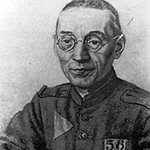
The poem ‘O Jesus’, which Titus Brandsma wrote – and which was smuggled out of the prison – is for many people a comfort.
Celebrating At Home - Fifth Sunday of Easter

Farewell, glory & discipleship of love
(John 13:31-35)
Given during Jesus’ last meal with his disciples, these words begin what is called The Farewell Discourse in John’s Gospel (13:31-17:26). They are Jesus’ last words to his disciples before his death.
In the course of offering assurance and comfort, Jesus develops various themes that have been introduced earlier in his ministry, including in particular glory, mutual indwelling and love.
His main point is the experience of life in God the disciples have and will continue to have. The relationship between the Father and the Son, which has been revealed in the first twelve chapters of the Gospel, Jesus now declares to be realised in the disciples.
The relationship between the Father, the Son and the Spirit are described in more detail here than anywhere else in the Bible. In these chapters, therefore, is the most profound teaching on God and discipleship in the Bible.
The first part of today’s Gospel reading is a bit confusing unless we understand that ‘glory’ in the biblical tradition has to do with the revelation of the unseen God. So, in these lines there is a sense of mutual glorification - the Father is revealed in the Son and the Son reveals the Father in his death on the cross. The Son will reveal the love of the Father most patently when he gives up his life.
Using the intimate form of address, ‘My little children,’ Jesus gently begins to prepare the disciples for the difficult reality of his leaving them.
Just as Jesus has been God’s love in action in the world, so now, the disciples must be.
The indispensable nature of abiding in love is underlined by the use of ‘commandment’. It is through their mutual love that all will recognise them as disciples of the One who loved even to laying down his life.
- Celebrating At Home - pdf Fifth Sunday of Easter [PDF](3.36 MB)
- Celebrating At Home - default Fifth Sunday of Easter [ePub](5.77 MB)
- Celebrando En Familia - pdf Quinto Domingo de Pascua(1.60 MB)
- Celebrando In Casa - pdf Quinta Domenica di Pasqua(1.61 MB)
Video "In Dialogue with Titus Brandsma"
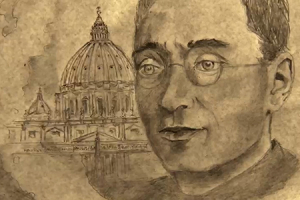
The following video "In Dialogue with Titus Brandsma", adapted from the book "The Courage of Truth" by Fr. Fernando Millán Romeral O. Carm, reviews some key passages of Titus' life, his faith and his testimony, shedding light on our life today.
Watch in French here
Watch in Spanish here
Watch in Portuguese here
Film on Titus to be Presented on Italian TV
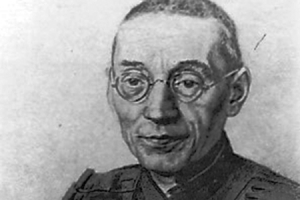
RAI (Radiotelevisione italiana) the Italian national broadcasting company will present the film "The Two Crosses" on Saturday, May 14 at 5 p.m. and Monday morning at 9:30 a.m. for audiences who want to learn more about the dramatic and painful story of Father Titus during World War II.
This film is available from Carmelite Editions and other Carmelite communication centers around the world for €15.00 or US$15.00. It will be available for purchase at the Titus Brandsma Center during the days of the canonization celebration in Rome, from May 9th to 14th. The original is in Italian but has subtitles in English and Spanish.


