











O.Carm
The Carmelites of Malta Plan their Future

Carmelites Decide to Remain in Valletta, Fgura, and Santa Venera
During the 2024 Provincial Chapter of the Maltese Province of the Carmelite Order, it was decided that the Carmelites would continue to sustain their presence and service in three out of six communities. This decision aimed to maintain the Carmelite presence in the parish of Fgura, at the national shrine of Our Lady of Mount Carmel in Valletta, and in the parish of St Venera. The Order will also continue to care for St Elias College. Consideration will be given to exploring new arrangements for houses where a continued presence is no longer viable. These decision have been taken due to decreased numbers in vocations.
Regrettably, the Chapter, with a heavy heart, also acknowledged the impracticality of maintaining a Carmelite community of friars in Mdina and Balluta. Collaborating closely with Archbishop Charles Scicluna and the laity who identify with the Carmelite Order, plans for the future ministry of pastoral care in Balluta will be formulated. Moreover, efforts will be made, in collaboration with the laity, to ensure the continuity of the Carmelite priory of Mdina as a centre for Carmelite spirituality.
Recognizing the long tradition of the Carmelite Order in Malta since the fifteenth century and the generous support from local communities over the decades, the Carmelites express understanding of the disappointment that this decision may bring to many. These changes are undertaken to fortify community life, strengthen Catholic witness, and promote vocations to continue enriching the Church in Malta with the Carmelite charism.
In the course of the Provincial Chapter, the new government of the Maltese Province was also elected, set to serve until 2027: Fr Charles Mallia as prior provincial, with Fr Maurice Abela, Fr Martin Schembri, Fr Alex Scerri, and Fr Ivan Scicluna as councillors.
Causa Nostrae Laetitiae

INITIUM NOVITIATUS
19-01-24 Daniel Paraguassú (PAR) Paranavaí, Brasil
19-01-24 Lucas Mateus Pereira de Sousa (Pern) Paranavaí, Brasil
19-01-24 Adryan Carlos da Silva (Pern) Paranavaí, Brasil
19-01-24 Gabriel Cabral de Sousa (Pern) Paranavaí, Brasil
19-01-24 Frankilin Rosneyda Silva Barbosa (Pern) Paranavaí, Brasil
19-01-24 Leandro da Silva Hardaim (Flum) Paranavaí, Brasil
PROFESSIO SOLEMNIS
02-02-24 Ronam Maria Rodrigues e Silva (Pern) Olinda, Brasil
02-02-24. João Paulo Prata (Pern) Olinda, Brasil
ORDINATIO SACERDOTALIS
27-01-24 Oscar A. Robles, Jr. (Phil) Agusan del Sur, Philippines
27-01-24 Marjune R. Caloring (Phil) Agusan del Sur, Philippines
27-01-24 Kim Paul M. Escobal (Phil) Agusan del Sur, Philippines
27-01-24 Rio Mar S. Sindac (Phil) Agusan del Sur, Philippines
Celebrating At Home - 1st Sunday in Lent

From Temptation to Transfiguration
(Mark 1:12-15)
Our great Lenten journey has begun! It’s a journey which begins in ash and ends in water. Fire is a profound part of our experience. We know its power to destroy, blacken and reduce to ash.
We know that evil can do the same - destroy our wholeness of spirit, blacken our lives and reduce the beauty of human life to so much dust.
We begin Lent in the ash of acknowledging our own part in harbouring, creating and doing evil - those places in our hearts where the fire of anger, bitterness, selfishness or narrowness of mind and heart has left nothing but cold ash.
The ash is a reminder that our true life is not found in mortal things which eventually turn to dust, but in eternal things. We also know that out of ash new life can bud, grow strong, bloom into fullness - that’s the Easter miracle.
As always, the Gospels of the first two Sundays in Lent provide a road map for our Lenten journey from temptation (this Sunday) to transfiguration (next Sunday).
We allow ourselves to be tempted out of the ash of selfishness and narrowness of heart and into a life of open-hearted goodness. We celebrate God’s graciousness to us by sharing what we have with those in need whether it be food, wealth, time, love, friendship or compassion. That’s what it means to ‘repent and believe the Good News’.
In these days when we are so conscious of the impact of human life on God’s creation, perhaps we could think about some permanent fasting from our excessive consumption of power, food and petrol in order to allow our earth to heal, to breathe and to continue to be a source of nourishment and life for the whole human family.
- pdf Celebrating At Home - 1st Sunday in Lent [PDF](3.19 MB)
- default Celebrating At Home - 1st Sunday in Lent [ePub](4.71 MB)
- pdf Celebrando en Familia - Primer Domingo de Cuaresma(569 KB)
- pdf Celebrando in Casa - I Domenica di Quaresima(562 KB)
- pdf Celebrando em familia - Primeiro Domingo da Quaresma(556 KB)
SEL Creates New Space for Carmelite Heritage Room

The Carmelite Heritage Room, dedicated in memory of William Murphy, at the National Shrine of Our Lady of Mount Carmel in Middletown, New York, has moved to a new space. Previously located in a room at the rear of the Edith Stein Conference Center, the Heritage Room is now welcoming visitors in the open area between the shrine and the provincial offices. The space provides visitors to browse the displays wherever the shrine itself is open. It is also able to better accommodate the growing number of visitors to the Shrine.
The new Carmelite Heritage Room was the brainchild of Fr. Mario Esposito, O. Carm, Prior Provincial of the Province of Saint Elias, and Fr. Mark Zittle, O.Carm, the Provincial Procurator. As part of a multi-faceted transition of the Shrine, Carol Bezak, the Shrine Director, coordinated the transition effort. A former Lay Carmelite office was transformed into the new Heritage room under the skillful direction and hard work of Tim Conklin, the Director of Operations and Maintenance.
The Carmelite Heritage Room will showcase material found in the Provincial Archives, where thousands of historical documents, records of Provincial events, photographs, works of art, and religious objects are cataloged and maintained. Currently various chalices used over the history of the province are displayed. There is also artwork and a display on the life of Carmelite St. Titus Brandsma who was canonized in May 2022.
Four display cases will allow visitors to get an up-close look at material that tells the story of the province that began at Our Lady of the Scapular Church of Mt. Carmel at 28th Street in New York’s Manhattan in 1889. The plan is for some of the displays, which will be themed, to change every two months.
Currently one of the cases holds ancient books from the 16th century in Spanish and Latin. Another holds some of the writings of Alfred Isacsson, O. Carm., an authority on the province’s history and the founder of the provincial archives. A third case contains Scapular magazine and other publications of the province. The final display case holds brochures from the now demolished St. Albert’s Junior Seminary and vocation materials.
Currently, the Rev. Alfred Isacsson, O. Carm. Provincial Archives is under the direction of Vincent Begley. Mr. Begley was historian for 10 years at Mount St. Mary College in Newburgh, New York and was the historian for Fordham University’s 150th anniversary in 1991.
Visitors to the Carmelite Heritage Room are heartily welcome.
CINA Podcast on Desert Hospitality & Carmelite Vocation
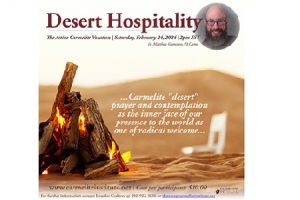
Saturday, February 26, 2024 | Carmelite Institute of North America
CINA Podcast on Desert Hospitality: The Active Carmelite Vocation on February 26, 2024
What does Mount Carmel have to do with the world? In this webinar, Fr. Matthew Gummess, O. Carm., offers a reflection on the Carmelite charism in terms of "desert hospitality." He suggests that Carmelite "desert" prayer and contemplation is the inner face of our presence to the world as one of radical welcome—desert hospitality.
His reflection centers on St. Thérèse of Lisieux's profound insight, towards the end of her life, that she was seated at table with sinners, as one with them. He also offers some practical suggestions on relating desert hospitality to our Lenten practices of prayer, fasting, and almsgiving.
Cost per participant is US$10.00.
Carmelite Matt Gummess is a Ph.D. candidate in history/philosophy of science and systematic theology at the University of Notre Dame in the United States.
Lenten Calendar: Transformation Begins at a Table

The observance of Lent has always involved food-fasting and abstinence. The Sisters of Charity of New York and Saint Elizabeth decided to focus on footprint/food justice and offer this simble calendar for the season of Lent and the Triduum for your reflection.
Transformation Begins at a Table: Lent 2024
“Transformation begins at table. From there we savor and save the world. If Earth is to survive humanity, it will be because people have awareness at table.” Donna Schaper
February
February 14: Ash Wednesday: Place a bowl of soil in your prayer space during Lent. Remember, Earth Creature, that you come from Earth and unto Earth you shall return.
February 15: Nuns Against Gun Violence invites us to fast during Lent against gun violence. Sign up for the fast here: https://docs.google.com/forms/d/e/1FAIpQLSfFmZhyWBkqu6wRavHW6mitIzYhxfKqKzEA3_1A7vc380JxBg/viewform
February 16: Try to make your Lenten meals sacred events with tablecloths, cloth napkins, flowers, and candles.
February 17: At Thich Nhat Hahn’s Plum Village monastery, each morsel of food is chewed thirty times.
February 18: First Sunday of Lent “The fight against hunger demands we overcome the cold logic of the market, which is greedily focused on mere economic profit and the reduction of food to a commodity, like many others, and strengthen the logic of solidarity.” Pope Francis
February 19: Each week of Lent, add one more organic product to your shopping cart.
February 20: Have a conversation with others about meal customs in your family/culture/religion. How have meals been formative of the person you are?
February 21: Be in a relationship of kinship with trees by using cloth napkins and towels; old tee shirts to wipe up spills.
February 22: Pray for the millions of fisher folk in the world whose livelihood is destroyed by warming oceans and ocean acidification.
February 23: Gaze at your bowl of Earth and recall that we are experiencing a “dark night of the soil.” Each year, an estimated 24 billion tons of fertile soil are lost due to erosion.
February 24: Visit a farmers’ market.
February 25: Second Sunday of Lent “Heaven is a banquet and life is a banquet, too, even with a crust, where there is companionship. We have all known the long loneliness and we have learned that the only solution is love and that love comes with community.” Dorothy Day
February 26: Pause before your meal and reflect – In this food the entire universe is supporting my existence.
February 27: Make an act of contrition today for the ways you have wasted food.
February 28: Plan a simple soup and bread supper with friends and watch a food related movie, e.g. Cowspiracy, Just Eat It: A Food Waste Story; Forks Over Knives.
February 29: Pray for farmers today.
March
March 1: Donate to a food pantry or soup kitchen.
March 2: Make your own the prayer of Dorothy Day in times of tension and difficulty, “Our Lady of Cana, send us some wine!”
March 3: Third Sunday of Lent “Don’t eat anything your great-grandmother wouldn’t recognize as food.” Michael Pollan
March 4: Consider buying food from a company like Misfits Market that sells food that is good to eat but not “pretty” enough for the supermarket https://www.misfitsmarket.com/about-usThe observance of Lent has always involved food-fasting and abstinence. The Sisters of Charity of New York and Saint Elizabeth decided to focus on footprint/food justice at their 2023 Assembly. Join us this Lent in a focus on a new relationship with food. Transformation begins at a table!
March 5: “God’s kingdom is imagined as a table where there are places for everyone, everyone has a place of honor, and everyone gets enough.” Marianne Sawicki
March 6: Resolve this Lent to grow some of your own food, even if it’s just some herbs on windowsill pots.
March 7: “It is for your love alone that the poor will forgive the bread you give them.” St. Vincent de Paul
March 8: International Women’s Day - Thank a woman you know who is involved in the production or serving of food.
March 9: Eat at a restaurant of a culture different from your own.
March 10: Fourth Sunday of Lent “If you really want to make a friend, go to someone’s house and eat with him…The people who give you their food give you their heart.” César Chávez
March 11: 40% of food purchased in the US is thrown away. As you begin your week, look into your refrigerator and plans meals according to what you have, to avoid food waste.
March 12: Pray for justice for migrant workers today.
March 13: Form a group of peers or colleagues to investigate food waste in your school, workplace, neighborhood, parish.
March 14: “Jesus’ paschal mystery, celebrated at the heart of Eucharist, is reflected today in Earth’s processes of dying and rising, whether it be devastating droughts and floods, poisoned rivers and polluted oceans, or regeneration, reforestation, and revitalization.” Mary McGann, RSCJ
March 15: Shop the peripheries of the supermarkets (where the fresh foods usually are) and avoid the center aisles (where processed foods usually are).
March 16: “We don't want to EAT hot fudge sundaes as much as we want our lives to BE hot fudge sundaes. We want to come home to ourselves.” Geneen Roth
March 17: Fifth Sunday of Lent – Lent trumps St. Patrick’s Day this year but enjoy some Irish soda bread today nonetheless.
March 18: When planning your meals this week, plan to savor as many different types of vegetables as you can and as little red meat as you can.
March 19: Feast of St. Joseph and Spring Equinox. Take a walk and notice the signs of new growth in nature.
March 20: When you buy chocolates for your Easter basket, buy Fair Trade. Don’t let your pleasure be the source of misery for others. Best brands: Divine, Equal Exchange. Worst brands: Ferrero, Godiva.
March 21: Passover begins at sundown tomorrow. Plan to join a Seder meal with Jewish friends.
March 22: World Water Day-Drink a glass of water reverently. Eat in ways that reverence water. Pound for pound, meat has a much higher water footprint than vegetables, grains or beans.
March 23: A healthy plate of food will include a wide variety of colors.
March 24: Palm Sunday -- “If there is hunger anywhere in the world, then our celebration of the Eucharist is somehow incomplete everywhere in the world …. In the Eucharist we receive Christ hungering in the world. He comes to us, not alone, but with the poor, the oppressed, the starving of the earth.” Pedro Arrupe, SJ
March 25: Enjoy the light of the full moon tonight and reflect that just as the moon's gravitational pull causes tides to rise and fall, it also affects moisture in the soil. Seeds will absorb more water during the full Moon and the new Moon, when more moisture is pulled to the soil surface.
March 26: Plan to give a gift of food to the catechumens in your parish who will receive the sacraments at the Easter Vigil.
March 27: Think of Jesus in his prison cell and learn about the movement to bring better food to people imprisoned https://impactjustice.org/innovation/food-in-prison/#report
March 28: Holy Thursday – “It is in the Eucharist that all that has been created finds its greatest exaltation. Grace, which tends to manifest itself tangibly, found unsurpassable expression when God himself became man and gave himself as food for his creatures,” (Laudato Si’, 236).
March 29: Good Friday –“I think nothing shows forth the Paschal Mystery quite like compost. It really is a tomb-like place, a container that holds endings and beginnings. And composting is a sacred work that echoes the Paschal Mystery.” Sr. Janet Gildea, SC
March 30: Holy Saturday –Light a candle and renew your commitment to food practices that are healthy for you and healing for Earth.
March 31: Easter Sunday – “First and last alike receive your reward; rich and poor, rejoice together! Sober and slothful, celebrate the day! You that have kept the fast, and you that have not, rejoice today for the Table is richly laden! Feast royally on it, the calf is a fatted one. Let no one go away hungry. Partake, all, of the cup of faith. Enjoy all the riches of God’s goodness!” Easter homily of St. John Chrysostom
Courtesy of the Sisters of Charity of Saint Elizabeth, Convent Station, New Jersey (USA)
The Province of Malta Celebrates Its Elections

The Province of Malta Celebrates Its Elections in First Part of the Provincial Chapter
During the first part of the Provincial Chapter held February 5-9, 2024, the elections of the leadership of the Province of Malta took place. The gathering was held at the Dar il-Ħaninn Samaritan Center of the Society of Christian Doctine (M.U.S.E.U.M.) whose founder was St. George Preca, a Third Order Carmelite. During the meetings, the elections for the the prior provincial and councilors were held.
Míċéal O'Neill, the prior general, accompanied by Richard Byrne, the Councillor for the Europe, also participated as did Michael Farrugia, procurator general and member of the province.
The following members were elected to leadership at the meeting:
Prior Provincial | Prior Provincial | Priore Provinciale
Charles Mallia, O. Carm.
1st Councilor | 1er Consejero | 1o Consigliere
Maurice Abela, O. Carm.
2nd Councilor | 2do Consejero | 2o Consigliere
Martin D. Schembri, O. Carm.
3rd Councilor | 3er Consejero | 3o Consigliere
Alexander Scerri, O. Carm.
4th Councilor | 4to Consejero | 4o Consigliere
Ivan Scicluna, O. Carm.
Celebrating At Home - 6th Sunday in Ordinary Time

Continuing the Journey with Jesus
(Mark 1:40-45)
Following last week’s Gospel, Jesus has set out to preach and heal in the other towns of Galilee when a leper comes to him and pleads for healing.
In Biblical times people with any kind of shiny, scaly skin condition were usually considered to have leprosy. This is not Hansen’s Disease - the proper name for leprosy as we know it today.
Anyone suspected of being leprous had to live outside their town for fear of spreading the disease to others.
They had to leave their home and family, their job, their community and their synagogue. They were dependent on others to bring them food and water.
This sense of fear and suspicion about lepers is a stark contrast to the welcome given by Jesus to the man in the Gospel.
He comes to Jesus and asks him to make him clean, to cure him. Jesus is deeply moved and touches the man (which must have required great compassion) and cures him. In healing the man, Jesus has done much more for him than simply relieving him of a distressing ailment. Jesus has literally given the man his life back. Now he can go home to his family, take up his job again and renew his religious practice in the synagogue.
In Jesus’ day many people took illness, disease and disability as a sign that people were also morally ill, that they had sinned, done something wrong. By healing the sick, Jesus removes the taint of evil from them as well.
Interestingly, there is a kind of ‘role-reversal’ in this Gospel. In the beginning it is the leper who is the outcast, the one who must live outside the town.
Because the cured man tells the story everywhere, Jesus now becomes the one who has to stay outside the towns and villages. Never the less, the people, like the leper, still come to him for healing.
Aware of our need for healing, we, too, can take the initiative by approaching Jesus. We will be met with welcome, compassion and love. We can be restored to our rightful place as beloved sons and daughters. We, too, can tell the story of what God has done for us.
- pdf Celebrating At Home - 6th Sunday in Ordinary Time [PDF](2.99 MB)
- default Celebrating At Home - 6th Sunday in Ordinary Time [ePub](5.66 MB)
- pdf Celebrando en Familia - VI Domingo del Tiempo Ordinario(760 KB)
- pdf Celebrando in Casa - VI Domenica del Tempo Ordinario(755 KB)
- pdf Celebrando em familia - VI Domingo Do Tempo Comum(749 KB)
Carmelite Nuns in Zaragoza Celebrate Elective Chapter

On February 1, 2024, the triennial chapter of the Carmelite nuns of the Monastery of the Incarnation in Zaragoza, Spain, took place. Archbishop of Zaragoza, Mons. Carlos Manuel Escribano led the election of the prioress. Following the election of the prioress, the chapter reunited and continued with the elections of the other offices of the monastery.
In 1614 the license for the foundation of the Convent of the Incarnation in Zaragoza was granted. Ana Carrillo, the foundress, gave a large dowry, along with two of her nieces, who would enter the convent to become Carmelites. The following year, in July, Carmelite nuns from different houses of the order arrived to take possession and inaugurate the monastery. Among these was Ven. Seraphina Bonastre (†1649) assisted by the prior provincial of Aragon at the time, Michael Ripoll.
With the foundress' property, they acquired a house, patio, and orchard and began the construction of the house. Soon the funds ran out but, with great difficulty, they managed to finish the work and keep the foundation open.
During the government's seizure of ecclesiastical property, what is known as the ecclesiastical confiscations of Mendizábal (1835-1837), the community managed to subsist by dedicating itself to teaching.
The monastery belongs to the Mater Unitatis Federation.
The results of the elective chapter were as follows:
Prioress | Priora | Priora:
Madre Hannah Wairimu Kamau Ngigi, O. Carm.
1st Councilor | 1ª Consejera | 1ª Consigliera:
Hna. Elena-María Samper, O. Carm.
2nd Councilor | 2ª Consejera | 2ª Consigliera:
Hna. Mónica Macharia, O. Carm.
3rd Councilor | 3ª Consejera | 3ª Consigliera:
Hna. Lilian Irima, O. Carm.
4th Councilor | 4ª Consejera | 4ª Consigliera:
Hna. Claudia Raozivola, O. Carm.
Treasurer | Ecónoma | Economa
Hna. Lilian Irima, O. Carm.
Formator | Formadora | Formatrice
Hna. Everline Alina, O. Carm.
Sacristan | Sacristana | Sacrestana
Hna. Mónica Macharia, O. Carm.
Day Against Human Trafficking Celebrated

International Day of Prayer and Awareness Against Human Trafficking
Journeying In Dignity: Listen, Dream, Act
The Unions of Superiors and Superiors General of Religious Institutes have organized the Day of Prayer and Awareness against Human Trafficking on February 8, 2024. That date is the Feast of St Josephine Bakhita, a Sudanese nun, who as a child had the traumatic experience of being a victim of human trafficking.
On Sunday, Pope Francis welcomed young people from many countries who came to Rome to celebrate the the Day of Prayer and Awareness. Fifty young representatives from around the world of the partner organizations are in Rome for a week of networking and training against human trafficking.
On Thursday, February 8 there will be an Online Pilgrimage of Prayer and Awareness Against Human Trafficking entitled "Journeying in Dignity". Resources are available here


