








O.Carm
Causa Nostrae Laetitiae

ORDINATIO DIACONALIS
19-03-24 Wanderson Luiz Freitas (Pern) Jaboatão dos Guararapes, Brasil
27-04-24 Elysée Kombi Kalihi (Ita-Congo) Butembo, RepCongo
27-04-24. Clement Kanyoro Biaruhanga (Ita-Congo) Butembo, RepCongo
27-04-24 Elisée Kasereka Kayilanda (Ita-Congo) Butembo, RepCongo
04-05-24 Ryan Joseph Resurrección (PCM) Middletown, USA
04-05-24 Gregg Jude Durham (SEL) Middletown, USA
ORDINATIO SACERDOTALIS
27-04-24 Jean Bosco Kasereka Sivihwa (Ita-Congo) Butembo, RepCongo
Pope Declares 2025 Jubilee Year of Hope

In a bull entitled Hope Does Not Disappoint, Pope Francis explains that the coming Jubilee Year is a Holy Year also celebrating the 1,700th anniversary of the Council of Nicea (325). Referencing Scripture, the pontiff prays that “the witness of believers be for our world a leaven of authentic hope, a harbinger of new heavens and a new earth where men and women will dwell in justice and harmony, in joyful expectation of the fultillment of the Lord’s promises.”
He writes, “Everyone knows what it is to hope. In the heart of each person, hope dwells as the desire and expectation of good things to come, despite not knowing what the future may bring.” He goes on to explain that hope is born of love which ultimately comes from Jesus upon the cross. In a few lines he describes St. Paul’s idea on hope and gives a short history of the jubilee years as pilgrimages. The Jubilee Year of 2025 he sets up as a Pilgrimage of Hope.
The pope will open the holy door of St. John Lateran, the cathedral of Rome, on November 9—the 1700th anniversary of its dedication. The door to St. Peter’s will be opened on December 29 and that of the Basilica of St. Mary Major on January 1—the Solemnity of Mary, Mother of God. On January 5, 2025, the Holy Door of St. Paul Outside the Walls will be opened. All diocesan bishops are to celebrate a Mass as the solemn opening of the Jubilee Year. A delegate can be designated for celebrating in co-cathedrals. The Holy Year will conclude with the closing of the Holy Doors on Sunday, December 28, 2025.
Returning to a constant theme of his pontificate—world peace—Pope Francis writes that “the first sign of hope should be the desire for peace in our world…,” and he laments that we seem to be further from peace.
He wants us to have an enthusiasm for life and “a readiness to share it.” This brings him to comment on “the alarming decline in the birthrate” in some countries, which he blames on “today’s frenetic pace, fears about the future, the lack of job security and adequate social policies, and social models whose agenda is dictated by the quest for profit rather than concern for relationships.”
Finally Pope Francis calls on the Christian community to be “signs of hope” and details a variety of concrete ways this might occur. He asks “with all my heart that hope be granted to the billions of poor, who often lack the essentials of life,” and reminds the readers that “the goods of the earth are not destined for a privileged few, but for everyone.” He calls for a refocusing of financial priorities: “I renew my appeal that with the money spent on weapons and other military expenditures, let us establish a global fund that can finally put an end to hunger and favor development in the most impoverished countries, so that their citizens will not resort to violent or illusory situations, or have to leave their countries in order to seek a more dignified life.”
As 2025 coincides with the first ecumenical council of the Church, that of Nicea, this Jubilee Year will also be celebrating the 1700th anniversary of that Council. Pope Francis calls it “a milestone in the Church’s history” as it sought to preserve Church unity and debated the full divinity of Christ, establishing the concept of His “consubstantiality” with the Father, incorporating this into a Creed that is still recited today. The Council also discussed the date of Easter, unfortunately failing to come up with a universal method of establishing the date of celebration. In 2025, a common celebration will take place however.
The document was given at St. John Lateran on May 9, the Solemnity of the Ascension of Our Lord. It is the 12th year of Francis’ pontificate and his second Jubilee Year.
Spes non confundit: Bull of Indiction of the Ordinary Jubilee of the Year 2025 (English)
Decree on the Granting of Indulgence during the Ordinary Jubilee Year 2025 (English)
HCSCJ Concludes 100 Anniversary Celebrations
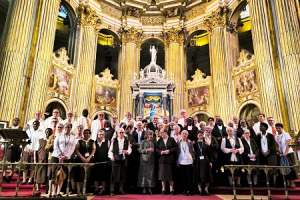
HCSCJ Congregation Concludes 100 Anniversary Celebrations
The closing of the centenary of the foundation of Hermanas Carmelitas del Sagrado Corazón de Jesús (HCSCJ) took place from May 11-13, 2024, in Málaga, Spain. . The meeting, which began in the late afternoon on May 11 with words of welcome by the Superior General of the HCSCJ, Sr. Mª Teresa Delgado, was both intense and enriching. More than 200 people (religious, sisters, and lay people) took part. Among the programmed activities, there was a series of talks and group meetings to share the reflections; there were also moments of prayer and Eucharistic celebrations with a large number of faithful, attracted by the Carmelite spirituality of Mother Asunción Soler Gimeno (1882-1959), the foundress; finally, the rich and abundant lunches and dinners put a fraternal finishing touch to all the events.
Fr. Miceál O'Neill, the prior general of the Carmelite Order, gave the first talk on "The Richness of Carmelite Spirituality for Today's World." Other talks continued on Sunday, one on "Christocentrism in Mother Asunción," given by the diocesan priest, Fr. Sevo Agotinho; another on "The Charismatic Witness with Those Deprived of Liberty," given by the priest Pablo Morota; and the General Coordinator of the Mother Asunción Carmelite Family, Prof. Guillermo Chumilla, spoke on "How to Live the Christian Commitment from the Charism of Mother Asunción."
On Sunday, a solemn Eucharist of the Ascension was celebrated in the cathedral of Malaga, presided over by the Archbishop Emeritus of Pamplona, D. Francisco Pérez González. On Monday, May 13, after visiting the sisters' house in Monsalve, the prior general, Miceál O'Neill, blessed the bust of the Servant of God Mother Assumption which has been placed in the courtyard of the "Mother Assumption" School in Limonar (Málaga), Mother House of the HCSCJ, and then celebrated the closing Eucharist of this international meeting.
May the spiritual richness witnessed during these days and the joy experienced be a sign of the Christian hope that pervades the whole Mother Assumption Carmelite Family, so that, in the Holy Spirit, it may continue to give glory to God - always and everywhere - in the fulfilment of his will, as was the wish of Mother Assumption.
The Congregation was founded in Spain on May 20, 1924, by the Servant of God Asunción, with the goal to live according to the spirit of Carmel, in and with the people, especially the poor and needy. Diocesan approval was granted in 1938 and aggregation to the Carmelite Order took place on Jun3 7, 1947. The sisters, who commit themselves to the education of the youth, social action, and to the sick, as well as to other needs of the Church, have a presence in Spain, Portugal, the Dominican Republic, Venezuela, Kenya, and Mozambique. In 2022 there were 108 members in 18 houses.
Website of the Congregation is: hermanascarmelitasscj.com
Memorial of St. Simon Stock, Religious

16 May Optional Memorial (Obligatory Memorial the province of Great Britain)
As far as can be ascertained from the earliest references, Simon Stock was an English Prior General, known for his holy way of life, who died about 1265 in Bordeaux in France. After his death, miracles were recorded by those visiting his tomb and during the 14th century a local cult developed in Bordeaux.
Around 1400, a separate legend emerged in the Low Countries of a "holy Simon" who had a vision of Our Lady, in which she appeared to him bearing the scapular and promised: "This is a privilege for you and your brethren: whoever dies wearing it, will be saved." Within a few years, the two accounts had been merged and Simon Stock, the Prior General, was credited with having the vision of Our Lady. The combined account quickly became elaborated with imaginary biographical details of Simon's life, such as his birth in Kent, his living for some years as a hermit in the trunk of a tree and his authorship of the Flos Carmeli, a beautiful Carmelite hymn to Our Lady (which is, in fact, found in the 14th century and hence predates the legend).
The Carmelite Scapular and Its Confraternities
The scapular consists basically of two pieces of cloth, tied by thin cords, which rest one on the shoulders (between the "scapulae") and the other on the chest. The object, nowadays used for devotional purposes, originates from the "night" scapular used by religious so that they would never have to not be wearing their proper habit, not even at night.
By the middle of the 13th century, lay people began to be affiliated to the Order in order to share in the spiritual benefits. It was also offered by the Order as an expression of gratitude and recognition to benefactors. The scapular ended up constituting a customary means of handing over the habit to the laity and the consequent juridical-spiritual aggregation to the religious family. The white cloak, the sign of the Order in the Middle Ages, was given to lay people at the moment of their association.
Stories began to circulate of the miraculous gift of the habit from the Lord or Our Lady to the founders or saints of the various Orders. As a result, numerous scapulars exist. They are distinguished by different colors and images, precisely because of the wide use made of them by the various religious families and, over time, as a sign of consecration according to the different forms of spirituality.
From the end of the 15th century, the Carmelites began to hand over the scapular, which was considered the habit of the Order for lay people to be aggregated to the Order. Thus was born the Confraternity of the Scapular, which ended up practically supplanting or replacing the previous forms of lay aggregation to the Order. These confraternities were also found in churches not belonging to the Order.
A typical element of the devotion use of the religious habit among the laity was that either Our Lord or Our Lady would give it to the religious. Two visions are associated with the Carmelite scapular—both involving Our Lady and both doubtful as historical events. In the case of the appearance to St. Simon Stock, similar vision accounts are found continually in the traditions of the different religious families.
The very origins of the Order refer, one the one hand, to the protection of Mary, and on the other hand, to the “dedication” of the Carmelites to her, who is considered to be lady, sovereign because Mary is the Mother of the Lord. Even after their departure from the Holy Land, the Carmelites continued to consider themselves as subjects to the Lord Jesus and therefore to his Mother.
Members of most confraternities in the 17th and 18th centuries shows they were open to people of all classes: nobles, middle-class, laborers, peasants, artisans—both the rich and the poor. This kind of unity among members from different social backgrounds lasted a long time. It was a characteristic of Scapular confraternities as distinct from other types of confraternities, even religious ones.
The suppression of religious groups in the 19th century almost entirely destroyed the network of Scapular confraternities. The ones that survived very often continues to exist without much contact with the Order. The works of mercy almost entirely disappeared with what remained being more philanthropic than Christian charity. With the Canon Law Code of 1917, the confraternities were reorganized. The scapular devotion developed more and more as a sign of the protection of Mary, with the aspect of consecration to Mary and the demands of a covenant of made with Mary now written out.
Now to enjoy the privileges attached to the scapular, it suffices to receive it from an authorized person and to have your name written in the general confraternity register of the Order. This faculty has been extended to all priests and the need to have a register of inscriptions was done away with. The so-called “Rule of the Carmelite Third Order” set out norms for a Gospel way of life. The document reflects Carmelite values, proposing a commitment to prayer, the sacraments, the works of justice, and the building up of the human person in accordance with God’s plan.
Czech General Delegation Meets in Kostelní Vydří

Triennial Meeting of the General Delegation of Bohemia and Moravia
The General Delegation of Bohemia-Moravia (Czech Republic) was erected by the General Council of the Order of Carmelites on 2nd October 1984. It was the culmination of a ten-year period in which Fr. Metoděj Minařík secretly organized a group of people who took an interest in the Order, helped them spiritually, trained them and accepted their religious vows. After the erection of the Delegation, the confreres lived another five years in illegality, and after the year 1990 they were able to begin a regular religious life.
As this is a General Delegation within the Order, the Major Superior of the Carmelites in the Czech Republic is the Prior General. At the same time, general delegations are also headed by a superior called the Delegate General whom (along with two other councillors) the Prior General appoints every three years.
Once every three years, coinciding with the end of the mandate of the Delegate General, an assembly of the delegation takes place in order to meet, to strengthen the bonds of fraternity, to have ongoing formation and to discern solutions regarding the various issues that the Delegation faces at that time.
The most recent triennial assembly of the friars within the Delegation was held from 16th to 17th April 2024 in Kostelní Vydří. It was presided over by the Prior General, Míċeál O’Neill who was assisted by the General Councillor for Europe, Richard Byrne. After the Prior General’s address, the Delegate General, Norbert Žuška, OCarm, gave a report on the state of the Delegation.
During the course of the assembly, in small groups and together in assembly, the friars considered the state and health of the Delegation and identified various issues to be addressed and the concrete steps to be taken over the next three-year period. The friars also reflected on what the Czech Republic is asking of Carmelites today and gave an orientation to the new Delegate General and council. In addition, the friars shared with each other their experience and expectations for the various officials that need to be appointed within the Delegation.
A consultation was held regarding the candidates for Delegate General and for the two Councillors that will be appointed by the Prior General during the plenary meeting in May 2024 of the General Council.
On 17th April 2024, the Eucharist was celebrated with the members of the local parish and several members of the Third Order. During his homily, the Prior General spoke about privileged place that Mary holds in the hearts and minds of Carmelites.
Sr. Agnes Lokate Celebrates 80 years as Carmelite Nun

Sister Agnes Lokate celebrates 80 years as Carmelite Nun and 100 Years of Life
Sister Agnes Lokate will celebrate her "oak" jubilee of life in Carmel on May 16. Sister was born on July 11, 1924 in Heeten (Overijssel), the Netherlands. She entered the Carmelite monastery of St. Jozef in Zenderen in 1944. She made her first profession on February 22, 1946, and solemn profession three years later in 1949.
The first celebration will take place with a sung Eucharist celebration with choir and conductor in the Angeli Custodes nursing home in Raalte, where Sr. Agnes lives. On her centennial birthday, Sr. Agnes will be celebrated in her hometown of Heeten. At 2 p.m. there will be a sung Eucharist, followed by a reception until 5 p.m. for invited guests.
Sr. Agnes now resides with other Carmelite sisters in a care facility in Raalte.
Ad moltos annos!
Celebrating At Home - Pentecost

Sent to be God’s Love in the World
(John 15:26-27, 16:12-15)
At Pentecost we celebrate the gift of the Holy Spirit to the first group of Christian believers - the disciples.
This gift of the Holy Spirit is the culmination of the life, death and resurrection of Jesus.
It would be wrong to think that this gift happened only once, in one moment of history. In fact, the gifting of the Holy Spirit is a continuing event in the life of every believing person and, therefore, in every age of human history. The Holy Spirit is the presence of God with us - the enduring way in which Jesus remains present in the Church and in the life of each person.
Today we do not pray to receive the Holy Spirit. The presence of the Holy Spirit in us has been affirmed and proclaimed in the sacraments of Baptism and Confirmation. Instead, we pray to grow more aware of the Spirit’s presence in our lives and to allow that Spirit to grow within us, gradually re-shaping our minds and hearts in the image of Jesus.
Pentecost brings to a close the fifty days of the Church’s Easter celebrations. Soon we will begin Ordinary Time again. So, our feast today helps us understand that we take the Holy Spirit with us into the ordinary events and tasks of each day. That is how we allow the sacred to touch, heal and transform us and the world around us.
The spiritual search is for the heart of God within our own. When we enter into relationship with Christ through the Spirit, the gifts begin to flow more abundantly. The Spirit is the source of reconciliation with ourselves and with each other. Reconciliation is essential if we are to ‘hold and guard’ each other in the midst of all that life throws at us, especially at the moment.
The Spirit brings gifts of wisdom, courage, understanding, right judgement, knowledge, reverence, wonder and awe in God’s presence. May we be graced by them all as we discern and decide how we can best work together to build up each other and to let God’s love be seen at work in each of us.
World Communications Day 2024

58th Annual World Communications Day 2024 Celebrated Sunday, May 12
Pope Francis has dedicated his message for the 58th annual celebration of World Communications Day to a discussion of the wisdom of the human heart “to look at things with God’s eyes, to see connections, situations, events and to uncover their real meaning.”
His statement for the occasion is entitled Artificial Intelligence and the Wisdom of the Heart: Towards a Fully Human Communication. The pope writes that AI is “radically affecting the world of information and communication, and through it, certain foundations of life in society. These changes affect everyone.”
The Holy Father expresses the hope that “the new” will not be rejected “to preserve a beautiful world condemned to disappear.” He highlights the value that artificial intelligence presents. But he also warns it is more appropriately called “machine learning” since it is not “intelligence.” He says, “Machines possess a limitless greater capacity than human beings for storing and correlating data, but human beings alone are capable of making sense of that data.” The message closely links to the Pope’s message for the World Day of Peace, which was devoted to the development of systems of artificial intelligence (AI).
Pope Francis highlights some of the questions that arise as a result of the developments in the world of communications. The answers we give, he says, “will determine if artificial intelligence will end up creating new castes based on access to information and thus giving rise to new forms of exploitation and inequality. Or, if it will lead to greater equality by promoting correct information and a greater awareness of the epochal change that we are experiencing by making it possible to acknowledge the many needs of individuals and of peoples within a well-structured and pluralistic network of information.”
World Communications Day was established by St. Pope Paul VI in 1967 as an annual celebration to encourage reflection on the opportunities and challenges that the modern mean of social communication (the press, motions pictures, radio, television, and the internet) afford the Church to communicate the Gospel message.
We present some resources in various languages that may be useful for a celebration of the Day in your part of the world.
World Communications Day Website – Dicastery for Communication
Artificial Intelligence and the Wisdom of the Heart: Towards a Fully Human Communication
Text of Papal Message
We Must Maintain Our Independent Thinking and Discernment – Machines Should Assist Not Replace
(English only) Interview with Bishop John Arnold of Salford, England
Book Presentation on the History of a Carmelite Church

Presentation of the Book
La demolita chiesa di S. Nicola dei Cesarini a Roma
by Cristina Cumbo
Published by Edizioni Carmelitane
Speakers:
Ilaria Miarelli Mariani
Director of the Direzione Musei Civici della Sovrintendenza Capitolina
Giovanni Grosso, O. Carm.
President, Institutum Carmelitanum
Riccardo Santangeli Valenzani
Archeologist
Monica Ceci
Archeologist
Cristina Cumbo
Archeologist e Author
The program will take place Friday, May 17, 2024 at 17:00
Museo di Rome – Palazzo Braschi
Sala Tenerani
Piazza di San Pantaleo, 10
Rome
Entrance is free
Information: 06 0608
The Incunabula of the Carmelite Library Exhibit

Days of Enhancement of Ecclesiastical Cultural Heritage
At the Origins of Movable Type Printing
The Incunabula of the Carmelite Library
Dr. Rosa Parlavecchia will show some incunabula, accompanying the presentation with instrumentation in use in the ancient printing workshops.
It is preferable to communicate participation to the following address:
MAY 14, 2024
6 p.m.
Carmelite General Library
St. Albert International Center
via Sforza Pallavicini 10 - 00193 Rome


