








O.Carm
Priesthood Ordinations in Congo

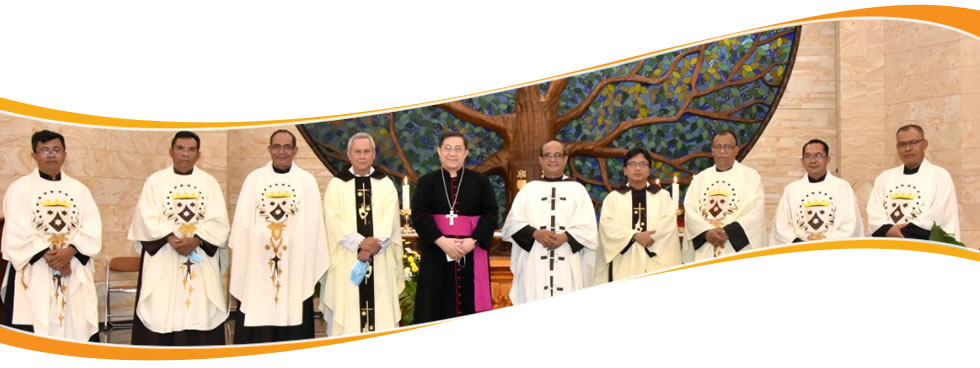
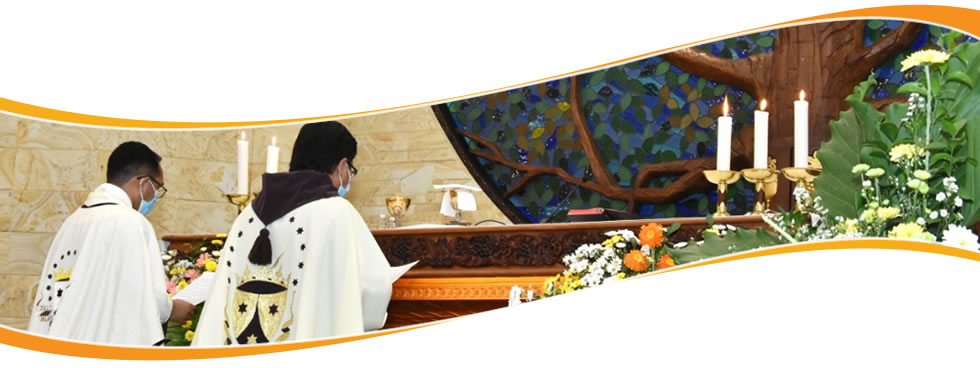
As part of the opening of the 50th anniversary celebrations in Congo, two members of the commissariat were ordained to the priesthood during the Mass on May 16. Bishop Dieudonne Uringi of the Diocese of Bunia ordained Philémon Kambale Sivasi, O. Carm., and Emery Losinu Ngadjole, O. Carm. during the celebrations. Fr. Emery is originally from Pimbo, Dem. Rep. Congo and Fr. Philémon is from Mutambi, Dem. Rep. Congo.
The celebrations continue in various places with various activities planned during the coming year.
The City of Nijmegen Honors St. Titus
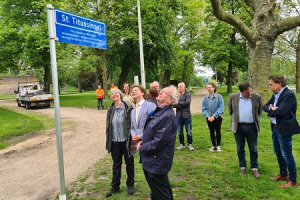
On May 15, 2023, on the first anniversary of the Canonisation of Saint Titus, the city council named the road over the main bridge that enters the city of Nijmegen in honour of Titus Brandsma.
The roads ends at the place where every year the memorial of the victims of the Second World War are remembered.
This is especially appropriate because Titus built bridges between both God and people, and between humans and one another.
A ceremony was held which was attended by Huub Welzen and Marieke Rijpkema gave a speech in tribute to Titus.
Carmel in Congo Celebrates 50 Years

Fifty Years of the Carmelite Way of Living the Gospel of Jesus Christ
The Prior General of the Order, Míčeál O'Neill, sent the following letter to the Carmelites and the people they minister with on the inauguration of celebrating 50 years of Carmelite presence in the Democratic Republic of the Congo.
I join today with many people in the Democratic Republic of the Congo and in Italy as the celebrations of the 50thanniversary of the presence of the Order of Carmelites in the DRC begin. Throughout these first fifty years the Carmelite friars, in collaboration with the local church, have offered the people the Carmelite way of living the Gospel of Jesus Christ, with its special attention to prayer, devotion to Mary, attention to the word of God and the social improvement based on the Gospel. There are now communities in Bunia, Butembo, Nioka, in the east, Kinshasa in the west and Kisangani in the north.
Through work in parishes, religious formation, and spiritual accompaniment, the Carmelites seek to offer to the local church what they have received as a charism and vocation. The Carmelite tradition speaks of people growing daily in their knowledge of the love of God. This knowledge is exemplified in the lives of the saints that the Carmelite tradition has produced. That challenge continues in these new times for Africa.
It is the challenge now to find the true dignity of the human person, free from outside political and economic interests, free to care for family, education, and the full dignity of every human person as a son or daughter of God. I pray that the presence of the Order of Carmelites in Africa, and in a particular way in the Democratic Republic of the Congo, may be a source of wisdom and consolation for all the people, and that the future for all may be one of greater peace and harmony in a country that God has blessed with such enormous and beautiful resources of faith, personality and nature.
May our Lady of Mount Carmel and the Saints of Carmel be for all beacons of light and hope in a common commitment to the love and truth of the Gospel of Jesus Christ and the mission of the Catholic Church.
Míċeál O’Neill, O. Carm.
Prior General
May 16, 2023
Le Carmel au Congo fête ses 50 ans
Cinquante ans de vie carmélitaine pour l'Évangile de Jésus-Christ
Le Prieur général de l'Ordre, le père Míčeál O'Neill, a envoyé la lettre suivante aux Grands Carmes et aux personnes avec lesquelles elles travaillent, au debut de la célébration du 50e anniversaire de présence du Carmel en République démocratique du Congo.
Je me joins aujourd'hui aux nombreuses personnes en République démocratique du Congo et en Italie à l'occasion du début des célébrations commémorant le 50e anniversaire de la présence de l'Ordre des Grands Carmes en RDC. Au cours de cettes cinquante premières années, les frères carmes, en collaboration avec l'église locale, ont offert au peuple la façon carmélitaine de vivre l'Évangile de Jésus-Christ, avec un adhésion particulier à la vie de prière, à la dévotion mariale, l'attention à la Parole de Dieu et le développement social fondé sur l'Évangile. Il y a maintenant des communautés à Bunia, Butembo, Nioka, à l'est, Kinshasa à l'ouest et Kisangani au nord.
Par leur travail dans les paroisses, la formation religieuse et l'accompagnement spirituel, les Grands Carmes cherchent d'offrir à l'Église locale ce qu'elles ont reçu: leur charisme et leur vocation distinctive. La tradition la tradition carmélitaine est constituée de personnes qui chaque jour progressent dans leur connaissance de l'amour de Dieu. La vie des saints que la tradition carmélitaine a produite est un exemple de cette connaissance. Cet idéal continue en ces temps nouveaux pour l'Afrique.
Il s'agit aujourd'hui de retrouver la véritable dignité de la personne humaine, libérée des intérêts politiques et économiques extérieurs, libre de s'occuper de sa famille, libre d'avoir accès à l'éducation, et de respecter la pleine dignité de chaque personne humaine en tant que fils ou fille de Dieu. Je prie pour que la présence de l'Ordre des Carmes en Afrique, et d'une manière particulière en République Démocratique du Congo, soit une source de sagesse et de consolation pour tout le peuple, et que l'avenir de tous, soit celui d'une plus grande paix et harmonie dans un pays que Dieu a béni avec de si énormes et belles ressources de foi, d'humanité et de la nature.
Je prie afin que la présence de l'Ordre des Grands Carmes en Afrique, et en particulier dans la République Démocratique du Congo, soit pour tous les peuples une source de sagesse et de consolation, et que l'avenir de tous soit marqué par une plus profonde conciliation et harmonie dans ce pays que le Seigneur a comblé de ressources si grandes et si merveilleuses au niveau de la foi, de la sensibilité et de la splendide nature.
Que Notre-Dame du Mont-Carmel comme les saints du Carmel soient pour tous comme des rayons de lumières et d'espérance pour un engagement solidaire en faveur de l'amour et de la vérité de l'Évangile de Jésus-Christ ainsi que par rapport à la mission de l'Église catholique.
Avec gratitude, je souhaite à tous d'heureuses célébrations.
Míċeál O'Neill, O. Carm.
Prieur général
16 mai 2023
St. Simon Stock, Religious

16 May Optional Memorial (Obligatory Memorial the province of Great Britain)
In the short historical note for his liturgical celebration found in the current Propers of the Liturgy of the Word, we read, "Of English origin, he lived in the 13th century and died in Bordeaux. Venerated in the Carmelite Order for his exalted holiness and devotion to the Blessed Virgin." An attempt has thus been made to summarize the problematic life of the saint.
Indeed, it is not easy to say anything about him with any certainty. The information comes from three kinds of sources, and they have many contradictions between them. Also it is not always possible to know whether they refer to the same person. This is why we think of the existence of "two" persons with the same name as Simon: one a prior general (and in this case his term of office should be either before 1249 or between the years 1253-54 or in 1257-1266, the only spaces available in the list of priors general); and another man, a simple religious person esteemed for his holiness and devotion to Our Lady. These figures would then be merged into one, through a transfer of news from one type of source to another, and with other unreliable reports mixed in.
The Order's tradition links the famous tale of the "vision of the Scapular" to the saint of the Order. To understand the details of this "vision"—of which nothing is known regarding place and date (although traditionally put in 1251)—it is necessary to consider that the story is presented as a literary genre common in the medieval period. The content is similar to that developed by a number of other religious orders: Our Lady told the saint that whoever died piously wearing the scapular would not go to hell. It is a theological truth "dressed up" with the typical form of medieval exempla. (a short tale incorporated into a sermon to emphasize a moral or illustrate a point of doctrine). The story began to spread between the end of the 14th century and the beginning of the following century, while the fact of the "vision" was placed about the middle of the 13th century.
Liturgical worship to St. Simon Stock appears in Bordeaux, France from 1435, in Ireland and England from 1458, while across the Order the feast was introduced later by decree of the general capitol of 1564. In the Carmelite calendar reform of 1584 the feast was dropped. In the 17th century, the celebration of St. Simon reentered but was delisted in 1972. It returned in 1978 with the due approval of the Holy See and with the note “as long as care is taken to eliminate any relation to the problematic view of the scapular.”
(Emanuele Boaga, Simone Stock, Dizionario Carmelitano, 2008)
Prior General on the First Anniversary of St. Titus

The First Anniversary of the Canonization of St. Titus Brandsma
The 15th of May marks the first anniversary of the canonization of our brother Titus Brandsma, canonised along with nine other holy men and holy women, by Pope Francis in St. Peter’s Square in 2022. The memory of that celebration and the days that surrounded it still live in the minds and hearts of thousands of people all around the world. It was particularly moving for all of us who had the blessing of being in Rome when the event was taking place.
Now one year later, we are aware of the good feeling that the memory, experience, and teaching of Titus has generated. The work of translating his works into English continues, paving the way for many other translations in many other languages in the future. It is not that we want to be carried away only by this most recent to our long list of saints. It is rather that in these troubled times we take from Titus an assurance and a challenge. The assurance is that the way of life embraced by Carmelites in many different ways is “good and holy” (Rule Ch. 20). The challenge is to follow it in the selfless and knowledgeable way that Titus did.
At this time, when war and violence are so much part of the headlines of every day, Titus reminds us of the awfulness of war, the awfulness of any kind of violence committed against the human person and the stark reality of a society that has lost the sense of any need of knowing God and his mercy.
Here again is the challenge to Carmelites, following the example of Mary our Mother, and of Elijah our disturber, and inspired by the life and example of Titus Brandsma, we will witness to the great desire of God for peace and unity in the world, a peace that comes from God, and that only God can give to those who are willing to receive it.
May we see the end of all wars in our time and together build a world environment in which men and women of every age and nation and background will see that their dignity is respected and that with God’s grace they will grow to maturity, giving generously of their gifts for the building up of that world in which everyone can live a full and dignified life.
Míceál O’Neill, O. Carm.
Prior General
May 14, 2023
Province of the Netherlands Holds Elections

The Chapter of the Province of the Netherlands took place from May 9-12, 2023, at the Franciscushuis retreat center in Denekamp. Both the Prior General Míceál O'Neill and the General Councilor for Europe, Richard Byrne, participated.
Today’s Province of the Netherlands celebrated its 100th anniversary in 1996. Houses existed in the country centuries before but they formed part of the Lower German Province. However all the houses in what is now the Netherlands ceased to exist in 1581 when the Netherlands declared themselves independent of Spain. In 1652, a foundation was made in Boxmeer by the noted Carmelite, Daniel of the Virgin Mary. That house belonged to the Flemish Province.
Boxmeer survived the suppression of the Flemish Province under Napoleon but was not allowed to accept novices. When this ban was lifted in 1840, only three elderly friars remained. The community was soon reconstituted and in 1855 founded Zenderen. These two houses, along with Straubing, became the Germano-Holland Province in 1879. On the feast of the Immaculate Conception, 1896, the General Council of the Order established the Province of the Netherlands.
Over the years the Province of the Netherlands became the largest and one of the most flourishing in the Carmelite Order. It has distinguished itself especially in promoting the spread of the Order. Members went to work with the Choctaw native people in Tucker, Mississippi (USA) accompanying them on their removal to current day Oklahoma. From 1904 it assisted in the restoration of the Rio de Janeiro Province (Brazil). In 1923 it began a mission in present Indonesia which has since become the largest province in the Order. In 1924 it repossessed the convent of Mainz and revived its mother Province of Lower Germany. In 1958 members founded the Order in the Philippines, which has since become a province.
The following members were elected to leadership:
+ + +
Provincial | Provincial | Provinciale
Fr. Huub Welzen, O. Carm.
1st Councilor | 1er Consejero | 1o Consigliere
Fr. Ton van der Gulik, O. Carm.
2nd Councilor | 2do Consejero | 2o Consigliere
Fr. Tom Buitendijk, O. Carm.
3rd Councilor | 3er Consejero | 3o Consigliere
Fr. Ben Wolbers, O. Carm.
4th Councilor | 4to Consejero | 4o Consigliere
Fr. Hein Blommestijn, O. Carm.
Elected to the Extended Provincial Board
Anne-Marie Bos and Minnie Pasop
Celebrating At Home - Sixth Sunday of Easter
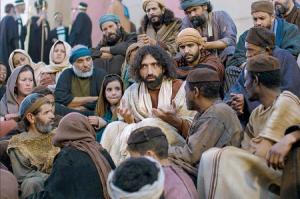
Promise of the Spirit, Love among us,
Love within us
(John 14:15-21)
As we approach the coming feasts of the Ascension and Pentecost, the Gospel today focuses on the Holy Spirit.
Jesus returns to the Father in the Ascension, but remains with his disciples through the coming of the Holy Spirit at Pentecost. This Holy Spirit keeps us in a communion of love with Jesus, with the Father and with one another.
The commandments of Jesus are always about love - love of God and love of neighbour. Those who live by these commandments of Jesus abide with him, others and the Father in love.
Along with the call to love comes a gift to help us, to accompany us on our journey, lending knowledge, courage and a deep experience of God’s life and love.
Jesus is the reign of God in person. He is both the image of God and the model of the redeemed human being that each of us is called to be.
The Gospel makes a number of important points: the basis of our relationship with Jesus is love; Jesus’ return to the Father does not leave us orphans because his spirit, the Spirit of truth, the Advocate, will be with us always; Jesus will, one day, return.
The whole Gospel reading today is like a love poem.
God’s love for us, shown clearly in the life of Jesus, draws us into love with him and one another and allows us to share God’s life both now and for ever.
May the new life we celebrate over the next fifty days bring us the creativity of Spirit we need to be the living heart of God in our world today.
- pdf Celebrating At Home - Sixth Sunday of Easter [PDF](5.68 MB)
- default Celebrating At Home - Sixth Sunday of Easter [ePub](4.33 MB)
- pdf Celebrando en Familia - Sexto Domingo de Pascua(402 KB)
- pdf Celebrando in Casa - Sesta Domenica di Pasqua(401 KB)
- pdf Celebrando em familia - Sexto Domingo da Páscoa(404 KB)
Provincial Chapter of the ACV Province Held

The Provincial Chapter of the Province of Aragon, Castile and Valencia was held April 12-14, 2023, at the "St. Ignatius" Spirituality Center in Salamanca, Spain. The theme of the meeting was: "The radical witness of consecrated life. Faithful to our Carmelite charism".
On April 14, 2023, in a festive atmosphere, Bishop José Luis Retana Gozalo, Bishop of Ciudad Rodrigo and Salamanca, visited the capitulars, thanking God for the richness that the Carmelite charism brings to the Church and for its presence in the Diocese of Salamanca. Sister Merry Teresa Sri Rejeki, Superior General of the HHCVMMC, and Sister Francisca Rubio, Vicar General of the HHCVMMC, accompanied the capitulars at the closing meal of the Provincial Chapter.
The Province has a long and rich history. Following the suppression in 1835 of religious life in Spain, the “Province of Spain” was restored (circa 1889), then in 1906 was divided into two provinces, Valentine Arago and Baetica. The name recalls the ancient Province of Aragon which was established in 1416 although the name appeared in records as early as 1330.
Beginning in 1894, before the division of the Province of Spain," the members worked in restoring the Provinces of Rio de Janeiro and Pernambuco. From 1920, the province carried out missionary work in other countries of Latin America, founding houses in Puerto Rico, Venezuela, Argentina, and the Dominican Republic. A general commissariat was established in Catalonia in 1932 from houses of the province. Catalonia became a province itself in the 1950s. In 1932 Castile as well was broken off from the Arago Valencia Province and a commissariat general was established in 1948; it became a province in 1984.
A provincial commissariat of the Antilles was set up. Under the patronage of Maria Magdalena de’Pazzi. The commissariat comprises the Republic of Santa Domingo and Puerto Rico.
The new Province of Aragon-Castile-Valencia was born in 2014 from the union of the Provinces of Castille and Aragon-Valencia. The new province is under the patronage of St. John of the Cross.
The following were elected to leadership:
. . .
Provincial | Provincial | Provinciale
P. Salvador Villota Herrero, O. Carm.
1st Councilor | 1er Consejero | 1o Consigliere
P. Desiderio García Martínez, O. Carm.
2nd Councilor | 2do Consejero | 2o Consigliere
P. Luca Zerneri, O. Carm.
3rd Councilor | 3er Consejero | 3o Consigliere
Fra. Manuel García Villaescusa, O. Carm.
4th Councilor | 4to Consejero | 4o Consigliere
P. Vicente Aranda Guillén, O. Carm.
Commissary Provincial of the Antilles | Comisario Provincial de las Antillas | Commissario Provinciale delle Antille
P. Randy Rudecindo Marte, O. Carm.
An Interview with Fr. Toni on Congo’s 50 Years of Carmel

An Interview with Fr. Roberto Toni, prior provincial of the Italian province
Congo’s 50 Years of Carmel and Some Ideas on the FutureCarmelite Fr. Roberto Toni serves as the prior provincial of the Italian province. He reflected on the establishment of Carmel in the Congo by the province he now leads and what he sees as the future. Here is a summary of what he wrote in response to questions from CITOC.
Fifty years ago, the province established Carmel in what was then called Zaire. Before that it was known as the Belgian Congo. Today it is the Democratic Republic of the Congo. The Italian province was then known as the Roman province.
With the Second Vatican Council, a new missionary spirit developed in the Order. In 1973 when the Carmelites went to then Zaire, only eight years had passed since the conclusion of the Council. The spirit of a new Spring for the Church was in the air. The entire Roman Province, corresponding to Central Italy, mobilized with great enthusiasm for that first presence. Three missionaries went: Fr. Arcangelo Colandrea, Fr. Ubaldo Pani, and Fr. Domenico Fiore (two of whom are still living). These first seeds of Carmel settled on around the village of Jiba, in Ituri, in the northeastern part of the great country, near Lake Albert, in the diocese of Bunia.
Through the periodical La Madonna del Carmelo and the work of the person in charge, Fr. Riccardo Palazzi, the whole Province, friars, nuns, sisters, tertiaries and laity of the shrines and parishes, was regularly informed of the mission's growth steps. It was also helpful in the collecting of funds and the sending of materials that would be useful in the mission.
When the Italian province of the Carmelites was established in 1991, the mission in the Congo had developed considerably. It became the patrimony and commitment for the whole Carmelite Family that made up the new province. It was also an occasion for strengthening the unity through a common effort.
After Bunia, there was Butembo, then Nioka, then the foundation in the capital, Kinshasa, and finally, not so many years ago, Kisangani. Today it is a provincial commissariat with 11 houses, about 74 confreres, including novices. Some of these Carmelites are in the communities in Italy to help our presence these or to specialize in studies. The "mission" itself has become, in turn, "missionary."
Congo opened our minds to the universality of the Church and Carmel; in that same year, 1973, Carmelite Fr. Lauro Negri departed from Veneto for Latin America. Colombia, along with the Congo, became a "window" of new Carmelite life in the world.
There is still a long way to go, but we have seen the Carmelite charism entering African and Congolese culture, the blossoming of vocations, and the need for discernment. There is the challenge of evangelical coherence and a charity that goes beyond mere welfare. This window on a rich, joyful, and troubled Africa has allowed us, the brothers in Italy, Colombia, and now Romania to come into contact with and share the dramas of these last thirty years in Congo. There have been wars, massacres, exoduses of refugees within the country. All of this breaks through the door of our indifference and calls us to "bear one another's burdens," to reflect on why there is so much injustice, to ask what we can do.
The Church in Congo, with its youth and challenges, has known Carmel and, through the mouth of the bishops, asks us to "authentically be we are." Even simple people can discern by looking at us whether we are just going through the motions or are true believers who are credible. From us they for evangelical radicalness in the witness of fraternity, prayer, and humble and selfless service. It would make no sense to accommodate ourselves or to become implementers of works without quality and soul. The Congolese people have a strong sense of spirituality. But the consumer mentality, for which everything has a price, as well as secularism, are making their way into the hearts and practices of the people, especially of the youth. Hence the corruption, the conflicts, the disintegration of a humanity full of values that are in danger of being lost. As Carmelites, as contemplative brothers and prophets, we have much to witness to.
If we follow Christ Jesus, there is no alternative to his gift of life. Today, fifty years after that beginning, our Province asks: what does the Lord ask of us who are called to live following Him?
Carmel in Congo Celebrates 50 Years

On Tuesday, May 16, 2023, the Order will begin a yearlong celebration of its presence in the Democratic Republic of the Congo. To begin the celebrations, a solemn Eucharist will be held in the parish of Isidore Bakanja at Chemchem (Bunia). The bishop of Bunia, Msgr Dieudonnè Uringi will preside.
As a provincial commissariat of the Italian province, a host of people from around the Congo and Italy are expected to participate. These include the General Councilor for Africa, Conrad Mutizamhepo, representing the prior general. Also participating will be Roberto Toni, prior provincial of the Italian province, Henry Venecia Cerro, provincial councilor, Sebastian Benchea, secretary of the council and province, and Giuseppe Grussu, provincial treasurer, Guido Sartori. Also present will be Mario Serra who served in the missions previously.
Two Carmelites will be ordained during the ceremony: Emery Losinu Ngadjole and Philémon Kambale Sivasi.
Congratulations to the Congolese, the Italian province, and the Church on this milestone in the development of Carmel in Africa.


