









The Elective Chapter of the Carmelite Monastery of Paranavaí, Brazil, was held 10 October 2015. The following were elected:
- Prioress: Sr. Derly de Paula Moreira, O.Carm.
- 1st Councilor: Sr. Edna Maria Lopes de Sousa, O.Carm.
- 2nd Councilor: Sr. Maria do Carmo da Conceição , O.Carm.
- Director of Novices: Sr. Edna Maria Lopes de Sousa, O.Carm.
- Treasurer: Sr. Edna Maria Lopes de Sousa, O.Carm.
- Sacristan: Sr. Derly de Paula Moreira, O.Carm.
From July 23 to August 9 in Lima, Peru, a formation course was carried out for students and young formators in the Americas. The meeting covered issues in the field of academics, spirituality and psychology, as well as workshops on leadership, several pastoral experiences in poor areas of Lima and some cultural visits. Keynote speakers were John Welch, O. Carm., USA; and Carlos Mesters, O.Carm., Brazil, who spoke of the great Carmelite saints and the great figures of Mary, Elijah and Elisha. This first course was organized by Raul Maraví, O. Carm., General Councilor of the Americas, at the request of superiors, commissaries and delegates from the Americas. This meeting was attended by 23 friars from 10 different nations in the hemisphere, who enjoyed the internationality of the Order and a great fraternal atmosphere.
Also, from 26 to 31 October, the IV ALACAR Congress will be held in San Salvador, El Salvador (Central America), bringing together representatives of the O.Carm. and OCD families of Latin America: friars, nuns, religious and laity. The conference will focus in Saint Teresa of Jesus on the occasion of the V centenary of her birth. Both Fr. Fernando Millán Romeral, O.Carm., Prior General of the Carmelite Order, and Fr. Saverio Cannistrà, OCD, Superior General of the Discalced Carmelites, will be speakers at this important gathering.
Pope’s Prayer Intentions for October 2015
Universal: Human trafficking - That human trafficking, the modern form of slavery, may be eradicated.
Evangelization: Mission in Asia - That with a missionary spirit the Christian communities of Asia may announce the Gospel to those who are still awaiting it.
Lectio Divina October - Octubre - Ottobre 2015
| Ipad-Iphone | Kindle | ||
| English | download ebook | download ebook | download PDF |
| Español | descargar eBook | descargar ebook | download PDF |
| Italiano | download eBook | download eBook | download PDF |
- Thursday, October 1, 2015
- Friday, October 2, 2015
- Saturday, October 3, 2015
- Sunday, October 4, 2015 - 18
- Monday, October 5, 2015
- Tuesday, October 6, 2015
- Wednesday, October 7, 2015
- Thursday, October 8, 2015
- Friday, October 9, 2015
- Saturday, October 10, 2015
- Sunday, October 11, 2015
- Monday, October 12, 2015
- Tuesday, October 13, 2015
- Wednesday, October 14, 2015
- Thursday, October 15, 2015
- Friday, October 16, 2015
- Saturday, October 17, 2015
- Sunday, October 18, 2015
- Monday, October 19, 2015
- Tuesday, October 20, 2015
- Wednesday, October 21, 2015
- Thursday, October 22, 2015
- Friday, October 23, 2015
- Saturday, October 24, 2015
- Sunday, October 25, 2015 - 18
- Monday, October 26, 2015
- Tuesday, October 27, 2015
- Wednesday, October 28, 2015
- Thursday, October 29, 2015
- Friday, October 30, 2015
- Saturday, October 31, 2015
The Elective Chapter of the Carmelite Monastery of Carpineto Romano, Italy, was held 21 September 2015. The following were elected:
- Prioress: Sr. M. Noemi Malagesi, O.Carm.
- 1st Councilor: Sr. M. Paola Ricci, O.Carm.
- 2nd Councilor: Sr. M. Valentina Rossin, O.Carm.
- 3rd Councilor: Sr. M. Rosa Fois, O.Carm.
- 4th Couniclor: Sr. M. Carla Zinno, O.Carm.
- Director of Novices: Sr. M. Valentina Rossin, O.Carm.
- Treasurer: Sr. Anna Luisa Voltazza, O.Carm.
- Sacristan: Sr. M. Mihaela Catana, O.Carm.
The Provincials, Commissaries and Delegates General of the European Geographical Area met together in Rome from the 16th to 18th September 2015. Having reflected on the current situation of the Order in each of the provinces, they discussed in detail the question of collaboration in the area of initial formation. A common European novitiate having been established in Salamanca, Spain, some years ago, they have now agreed to prepare the way for the establishment of a European International formation community for initial formation in Rome. Apart from their work in general assembly and in regional groups, the provincials were addressed by the Prior General, Fr. Fernando Millán Romeral, Fr. John Keating, Councillor General for Europe and Fr. Míċeál O’Neill, Prior of St. Albert’s International Centre in Rome, who also acted as chairman for the meeting. They also issued the following message to all Carmelite communities in Europe:
The Carmelite Provincials of Europe, meeting in Rome, from the 16th to the 19th of September, and fully aware of what is happening to the thousands of refugees who seek to find a welcome in our countries, make an appeal to all our communities, to live in the spirit of our constitutions (No.114). “Social reality challenges us. Attentive to the cry of the poor, and faithful to the Gospel, we must take our stand with them, making an option for the “little ones”. (...) to bring to our brothers and sisters a word of hope and salvation from their midst, more by our lives than by our words ... ; (...) allegiance to Jesus also means allegiance to the poor and to those in whom the face of Christ is mirrored preferentially.” Mindful that in the beginning we too were pilgrims, and urged by our contemplative and prophetic charism, we invite each community, to the extent that each one can, to be open to the kind of solidarity that this humanitarian situation demands and that the Church asks of us too.
Rome, 18th of September, 2015

With the celebration of the 500th anniversary of the birth of Saint Teresa of Jesus we come to the summit of the commemoration of this great Carmelite saint. Various news of CITOC-online has reported the initiatives celebrated in many Provinces of the Order. In addition, during the General Chapter of the Discalced Carmelites, our Prior General presided at the Eucharist in the “Holy place”, the birthplace of Saint Teresa. He was accompanied by Fr. Xavier Cannistrà, Superior General of the Teresian Carmelites who was just re-elected as Superior General. In this issue of our magazine, we dedicate a large part to this Saint of Carmel: a biography of her life, an article on her characteristics, and finally a portrayal of her as a woman of prayer.
Another great figure of more recent times was beatified on May 23, 2015, in El Salvador: Bishop Oscar Arnulfo Romero. His beatification, so long-awaited, gives us the opportunity to present two articles on his love and pious devotion to Our Lady of Mount Carmel and a presentation of Carmel in El Salvador.
It was a great honor for the whole Order that Fr. Bruno Secondin, O.Carm, preached the retreat to Pope Francis and members of the Roman Curia. We are excited to share an article in which he shares with us this unique experience.
The history of Carmel has always responded to the challenges resulting from the changes of the historical moment. An example of this is the report on the merger of the two Institutes of the Sisters of Our Lady of Mount Carmel and the Carmelite Sisters of Grace. This issue also features another article on Carmelite nuns, presenting a look at the reality of our nuns in Asia.
In addition to these articles, and other information from around the world, we present a selection of top news, some of which was already published in CITOC-online, as we catch a glimpse of the current activities of the Order.
To undertake (prayer [JH]) is a matter of life and death for all Christians. And no one, however lost he may be, should set it aside if God has awakened him to so great a good.
Camino de perfección 16:3
The continuation of the book is therefore entirely dedicated to prayer. However, Teresa has trouble finding a good starting point. What she actually wants to discuss is contemplative prayer (contemplación), but she realizes that not everyone is called to this. In this respect we can only trust in God’s grace. This is why it is better not to have a qualitative judgment on the different types of prayer and humbly to accept what the Lord in His goodness gives us (Camino de perfección 16:18). In the continuation Teresa does, however, make clear that prayer is not a goal in and of itself. We don’t come to prayer by reciting standard formulas but by inwardly directing ourselves towards God and placing our trust in Him alone. Then God Himself will lead us to the source of living water. According to Teresa this source is located in the centre of our soul and when we drink from this source, we are assuaged with a thirst that pulls us ever deeper into the infinite longing of God (perfection).
How right and true, as words coming from the mouth of Truth Itself, that such a person will not thirst for anything in this life – although thirst for the things of the next life increases much more than can ever be imagined through natural thirst!
How thirsty one becomes for this thirst! The soul understands the great value of this thirst, and even though the thirst is a most painful, wearying one, it brings with it the very satisfaction by which it is assuaged, in such a way that it is a thirst unquenchable except in earthly things. Indeed, this thirst slakes in such a way that when God satisfies the thirst, the greatest favour He can grant the soul is to leave in it this same need – and a greater one – to drink the water again.
Camino de perfección 19:2
For Teresa the inner goal of prayer is that we come into contact with God and learn to trust this Source within ourselves more and more. The way in which this is brought about is of secondary importance to her. Since God works in mysterious ways in this regard, it is not our place to determine this. What is important is that we open ourselves for God in prayer, trusting that He is truly leading us on a path that He alone knows. This is why the way of prayer is a royal road and on it we should not shrink or be irresolute:
For when you are about to gain the treasure – or steal it, since the Lord says that the violent take it away (Matthew 11:12) – by a royal road and by a safe road, the road chosen by our King and all His elect and saints, they will tell you that there are so many dangers and so many things to fear.
Camino de perfección 21:5
We travel the road of prayer, when we, in our longing, orient ourselves towards God and do not doubt that we are seen by God in this. This is why, according to Teresa, vocal prayer (oración vocal), as an expression of this inner orientation, cannot be separated from mental prayer (oración mental) or this inner orientation itself. For this it is not necessary to use long prayers. A simple Lord’s Prayer or Hail Mary suffices to direct our attention and enter into contact with the Source of our life:
Is it too much to ask you to turn your eyes from these exterior things in order to look at Him sometimes? Behold, He is not waiting for anything else, as He says to the bride, than that we look at Him. In the measure you desire Him, you will find Him. He so esteems our turning to look at Him that no diligence will be lacking on His part.
Camino de perfección 26:3
Jos Huls, O.Carm.,
The Spanish Inquisition had banned many spiritual books for the general public, and especially for women, and so the Sisters of the newly founded Convent of Saint Joseph in Avila asked St Teresa whether she herself would write something on prayer or the spiritual life (Morgain, 1997). For Teresa this was the go-ahead to start writing a new book of a practical nature. She gave the book the title “The Way of Perfection” (Camino de perfección), an introduction to the contemplative life. She begins her book, however, with the “disasters” that were then occurring in northern Europe as a consequence of the Reformation. She wants to do something against this “evil”, but must acknowledge her limited role as a woman in a highly male-dominated society (Álvarez, 2006):
I realized I was a woman and wretched and incapable of doing any of the useful things I desired to do in the service of the Lord. All my longing was and still is that since He has so many enemies and so few friends that these few friends be good ones. As a result I resolved to do the little that was in my power; that is, to follow the evangelical counsels as perfectly as I could and strive that these few persons who live here do the same. I did this trusting in the great goodness of God, who never fails to help anyone who is determined to give up everything for Him.
Camino de perfección 1:2[1]
Teresa’s stance with regard to this discrimination is not neutral and she is of the opinion that it goes against the spirit of the Christian faith. Jesus clearly made a stand for women and gave them a prominent role. Thus we read in a passage which was removed by a censor:
Nor did You, Lord, when You walked in the world, despise women; rather, You always, with great compassion, helped them. And You found as much love and more faith in them than You did in men. Among them was Your most blessed Mother, and through her merits – and because we wear her habit – we merit what, because of our offences, we do not deserve. Is it not enough, Lord, that the world has intimidated us... so that we may not do anything worthwhile for You in public or dare speak some truths that we lament over in secret, without Your also failing to hear so just a petition? I do not believe, Lord, that this could be true of Your goodness and justice, for You are a just judge and not like those of the world. Since the world’s judges are sons of Adam and all of them men, there is no virtue in women that they do not hold suspect. Yes, indeed, the day will come, my King, when everyone will be known for what he is. I do not speak for myself, because the world already knows my wickedness – and I have rejoiced that this wickedness is known publicly – but because I see that these are times in which it would be wrong to undervalue virtuous and strong souls, even though they are women.
Camino de perfección 3:7
Despite this clear protest against a policy which drives women further and further into the margins of public life, Teresa is not a champion of women’s rights before the term existed. Her protest mainly concerns the attitude of the Church of her time, which considers women suspect from the start. She opposes this attitude, because it is not in accordance with the Gospel and so goes against the will of God. Jesus acknowledges women and gives them their rightful place. And so Teresa is of the opinion that, in her time also, women can be important to combat the crisis in the Church. They may lead a (compulsorily) hidden life, but their share in the battle the Church has to fight against “evil” is no less for all that.
The danger of such a statement is that it remains nothing but a hollow phrase. For Teresa, however, it expressly has to do with the life she is called to as a Carmelite nun and which she rightfully calls a daring venture. There may be external attacks on the church, but the greatest danger comes from within and has to do with what Teresa calls offending Christ. Christ is not seen in His unimaginable offer of love. Instead people concern themselves with outward affairs that for the “world” may seem important, but do not touch the core of our existence. This is why the Sisters, as true soldiers of Christ, must defend the inside of the city and in so doing support the other soldiers who have to hold their own in the world (Camino de perfección 3:1). This inward movement is essential for Teresa and it evokes a battle that does not end at the boundaries of the convent. There, too, there is a continual tension between inside and outside, between that which is avowed and the true confrontation with God.
The Carmelite life, as it is advocated by Teresa, can best be described as a life lived purely out of the love of Christ or God. The Sisters have abandoned everything to entrust themselves with all their soul to this love. The “perfection” the Carmelite nuns have to strive for is therefore not to be sought in faultless conduct, but in the unconditionality of their surrender to this divine love. Although the “Way of Perfection” is primarily directed towards prayer (De Pablo Maroto, 1973; Herraiz Garcia, 1981), in the first chapters of the book Teresa mainly emphasizes the material expression of this in the Sisters’ life. In doing this she seems to want to express that the spiritual cannot be abstracted from the material. Prayer remains empty when it is not put into practice in life as it is concretely lived. Thus, as early as the second chapter of her book, Teresa indicates how important it is to be unconcerned and not to worry about material needs:
Don’t think, my Sisters, that because you do not strive to please those who are in the world you will lack food. I assure you that such will not be the case. Never seek sustenance through human schemes for you would die of hunger – and rightly so. Your eyes on your Spouse! He will sustain you. Once He is pleased, those least devoted to you will give you food even though they may not want to, as you have seen through experience. If in following this advice you should die of hunger, blessed be the nuns of St Joseph’s! For the love of the Lord, do not forget this. Since you have given up an income, give up worry about food. If you don’t, everything will be lost.
Camino de perfección 2:1
For Teresa, trust in God is not something abstract. We cannot say that we trust God, and at the same time cover ourselves on other levels. He who gives himself, gives himself completely, or his gift means nothing. The same is true of the three most important virtues of the Carmelite life – charity, detachment and humility – which are all directed towards easing us away from our self-absorption, trusting that we are in everything the Other’s concern.
Camino de perfección 5:15
Jos Huls, O.Carm., is a member of the Dutch Province of the Order and senior researcher at the Titus Brandsma Institute at Nijmegen in the Netherlands.
[1] The English edition used is Volume II of The Collected Works of St Teresa of Avila: The way of perfection. Meditations on the Song of Songs. The Interior Castle translated by Kieran Kavanaugh & Otilio Rodriguez. Washington: Institute of Carmelite Studies. 1980.
Following the first part of the European Carmelite Youth programme “Awakening” held at Casa São Nuno, Fatima, Portugal in August 2014 with 58 participants, a second group gathered at San Felice del Benaco, Italy from the 19th to 23rd August 2015. This time there were 45 participants from the Italian, Neapolitan, Maltese and Polish Provinces (Italy, Malta, Romania and Poland), together with two sisters from the Instituto di Nostra Signora del Carmelo. The Prior General, Fr. Fernando Millán Romeral was present for two days and spoke to the participants about “Three witness of love” in our Carmelite tradition: Titus Brandsma, Edith Stein and Angelo Paoli. Fr. Miċeál O’Neill (Hib) presented the topic “Voices of Carmelite Women”: Teresa of Avila and Mary Magdalen de Pazzi. The members of the Carmelite European Youth Committee, Sabrina Rubio Perez, Victor Navarrro Poncela and Carmelites, Luca Sciarelli, Dave Twohig and Tommaso Bacci guided each day and also spoke on various topics including our Carmelite story, the Blessed Virgin Mary and lectio divina. The programme ended with Mass of the Sunday celebrated by the Prior General, with the young people and the local people in the beautiful Carmelite church at San Felice. The event was coordinated by the General Councillor for Europe, John Keating. The committee wish to express their gratitude to the community and the staff of “Il Carmelo” for the wonderful hospitality afforded to them at this spiritual centre of the Italian Province. To conclude a very successful programme three young women and two Carmelites of the Polish province gave a presentation on the forthcoming World Youth Day (WYD) that will take place in Krakow, Poland from 25th – 31st July 2016. They reminded the participants that it is now possible to register for the WYD through local dioceses or on the official international website. Groups wishing to participate in the WYD programme should do so through these agencies. Prior to the official events of the WYD, the Polish Province invites all Carmelite groups to participate in a special Carmelite Day on July 27th at their house in Krakow.
Those wishing to participate in this one-day Carmelite event have to make a separate registration for the Carmelite Day – for this and all other inquiries please visit www.sdm.karmelici.pl
More...
Pope’s Prayer Intentions for September 2015
Universal: Opportunities for the young - That opportunities for education and employment may increase for all young people.
Evangelization: Catechists - That catechists may give witness by living in a way consistent with the faith they proclaim.
Lectio Divina September - septiembre - settembre 2015
| Ipad-Iphone | Kindle | ||
| English | download ebook | download ebook | download PDF |
| Español | descargar eBook | descargar ebook | download PDF |
| Italiano | download eBook | download eBook | download PDF |
- Tuesday, September 1, 2015
- Wednesday, September 2, 2015
- Thursday, September 3, 2015
- Friday, September 4, 2015
- Saturday, September 5, 2015
- Sunday, September 6, 2015
- Monday, September 7, 2015
- Tuesday, September 8, 2015
- Wednesday, September 9, 2015
- Thursday, September 10, 2015
- Friday, September 11, 2015
- Saturday, September 12, 2015
- Sunday, September 13, 2015
- Monday, September 14, 2015
- Tuesday, September 15, 2015
- Wednesday, September 16, 2015 - 09
- Thursday, September 17, 2015
- Friday, September 18, 2015
- Saturday, September 19, 2015
- Sunday, September 20, 2015
- Monday, September 21, 2015
- Tuesday, September 22, 2015
- Wednesday, September 23, 2015
- Thursday, September 24, 2015
- Friday, September 25, 2015
- Saturday, September 26, 2015
- Sunday, September 27, 2015
- Monday, September 28, 2015
- Tuesday, September 29, 2015
- Wednesday, September 30, 2015
Carmelite Youth Day 27th July in Kracow for the World Youth Day in 2016.
The World Youth Day (WYD) will take place in Krakow, Poland from 25th – 31st July 2016. It is now possible to register for the WYD through local dioceses or on the official international website. Groups wishing to participate in the WYD programme should do so through these agencies.
The Polish Carmelite Province wishes to extend a very warm welcome to young Carmelite groups attending this important occasion in 2016. Prior to the official events of the WYD, the Polish Province invites all Carmelite groups to participate in a special Carmelite Day on July 27th at their monastery in Krakow in the presence of Mary, Lady of Hope.
If you wish to participate in this one-day Carmelite event, please visit www.sdm.karmelici.pl
This website contains important information about the event, and allows for registration of groups for the Carmelite Day. It is important to note that registration for the Carmelite Day does not include registration for WYD programme. Each group must also register with the Central Committee of the World Youth Day in their local dioceses, or through the official international website.
In a time when people have been discussing the Christian roots of Europe and a European Constitution with no mention of its indestructible Christian roots, we meet the figure of Edith Stein (Teresa Benedicta of the Cross). She was an eminent European personality in her life, her thought and her work.
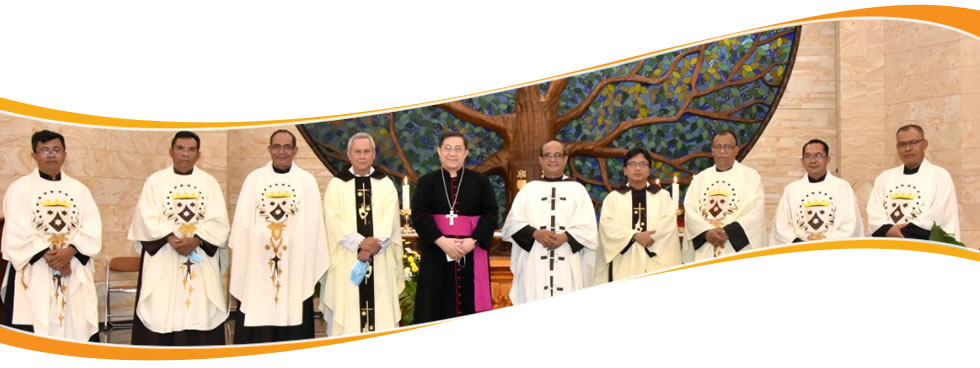
During the Provincial Chapter of the Province of Indonesia held on 27 July-1 August 2015 were elected:
- Prior Provincial: Fr. Ignasius Budiono, O.Carm.
- Vice Prior Provincial: Fr. F.X. Hariawan Adji, O.Carm.
- First Councilor: Fr. Albertus Djono Moi, O.Carm.
- Second Councilor: Fr. Michael Moelja Hartomo, O.Carm.
- Third Councilor: Fr. Heribertus Supriyadi, O.Carm.
- Fourth Councilor: Fr. Albertus Medyanto, O.Carm.


