


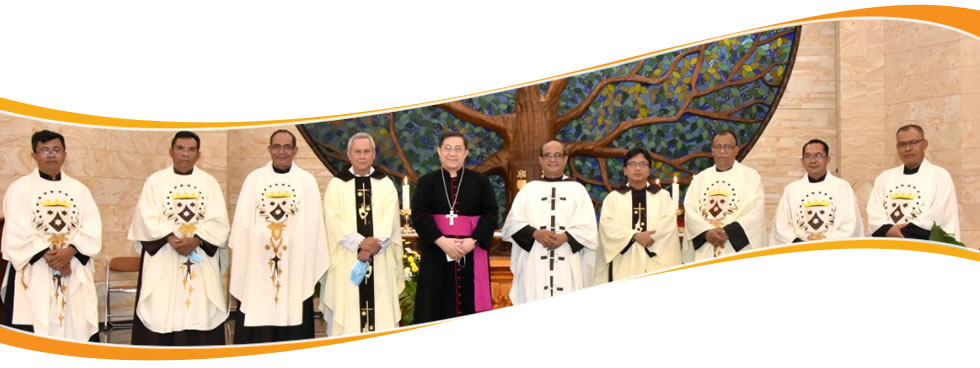






The Carmelite Formators from Burkina Faso, Cameroon, DR Congo, Kenya, Mozambique, Tanzania and Zimbabwe met at the Mutare Diocesan Pastoral Training Centre, Zimbabwe from 21-29 July 2018 for a conference under the theme: Vision of African Carmel - Experiences, challenges and responses - towards establishing a vibrant Carmel in Africa. The meeting was organised by the General Councilor for Africa, Fr. Conrad Mutizamhepo, O.Carm. and the Key speakers were drawn from different Congregations.
A statement agreed upon by the participating formators underlines the importance of joint formation programmes, exchange programmes between students within African countries, be they Philosophy or Theology students and that formators may be assisted and surrounded in formation communities by brothers who have a vital interest in the ministry of formation. They also recommend that formators themselves receive formation.
The formators are deeply grateful for this opportunity and for the vision, concerns and resources allocated them, which show that formation is a central concern for African Carmel, and indeed, of the entire Order.
On this past 2 August, a commemorative ceremony took place in the concentration camp of Dachau, Germany, to honor the ten Carmelites buried there, among whom were Titus Brandsma and Hilary Januszewski, beatified in 1985 and 1999 respectively.
This ceremony concluded the international course of formation for Carmelite students which took place in Holland and Germany, and which Citoc-online will presently describe. The celebration began with a welcome by the prioress of the Discalced Carmelite nuns of Dachau, called the Carmel of the Precious Blood (“Karmel Heilig Blut”). She illustrated for the participants the history and the motive of the nuns’ presence in such a place: reparation and prayer for reconciliation and peace.
The Carmelites present were then led in procession to the Memorial of the camp, where the Prior General, Fernando Millan Romeral, O.Carm., unveiled a stone which recalls the ten Carmelites, eight Poles and two Dutchmen, who had been in this place of suffering and oppression. There, they had the opportunity to greet the director of the Dachau memorial, Doctor Gabriele Hammermann.
Afterward, the participants experienced a touching moment of common prayer at “Barracks 26” (where most of the Carmelite prisoners lived), and then celebrated the Eucharist in the chapel of our Discalced Carmelite Sisters, who hosted this large group of young Carmelites with great joy and fraternity. In the name of the preparatory commission, Father Benny Phang Khong Wing, O.Carm., General Councilor for Formation thanked the sisters for their presence in the camp, and for their incisive witness.

The Prior General concluded the celebration asking that “the witness of Blessed Titus Brandsma and Blessed Hilary Januszewski would help the Carmelites of the Twenty-first century to be men and women of reconciliation and signs of God’s love for every human being.”
This last July 19, the Ambassador of the Netherlands to the Holy See, His Royal Highness Prince Jaime Bernardo of Bourbon-Parma, accepted the invitation of the Prior General Fr. Fernando Millán Romeral, O.Carm., and paid a visit to our Curia in Rome. The Ambassador was welcomed by the prior of the community, Fr. Christian Körner, O.Carm. He was interested in the process of canonization of Blessed Titus Brandsma, and in different topics about the Order and its presence in various parts of the world. After dinner, together with the community members present in Rome, the Prior General gifted the Ambassador with a selection of books on Blessed Titus Brandsma, and with the Carmelite Monasticon of the Netherlands. The whole encounter took place in a delightful and relaxed atmosphere.
Flos Carmeli, vitis florigera,
splendor caeli, Virgo puerpera singularis.
Mater mitis, sed viri nescia,
Carmelitis esto propitia,
stella maris.
IN SOLLEMNITATE B.V. MARIAE DE MONTE CARMELO
Fernando Prior Generalis
Domusque Generalis Communitas
16. VII. 2018
Image: Madonna del Carmine, Curia Generalizia, Roma, Italia
From June 29 to July 2, 2018, the 24th Assemby of the Carmelite Family of the Iberian Region took place in Tarrassa. It was prepared and coordinated by the Carmelite Province of Catalonia. The theme for reflection was: "Carmel is committed to the care of our common home."
The lectures were given by: Eduardo Agosta, a Carmelite religious from Argentina, who addressed the theme: "The Genesis of Laudato SI" (how we got to this work, why this topic, the global crisis and its structure). With scientific data Eduardo made us reflect on the urgent importance of taking care of our mother earth. José Luis Gutiérrez, a lay Carmelite from Madrid, in his lecture entitled, "Conversion in the midst of the people", encouraged us to take a stand in caring for our common home through with daily gestures that are within reach. Pedagogically and dynamically he made us see the importance of opening ourselves to an authentic conversion, individually and in communally, to be protectors of God's work. Llorenç Puig, SJ, spoke about approaches to Laudato SI from the faith, from three points of view: rupture, eschatological and just. Later he coordinated group work to answer some questions about the motivations that act as resistance to achieving an integral ecology in each of our environments.
The environment of fraternity and communication was evident to all. The celebrations of the Eucharist were led by Fathers, Paco Daza (Bêtica Provincial, Luis Maza (Catolonia Provincial) and the last day by Fr. Desiderio García (ACV Provincial).
The meeting closed in a spirit of joyful renewal, for having experienced Carmelite fraternity and always with the commitment to put into practice all that was offered to us at this meeting, thereby, to make our common home, our Mother Earth, more habitable.
Pope's Prayer Intentions for July 2018
Evangelization: Priests and their Pastoral Ministry
That priests, who experience fatigue and loneliness in their pastoral work, may find help and comfort in their intimacy with the Lord and in their friendship with their brother priests.
Lectio Divina: July - Julio - Luglio 2018
|
|
|
|
ENGLISH | |||
ESPAÑOL | |||
ITALIANO |
 IPAD-IPHONE
 KINDLE
 PDF
PDF
- Sunday, July 1, 2018
- Monday, July 2, 2018
- Tuesday, July 3, 2018
- Wednesday, July 4, 2018
- Thursday, July 5, 2018
- Friday, July 6, 2018
- Saturday, July 7, 2018
- Sunday, July 8, 2018
- Monday, July 9, 2018
- Tuesday, July 10, 2018
- Wednesday, July 11, 2018
- Thursday, July 12, 2018
- Friday, July 13, 2018
- Saturday, July 14, 2018
- Sunday, July 15, 2018
- Monday, July 16, 2018
- Tuesday, July 17, 2018
- Wednesday, July 18, 2018
- Thursday, July 19, 2018
- Friday, July 20, 2018
- Saturday, July 21, 2018
- Sunday, July 22, 2018
- Monday, July 23, 2018
- Tuesday, July 24, 2018
- Wednesday, July 25, 2018
- Thursday, July 26, 2018
- Friday, July 27, 2018
- Saturday, July 28, 2018
- Sunday, July 29, 2018
- Monday, July 30, 2018
- Tuesday, July 31, 2018
The Elective Chapter of the Carmelite Monastery of Mayagüez, Puerto Rico, was held 21 June 2018. The following were elected:
- Prioress: Sr. M. Lourdes M. de Jesús Crucificado Avilés Calderón, O.Carm.
- 1st Councilor: Sr. M. Antonia de Jesús Sacramentado Acevedo Lorenzo, O.Carm.
- 2nd Councilor: Sr. M. de la Trinidad Rodríguez Barbosa, O.Carm.
- Director of Novices: Sr. Monserrate M. del Corazón Crucificado de Jesús Lugo Millán, O.Carm.
- Treasurer: Sr. M. de la Trinidad Rodríguez Barbosa, O.Carm.
- Sacristan: Sr. Monserrate M. del Corazón Crucificado de Jesús Lugo Millán, O.Carm.
During the Provincial Chapter of the American Province of Saint Elias held on 19-22 June 2018 were elected:
- Prior Provincial: Fr. Mario Esposito, O.Carm.
- First Councilor: Fr. Paul Denault, O.Carm.
- Second Councilor: Fr. Joseph Nguyen Do, O.Carm.
- Third Councilor: Fr. Mark C. Zittle, O.Carm.
- Fourth Councilor: Fr. Francis Amodio, O.Carm.
More...
The Elective Chapter of the Carmelite Monastery of Caudete, Spain, was held 14-15 June 2018. The following were elected:
- Prioress: Sr. Josefina Marco Navarro, O.Carm.
- 1st Councilor: Sr. Estela Santos Torres, O.Carm.
- 2nd Councilor: Sr. Cristina Conejero Rodríguez, O.Carm.
- Director of Novices: Sr. Estela Santos Torres, O.Carm.
- Treasurer: Sr. Estela Santos Torres, O.Carm.
- Sacristan: Sr. Cristina Conejero Rodríguez, O.Carm.
During the Provincial Chapter of the Irish Province held on 10-14 June 2018 following earlier elections were confirmed:
- Prior Provincial: Fr. Richard Byrne, O.Carm.
- First Councilor: Fr. Brian McKay, O.Carm.
- Second Councilor: Fr. Éanna Ó hÓbáin, O.Carm.
- Third Councilor: Fr. Simon Nolan, O.Carm.
- Fourth Councilor: Fr. David Twohig, O.Carm.
- Commissary Provincial of Zimbabwe: Fr. Vitalis Tendai Benza, O.Carm.
During the Provincial Chapter of the Italian Province held on 4-9 June 2018 were elected:
- Prior Provincial: Fr. Roberto Toni, O.Carm.
- Vice Prior Provincial: Fr. Lucio Maria Zappatore, O.Carm.
- First Councilor: Fr. Nicola Sozzi, O.Carm.
- Second Councilor: Fr. Giuseppe Midili, O.Carm.
- Third Councilor: Fr. Carlos Rivera Rodríguez, O.Carm.
- Fourth Councilor: Fr. Augustin Barbut, O.Carm.
Last June 1st, the biannual meeting of our General Council with that of our Discalced brothers took place in our Curia in Rome. After praying Midday Prayer, the Prior General, Fr. Fernando Millán Romeral, O.Carm., welcomed the members of the OCD General Council and presented the program of this meeting that follows the meetings that have been taking place regularly for more than 25 years.
To begin, the theme of the triennial meeting of both councils that will take place in Dublin (Ireland) from May 27 to 31, 2019, was set: "The missionary journey of Carmel today". In view of that, a small committee was formed by Fr. John Keating, O.Carm. and Fr. Daniel Chowning, OCD., to have responsibility for preparing the meeting.
Both councils were informed of the preparations for the "Carmelite Day" that will be celebrated on January 28, 2019 within the framework of the World Youth Day that will take place in Panama. The Discalced Carmelites from the Province of Central America and the Carmelites from El Salvador are collaborating for this day.
Likewise, the program for the 5th meeting of ALACAR (Latin American Association of Carmelites) that will take place in Santo Domingo next autumn was presented. The theme of this meeting will be, "The martyrs of yesterday for the Latin American Carmel of today" and it will look at such figures as Oscar Romero, Tito Brandsma and Edith Stein.
The General Superior, Father Saverio Cannistrà, OCD, reported on some questions concerning "Cor Orans" (the recent application instruction on female contemplative life, from the CIVCSVA ). An interesting dialogue and a wide-ranging exchange of ideas were generated around the subject.
Next, the latest information sent by Bro. Fausto Spinelli, OCD, president of the joint international commission, on the steps that are being taken with the municipality of Haifa and the corresponding government authorities of Israel for the restoration and maintenance of the ruins of the first Carmelite monastery in the Wadi es-Siah on Mount Carmel, were shared.
Finally, the two councils exchanged various items of information regarding upcoming events in both orders. The meeting, which took place in an atmosphere of great fraternity and joy, ended with the community meal.


