








O.Carm
Vitam Coelo Reddiderunt

|
08-10-24 |
|
|
|
|
|
30-09-24 |
|
|
|
|
Wahpeton Carmelite Nuns and Friends Celebrate 70 Years

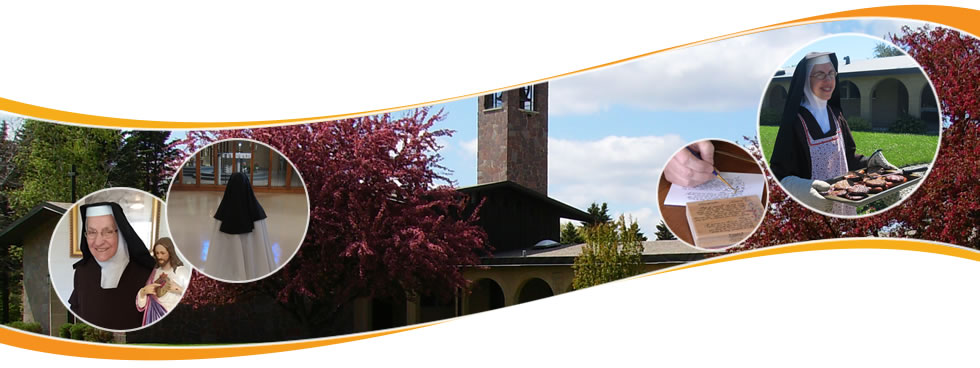
On Wednesday, November 6, 2024, the community of Carmelite nuns in Wahpeton, North Dakota and their friends and benefactors gathered to celebrate the 70th anniversary of the founding of their Carmel of Mary monastery. The actual date of the foundation is November 1—the Feast of All Saints. Among those attending were a number of Lay Carmelites as well as school children who lectured, sang, and served at the altar.
The celebration took place at St. John’s Church in Wahpeton with Bishop John T. Folda of the Diocese of Fargo celebrating. The church was full with over 150 adults and 80 students from the parish school attending. Cake and ice cream were served afterwards. During the reception, the sisters sang a newly composed hymn for their 70th anniversary invoking Mary as the Flower of Carmel, Sweet Prairie Rose, Resplendent Virgin and Hope of All Carmelites.
In his homily, Bishop Folda spoke about the original 7 founding sisters—courageous pioneers he called them—and their willingness to leave their monastery in Allentown, Pennsylvania to start something new in the wilds of North Dakota. He also spoke of the many blessings the diocese and State of North Dakota have received through the prayers of the sisters. He said, “The sisters pray not only for us but with us, lifting our needs to God.”
He also spoke about the community, “continually living a life of prayer and intercessions, being a sign of God’s presence among us, because they live in the presence of God, and inspire others to do so.” He expressed great gratitude for the presence of the Carmelites in the diocese.
In 1953, Archbishop (later Cardinal) Aloisius Muench and Bishop Leo Dworschak, the auxiliary bishop, desired to have a special tribute to Our Blessed Mother for the forthcoming Marian Year of 1954. The answer came "out of the blue!”
Patrick Flood, a professor at Seton Hall University in New Jersey, knew that the Carmelite Nuns in Allentown, Pennsylvania were searching for a suitable place to make a new foundation. He received an appeal for the Indian Missions in North Dakota and decided to pursue the possibility.
Flood wrote to the bishops and asked if they would be interested in having a Carmelite Monastery in their diocese. With great delight they saw God's providential answer to their desire for a fitting tribute to Our Lady. A flurry of communications went between the bishops and the Carmelite superiors in Allentown. Permission for the foundation were granted by the Holy See at the canonization of Pope Pius X in May 1954.
On October 31, 1954, seven nuns, with Mother Mary Rose as prioress, set out for North Dakota. On November 1, Bishop Dworschak offered the first Mass for the Community in the old St. Francis Hospital owned by the Franciscan Sisters of Little Falls, MN. The Carmel of Mary was founded in Mary’s honor in her Marian Year.
The bishops also desired to have a public Marian shrine on the grounds in front of the monastery. Pilgrimages to the Shrine of Our Lady of the Prairies began in 1957 and have continued every August since then.
As candidates arrived, we outgrew the temporary monastery. Construction of the new monastery begin on land 6.5 miles (10.46 km) northwest of Wahpeton. The nuns moved in on October 24, 1964.
As part of the anniversary year celebrations although not driven by the anniversary, the nuns are building an infirmary wing so that the other sisters can be taken care of at home. Sr. Madonna said, “We had need for an infirmary wing in mind before the anniversary celebration but the two events coincided perfectly.”
Closing out the celebration, the prioress, Mother Madonna of the Assumption Morales, wrote, “We are so deeply grateful to all our friends and benefactors who have "journeyed" with us by your bountiful support in every possible way. God bless you, each and everyone! You are daily in our grateful prayers.”
Guests received a poppyseed loaf cake and biscotti baked with love the Carmelite Hermits in Christoval, Texas and tied with a gold bow. They also received a Carmel of Mary booklet and the children received a little nun carved out of wood.
(Pictures courtesy of the Carmel of Mary Carmelite Monastery and William J. Harry, O. Carm.)
St. Elizabeth of the Trinity (OCD), Virgin

8 November | Optional Memorial
O my God, Trinity whom I adore, help me to become completely self-concerned, to fix myself in You, motionless and tranquil, as if my soul were already in eternity. Let nothing disturb my peace or make me leave You, O my Immutable One, but let each moment plunge me more and more into the depths of Your mystery.
Pacify my soul, make it Your heaven, Your beloved dwelling place, Your resting place. May I never leave you alone, but be there all, wholly awakened in my faith, all in adoration, fully surrendered to your creative action.
O my beloved Christ, crucified for love, I would like to be a bride for your Heart, I would like to cover you with glory, I would like to love you to the point of dying. But I feel my helplessness and ask you to “clothe me with you,” to identify my soul with all the movements of your soul, to submerge me, to invade me, to substitute yourself for me, so that my life may be but an irradiation of your life. Come into me as Worshipper, as Repairer and as Savior.
O Eternal Word, Word of my God, I want to spend my life listening to You, I want to make myself perfectly docile to learn everything from You. Then, through all the nights, all the voids, all the helplessness, I always want to stare at You and remain under Your great light. O my beloved Star, fascinate me so that I may never again leave Your irradiation.
Consuming fire, Spirit of love, “descend in me,” that it may be made in my soul as an in-carnation of the Word and I may be to Him an added humanity in which He renews all His Mystery.
And you, O Father, bend over your poor little creature, “cover her with your shadow,” and see in her only “the Beloved in whom you have placed all your complacencies.”
O my Three, my all, my bliss, in-finite solitude, immensity in which I lose myself, abandon myself to You like a prey. Bury Yourself in me that I may bury myself in You, waiting to come and contemplate in Your light the abyss of Your greatness.
To read more on the life of St. Elizabeth of the Trinity ...
Blessed Francis Palau y Quer, (OCD), Priest

7 November Optional Memorial in the Provinces of Spain
In his providence God has disposed that our evils should not be remedied and that his graces should not be granted to us except through prayer, and that through the prayer of some others should be saved (cf. Jas 5:16 ff). If the heavens dripped from on high and the clouds made the righteous rain, if the earth opened and the Savior sprang forth (cf. Is 45:8), God willed that the cries and supplications of the holy Fathers and especially of that singular Virgin who persuaded the heavens by the fragrance of her virtues and drew the uncreated Word into her bosom should precede his coming. The Redeemer came and through continuous prayer reconciled the world to his Father. For the prayer of Jesus Christ and the fruits of his redemption to be applied to some nation or people, for there to be those who enlighten them with the preaching of the Gospel and administer the sacraments to them, it is indispensable that there be someone or many who by groanings and supplications, by prayers and sacrifices have won over that people and reconciled them with God.
To this, among other ends, aim the sacrifices we offer on our altars. The holy host that we present on them daily to the Father, accompanied by our supplications, has not only the purpose of renewing the memory of the life, passion and death of Jesus Christ, but also of obliging through it the God of goodness so that he may deign to apply the redemption of his Son to the nation, province, city, village, or to that or those people for whom holy Mass is celebrated. It is precisely in it that the redemption, that is, the conversion of the nations, is dealt with the Father. Before the redemption was applied to the world or, which is the same, before the banner of the Cross was raised among the nations, the Father arranged for his Only Begotten, made flesh, to deal with it by means of “continual supplications, with loud cries and with tears” (Heb. 5:7), by anguish of death and by the shedding of all his blood, especially on the altar of the Cross, which he raises on the summit of Calvary.
In order to grant his grace even to those who neither ask for it nor can ask for it, or do not want it, God arranged and commanded, “Pray for one another, that you may be saved” (Jas. 5:16 ff). If God granted the grace of conversion to St. Augustine, it is due to the tears of St. Monica; and the Church would not have St. Paul, says a holy Father, if it were not for the prayer of St. Stephen. And it is worthy of mention here that the Apostles, sent out to preach and teach all nations, recognize that the fruit of their preaching was rather the effect of prayer than of their words, when in electing the seven deacons to be in charge of the external works of charity they say, “We will devote ourselves continually to prayer and to the ministry of the word” (Acts 6:4). Note well: they say that they will devote themselves first to prayer and only later to the ministry of the word, because they undoubtedly never went to convert a people before they obtained their conversion in prayer.
Jesus Christ spent his whole life in prayer and preached only three years.
Just as God does not dispense his graces to men except through prayer, because he wants us to acknowledge him as the source from which all good comes, neither does he want to save us from dangers nor heal sores nor console us in afflictions except through prayer itself.
To read more on the life of Blessed Francesco Palau, OCD ...
Celebrating At Home - 32nd Sunday in Ordinary Time

The Way of Generous Service
(Mark 12:38-44)
Our readings this weekend should shape our response to those in need. It is two widows who show us the way to live according to the mind and heart of God.
The first reading tells of a poor widow’s generosity to Elijah the prophet. Even though she was down to her very last portion of food, which she was saving for her son and herself, she was prepared to share it with Elijah. Her reward was a never-ending supply of flour and oil.
The same generosity is shown by the widow (but not by the scribes) in the Gospel. Her dedication and generosity in the midst of her poverty was a real sacrifice.
The widow is a contrast to the wealthy scribes who parade around in long robes and make a show of lengthy prayers. Jesus condemns them for their insincerity, their use of religious show to enhance their status and their unjust exploitation of widows.
Jesus does not want his disciples imitating the showy religiosity of the corrupt scribes, but rather the sincerity and generosity of the widow who gave ‘her all’ just as Jesus will shortly give ‘his all’ on the Cross. It is a reinforcement of the messages about ‘coming to serve, not to be served’ which have dominated the last four weeks of readings.
The way of Jesus is not about show, but about sincere dedication and generosity in our service of God and one another. Remember the contrasting stories about James and John and Bartimaeus over the last couple of weeks.
Following Christ is not about giving the ‘left overs’ but giving everything. The two widows gave all they had to live on. Jesus will give his life for our salvation.
It is the kind of dedication and selfless generosity we see in people who put their own lives at risk while attempting to rescue others from disaster. Disciples are called to give all in their following of Jesus and in their generous service of others.
- pdf Celebrating At Home - 32nd Sunday in Ordinary Time [PDF](3.10 MB)
- default Celebrating At Home - 32nd Sunday in Ordinary Time [ePub](4.51 MB)
- pdf Celebrando en Familia - XXXII Domingo del Tiempo Ordinario(282 KB)
- pdf Celebrando in Casa - XXXII Domenica del Tempo Ordinario(284 KB)
- pdf Celebrando em família - XXXII Domingo do Tempo Comum(268 KB)
Nuno As A Carmelite

St. Nuno Álvares maintained an almost childlike in his devotion to God and his strict code of morality, even for the soldiers in his army. He attributed his stunning victories to Mary’s intercession on his behalf. Although the “Holy Constable” was one of the most powerful men in the kingdom, he used his wealth and influence to promote religious devotion, and to build many churches as signs of his gratitude. Perhaps the most spectacular of his churches was the imposing Carmo in Lisbon, which he entrusted to the care of the Carmelites. He provided built a large house to house the religious. At that time, there was only a single Carmelite house in Portugal, at Moura. The new house and church were lavishly endowed by the Constable, who also insisted on regular prayer and strict observance of the Rule.
While the ruins of the Carmo church in Lisbon stand today as just a shell following the Lisbon earthquake of 1755, the house he built for the Carmelites next to the church remained intact. In fact, St. Nuno would enter the Order and live as a brother in this house following his retirement from military duty. Today, the building, known as the Carmo Barrack, serves as the headquarters of the National Republican Guard (GNR) although it retains a few of the features that were present in the time of St. Nuno.
On the ground floor a “cell” contains a few objects from the life of St. Nuno. A plaque near the door of the cell reads “This is the location of the cell where the Constable died on November 1, 1431.” On the bed is his habit. On one wall hangs two objects of popular mortification: a discipline, an instrument for self-flagellation and a metal chain cilice with inwardly-pointing tines.
Other objects include a flag decorated a large Cross and images of St. George, St. Thiago, St. John and of Mary, one with the Child Jesus. There is also a large trunk and a small statue of the Saint standing on an old altar decorated with a large Cross in a style favored by St. Nuno.
St. Nuno Álvares Pereira's tomb was lost in the famous 1755 Lisbon earthquake. His epitaph read:
"Here lies that famous Nuno, the Constable, founder of the House of Bragança, excellent general, blessed monk, who during his life on earth so ardently desired the Kingdom of Heaven that after his death, he merited the eternal company of the Saints. His worldly honors were countless, but he turned his back on them. He was a great Prince, but he made himself a humble monk. He founded, built and endowed this church in which his body rests."
540 Years of Carmelite presence at Traspontina
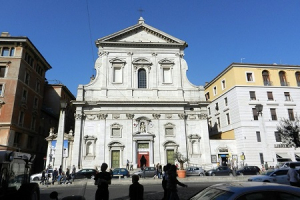
540th Anniversary of the Entrustment of the Parish S. Maria in Traspontina to the Carmelites
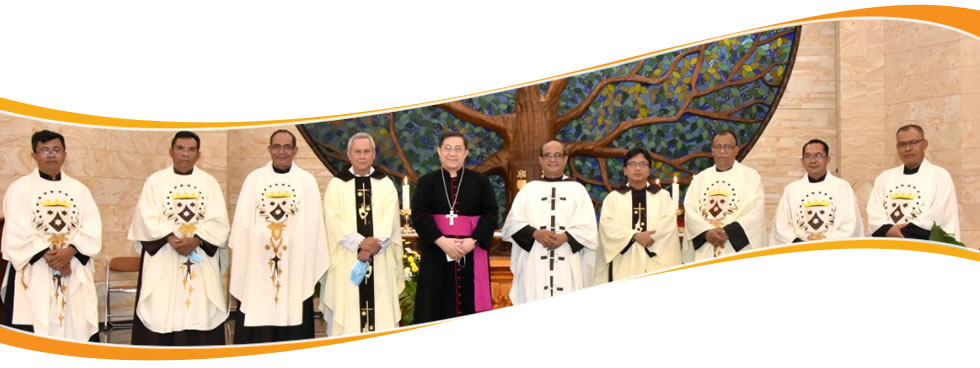
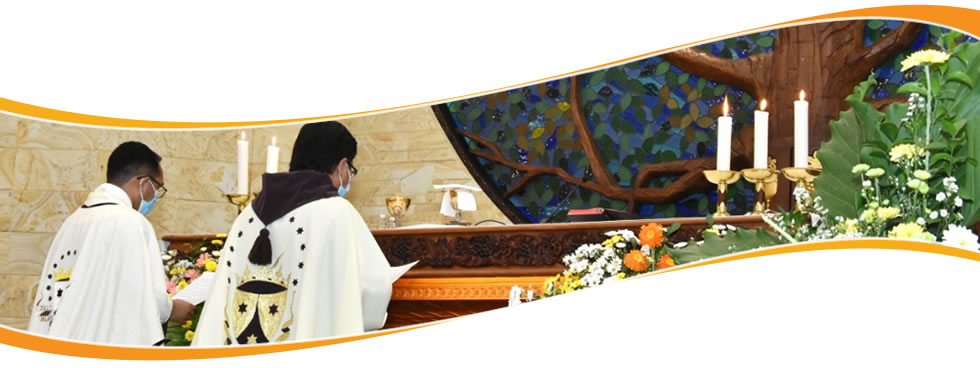
On Friday, November 15, the Carmelites will be celebrating the 540th anniversary of presence at S. Maria in Traspontina. Pope Innocent VIII gave responsibility for the church to the Carmelites in the bull Sacrosanctae et militantis Ecclesiae.
The founding of the church has been documented back to 772 under the papacy of Adrian I. It was always dedicated to Mary, the Mother of Jesus. The church building was located very close to Castel San Angelo when the Carmelites took possession during the papacy of Innocent VIII in 1484. The intent was to move closer to the Vatican where they popes had decided to maintain their permanent residence after the Council of Constance which ended the Western Schism (1378-1418). Plans to expand the defenses of Castel San Angelo with a ring of ramparts forced the destruction of the old church and the need for the Carmelites to build a new one. The prior general at the time, Nicolas Audet (1523-1562) insisted the Order remain close to the Vatican. The Carmelites were eventually allowed to move even closer to the Vatican, to the current location, with the foundation stone put in place by Giovanni Rossi (1562-1578).
For the celebration on November 15, the schedule is:
6 pm: Rosary
6:30 pm: Mass and prayer of suffrage for all deceased Carmelites in the community
7:15 pm: Organ concert, Gratias agimus tibi, given by Jordi-Agustí Piqué i Collado, OSB, a professor of Theology, Liturgy, and Music at the Pontifical Ateneo Saint’Anselmo in Rome.
8 p.m.: Aperitif in the parish hall.
Concelebrants are requested to bring white surplice and stole with them.
The website of the parish is: www.parrocchiatraspontina.it
(Photos courtesty of parish website and William J. Harry, O. Carm.)
Saving the Maltese Carmelite Library

Alfred Mizzi Foundation and Notarial Archives Foundation Join to Save Maltese Carmelite Library
In February 2022, a powerful storm hit the country of Malta. Small islands situated in the Mediterranean Sea, the country endured showers of hail and rain as well as winds at the beginning of the month. The historic Carmelite library in the Carmelite prior in Valletta, suffered severe damage. Besides numerous manuscripts and books being heavily damages, the wooden structure of the library itself was heavily damaged as well.
According to published reports, the Alfred Mizzi Foundation and the Notarial Archives Foundation have joined efforts to save the library. Since February 2024, the NAF and its team of volunteers have been carefully removing the books and manuscripts from the shelves of the library. This will allow the wooden library structure to undergo the necessary restoration as well as the books.
Warranted wood conservator Josef Aquilina has been entrusted with this job. While emptying the shelves, NAF volunteers are also superficially dusting the books and making an inventory. The books are then placed in archival boxes and temporarily stored in a different area of the priory. Besides the water damage, many of the books suffer from biological and chemical damage accumulated over the years. The conservation of the books is being done under the supervision of the NAF's warranted book and paper conservators Chanelle Mifsud Briffa and Maria Borg.
Carmelite Alex Scerri, the prior of Valletta, contacted the Dean of History from the University of Malta to seek help. The NAF got involved and with their help and the volunteers, the Mizzi Foundation became involved.
The Alfred Mizzi Foundation has committed to sponsoring the preliminary works and surveys for the conservation of the wooden library structure. This will guarantee that the structure is professionally reconstructed to last for many years.
The monastery in Valletta and its library houses many items of interest. The majority of the books deal with either theology or philosophy. But there are also works on Carmelitana and Melitensia which are of particular interest because they go back to the period of the Knights of Malta in the 15th century. The holdings include 7 incunabula, books using metal type and created before the printing press was invented. They differ from manuscripts, which are documents written by hand. The oldest of these incunabula in the Carmelite library in Valetta dates from 1471.
Fr. Alex spoke about the task ahead. “Quotes are still being studied by the architect, but the cost will be thousands of Euro. The plans are to restore the main roof of the bibliotheca which has to be built again as well as the furniture. So the cost of the project will be very large.”
The Carmelite Order arrived in Malta in 1418. The Carmelites agreed to serve at a chapel and minister to the people in the area around Lunzjata (Rabat). The church and convent in Valletta were founded in 1570.
Valletta’s Shrine of Our Lady of Mount Carmel underwent various transformations over the centuries. Damaged during the Second world War, it was rebuilt from 1958 to 1981 providing a new skyline for the city with its striking dome. It is now a UNESCO World Heritage Site.
Fr Alex expressed his thanks to the Notarial Archives Foundation, The Alfred Mizzi Foundation, and the volunteers for their hard work and dedication in preserving the historic library and the patrimony of the Carmelite library. “The community and I are very grateful to all the volunteers who make the sacrifice to come each week to remove the books and make sure they are properly cared for. We are also grateful to everyone who has taken an interest in this major project so that our Carmelite heritage in Malta and especially in Valletta, dating back to 1570, will be restored and preserved for future generations.”
The Alfred Mizzi Foundation funds projects related to Maltese culture, its heritage, education, the environment and social solidarity. It promotes and assists the presentation and development and the public manifestation of Maltese heritage, including culture and the environment. The Notarial Archives Foundation is a non-governmental voluntary organization which seeks to preserve and raise awareness of the 600-year-old collection of notarial deeds of the Notarial Registers Archive. Since these records document the history of Malta, their availability to future generations is of paramount importance.
(Pictures courtesy of the Valletta Priory)
Exhortations of Bl. Frances of Amboise to the Nuns

November 5 | Optional Memorial
Temptation Stimulates Virtue
From the Exhortations of Blessed Frances of Amboise to the Nuns
Whatever sorrow or discomfort you have in your hearts, bear it as patiently as you can, and think of it as your cross. Help our Lord and bear it with him, willingly, good-humoredly, for you must always bear the cross, and if you reject one, you may find another heavier one. With faith and hope in God's help, temptation is overcome. We must not lose heart and stop on our way, but always take courage. Think of the pains and great temptations that the holy fathers had to endure in the desert. The pains they suffered in the spirit, were without comparison much harder than the penances and austerities they imposed on their bodies. He who is not tempted acquires no virtue. So accept what pleases God, who never sends suffering that is not for our good. He says in the Gospel: Whoever wants to come after me, begin to deny himself, that is, to forget himself, to have no self-esteem, to despise himself and to desire to be despised by others. Our Lord says we must take up the cross in order to follow him, that is, accept penance and torments for his sake, as he bore the cross for our sake.
But I recommend, do not carry it as Simon of Cyrene did! To our Lord, exhausted from the beatings and torments he had endured, the Jews, fearing that he would die before reaching the place where he was to be crucified, took down the cross and loaded it on Simon. Simon took it reluctantly and although he carried it, he did not die on it like our Lord, who carried it of his own choice and willingly, and died there rendering his soul to God his Father.
Do as he did, following his example. You have the cross of penance; bear it willingly to the end: in it you will die and render your souls to him. Praise and thank God for calling you to his service. Despise no one. Think that God's command is that you love your neighbor as yourself and all your [brothers and sisters], even those who do or want to harm you.
Above all, have charity for one another and concern yourselves about overcoming your passions. Take one remedy today and another tomorrow. Thus you will gradually come to overcome your temptations, and when our Lord sees your good will and perseverance, He will give you His grace and help you to carry the burdens of religious life to the end. Nothing will be difficult for you to bear for His sake.
(Carmelus,11 [1964] 254-255)
Bl. Frances d’Amboise, Religious

5 November Optional Memorial
Bl. Frances D'Amboise was born in 1427, probably at Thouars, France. At fifteen years of age, she was married to Peter II, Duke of Brittany and crowned with him in the cathedral at Rennes in 1450. She was widowed in 1457 and, not wanting a second marriage, she turned towards religious life. For this purpose, she built a Carmel for sisters at Bondon in 1463 following the advice of Blessed John Soreth, Prior General of the Carmelites.


