








O.Carm
Invitation to the II Biennial Congress of the Brandsma Circle

Invitation to the Second Biennial Congress of the Titus Brandsma Circle
Rome, November 27-29, 2025
Registration is open for participants of the next congress of the Titus Brandsma circle. Please register via our website: https://titusbrandsmacircle.org
Please find the program here. It is also available on our website:
https://titusbrandsmacircle.org/program-congress-2025/
The fee for the conference, your stay in Instituto Maria SS. Bambina, the meals which are mentioned in the program, the tours, including transfer and entrance, coffee and tea comes to € 590 / US$ 670 for members of the Titus Brandsma Circle who paid their contribution this year and € 640 / US$ 727 for those who are not members or who did not pay their contribution.
Please transfer your conference fee to the following bank account:
Istituto per le Opere di Religione, Cortile Sisto V – 00120 – Città del Vaticano, giving TITUS BRANDSMA CIRCLE, account number 12918060, IBAN: VA62001000000012918060, BIC: IOPRVAVX or IOPRVAVXXXX.
Please transfer half of the full amount, that is € 295.00 / € 320.00 by the middle of June at the latest. The other half of the full amount can be transferred at the end of September.
The membership fee for the Titus Brandsma circle is €50.00 or US$50.00 for Europe and North America. The fee for members in Asia, Africa, and South America is €40.00. There is a €10 or US$10 discount for members of the Order.
Titus Brandsma Congress November 27-29, 2025
Via Paolo VI, 21,
Zona Extraterritoriale Citta` Del Vaticano
Phone: 0039/0669893511
Email: Questo indirizzo email è protetto dagli spambots. È necessario abilitare JavaScript per vederlo.
Arrival registration: November 26, 14:00 to 22:30
Opening hours: 6:00 a.m. to midnight
Lunch: 13:00
Dinner (only on November 29): 20:00
Giovanni Grosso
Giovanna Brizi
Michael Plattig
Secretary: Elisabeth Hense (Questo indirizzo email è protetto dagli spambots. È necessario abilitare JavaScript per vederlo.)
Program
November 27, 2025 (Chair Giovanni Grosso)
8.30 – Morning Prayer (Januarius Elijah Mutinda)
9.15 – Lectures. (20 minutes each, discussion in between) – Sala Luciani
- Word of Welcome (Fernando Millán Romeral)
- Titus Brandsma and the Liberating Power of Truth in John 8:32 (Lester Hallig)
- Titus Brandsma, the Resistance Fighter (Anne-Marie Bos)
- Journalists Ask for an Additional Patron Saint (Emmanuel van Lierde)
11.00 – Coffee / Tea
11.30 – Lectures. (20 minutes each, discussion in between)
- Titus Brandsma and Animal Protection (Michael Plattig)
- A Contemplative Prophetic Brotherhood in the Midst of the People: Titus Brandsma and the Elian Prophetic Dimension of the Carmelite Charism (Francis Lefani Mwanza)
- Mysticism and the Everyday: Titus Brandsma and the Search for God in the Contemporary World (Bruno Schröder – online)
13.00 – Lunch
14.00 – Free Time
16.00 – Coffee / Tea at CISA (Centro Internationale San Alberto)
16.30 – Tour through the Archive and the Library (Giovanna Brizi / Giovanni Grosso)
18.00 – Free Time
November 28, 2025 (chair Michael Plattig)
8.30 – Morning Prayer (Januarius Elijah Mutinda)
9.30 – Lectures (20 minutes each, discussion in between) – Sala Luciani
- Titus Brandsma and Soreth (Patrick Mullins)
- Titus Brandsma and the Journaal Ons Geestelijk Erf (Rob Faesen)
- What Concept and Image of God for today? Inspiration taken from Titus Brandsma’s Lecture On the Concept of God (Charlo Camilleri)
11.00 – Coffee / Tea
11.30 – Lectures (20 minutes each, in between discussion)
- Titus Brandsma: The Decolonizing Dimension of the Mission of the Dutch Carmelite Order to Malang-Indonesia within the Context of Colonization. (Edison Tinambunam)
- Societal Action Inspired by Titus Brandsma (Rico Ponce)
- A New Bibliography of and about Titus Brandsma (Henk Rutten – online)
13.00 – Lunch
15.30 – Coffee and Tea
16.00 – Silvio Maestranzi: Le due croci /The two crosses (introduction to the film Fernando Millan Romeral)
19.00 – Free Time
November 29, 2025 (Chair Fernando Millán Romeral)
8.30 – Morning prayer (Januarius Elijah Mutinda)
9.30 – Lectures (20 minutes each, discussion in between) – Sala Luciani
- Titus Brandsma as a Carmelite Retreat Leader (Sanny Bruijns)
- The Poetry of St Titus Brandsma – An Underappreciated Part of His Oeuvre? (Marcin Polkowski)
- Titus Brandsma and Marian Spirituality in Rome: Santa Maria Antiqua and the Catacombs of Priscilla (Giovanni Grosso)
11.00 – Coffee / Tea
11:30 – Network Titus Brandsma Circle: Report of the Bursar, Elections of the President, Bursar, and Secretary by the Members of the Titus Brandsma Circle, Plans for the Next Congress in 2027 (Christian Körner, Fernando Millán Romeral)
12.30 – Break out groups
13.00 – Lunch
15.00 – Tour of the Catacombs of Priscilla (Giovanni Grosso)
19.00 – Eucharist
20.00 – Dinner at Maria Bambina
Departure from Maria Bambina, Rome on November 30, 2025, no later than 9:30 a.m.
100 Years of the Canonization of St. Thérèse of Lisieux

Normandy Celebrates 100 Years of Sainthood for Its Most Famous Citizen
The Catholic Church and the town of Lisieux celebrated the 100th anniversary of the canonization of St. Thérèse of the Child Jesus and of the Holy Face with three days of solemn celebration on May 16-18, 2025. On May 18, the Basilica of St. Thérèse carried a live broadcast of Pope Leo XIV’s inauguration Mass from St. Peter’s Square in Vatican City on large screens.
The popular French saint, often referred to by devotees as "The Little Flower," was born Thérèse Martin. Following just nine years of religious life in the cloistered Carmelite monastery in Lisieux, she died at the age of 24 of tuberculosis in 1897. She lived with two of her older sisters and eventually her closest sibling in the same monastery.
Following her death, Thérèse became known worldwide through her spiritual memoir, Story of a Soul. She quickly became the object of astonishing devotion. The basilica built in her honor in Lisieux is today the second most visited place of pilgrimage in France after Lourdes. Some 1 million visitors come annually to the basilica. Beatified in 1923, she was canonized in Rome on May 17, 1925, by Pope Pius XI, who proclaimed her patroness of missions in 1927. Pope Pius X called her “the greatest saint of modern times.” One hundred years after her death, in 1997, St. John Paul II declared her a Doctor of the Church.
The celebrations this year involved the entire city. Activities were planned to appeal to everyone, regardless of their age, level of faith or religious practice.
On May 16 in the evening -- a procession carrying the relics of St. Thérèse on a horse-drawn cart traveled through the streets of Lisieux, followed by several hundred people. This is the reliquary which has travelled the world always bringing in large crowds of Thérèse’s devotees. The reliquary spent some time in the Cathedral where the Martin family went to Mass regularly. It was then transferred to the basilica for a vigil of prayer.
The following day, the reliquary was displayed in front of the basilica. Some of her writings were read and the large crowd sung hymns. The Mass included the reading of the homily that Pope Pius XI delivered in Rome during the canonization Mass in 1925.
The rest of the weekend, pilgrims and others participated in activities related to the life and spirituality of St. Thérèse. They were able to make a jubilee pilgrimage and go to confession, but also take part in treasure hunts for children, guided tours of the wax museum, and, in a nod to 21st century intrigues, helped build a large structure out of Lego-style building bricks.
People dressed in late 19th century period costumes, took visitors through places Thérèse lived so they could easily enter into the atmosphere of everyday life in Lisieux in St. Thérèse's time.
The bishop of Diocese of Bayeux and Lisieux, Jacques Habert, commented that there today a fascination for people of various backgrounds with Thérèse. "When I walk across the square in front of the basilica in Lisieux, I am always struck by the number of people who clearly are not used to going to church," he said. "They have heard about Thérèse, are interested in her, and want to come in and light a candle. It is a kind of attraction that is beyond our understanding."
"During World War I, many soldiers, both French and German, testified to their devotion to her and the graces they had received through her intercession," Father Schwab added. "And since then, enthusiasm for her has not waned.
---
Celebrating At Home - Ascension Sunday

Called to be the Living Presence of God (Luke 24:46-53)
The feast of the Ascension commemorates the return of Jesus to the Father. Jesus leaves in body but remains with us through the gift of the Spirit. We will celebrate the gift and presence of the Holy Spirit in next Sunday’s feast of Pentecost.
The true meaning of our feast today is not found in Jesus’ leaving, but in the way he calls his disciples back together, to re-form them as a new community entrusted with the spread of the Gospel. Jesus sends the disciples out to make disciples of all nations and to teach them his way. But the disciples are not left to do all that on their own. Jesus promises that he is with them always.
Jesus has called the ragged, group of disciples, scattered after his crucifixion, back to himself to form them, fragile and doubtful as they are, into a community for mission in the name of God. The task of the historical Jesus is complete; the task of the church as the living Body of Christ has just begun. It is comforting to recognise that Jesus doesn’t insist on perfection before he calls us and entrusts us with his mission.
This mission is authorised by God and passed on to us through Jesus. It is not about authority over others. It is actually a call to act as God would act, true to God’s heart as Jesus has taught us.
Ever since Easter, we have been proclaiming that Jesus is alive. The feasts of the Ascension and Pentecost help us to realise that we are part of a long tradition of faithful disciples. We have our faults and failings, but our call is to witness to and teach the way of Jesus by the kind of people we are, the values and attitudes we hold, in thought, word and action - to be the living presence of God in the world today.
Lectio Divina June, 2025

Opening Prayer
Shaddai, God of the mountain, You who make of our fragile life the rock of your dwelling place, lead our mind
to strike the rock of the desert,
so that water may gush to quench our thirst.
May the poverty of our feelings
cover us as with a mantle in the darkness of the night and may it open our heart to hear the echo of silence until the dawn,
wrapping us with the light of the new morning, may bring us,
with the spent embers of the fire of the shepherds of the Absolute who have kept vigil for us close to the divine Master, the flavor of the holy memory.
St. Mary Magdalene de’ Pazzi, Virgin

25 May Feast
From On Revelation and On Temptation of Saint Mary Magdalene de' Pazzi, virgin
Come, Holy Spirit
You are truly wonderful, O Word, in the Holy Spirit, in causing him to infuse himself into the soul, through which infusion it is united with God, conceives God, tastes God, and delights in nothing but God.
And the Holy Spirit comes into the soul always marked with that precious seal of the Blood of the Word, the Lamb who was slain; indeed, it is the Blood that moves him to come, if he moves of himself and wills to come.
The moving Spirit is in itself the substance of the Father and the substance of the Word; and it departs from the essence of the Father, from the good pleasure of the Word, and comes as a source spreading itself in the soul, and the soul drowns itself in Him. And as two rivers flow forth and unite together in such a way that the smaller one loses its name and takes that of the larger one, so does this divine Spirit who comes to the soul to unite with it. But it is necessary that the soul, which is the smaller one, lose its name and leave it to the Holy Spirit; and it must do this by transforming itself so much in the Spirit that it becomes one with Him.
And this Spirit, dispenser of the treasures that are in the bosom of the Father and treasurer of the counsels that are made between the Father and the Word, is infused into the soul in such a gentle way that it is not understood and, because of its greatness, is esteemed by few.
With its weight and lightness, it moves in all those places that are suitable and prepared to receive it. By its frequent speech and supreme silence, it is heard by all; with an impetuous gaze, immobile and most mobile, it infuses itself into all.
Elective Chapter Held in Villalba del Alcor, Spain

Elective Chapter Held in Villalba del Alcor (Huelva), Spain on May 13, 2025
On May 13, 2025, the Carmelite nuns of the Monastery of St. John the Baptist (San Juan Bautista) in Villalba del Alcor (Huelva) España held their elective chapter.
The monastery was founded in 1619 by the nuns of the Monastery of St. Anne in the city of Seville, under the leadership of Sister Beatrice Tinoro of St. John the Baptist († 1622) and with the support of Saint Franco García Jiménez, her cousin. They were accompanied by several lay women who intended to take the Carmelite habit in the new community. They were highly motivated following the Council of Trent.
From here the monastery of the Most Blessed Sacrament (Monasterio del Smo. Sacramento) in the city of Cañete la Real was founded (1662). The monastery celebrated its 400th anniversary in 2019.
The webpage of the monastery with a large selection of pictures from the 2019 celebrations as well as other information is located at www.carmelitasenvillalba.com
The following were elected to leadership:
Prioress | Priora | Priora:
Sor María del Carmen del Toro Medina
1st Councilor | 1ª Consejera | 1ª Consigliera:
Sor María Pilar Martín Gómez
2nd Councilor | 2ª Consejera | 2ª Consigliera:
Sor María Inés Vázquez Gallardo
3rd Councilor | 3ª Consejera | 3ª Consigliera:
Sor María Consuelo de Jesús Pérez García
4th Councilor | 4ª Consejera | 4ª Consigliera:
Sor Antonia María Díaz Sánchez
Treasurer | Ecónoma | Economa
Sor María Yolanda Romero Talamante
Formator | Formadora | Formatrice
Sor María Pilar Martín Gómez
2000 Journalists Receive Thanks of Pope Leo XIV
June 1, 2025 | Share With Gentleness The Hope that Is In Your Heart
World Day of Communications To Be Celebrated Worldwide. In Rome, 2000 Journalists Receive Thanks of Pope Leo XIV
The 59th World Day of Social Communications, celebrated annually by the Catholic Church, will be held on June 1, 2025, the Sunday before Pentecost. The theme for this year is Share with Gentleness the Hope that is in Your Hearts. It is focused on the idea of "disarm[ing] communication of all prejudice and resentment, fanaticism and even hatred; let us free it from aggression." The message for the upcoming World Comunications Day was released on January 24, 2025, the feast of St. Francis DeSales.
The theme of the message, according to the Press Office of the Holy See, “draws attention to the fact that today too often communication is violent, aimed at striking and not at establishing the conditions for dialogue. It is therefore necessary to disarm communication, to cleanse it of aggression. From television talk shows to verbal wars on social networks, there is a risk that the prevailing paradigm is that of competition, opposition, and the will to dominate."
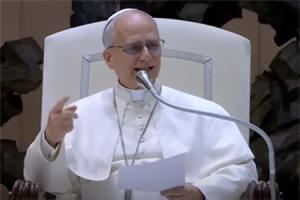
Pope Leo XIV expressed his appreciation for the world press by holding an audience for over 2000 members who reported from Rome following the death of Pope Francis through his own election. He called for them to be faithful to their vocation, whatever their particular role in media. In his first audience with journalists as the pontiff, Leo renewed pleas for a more peaceful world. He also expressed solidarity with journalists who were jailed "for seeking and reporting the truth" and said their suffering "challenges the conscience of nations and the international community." The Committee to Protect Journalists said 361 journalists were in jail in 2024. Reporters Without Borders puts the number at 550 as of December 2024.
The Dicastery for Communications led the Church in its Jubilee celebration of Communications during one the first Jubilee celebrations in January. The celebrations included all those who work in the field of communication, especially journalists and media professionals. The three days of celebration, at which communications directors from the Order participated, took place January 24-26, 2025. These days were some of the last public appearances of Pope Francis prior to his hospitalization on February 14. The Dicastery also invited communications leaders from the religious orders and congregations as well as those of the Church's conferences of bishops to a separate three-day conference on the future of the Church's communications work. The sessions began with a private meeting with Pope Francis at the Vatican.
World Communications Day was established by Pope St. Paul VI in 1967 following the Second Vatican Council as an annual celebration that encourages reflection on the opportunities and challenges that the media offer and how the Church can better communicate the Gospel message.
Papal Message for 59th World Day of Social Communications
Released January 24, 2025
Pope Leo Message to the Journalists on May 12, 2025
Text of Message in English | Video: Pope begins speaking at the 8:00 minute mark
For more information on the Jubilee Celebration of Communications ...
Papal Address to Dicastery Discussion of Future of Church Communications
January 27, 2025 - Clementine Hall
Celebrating At Home - Sixth Sunday of Easter

Remembering & Making Present (John 14:23-29)
Our reading of The Farewell Discourse in John’s Gospel (13:31-17:26) continues in the Gospel for today as Jesus makes a number of promises to the disciples.
The opening words say that those who love Jesus will keep his word. This is not like keeping road rules. It is about allowing the word of Jesus to form our hearts and shape our lives. Throughout John’s Gospel the word that Jesus speaks is about his boundless affection for the Father and the disciples.
Another favourite theme of John is that, just as the Father and Jesus abide together in love, they will also come to abide in the heart of the disciple. It is this bond of love that creates the ‘dwelling place’ for God in the heart of the disciple. There is no separation from the Father; the disciple does not need to look to a heavenly place in order to experience the presence of God.
Jesus promises that the Father will send the Advocate, the Holy Spirit, to help the disciples ‘remember’, that is, to understand more deeply the words and actions of Jesus, especially his death and resurrection. This remembering will make Jesus present to them.
Abiding in the love of Jesus and the Father brings a peace that cannot otherwise be found in this world, so the disciples have no need to be afraid of the future, not even the impending departure of Jesus. In fact, if they are already truly abiding in the presence of God and Jesus in their hearts, why should his physical departure disturb them?
Jesus does not speak these words in the sense of foretelling the future, but rather to prepare the disciples for their daily ‘remembering’ of, and making present, his words and actions in their own lives. This Gospel begs us ask ourselves if we are truly people who remember Jesus and allow his Spirit to shape our words, thoughts and actions so that he may remain present to us and to those around us.
- pdf Celebrating At Home - Sixth Sunday of Easter [PDF](2.89 MB)
- default Celebrating At Home - Sixth Sunday of Easter [ePub](2.80 MB)
- pdf Celebrando en Familia - Sexto Domingo de Pascua(515 KB)
- pdf Celebrando in Casa - VI Domenica di Pasqua(513 KB)
- pdf Celebrando em família - Sexto Domingo da Páscoa(460 KB)
St. Joachina de Vedruna, Religious

22 May Optional Memorial
Yes, we must purify our hearts from everything that can prevent true love for Jesus. He alone is love, and in love he desires to communicate with us. The good Jesus calls us continually, without ceasing. How long will we remain deaf to his invitation? Let us offer our hearts to Jesus, let us give him our will, let us place our faculties and our senses at his service.
Let there be no disorderly attachment to creatures in our hearts, but only love, an ever more ardent love, because love is never satisfied and does not rest until it has consumed itself. And when the pure love of Jesus has completely inflamed our hearts, it will remove everything that is not love.
Let us not sleep, then: let us love God without ceasing. God alone, creator of heaven and earth, be our peace, our comfort. For we can always find the One who remains forever; everything else passes away, is transitory.
Love, love, I urge you to a love that is ever more ardent, that never ceases. The more we love God, the more we will desire to love him. And when we have Jesus in our hearts, we will be certain that we possess all things in him and with him.
A 16th-Century Pop-Up Book

We present one of the earliest examples of animated books, or pop-up books, that we came across while cataloguing our antique collection. It is a cinquecentina, printed in Lyon in 1567, containing the De Sphaera of the astronomer and mathematician Giovanni Sacrobosco (John of Holywood or Holybush), the most widely read treatise on astronomy in the Middle Ages, especially at the universities. The volume contains numerous three-dimensional illustrations depicting the solar system, intended to extend and complete the author's discussion.
In the image, taken from one of the pages of the volume, you can see a reproduction of a lunar revolver, an instrument that allowed the phase, age, and constellation of the moon to be determined. This instrument, composed of several overlapping paper discs, was fixed to the page below by a pin, which allowed each disc to rotate freely around the central axis.
[from: ABiGOC: Archivio e Biblioteca Generali dell’Ordine Carmelitano]


