





O.Carm
Annual Lecture on the Carmelite nun Ruth Burrows

Center for Carmelite Studies hosting Annual Lecture on the Spirituality of Ruth Burrows on November 18
The Annual Lecture of the Center for Carmelite Studies will feature Dr. Michelle Jones speaking on the spirituality of Carmelite nun Ruth Burrows. The event will take place in Caldwell Auditorium on the campus of The Catholic University of America. It is open to the public and there is no charge. The talk will also be livestreamed.
Ruth Burrows – the nom de plume of Sr. Rachel Gregory, a Discalced Carmelite nun from England – is a very popular writer of spirituality. Describing the central theme that runs throughout her work, she writes: “God offers himself in total love to each one of us.”
Dr. Michelle Jones is a lecturer in theology at the Australian Institute of Theological Education. Her area of specialization is spirituality, with a particular focus on Carmelite spirituality. She has written about Ruth Burrows having access to a collection of unpublished writings and personal correspondence as well as live interviews with Burrows.
The event starts at 17:00 (5PM Eastern USA) and is scheduled to last for 90 minutes. A buffet reception will follow the lecture.
The Center for Carmelite Studies was established and endowed by the Carmelite Province of the Most Pure Heart of Mary in November 2017. The center is located on the campus of the Catholic University of America in Washington, DC.
The Carmelite General Archives on Academia.edu

The General Archives and Library of the Carmelite Order on Academia.edu
The General Archives and Library of the Carmelite Order in Rome have recently become part of the Academia portal, with the aim of sharing and disseminating among scholars, both religious and lay, the numerous publications (monographs, essays and articles) that have resulted from the research conducted in the Archives and Library in recent years. The various studies were published by Edizioni Carmelitane, the publishing house of the General Curia of the Carmelite Order and the Institutum Carmelitanum.
The broader purpose was also to make the Carmelite Archives and Library known as not only ecclesiastical but also cultural institutions, including them within the international scientific community for possible future collaborations and projects.
For the time being, the latest works released in the different series of Edizioni Carmelitane have been included, which you can view at the following link: https://independent.academia.edu/ArchivioeBibliotecageneralidellordinecarmelitano
Celebration of All Carmelite Saints

14 November Feast
About the joys of heaven I dare not write inconsiderately. Isaiah and then Paul in his first letter to the Corinthians wrote: Those things which eye has not seen, nor ear heard, nor ever entered the heart of man, these has God prepared for those who love him. How could I attempt to put into words what you cannot even imagine? I will however say something to urge you to desire to see those things that mortal eyes are unable to see. Such desire, by elevating the mind from earthly things to heavenly things, causes them, while still remaining earthly and mortal, at least in part to become heavenly. If it is true that where your treasure is, there will also be your heart, if our treasure is in heaven, it is necessary that our heart also be in heaven. If it is in heaven, it has heavenly dimensions, and it is necessary that heavenly be the desires of our heart, through the endeavor to meditate on great and infinite things starting from the smallest.
As heaven surpasses earth in size, height and beauty, so I do not doubt that heavenly goods are to be preferred to earthly ones. I say that I do not doubt them; and yet I do not know them, because they are superior to all our imagination. Man has two intellectual faculties: the intellect and the will. The intellect likes to know the truth, the will likes to have comfort, and to such a degree that there can be nothing more desirable in this life. Our knowledge is imperfect, and imperfect is our prophecy. We reason as children, we speak as children, for we see as in a mirror, in a confused way; in fact, a corruptible body burdens the soul and burdens the mind from many thoughts. But in Heaven man will see face to face and know perfectly as he is known; that which is imperfect will disappear, and our desire will be fully satisfied because the supreme essence, which is the truth first, will be revealed to our intelligence. Then the word “stop and know that I am God” will be fulfilled. Now the intellect, tormented by so many fantasies like a child in a marketplace, admires now this or that; it does not stop, it does not see God, but frets and toils in vain.
This homeland, on the other hand, insofar as we live holy, is the homeland of our hope and desires. Placed in it the prophet says: Wonderful things are said of you, city of God. And also: How lovely are your dwellings, Lord of hosts! My soul languishes and longs for the atria of the Lord. And: as a doe yearns for streams of water, so my soul yearns for you, O God. My soul thirsts for God, for the living God; when shall I come and see the face of God? Then God will be all in all, and as much as each one wants will be provided by God. God will creep so sweetly into our minds, that what the Prophet says will be perfectly fulfilled: I will be satisfied with your presence.
The blessed will hear resounding from all sides the highest praises of God, according to the word of the Prophet: blessed is he who dwells in your house: always sing your praises. They will see the heavens and taste all their harmony, they will see Christ and His Mother and all the glorious bodies of the blessed. These, now incorruptible and clothed in incomparable beauty, will be such a sweet spectacle to the beholders that they will not know what better to desire.
To read more ...
International Liturgical Conference in 2025

International Liturgical Conference Planned for May 5-10, 2025 in Rome
The International Liturgy Commission is sponsoring an International Liturgical Conference at “Il Carmelo” the Carmelite center in Sassone, Italy. The conference will take place May 5-10, 2025 and is open to all members of the Carmelite Family as well as anyone interested in knowing more about Carmelite liturgy. The theme of the conference is Encountering the Risen Lord: Liturgy and Prayer in Carmel Today.
The organizers stress that this conference is more pastoral than academic. The themes that will be explored include the role of liturgy within a synodal church, celebrating the Word of God, celebrating Mary and the saints of Carmel in their feasts and the art of celebration of the liturgy (ars celebrandi) . The way in which these various aspects are inculturated in the different geographic areas of the Carmelite Family will also be explored.
Speakers will include Cardinal Arthur Roche (prefect of the Dicastery for Divine Worship and the Discipline of the Sacraments), Míceál O’Neill, O. Carm. (prior general), Fernando Millán Romeral, O. Carm. (former prior general), Donna Orsuto (Pontificia Università Gregoriana), Anastasia di Gerusalemme Cucca, O. Carm. (prioress, Monastery of St. Stephen in Ravenna), Giovanni Grosso, O. Carm. (president of the Institutum Carmelitanum), Michael Plattig, O. Carm., Désiré Unen Alimange, O. Carm., Giuseppe Midili, O. Carm. (Pontificio Ateneo Sant'Anselmo), Valéry Bitar, OCD (Teresianum), and Sabino Chiala (prior of the Monastery of Bose) and others.
Lake Elmo Hermits Building New Chapel

Carmelite Hermits in Lake Elmo (USA) Building Bigger Chapel to Accommodate New Vocations
According to a report of the Our Sunday Visitor, the Carmelite hermits in Lake Elmo, Minnesota (USA) need to expand their monastery because of an increase in vocations to the hermit life. “We must build to accept more men …” John Mary, prior of the Hermits of the Most Blessed Virgin Mary of Mount Carmel, is quoted as saying. “We must build for the good of our families, our community, our country and our world. We must build so the faithful can pray with us!”
The current community consists of nine priests and brothers. The hermits were aggregated to the Carmelite Order on May 14, 2003. According to the hermitage’s website, their life consists of three elements – prayer, work and study. Particular emphasis is given to Carmelite and monastic spirituality and to the liturgy. “Manual labor provides an important balance to the work of the mind and helps to sustain the hermitage. We have an extensive garden, carpentry and leather shops, as well as a studio of sacred art.” According to the prior “The solemn celebration of the liturgy is important to us, as is a generous amount of time spent in contemplative meditation and the prayer of the heart.”
The construction of the chapel began in 2022 and is planned to be completed in the summer of 2025. Besides the new chapel, four new hermitages will also be built.
“The favorite part of the chapel for me will be its beauty,” the prior said. “Beauty is one of the attributes of God and the way in which he created the world.” The chapel’s design was inspired by the early Christian churches of Rome and Ravenna, Italy. “It has an elegant Ravenna-esque patterned brick exterior with a stone and plaster basilica interior, including marble columns and arches, side aisles, clearstory, triple apses and a series of Carmelite saints processing toward the altar,” he said.
The architect for the project is the award-winning architecture professor, Duncan Stroik, from the University of Notre Dame.
“Beauty inspires us to see beyond ourselves with all our contradictions and shortcomings, and to glimpse something of the eternal,” Fr. John Mary said. “Beauty stirs awe in us and motivates us to seek something better in our personal moral life.”
“We are thrilled that [the chapel] is under construction and hope it will draw many pilgrims to experience its beauty and the solemn liturgy of Carmel.”
Guests are welcome. “Quite a few friends, benefactors, and neighbors have asked to attend Mass or share in our Divine Office,” the prior said. Now they can partake in the sacrament of confession and spiritual guidance, and visit the hermitage gift shop (also available online), which includes art from the hermits sacred art studio. But the guests will have to wait to worship with the hermits. There is no more room in the current 18 foot by 18 foot chapel. But the new chapel will accommodate up to 44 people.
(Pictures courtesy of the Hermitage of the Blessed Virgin Mary website)
Triennial Chapter of the Carmelite Nuns in the Philippines

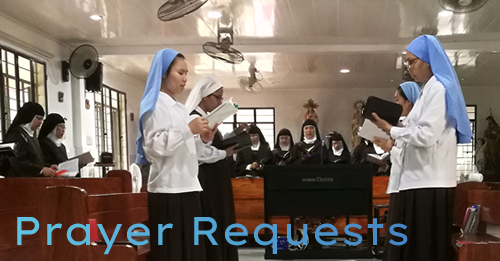
Triennial Chapter of the Carmelite Nuns of Santa Ignacia (Tarlac), Philippines
The Elective Chapter of the Carmelite Monastery of Mater Carmeli in Santa Ignacia (Tarlac), Philippines was held on October 24, 2024. Due to the death of the Bishop of Tarlac, the prior provincial of the Philippine Province of St. Titus Brandsma, V. Rev. Rico Ponce, O. Carm., presided.
The monastery was founded on December 7, 2001 by seven nuns from the Carmelite monastery of the Holy Family in Guiguinto, inspired by the 750th anniversary of the Scapular. Among several possible locations for a monastery, founding Carmel in Sta. Ignacia seemed the best suited for a cloistered life of prayer, sacrifice and contemplation.
The monastery belongs to the Stella Maris Federation.
The following were elected:
Prioress | Priora | Priora:
Sr Arlene Marie Reporte, O. Carm.
1st Councilor | 1ª Consejera | 1ª Consigliera:
Sr Mary Ann Inosanto, O. Carm.
2nd Councilor | 2ª Consejera | 2ª Consigliera:
Sr Maria de San Jose Arquita, O. Carm.
3rd Councilor | 3ª Consejera | 3ª Consigliera:
Sr Rachel Marie Perez, O. Carm.
4th Councilor | 4ª Consejera | 4ª Consigliera:
Sr Kayzel Marie Tumambing, O. Carm.
Treasurer | Ecónoma | Economa
Sr Mary Ann Inosanto, O. Carm.
Formator | Formadora | Formatrice
Sr Rachel Marie Perez, O. Carm.
Sacristan | Sacristana | Sacrestana
Sr Kayzel Marie Tumambing, O. Carm.
Bl. Maria Teresa Scrilli, Virgin

13 November Optional Memorial in the Italian Provinces
The feeling of the Divine Presence had become to me as I already said continuous: in prayer I was not able to profit from books, nor to make it vocal: it was a most sweet union (if I am not mistaken of the prayer of stillness; I say give this the name of union, believing it to be such, according to my little knowledge) I said it was a most sweet union, from which I did not know how to detach myself, or rather, I did not resign myself to the cessation of it, unless persuaded to leave God, for God; that is, to leave God in the contemplation of Magdalene, to find him in the proper duties, of Martha's cares; which if she had given her place, and no more, and yet had not all poured herself into them, by the Divine Master I believe, would not have been correct: Who enjoys indeed, that we leave to enjoy Him, to toil for Him: and then return to rest in Him. Oh, what a good guide is in this (as in everything else) the pure love of You! And how easy is it, the going to it mixed, love to us! I say to our satisfaction, that though spiritual, I do not believe it good; nor ever did I believe; now I am confirmed in this, by some things I have read, it seems to me in the writings of S. M. Teresa but as I said even before I read of them, I had such an opinion. It is great misery, what I see, and therefore I have taken experience of it: that, either we want to be pious, and spiritual, in our own way, or we are not at all: the small heads easily fall into the first error, the big ones, (not the big ones) into the second misfortune. Oh my God! Bad thing is pride; nay, most evil, as it disrupts, and diverts, Man's most beautiful endowment, which is to understand, for its true direction. Oh, if this were spent for which Thou didst bestow it-oh our happiness! And why is it not meant, while Thou of this, (I say of intellect) can made a gift? Ah! Our happiness that is wasted on vain and fallacious things, which we may not come to understand; either because it is not given to us, or because taken from them, by an immature death.
Oh blindness-oh blindness! To lose oneself in human sciences, when these do not serve, the immortal purpose: and such surely cannot be called, that which once has its term.
O my Bridegroom, O my Bridegroom: how hard a thing is such cognition, to those who so love Thee! I say the understanding how much to men, is neglected the knowledge of Thee--as if every other thing were more necessary than this. Oh, upheaval of human intellects! That in our century, by the best (I say by those who want to be true Christians), many things are approved, and much more in circumstance practiced, with the defense of duty of convenience, and customs of the times, which with the going of them, become uncivilized and vary.
Oh you ... civilization, to us baleful, if, little by little, in the heart of man, you extinguish Religion of it! O Bridegroom, O Bridegroom: and who will follow Thee, there in the midst of the great world?
If, there be those who do it not out of malice; who regard themselves out of human respect; others do it not, out of ignorance...I say, to be in this, bred, and brought up, out of condition and misery: that are not these, those, who the first expressed, such as are procuring and enthralled, in vain sciences of the world, and neglected they stand, in the knowledge of the things of God: ah! It has not quite there, where to rest its head: everywhere, thorns and thorns are mirrored, of vanity, and vanity; and I fear, that even what appears virtue, is not true, not sodden, piety; if the rich do not escape, and for fear of infection; but more of honor greedy, than nauseating of this; we enjoy being after it.
To read more on the life of Bl. Maria Teresa Scrilli ...
To learn more about the life of Mother Maria Teresa and her work and legacy, we suggest reading The Autobiography of Maria Teresa Scrilli, Foundress of the Institute of Our Lady of Mount Carmel published by Edizioni Carmelitane
Celebrating At Home - 33rd Sunday in Ordinary Time

When the Son of Man Appears
(Mark 13:24-32)
With the approach next Sunday of the Feast of Christ the King and the end of the Liturgical Year, our readings this Sunday take on an ‘end times’ feel.
In the Gospel Mark presents a vision of the full establishment of the Kingdom and the coming of Christ as the final proof of God’s victory. The language is necessarily that of symbol and myth as it describes something yet to come, not an historical reality. But this does not mean that it has no relationship with reality.
The vision is set against the background of a time of distress. Early Christian communities, like Mark’s, certainly endured much distress through persecution and suffering and their struggles to follow the teachings of Jesus.
The coming in glory of the risen Jesus together with the great gathering of his people from every corner of the earth, were meant as reassurance to a weary and frightened community of believers. They have followed the way of discipleship, sharing in Jesus’ suffering, some to the point of death. One day the final victory will be God’s and they will enter with Jesus into the fullness of the Kingdom.
In the meantime, however, disciples have to learn to read the signs of the presence of Jesus in everyday life. Jesus is not sitting passively at God’s right hand. Through the Holy Spirit he continues to be actively present in the hearts and lives of believers, and in the universe.
Neither are the disciples to wait passively for the final coming. We wait in patient hope, but not in idleness, because the ministry of making Christ present in every thought, word and action, and every moment of history, continues.
The Gospel ends on a note of uncertain certainty: Christ will come, but we don’t know when.
- pdf Celebrating At Home - 33rd Sunday in Ordinary Time [PDF] (2.81 MB)
- default Celebrating At Home - 33rd Sunday in Ordinary Time [ePub] (4.14 MB)
- pdf Celebrando en Familia - XXXIII Domingo del Tiempo Ordinario (300 KB)
- pdf Celebrando in Casa - XXXIII Domenica del Tempo Ordinario (302 KB)
- pdf Celebrando em família - XXXIII Domingo do Tempo Comum (298 KB)
Vitam Coelo Reddiderunt

|
08-10-24 |
|
|
|
|
|
30-09-24 |
|
|
|
|
Wahpeton Carmelite Nuns and Friends Celebrate 70 Years

On Wednesday, November 6, 2024, the community of Carmelite nuns in Wahpeton, North Dakota and their friends and benefactors gathered to celebrate the 70th anniversary of the founding of their Carmel of Mary monastery. The actual date of the foundation is November 1—the Feast of All Saints. Among those attending were a number of Lay Carmelites as well as school children who lectured, sang, and served at the altar.
The celebration took place at St. John’s Church in Wahpeton with Bishop John T. Folda of the Diocese of Fargo celebrating. The church was full with over 150 adults and 80 students from the parish school attending. Cake and ice cream were served afterwards. During the reception, the sisters sang a newly composed hymn for their 70th anniversary invoking Mary as the Flower of Carmel, Sweet Prairie Rose, Resplendent Virgin and Hope of All Carmelites.
In his homily, Bishop Folda spoke about the original 7 founding sisters—courageous pioneers he called them—and their willingness to leave their monastery in Allentown, Pennsylvania to start something new in the wilds of North Dakota. He also spoke of the many blessings the diocese and State of North Dakota have received through the prayers of the sisters. He said, “The sisters pray not only for us but with us, lifting our needs to God.”
He also spoke about the community, “continually living a life of prayer and intercessions, being a sign of God’s presence among us, because they live in the presence of God, and inspire others to do so.” He expressed great gratitude for the presence of the Carmelites in the diocese.
In 1953, Archbishop (later Cardinal) Aloisius Muench and Bishop Leo Dworschak, the auxiliary bishop, desired to have a special tribute to Our Blessed Mother for the forthcoming Marian Year of 1954. The answer came "out of the blue!”
Patrick Flood, a professor at Seton Hall University in New Jersey, knew that the Carmelite Nuns in Allentown, Pennsylvania were searching for a suitable place to make a new foundation. He received an appeal for the Indian Missions in North Dakota and decided to pursue the possibility.
Flood wrote to the bishops and asked if they would be interested in having a Carmelite Monastery in their diocese. With great delight they saw God's providential answer to their desire for a fitting tribute to Our Lady. A flurry of communications went between the bishops and the Carmelite superiors in Allentown. Permission for the foundation were granted by the Holy See at the canonization of Pope Pius X in May 1954.
On October 31, 1954, seven nuns, with Mother Mary Rose as prioress, set out for North Dakota. On November 1, Bishop Dworschak offered the first Mass for the Community in the old St. Francis Hospital owned by the Franciscan Sisters of Little Falls, MN. The Carmel of Mary was founded in Mary’s honor in her Marian Year.
The bishops also desired to have a public Marian shrine on the grounds in front of the monastery. Pilgrimages to the Shrine of Our Lady of the Prairies began in 1957 and have continued every August since then.
As candidates arrived, we outgrew the temporary monastery. Construction of the new monastery begin on land 6.5 miles (10.46 km) northwest of Wahpeton. The nuns moved in on October 24, 1964.
As part of the anniversary year celebrations although not driven by the anniversary, the nuns are building an infirmary wing so that the other sisters can be taken care of at home. Sr. Madonna said, “We had need for an infirmary wing in mind before the anniversary celebration but the two events coincided perfectly.”
Closing out the celebration, the prioress, Mother Madonna of the Assumption Morales, wrote, “We are so deeply grateful to all our friends and benefactors who have "journeyed" with us by your bountiful support in every possible way. God bless you, each and everyone! You are daily in our grateful prayers.”
Guests received a poppyseed loaf cake and biscotti baked with love the Carmelite Hermits in Christoval, Texas and tied with a gold bow. They also received a Carmel of Mary booklet and the children received a little nun carved out of wood.
(Pictures courtesy of the Carmel of Mary Carmelite Monastery and William J. Harry, O. Carm.)