








17 April Memorial
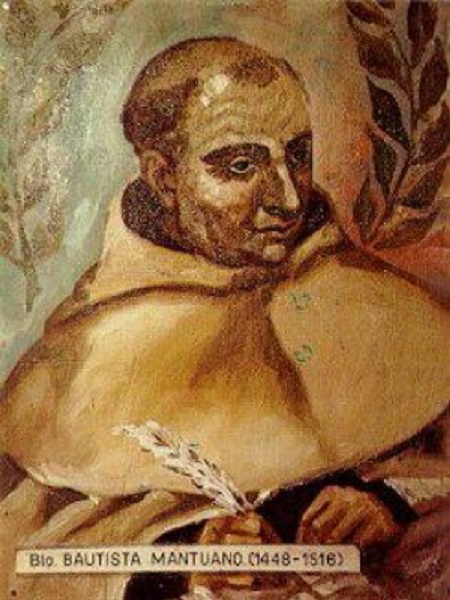
Baptist Spagnoli was a literary genius. He devoted the fruitfulness of his extraordinary literary ability to the service of the Order and the Church. His Apologia pro Ordine Carmelitarum (Apology for the Order of Carmelites) stands as the principal testimony to his love for Carmel, while his total devotion to the Church is attested not only by his poems in honor of Innocent VIII, Julius II, and Leo X, but also by all those writings that reveal his active engagement with the issues most deeply felt by Christendom at the time, such as, for example, the Obiurgatio cum exhortatione ad capienda arma contra infideles, ad reges et principes christianos (Admonition and Exhortation to Christian Kings to Take Up Arms Against the Infidels).
The events that were then disrupting the life of the nation also caused him to write. His verses Pro pacata Italia post bellum ferrariense (To Italy at Peace After the War of Ferrara), those of In Romam bellis tumultuantem (Against Rome in Turmoil from Wars), the poem Debello veneto commentariolus (Brief Commentary on the Venetian War), the Trophaeum pro Gallis expulsis produce Mantuae (Victory Ode on the Expulsion of the Gauls by the Duke of Mantua), and above all the De calamitatibus temporum (The Calamities of the Times), reprinted nearly thirty times between 1489 and 1510 alone, demonstrate how deeply the Mantuan felt the drama that was tormenting Italy in those years.
The friendships that bound him to distinguished figures of the time is proof of his high prestige in the world of culture. He was one of the most celebrated figures of the humanist movement, especially for his work Bucolica: seu adolescentia in decem aeglogas divisa (Bucolica or Adolescence Divided into Ten Eclogues), of which there are nearly 150 editions, more than a hundred of them in the 16th century alone, which is why his contemporaries, including Erasmus of Rotterdam, proclaimed him the Christian Virgil.
His poetic work, whose fame reached as far as Shakespeare with some even included in his play Love’s Labour’s Lost—influenced English literature in particular: Alexander Barclay paraphrased his eclogues, Edmund Spenser imitated him in The Shepheardes Calender (twelve pastoral eclogues), and John Milton in the Ode on the Morning of Christ’s Nativity.
The work required by the various offices entrusted to him and his intense literary activity did not distract him from the Carmelite ideals of the interior life and a tender devotion to the Blessed Virgin.
The practice of the virtues and renunciation of the world form the theme of his De vita beata (The Blessed Life), a dialogue he wrote when he was barely sixteen years old; the aspiration to solitude and the desire for the presence of God are constantly found in his works and in his correspondence. In honor of Mary, he composed several odes and a three-volume poem, the Parthenices Mariana (Songs to the Virgin), which spread rapidly throughout Europe, as some seventy editions were published, fifteen in the fifteenth century and nearly fifty in the sixteenth. He worked to have the custody of the sanctuary of Loreto entrusted to his Congregation, which he obtained, albeit for only a few years, in 1489.
The six Parthenices composed in honor of the martyrs Catherine, Margaret, Agatha, Lucy, Apollonia, and Cecilia, and the poems in honor of St. John the Baptist, St. George, and other saints, constitute, together with the twelve books of the De sacris diebus (The Sacred Days), another example of his religious piety.
Impressed by the growing corruption of the clergy and the people, he expressed his reformist aspirations not only through his insightful literary works, such as the IXth eclogue De moribus curiae romanae (On the Customs of the Roman Curia), but also through a passionate speech delivered in the Vatican Basilica in 1489, before Innocent VIII and the cardinals. Some of his particularly harsh statements led Luther himself to rely on the authority of Baptist to take a stand against Rome. And in an Anthologia... sententiosa collecta ex operibus Baptistae Mantuani (Anthology of Sentences Collected from the Works of B.V.M.), published in Nuremberg in 1571, the Protestants went so far as to point to the Carmelite as a precursor of the German reformer. But it is worth noting the essential difference between the reformist spirit of Blessed Mantuano, who sought to work within the Church, and that of Luther, which was to lead to schism.
Adapted from the entry for Baptist Spagnoli by Edmondo Coccia in Santi del Carmelo, a cura di Ludovico Saggi Ocarm, Institutum Carmelitanum, Roma, 1972.
To read more ...