



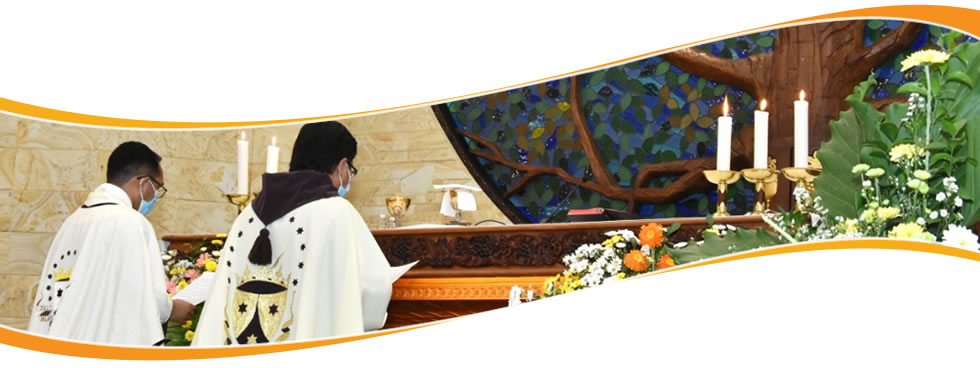


Formula Vitae: a living text for Carmel today
800 years of Papal Recognition (1226 – 2026)
Five moments of prayer and reflection for communities
Dear sisters and brothers in Carmel,
This year we are celebrating 800 years of papal recognition of the Carmelite Formula Vitae. This was a key moment in our early history and is an important anniversary to celebrate.
 Celebrating a vital moment
Both General Councils considered the importance of this year for the Carmelite Family at our joint meeting in March 2026 and wish to celebrate it in various ways. Both General Councils are planning a number of initiatives in the coming months.
Indeed, we believe that it would be fruitful for the entire Carmelite Family to reflect once again on our Carmelite Rule and see it as a living text for today. Earlier this year, the General Council commissioned Míceál O’Neill OCarm to compile a series of five moments of prayer and reflection for this anniversary. (For convenience, we asked that he would use the text of the Rule as it was finally modified as the basis for these reflections.)
As we enter the final months of this anniversary year, each community of friars, nuns, Third Order and other groups in the Order is invited to take these reflections and use them over several community meetings. You may find additional ways within your local contexts to celebrate this anniversary.
Understanding the context
It is important to understand the context of what happened 800 years ago. At some point in time, the hermit-brothers living on Mount Carmel decided to undergo a more formal organisation. They asked St Albert of Jerusalem to set down their way of life along the lines they were already living. We know that sometime between his arrival in the Holy Land in 1206 and his murder in 1214, Albert wrote the Formula Vitae for them.
Yet, an unforeseen problem arose. The Fourth Lateran Council in 1215, wishing to limit further diversification of religious life, obliged new orders to choose one of the already approved rules. This led towards a general amalgamation of religious orders. Thus, using the legislation of the Fourth Lateran Council as an excuse, Carmelites were sometimes refused permission to preach in public venues.
Even so, the Carmelites defended their position with the fact that their Formula Vitae came before the prohibition of 1215.
Pope Honorius III (Ut vivendi normam)
Subsequently, the hermits of Mount Carmel made contact with the Holy See in order to secure their legal standing. On January 30, 1226, Pope Honorius III’s Ut vivendi normam, addressed to the “Prior and hermit-brothers of Mount Carmel,” formally accepted the Carmelites’ claim to have received their Formula of Life before the Fourth Lateran Council of 1215. This document recommended Albert’s Formula Vitae granting an indulgence to those who accepted that way of life as obligatory.
Ut vivendi normam (1226) could be considered an acknowledgement or an implicit approbation (but not a “confirmation” in the proper sense) of the Formula of Life. Although it did not formally recognise the Carmelites as religious, in the proper sense of that term, Ut vivendi implied that their regular observance of the norm of life given by Albert gave them a canonical status different from that of ordinary laymen. Had the Carmelites been formally recognised as Religious at this point, they would have been obliged to accept “one of the rules approved” by the Fourth Lateran Council.
Building the Carmelite Family
Over the subsequent centuries, Carmelites have spread throughout the world. There are now two branches of Carmelites: The Order of the Brothers of Our Lady of Mount Carmel (OCarm) and the Order of the Discalced Brothers of the Blessed Virgin Mary of Mount Carmel (OCD), fruit of the St Teresa of Avila Reform. Together these two branches are a ‘family of families’ made up of several thousand Carmelite friars, nuns, members of the Third Order, affiliated congregations of sisters and brothers, and very many people who feel a spiritual bond with Carmelite Order – often most especially through the wearing of the Scapular.
Every member of this family owes their origin as Carmelites to the Formula Vitae written by St Albert of Jerusalem which was first given papal recognition 800 years ago by Pope Honorius III in Ut vivendi normam. It was an important milestone of the journey of Carmel: a journey which continues today.
A key moment
While it did not completely and permanently resolve all the issues that Carmelites faced – and the text was modified on a small number of subsequent occasions – Pope Honorius III’s Ut vivendi normam in 1226 was the first recognition by the pope of the group of Carmelite hermits. Pope Innocent IV gave final approval to the Carmelite Rule in 1247.
This would be considered a key moment even without the problems that the hermit-brothers were facing through the decisions of the Fourth Lateran Council. It takes on an even greater significance because of that initial struggle.
We invite you to celebrate this important anniversary and to see the Rule as living text for today. In Carmel,
Desiderio García Martínez O. Carm, Prior General
pdf Read or download the Letter from the Prior General(416 KB)
image Download the Logo for the celebration(435 KB)
pdf ID - Surat - 800 tahun Pengakuan Paus(469 KB)
pdf ID - 800 tahun Carmelite Formula Vitae_INA(642 KB)
image Logo untuk perayaan tersebut(437 KB)
Pilgrims of Hope in a Pilgrim Church
Pilgrim, Welcome!
The Catholic Church sees itself as a “pilgrim church” (L.G. VII) It is a church that is on the way, creating its own story. It is the story of people down through the ages finding in its message a challenge to live a fuller life, to discover the seeds of eternal life that are already present in this life. It is a church of companionship that gives us the story of two disciples on the road out of Jerusalem towards Jericho, in conversation,  seeing their lives transformed by the “stranger” who joined them on the journey, (Lk 24, 13-35) or a women going to fetch water, who meets the same “stranger” at the well and begins to talk about her life and finds in him someone who was able to tell her everything about herself. (Jn 4, 1-42) People gather in this pilgrim church as members of a community of pilgrims, journeying together, nourished by the grace that comes in different forms, at different times and in different ways, but always from the one source, the love of God that has been poured into our hearts. (Rm 5,5)
You are a pilgrim, with your heart full of desire and your eyes open. You are open to the things that life will show you. Life shows us the things that God wants to show us and so all around us we can see the signs of God’s love - in creation, in nature, in other people, in faith communities, in events. You will find signs of hope also in the many churches that make up the pilgrim church. Each of these churches is a place where people find peace, because of what they see in the many symbols and features of the church, and also because of the realization that in these places pilgrims have prayed and celebrated, confessed their sins and built community, for generations, all with a sense of hope in the good that will come when the promises that have been given to them will be fulfilled. The pilgrim church announces those promises and lives in hope of their fulfilment.
You may find in all that Carmel represents a particular attention to the knowledge of God’s love as it has been poured into our hearts through the work of the Holy Spirit. This, it might be said, is Carmel’s best gift to the Church that sees itself as a pilgrim church waiting to see the full revelation of God’s love when Christ will be all in all and all of Creation will be one in Him.
This church offers us the companionship of Mary and the Saints for our journey, In particular, Mary as the mother and beacon of hope, holds a special place in the Carmelite tradition as a model of holiness and purity and a sign of hope because she was united to God and obedient to his will in all the circumstances of her life. Mary is recognized as blessed by her cousin Elizabeth, because she believed that all that was promised to her would come true. (Lk 1,45)
 It may be that we don’t think of hope so much when everything seems to be going well. Hope comes much more into play when we are disturbed or even frightened by what is happening in the world and we get a sense of our own powerlessness and the intricacies and unpredictability of humanity. It is then that we begin to think about hope, the assurance that all will be well. St. Paul in his very reassuring way reminds us in the Letter to the Romans that all things work for good for those who love the Lord. (Rm 8,29)
The Carmelite Rule, offers to those who follow it a pattern for their lives, somewhat like an architect’s design. You build the house, and the house is well built, with lots of forethought about how the people will live in it, but without much idea of what might happen when the people begin to live there. The rule suggests that while we live our lives in a well ordered fashion, we always leave space for what is not yet there, but will be because of the hope that they find in the promise of Christ’s return, whenever that might be. (Carmelite Rule 24)
Our hope is fundamentally our belief in Jesus Christ. It is he who offers us the salvation that is built into creation right from the beginning. Jesus is our model, our motivation and reward. Living a life that is similar to his, moved by him, through his Spirit, to do the best we can in this life, we come to the reward of being deeply united with him in this life, in thought, desire and existence. Being united with Jesus Christ, in this life and in the next, is the fulfilment of the Carmelite’s greatest hope.
God’s Merciful Indulgence and the 2025 Jubilee Year
Jesus told Peter, ‘Whatever you bind on earth will be bound in heaven, and whatever you loose on earth will be loosed in heaven’ (Mt. 16:19), the same promise being made to the disciples, collectively, in Matthew 18:18.
The power to bind is the basis of the penance imposed on the penitent by the confessor as part of the Sacrament of Penance and Reconciliation. The power to loose, on the other hand, has often taken the form of a mitigation, in the sense of replacing a very-demanding penance with another, easier one, which was granted when certain conditions were met, as when the Council of Epaone (517) reduced to two years the duration of the penance that apostates were to undergo on their return to the Church.
 For the pilgrims who came to Rome for the first ever Holy Year Jubilee, in 1300, and fulfilled the requirements, Pope Boniface VIII granted the complete removal of the temporal punishment due to sin. Quoting 1 Peter 1:19 on our having been ransomed ‘with the precious blood of Christ,’ Pope Clement VI’s Jubilee decree, Unigenitus Dei (1343), described the ‘copious flood, like a stream’ of Christ’s blood as ‘an unfailing treasure for human beings’ which Christ ‘committed to the care of St. Peter, who holds the keys of heaven, and to his successors, who are to distribute it to the faithful for their salvation’, applying it ‘with compassion, for pious and good reasons, in order that it may benefit those who are truly contrite, and who have confessed’.
Among the 95 Theses that drew up in Wittenburg, in 1517, Luther questioned the Pope’s teaching on indulgences and the spiritual treasure of the Church when he claimed that the ‘treasures of the Church whence the Pope grants indulgences are neither sufficiently named nor known among the people of Christ’ (n. 56) and he also questioned the ‘traffic in pardons [indulgences]’ (n. 73) because of the scandalous claims sometimes made concerning ‘the preaching of pardons [indulgences]’ (n. 81).
In its Decree on Indulgences (1563), the Council of Trent recognised that ‘the power of conferring Indulgences was granted to the Church by Christ,’ and that their use was ‘most salutary to the Christian people, and approved by the authority of the holy Councils.’ Recognising the validity of Luther’s criticism of how indulgences had been preached, however, Trent desired that ‘moderation be observed in accordance with the ancient custom approved in the Church,’ and that ‘all evil traffic’ in indulgences should be abolished.
Describing an indulgence as ‘the remission in the sight of God of the temporal punishment due to sins which have already been blotted out as far as guilt is concerned,’ Pope St. Paul VI presented the ‘treasury of the Church,’ not as ‘akin to a hoard of material wealth’, but as ‘the infinite and inexhaustible value which the expiation and merits of Christ have in the sight of God,’ through which ‘the whole of humanity’ can ‘be freed from sin and arrive at fellowship with the Father.’
Recognising that being reconciled with God through the Sacrament of Penance and Reconciliation ‘does not mean that there are no enduring consequences of sin from which we must be purified,’ Pope John Paul II described these ‘temporal consequences as including ‘an unhealthy attachment to creatures’ and everything that ‘impedes full communion’ with God and with our brothers and sisters.’ Recognising that, in the Church, ‘the holiness of one benefits others in a way far exceeding the harm which the sin of one has inflicted upon others,’ and, as a result, the ‘good works of the saints’ are constantly adding to ‘the treasures of the Church,’ he described the Jubilee indulgence for the Holy Year in 2000 as disclosing ‘the fulness of the Father’s mercy, who offers everyone his love,’ because it expressed the ‘total gift of the mercy of God’ by granting repentant sinners ‘a remission of the temporal punishment due for the sins already forgiven as regards the fault.’
In the title of his bull announcing the 2025 Jubilee Year, Spes non confundit, Pope Francis quotes St. Paul, ‘Hope does not disappoint’ (Rom. 5:5), and he points out that, at one time, the terms ‘mercy’ and ‘indulgence’ were interchangeable, because indulgences were ‘expressions of the fullness of God’s forgiveness, which knows no bounds,’ recognising God’s mercy, fully revealed in Christ, the basis of our hope. Describing those coming to Rome for that holy year as ‘pilgrims of hope,’ he prays that, for everyone, the Jubilee may be ‘a moment of genuine, personal encounter with the Lord Jesus,’ who is ‘our hope’ (1 Tim. 1:1).
Patrick Mullins, O.Carm.