





O.Carm
Celebrating At Home - 25th Sunday in Ordinary Time

Becoming A Child
(Mk 9:30-37)
Today’s readings continue last Sunday’s themes of Jesus as the ‘suffering servant’ and the nature of authentic discipleship.
On the road through Galilee Jesus continues to instruct the disciples that he will suffer and die and rise again, but the disciples seem very slow to understand and are too afraid to ask him about it. Perhaps it is an awful truth they just don’t want to face. Maybe they want Jesus to be a ‘warrior-king’, a liberator who would restore Israel to greatness and crush the Romans. Perhaps they have begun to think of themselves as princes and rulers in this new Israel.
Among themselves the disciples are not discussing the important things Jesus has told them about who he is and his destiny, but fighting about which of them was the greatest - who will be first in line to receive honour, power and glory in the kingdom of Jesus.
Using a little child as an example Jesus tells the disciples that real leadership is about service and giving without expecting anything in return.
It’s hard for us to grasp the power of what Jesus says and does here. In his time, unlike now, children had no social status or value at all. Until adulthood they were nobodies. To welcome a child would have required a person to put aside all their ideas of self-importance and adult status in order ‘to simply meet the child as an equal, as “child” to child.’ This is what Jesus is telling the disciples to do. Even more astonishing, Jesus goes on to identify both himself and God with the little child!
This is a direct challenge to the disciples’ understanding of Jesus’ messiaship and to their notions about God. ‘Is God to be thought of as a kind of extraterrestial Ruler to whom nothing but fear and service is due? Or is the God revealed by Jesus a God whose primary gesture toward human beings is that of One who serves, One who comes among us in the guise of a child?’ Jesus’ unusual gesture of hugging a child in public expresses powerfully the preciousness of each and every human person in the sight of God, no matter how small, insignificant or young. We, too, are hugged by God in this moment.
Seeking glory is not the calling of the true disciple. Doing things in order to gain rewards is not the calling of the true disciple. Putting aside discrimination, status and power to proclaim God’s love, compassion, care, justice and forgiveness is.
Every Christian is called to this ministry of servantleadership - that is, to be leaders in the doing of service.
cf Byrne, Brendan, A Costly Freedom - A Theological Reading of Mark’s Gospel (Sydney, St Paul’s, 2008), pp 152-153
- pdf Celebrating At Home - 25th Sunday in Ordinary Time [PDF] (2.81 MB)
- default Celebrating At Home - 25th Sunday in Ordinary Time [ePub] (1.73 MB)
- pdf Celebrando en Familia - XXV Domingo del Tiempo Ordinario (485 KB)
- pdf Celebrando in Casa - XXV Domenica del Tempo Ordinario (293 KB)
- pdf Celebrando em família - XXV Domingo do Tempo Comum (304 KB)
St. Albert of Jerusalem, bishop and lawgiver

September 17 | Feast
In 1205, Albert was appointed Patriarch of Jerusalem and a little later nominated Papal Legate for the ecclesiastical province of Jerusalem. He arrived in Palestine early in 1206 and lived in Acre because, at that time, Jerusalem was occupied by the Saracens.
At some point between 1206 and 1214, Albert was approached by the hermits gathered on Mount Carmel, "near the font of Elijah," and asked to set down their way of life in the form of a Rule. Albert's formula vitae (way of life), a relatively short document, encouraged the daily practices of the hermits in order to "follow Christ."
During his time in Palestine, Albert was also involved in various peace initiatives, not only among Christians but also between the Christians and non-Christians and he carried out his duties with great energy and dedication. On 14th September 1214, during a relgious procession, he was stabbed to death.
A list of books available from Edizioni Carmelitane on St. Albert and the Carmelite Rule are listed at the bottom of this announcement.
Read more about the life of St. Albert
Read about the Carmelite Rule | Text of the Rule
+ + +
Books Published by Edizioni Carmelitane on St. Albert of Jerusalem
Edizioni Carmelitane Webstore
Libros publicados por Edizioni Carmelitane sobre San Alberto
Tienda virtual de Edizioni Carmelitane
Libri pubblicati da Edizioni Carmelitane su Sant'Alberto
Sito Web di Edizioni Carmelitane
The Carmelites and St. Albert of Jerusalem. Origins and Identity
Patrick Mullins, O. Carm.
Celebrating St. Albert and His Rule. Rules, Devotion, Orthodoxy and Dissent
Edited by Michelle Sauer and Kevin Alban, O. Carm.
The Bollandist Dossier on St. Albert of Jerusalem
Daniel Papenbroeck, SJ | Edited and translated by Patrick Mullins, O. Carm.
St. Albert of Jerusalem and the Roots of Carmelite Spirituality
Patrick Mullins, O. Carm.
The Life of St. Albert of Jerusalem. A Documentary Biography. Part 1
Patrick Mullins, O. Carm.
The Life of St. Albert of Jerusalem. A Documentary Biography. Part 2
Patrick Mullins, O. Carm.
Alberto Patriarca di Gerusalemme. Tempo - Vita - Opera
Vincenzo Mosca, O. Carm.
Books Published by Edizioni Carmelitane on the Rule of St. Albert
Edizioni Carmelitane Webstore
Libros publicados por Edizioni Carmelitane sobre la Regla de San Alberto
Tienda virtual de Edizioni Carmelitane
Libri pubblicati da Edizioni Carmelitane sulla Regola di S. Alberto
Sito Web di Edizioni Carmelitane
Albert and His Rule
Michael Mulhall, O. Carm.
A Pattern for Life. The Rule of St. Albert and the Carmelite Laity
Patrick Thomas McMahon, O. Carm.
The Carmelite Rule. Proceedings of the Lisieux Conference. 4-7 July 2005
Various Authors
La Regola del Carmelo: Origine, natura, significato
Carlo Cicconetti, O. Carm.
Expositio paraenetica in regulam carmelitarum: Un commento alla regola del Carmelo
Giovanni Soreth | Tradotto da Giovanna D'Aniello, O. Carm.
Abdicatio Proprietatis. Sens et Défi de la Pauvreté Religieuse selon la Règle du Carmel et son inculturation dans le contexte de l'Afrique
Jean-Maria Dundji Bagave Makanova, O. Carm.
La Regola del Carmelo. Per una nuova interpretazione
Bruno Secondin, O. Carm.
In Ossequio di Gesù Cristo. Programma di studi sulla Regola del Carmelo
Emanuele Boaga, O. Carm. & A. de Castro Cotta, CDP
+ + +
A Carmelite Parish Providing Ministry to the Disabled
The Carmelite parish of St. Thérèse of Lisieux in Cresskill, New Jersey, was featured in an article in America Magazine on the Catholic Church’s disability ministry in the United States. St. Thérèse parish is a leader in this ministry.
The author of the article visited the parish and noted “people arrive early and families talk to each other.” She is noticed because she is new and they ask her name— a new experience for her even after having attended many different churches. The sanctuary “screams of the 1970s” but “the parish feels fully alive.” About 15-20 families regularly attend the monthy Sunday mass.
People with disabilities provide service as lectors and altar servers. Following the Mass the people gather in another building with much of the food and drink provided by the special needs Mass’s “hospitality committee which is staffed by many parishioners who have no connection to the disability community except for their desire to support it.”
The Mass was started by Carmelite Samuel Citero, the current pastor at St. Thérèse. His inspiration came from a pilgrimage he made to Lourdes in 2015. “It didn’t take a lot to convince our parish,” he said, thanks to its longstanding commitment to social concerns.
Unlike many U.S. parishes, St. Thérèse parish in a suburb of New York City has seen growth in recent years, including a handful who joined St. Thérèse because of their welcoming stance toward people with disabilities. “We’re not trying to steal people’s parishioners, but we do what we do,” he says.
The problem has been the welcome some of these families received in their own parish. “Some of them are refused sacraments, so we take on that responsibility,” Father Citero explains. Some people with disabilities are denied the Eucharist if the pastor believes they cannot “distinguish the body of Christ from ordinary food,” as instructed by the Pastoral Statement of the U.S. Bishops on Persons with Disabilities which was published in 1978. But many parishes lack catechesis for people with disabilities to begin to grasp the mystery of the Eucharist. (And few neurotypical adults face similar scrutiny about their understanding of transubstantiation.)
According to the article, “Masses like the one at St. Thérèse offer safe spaces for people with disabilities to worship, where no one blinks an eye if they have an outburst or need to step out for a moment. They might also offer sensory adaptations. The Masses include people with disabilities among the liturgical ministers, which reminds the rest of the congregation that people with disabilities have abundant gifts to share with the church.”
The parish can also be a place where people with disabilities who struggle to make friends as adults can find a community that welcomes them, affirms their dignity, and provides a space for them to offer their gifts and talents.
Body of St. Teresa of Avila Found Intact

On August 28, Authorities opened the silver reliquary containing the body of St. Teresa of Avila who died in 1582. The process was undertaken so that a study of the Saint’s relics can be carried out by the Italian doctors and scientists with the Vatican’s approval. The casket was previously opened in 1914, apparently so that the propositor general of the Discalced Carmelites at that time, Clemente de los Santos, could view the Saint’s body.
Photos were taken of the body at the time of the 1914 study. According to the Discalced Carmelites’ postulator general, Marco Chiesa, who was present at this recent opening, the body “is in the same condition as when it was last opened in 1914.” According to a press release, “the uncovered parts, which are the face and foot, are the same as they were in 1914." The press release also states, "There is no color, there is no skin color, because the skin is mummified, but it is seen, especially in the middle of the face. … Expert doctors see Teresa's face almost clearly."
Both viewings have confirmed that the body of Teresa has remained incorrupt.
The Diocese of Avila, where Teresa lived much of her life, wants canonical recognition by Rome of the relics.
For the opening of the casket to occur, a marble slab had to be removed. Then the case containing the body was moved to a room which has been set aside for the study of the relics. The urn was opened in the presence of the scientific medical team and Church authorities. The local community of Discalced Carmelites, as well as the general postulator of the Order, members of the ecclesiastical tribunal, and a small group of religious participated by singing the Te Deum.
The actual process of opening the urn required the assistance of two goldsmiths and 10 keys. Three keys are kept in Alba de Tormes, three are kept by the Duke of Alba, three are kept by the Discalced Carmelites in Rome, and one key is kept by the king of Spain. Three keys are required to open the gate protecting the tomb, three are needed to open the marble tomb, and the remaining four are required to open the silver reliquary itself.
According to news reports, scholars “were struck by its magnificent state of preservation and robustness. In Teresa’s final years, she did have trouble walking. She describes this ailment in her writings. According to Father Chiesa, the pain she experienced is quite understandable. “Analyzing her foot in Rome, we saw the presence of calcareous thorns that made walking almost impossible.”
Two goldsmiths assisted in the process of opening the tomb and reliquary. Ten keys that protect the tomb were required: three that are kept in Alba de Tormes, three kept by the Duke of Alba, another three that the father general keeps in Rome, in addition to the key kept by the king of Spain. Three of these keys are to open the outer gate, three are to open the marble tomb, and the other four are to open the silver coffin.
The Saint’s tomb was donated by King Ferdinand VI and his wife, Barbara of Braganza. It is noted for its fine workmanship.
St. Teresa’s writings are recognized as masterpieces of 16th century Spanish literature and spirituality. Her reflections on the process for one to progress toward God through prayer and contemplation are considered benchmarks in the history of Christian mysticism. She initiated a reform within the Carmelite Order which following her death became the separate Discalced Carmelite Order. She was canonized on March 12, 1622 by Pope Gregory XV along with Ignatius of Loyola, Isidore of Madrid, Francis Xavier, and Philip Neri. Pope Paul VI declared her to be a doctor of the Church in 1970.
Celebrating At Home - 24th Sunday in Ordinary Time

Who Am I?
(Mk 8:27-35)
All of us, at least to some extent, shape our identity and measure ourselves in response to the comments and ideas of others. From an early age we are taught how to speak, dress and act in order to be ‘acceptable’ to others. Usually this is a good thing, but sometimes it can go horribly wrong.
Celebrities, sports stars and young people can become so vulnerable to the expectations and reactions of the public, media and social media trolls that they end up with little identity of their own, or they develop a very distorted idea of their identity. Unfortunately, both these experiences have significant negative impacts on a person’s mental wellbeing.
This Sunday’s Gospel teaches us how to find our true identity.
Both the ‘people’ and Peter have ideas about who Jesus is. For the people he is John the Baptist, Elijah or one of the prophets returned from the dead. For Peter, Jesus is the Christ, the Messiah. But what happens next reveals that Peter and Jesus have very different ideas about who this Messiah is.
Though Peter understands correctly that Jesus is the Messiah, he misunderstands the kind of Messiah that Jesus is. Perhaps he wanted a Messiah who was a great warrior-king, powerful and glorious. He can’t imagine that his Messiah would meet the kind of end that Jesus talks about.
Jesus calls Peter, ‘Satan’. If Peter is to learn the true identity of Jesus and come to think with God’s heart, he must ‘get behind’ (follow) Jesus.
Such followers are called to renounce their false identity (often defined by what we have, what we work at, our delusions) and to find their true identity as God’s beloved son or daughter through a life poured out in loving service of others (taking up his/her cross).
I often think that parents are the great examples of what all this means. They constantly have to go beyond themselves, their own needs, hopes and desires and sacrifice their time, energy and money to care for their children with love. In doing so, they often discover their very best selves.
In the Gospel, Jesus, the true Messiah, appears not as a glorious God-King but as the Suffering Servant of God about whom Isaiah speaks in the first reading. The way of discipleship is not about self-glory but about true service, and about discovering our true identity as God’s beloved sons and daughters.
As disciples of Jesus we try to live our lives as a real service to our brothers and sisters in the world. But it’s not possible to do that until and unless we realise our true identity and call as God’s own people.
Then we become a source of love, mercy, hope, compassion, justice, truth, concern and Christian action as servants of God and each other. That is DOING the Gospel.
- pdf Celebrating At Home - 24th Sunday in Ordinary Time [PDF] (2.88 MB)
- default Celebrating At Home - 24th Sunday in Ordinary Time [ePub] (4.45 MB)
- pdf Celebrando en Familia - XXIV Domingo del Tiempo Ordinario (731 KB)
- pdf Celebrando in Casa - XXIV Domenica del Tempo Ordinario (479 KB)
- pdf Celebrando em família - XXIV Domingo do Tempo Comum (736 KB)
Prior General's Schedule for September 2024

Fr. Míċeál O'Neill, the prior general, has the following schedule planned for the month of September 2024:
September 1 - 14: Canonical Visitation of Poland
September 16 - 18: Congress for Lay Carmelites -- Rome
September 19 - 21: Provincial Chapter (Part 2) -- Malta
September 23 - 30: General Council Plenary Session -- Rome
75th anniversary of Carmelite Presence in Peru Celebrated

On August 3, 2024 the Peruvian Commissariat of the Province of the Most Pure Heart of Mary (PCM) celebrated the 75th anniversary of Carmelite presence in Peru.
The Carmelite Studies Program, which brings many of the PCM students together for a week of Carmelite input, was also celebrated during this time.
Former Prior General Fernando Millan spoke on Titus Brandsma and other Carmelite saints.
The Prior General, Míċeál O’Neill, presided at the procession and Mass on Saturday evening.
On Sunday, all of the Carmelites gathered for a Mass and banquet in Lurín at Villa Carmelitas, the Carmelite retreat center a few miles from Lima.
Carmelites from many different countries of the Americas and around the world were present.
Triennial Chapter of the Carmelite Nuns Held in Philippines

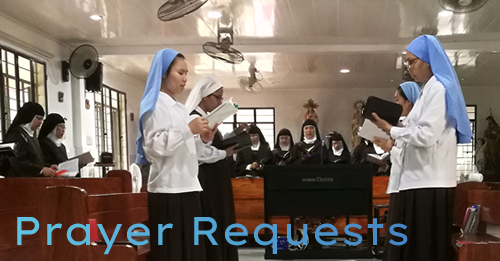
On August 26, 2024, the Carmelite nuns of the monastery of the Immaculate Heart of Mary in Tambacan, Burgos, Pangasinan, Philippines held there triennial elective Chapter. The local bishop, Napoleon Sipalay, Jr., OP, the bishop of Alaminos presided. Twelve nuns with both active and passive voice and four nuns with passive voice only participated.
The monastery was founded on May 1, 1993 with nuns from the monastery of Guiguinto. It was canonically erected on May 6, 1993. It belongs to the Federation of Stella Maris.
More information about the monastery and the nuns' lives can be found at: ocarmburgosph.weebly.com
The following were elected:
Prioress | Priora | Priora:
Sr Ma. Barbara C. Pulido, O. Carm.
1st Councilor | 1ª Consejera | 1ª Consigliera:
Sr Ma. Elena de la Eucaristia Z. Tolentino, O. Carm.
2nd Councilor | 2ª Consejera | 2ª Consigliera:
Sr Ana Maria del Sagrado Corazon D. Bernardo, O. Carm.
3rd Councilor | 3ª Consejera | 3ª Consigliera:
Sr Ma. Florencia Giuseppe M. Cruz, O. Carm.
4th Councilor | 4ª Consejera | 4ª Consigliera:
Sr Ma. Leonora of the Holy Trinity J. Borlongan, O. Carm.
Treasurer | Ecónoma | Economa
Sr Ma. Elena de la Eucaristia Z. Tolentino, O. Carm.
Formator | Formadora | Formatrice
Sr Miriam Therese of the Holy Spirit C. Albeza, O. Carm.
Sacristan | Sacristana | Sacrestana
Sr Ma. Florencia Giuseppe M. Cruz, O. Carm.
Celebrating At Home - 23rd Sunday in Ordinary Time

Loosening the Ligaments
(Mk 7:31-37)
Even with the benefits of modern technology and social media people can still feel deeply isolated, cut off from those around them. They share something of the experience of the man in this Sunday’s Gospel. He cannot hear and cannot speak properly. Living in the ancient world that must have been a profoundly isolating, frightening and frustrating experience for him. The people ask Jesus to lay a hand on the man. There were many travelling healers at that time, so the people’s request does not imply that they know who Jesus really is, only perhaps his reputation as a healer.
Jesus takes the man aside, away from the crowd, puts his fingers into the man’s ears and touches his tongue with spittle. Both are deeply intimate gestures and somewhat confronting. I wonder what it must have been like to be that man. How much did he understand about what Jesus was doing? Being deaf, did he even know what the crowd had asked Jesus to do for him?
Jesus looks up to heaven, sighs and says ‘Ephphatha,’ – ‘Be opened!’ All at once the man can hear and speak clearly. The man’s social isolation is ended. Now he can enter fully into relationship with other people. The man rejoices, the people rejoice and, even though Jesus asks them not to, they tell the story everywhere.
In telling this story Mark seems to suggest that without the intimate, healing touch of Jesus we remain deaf both to the voice of God and the cries of others, and unable to enter fully into relationship with either. We remain closed and crippled within ourselves, unable to hear the Word of God or pass it on to others.
But once touched by the power and spirit of Jesus we are opened to the Word made flesh, and God’s vision for human life.
Our inner ligaments, the things that once choked the Life within us, begin to be loosened and we begin to speak clearly of God’s loving concern for all humanity in every word and action.
- pdf Celebrating At Home - 23rd Sunday in Ordinary Time [PDF] (2.89 MB)
- default Celebrating At Home - 23rd Sunday in Ordinary Time [ePub] (4.65 MB)
- pdf Celebrando en Familia - XXIII Domingo del Tiempo Ordinario (525 KB)
- pdf Celebrando in Casa - XXIII Domenica del Tempo Ordinario (430 KB)
- pdf Celebrando em família - XXIII Domingo do Tempo Comum (501 KB)
Celebrating At Home - 22nd Sunday in Ordinary Time

Washing Hearts, Not Hands
(Mk 7:1-8, 14-15, 21-23)
This weekend we resume reading from St Mark’s Gospel. This Sunday’s episode is about ritual purity verses purity of heart. The Pharisees were a group of especially observant Jews. They took ritual observance very seriously. These observant Pharisees and some scribes criticise the disciples for ‘not following the tradition of the elders’ by not washing their hands before eating.
This passage is not about good hygiene but about a ritual practice. By the time of Jesus the Pharisees wanted to extend the laws of ritual purity, which applied only to priests, to all the people. Jesus accuses them of substituting the law of God with mere human regulations.
The second point that Jesus makes is that it is not what goes into a person from outside which makes them unclean, but what they harbour in their hearts and minds.
We, too, can fall into the trap of thinking that our ritual practices (going to Mass, saying the Rosary, etc) are all that is necessary to be good followers of Jesus.
Some Christians seem to think that ritual practice is about being at rights with God; almost like ‘paying God off’. That having been done, they are free to do what they like in their actions towards other human beings.
The teaching of Jesus in the Gospel today challenges both those views.
It is the reform of our hearts, not our ritual practices, which needs attention and is most important in living out the vocation God has given us. If the goodness of God is not seen through us, where can it be seen?
Jesus reminds his listeners that evil does not come from the outside, but from within. According to Jesus, being at rights with God is not achieved through ritual practice but through inner conversion to the mind and heart of God.
Real religion, according to the Jesus tradition, is not about ritual practise but about how we treat each other.
It’s our hearts, not our hands, which need washing.
- pdf Celebrating At Home - 22nd Sunday in Ordinary Time [PDF] (5.12 MB)
- default Celebrating At Home - 22nd Sunday in Ordinary Time [ePub] (8.09 MB)
- pdf Celebrando en Familia - XXII Domingo del Tiempo Ordinario (523 KB)
- pdf Celebrando in Casa - XXII Domenica del Tempo Ordinario (522 KB)
- pdf Celebrando em família - XXII Domingo do Tempo Comum (345 KB)