






O.Carm
Celebrating At Home - 2nd Sunday in Ordinary Time

The True Bridegroom
(John 2: 1-11)
Weddings are usually wonderful occasions. Family and friends come together to witness to and celebrate a couples’ love and commitment. The ritual is crowned with singing, dancing, eating and drinking. It has been so for centuries. In Jewish tradition a wedding could last for days, not hours.
It’s interesting that, in John’s Gospel, Jesus begins his ministry in the warm and homely setting of a village wedding in the same region in which Jesus had grown up. Mary, Jesus and his disciples have been invited.
Disaster strikes when the wine runs out. It’s not hard to imagine how acutely embarrassing and humiliating that would have been for the wedding couple and their families. From then on the wedding would have been remembered as, ‘the one when the wine ran out’.
Mary sees what has happened and mentions it to Jesus but he seems reluctant to do anything about it: ‘My hour,’ he says, ‘has not come yet.’ In John’s Gospel, Jesus’ hour will come on the cross, when he will reveal God as God truly is, through the sacrifice of divine love for the world.
Mary is not put off by Jesus’ reply. Perhaps she knows her Son better than he does himself at this point. ‘Do whatever he tells you,’ she says to the servants.
Even though his time had not yet come, Jesus acts with kindness and compassion, saving the couple from acute embarrassment and ensuring that the wedding celebration can continue with plenty of ‘the best wine’.
In telling this story, John is drawing on Old Testament themes which picture God as the ‘bridegroom’ of Israel. The bond of love between God and Israel was meant to be deep and enduring - like a marriage.
Such themes led to the expectation that the promised Messiah would restore this relationship.
In Jewish tradition it was the bridegroom’s responsibility to provide the wine for the wedding. In John’s story it is Jesus who ends up providing an abundance of the best wine, revealing Jesus as the divine bridegroom, come to take Israel back as bride. At the end of this Gospel passage, John tells us that Jesus’ action in turning the water into wine was the first of the signs he gave. In John’s Gospel there will be six more. All of them to do with healing, saving, restoring, feeding and giving life to human beings.
None are empty displays of Jesus’ power. The ‘glory’ of Jesus lies in revealing the God of love, especially in moments of real human need. The signs show that the power of love which comes from God is always at the service of human beings.
We, too, are called to allow the glory of God to shine out through us in loving, healing, transforming words and actions.
- pdf Celebrating At Home - 2nd Sunday in Ordinary Time [PDF] (2.71 MB)
- default Celebrating At Home - 2nd Sunday in Ordinary Time [ePub] (1.72 MB)
- pdf Celebrando en Familia - Segundo Domingo del Tiempo ordinario (823 KB)
- pdf Celebrando in Casa - II Domenica del Tempo ordinario (814 KB)
- pdf Celebrando em família - Segundo Domingo Do Tempo Comum (783 KB)
Book of Sr Daniela on Multiple Sclerosis presented
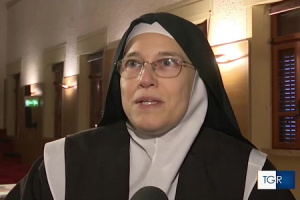
Adesso basta!: the Book of Sister Daniela Solustri on Multiple Sclerosis
TGR Rai Toscana interviewed Carmelite nun Sister Daniela Solustri, author of Adesso basta!, a book that presents her human and spiritual experience in light of the disease Multiple Sclerosis which she was diagnosed with 12 years ago.
Sister Daniela is a cloistered nun in a Carmelite convent in Cerreto di Sorano, in the province of Grosseto. In 2013, at the age of 42, she was diagnosed with Multiple Sclerosis, which brought with it suffering, fear of losing autonomy, and the inevitable slowing down of life.
In the TGR Rai Toscana broadcast on Wednesday, January 8, the nun said she “took several months to understand that the Lord was calling me to a radical form of life,” referring to the disease that afflicts her.
From the onset of the illness, Sister Daniela, who holds a degree in literature, began writing, first for herself but went on to shape a book, Adesso basta! (It Is Enough Now!).
The book, published by Effigi, was presented Tuesday, January 7, at 5 p.m. in the Friuli Hall of the San Francesco Convent in Grosseto. Together with the author, publisher Mario Papalini and Fr. Juliano Luiz Silva spoke. The moderator was Giacomo D'Onofrio, director of the Social Communications Office of the Diocese of Grosseto.
“Stop feeling pity for yourself, don't let life, when it seemingly becomes hostile, be unliveable,” the nun says in the interview. She added, “Everything that happens in life can be experienced as an overwhelming problem, or as an opportunity to unleash new resources, and in my case I am trying to live life with more intensity.”
Click to see the interview from TGR Rai Toscana below ...
Choir Books from the Mainz Carmelite Monastery Exhibit

The Whole World on Parchment: The Exhibition of the Choir Books from the Mainz Carmelite Monastery
An exhibition of ancient choir book from the Carmelite monastery entitled “The Whole World on Parchment. The Choir Books from the Mainz Carmelite Monastery,” is taking place in the Episcopal Cathedral and Diocesan Museum in Mainz, Germany from November 8, 2024 to March 23, 2025. The books were created from 1430 for the Carmelites to use during their religious services.
The prior general, Míceál O’Neill, O. Carm., together with the prior of the Carmelite community in Mainz, Josef Kemper, O. Carm., and with Richard Byrne, O. Carm., were invited to visit the exhibition in the week before it opened to the public, as final preparations were being made. As part of the exhibition, visitors are given the opportunity to lift up a replica of one of the choir books which, given the books weight 26kg each, most found difficult to do! They also saw the materials that were used to make the various inks and paints within the books.
The Carmelite Choir Books: Exquisite Illumination
There are only six books, but they are impressive. Weighing up to 26 kg per volume and a total of around 1,600 parchment pages, the so-called Carmelite choir books are among the giants of medieval manuscripts. But they are not only large and heavy, they are also exquisitely beautiful and original.
Created for the Mainz Carmelite monastery, the huge books were used in services several times a day and night: the 150 psalms as well as antiphons, hymns, canticles, and responsories as well as the changing chants of the mass.
But the books go far beyond their practical needs. The melodies in square notation on four red lines and the texts in the script typical of the time are equipped with a rich world of images that are among the highest quality and most bizarre in book illumination of the 15th century. Biblical figures, countless mythical and hybrid creatures, monsters, dragons, animals, plants and people cavort in scenes that range from graceful to crude and salacious. Nothing human seems alien to these books!
It expresses the deep wish that it is not chaos but a deeper meaning that holds them together: the songs give everyday life a pleasant structure, they “sanctify time,” the texts convey wisdom, the paintings show perfection and beauty and the countless drawings show the world in all its facets: love, desire and passion, human highs and lows.
The weighty topics are presented with an impressive lightness, not with a raised index finger, but with sweeping pen drawings and subtle, humorous irony. These books do not speak of the dark Middle Ages, but rather of 600 years of cheerful hope, which culminates in the last sentence of the Psalter: “Let everything that breathes praise the Lord!”
Carmelites & Mainz
The Carmelites were first mentioned in documents in Mainz in 1285 and from then on were present in the city for more than 500 years. Their monastery, with an extensive library, was a place of education and the convent contributed significantly to the founding of the university in 1477.
During secularization in 1802, the Carmelites lost their Mainz Carmel, the brothers were expelled, and the property was auctioned off. A large part of the valuable book holdings came into the possession of what is now the Mainz Scientific City Library, but also went into various archives and libraries around the world. The valuable late-medieval choir books ended up in what is now the Episcopal Cathedral and Diocesan Museum.
At the beginning of the 20th century, the late-Gothic monastery church was in such a deplorable state that the city council decided to demolish it. Many Mainz citizens protested against this. At the request of the bishop and thanks to the commitment of the Dutch Province, the Carmelites returned to Mainz in 1924.
The church building was transferred to the diocese. This was followed by renovations such as the restoration of the Gothic ceiling frescoes, the restoration of the church building after the Second World War and, most recently in 2009, an extensive redesign of the liturgical areas. Then as now, the Carmelites in Mainz are a contemplative community in the midst of people: the Carmelite Church is an inviting, spiritual place and the Carmelites are valued pastors in a diverse and colorful urban society.
Restoration, exhibition and digitisation
The restoration of the Carmelite choir books was funded by the state of Rhineland-Palatinate as part of the state funding program for the preservation of the collections. The digitization of the Carmelite choir books was carried out in the DFG project “Digitization of medieval manuscripts from Mainz, Worms and Speyer” at the Mainz University Library. The digitization project began with the Carmelites’ six large-format choir books and will be funded by the German Research Foundation (DFG) with 310,000 euros over the next three years.
Dr. Anja Lempges, deputy director of the Episcopal Cathedral and Diocesan Museum in Mainz, has worked on these highlights of European book art with a team of scientists and is presenting the special exhibition she has curated, “The Whole World on Parchment. The Choir Books from the Mainz Carmelite Monastery,” in the Episcopal Cathedral and Diocesan Museum in Mainz from November 8, 2024 to March 23, 2025.
“We would like to present the fragile, unique choir books of the Carmelites to a broad public,” explains Dr. Anja Lempges. The special exhibition is one of the highlights in the series of festivities for the 100th anniversary of the Episcopal Cathedral and Diocesan Museum in Mainz. The 100th anniversary of the repopulation of the Carmelite monastery in Mainz is also to be celebrated and is another reason for the special exhibition.
These six Carmelite choir books have been completely digitised. You can see the books for yourself here: (you have to scroll to the bottom of the page to find them):
https://gutenberg-capture.ub.uni-mainz.de/mittelalterlichehand/nav/index/all?facets=place%3D%22836512%22
However, if you can make your way to Mainz, it would be well worth seeing them and the associated exhibition for yourself. The exhibition finishes on 23rd March 2025.
Website for museum: https://www.dommuseum-mainz.de/die-ganze-welt-auf-pergament/
(Source: Cathedral Museum, Mainz, Germany)
-------------------
Images credits
St. Andrew Corsini, Bishop

January 9 | Feast
Born in Florence at the beginning of the 14th century, he entered religious life in the Carmelite house in his native city. He was appointed Provincial of Tuscany in 1348 by the General Chapter meeting in Metz and the following year he was named bishop of Fiesole, near Florence. He governed his diocese well, becoming a model of charity and an eloquent preacher. He was distinguished by his zeal for the apostolate, his wise judgement and his love for the poor. He was admired and appreciated by everyone. Many people, rich or less well endowed, came to him as peacemaker after the many years of in-fighting and quarrelling which had ruined their families and their cities. He died on 6th January 1374 and was canonised on 29th April 1629.
For more on St. Andrew Corsini and his work
Books Available from Edizioni Carmelitane:
St. Andrew Corsini, Carmelite (c. 1302-72) A Documentary Biography Part I
By Patrick Mullins, O. Carm.
St. Andrew Corsini, Carmelite (c. 1302-72) A Documentary Biography Part II
By Patrick Mullins, O. Carm.
Prior General's Schedule for January 2025

Fr. Míċeál O'Neill, the prior general, has the following schedule planned for the month of January 2025:
January 1-3: Philippines, fraternal visitation
January 3-11: Vietnam, fraternal visitation
January 13-14: Meeting of Europeans Provincials in Rome
January 15-19: Trinidad and Tobago, fraternal visitation
January 20-29: Honduras, El Salvador and Mexico, canonical visitation
January 30-31: Venezuela, Celebrations of the Centenary of the Affiliation of the Carmelite Sisters of Mother Candelaria to the Carmelite Order.
St. Peter Thomas, bishop

January 8th | Feast
Peter Thomas was a true Carmelite, not only in his relationship to Mary as the Queen and Decor Carmeli, but also in the way he lived his life according to the customs of the Order. However, his special commitment and concern was primarily for the unity of Christians. He constantly strove for reconciliation between the Church of Rome and the Orthodox Christians who had separated from the See of Peter in 1054. He developed an intensive apostolic activity as a peacemaker and defender of the popes. He always preached reconciliation. Miracles and extraordinary signs accompanied his eventful life.
A fresco created in 1880 by the Munich painter Max Fürst in the Carmelite church in Straubing shows St. Peter Thomas surrounded by confreres caring for the needy and giving communion to the sick. However, the painting also points to an essential characteristic of the saint's piety: his fervent devotion to Mary, who appears to him with the infant Jesus in her arms, accompanied by angels, and assures him of her protection and blessing. Tradition also credits him with writing a treatise on the Immaculate Conception of Mary (De Immaculata Conceptione BMV). Four volumes of his sermons have also been preserved.
In 1366, his chancellor and friend Philippe di Mézières, of whom he was also a spiritual director, wrote the biography of Petrus Thomas. Noted Carmelite historian, Joachim Smet, edited the Latin text from hitherto unpublished manuscripts. (The introduction and notes are in English.)
For more on St. Peter Thomas and his work, click here
Books Available from Edizioni Carmelitane:
The Life of Saint Peter Thomas by Philippe de Mézieres (Latin)
Introduction and Notes by Joachim Smet, O. Carm.
The Bollandist Dossier (1643) on St. Peter Thomas, O. Carm.
Edited and translated by Patrick Mullins, O. Carm.
The Revised Bollandist Dossier (1659) on St. Peter Thomas, O. Carm.
Edited and translated by Patrick Mullins, O. Carm.
Lectio Divina January 2025

Opening Prayer
Lord Jesus, send your Spirit to help us to read the Scriptures with the same mind that you read them to the disciples on the way to Emmaus. In the light of the Word, writtenin the Bible, you helped them to discover the presence of God in the disturbing events of your sentence and death. Thus, the cross that seemed to be the end of all hope became for them the source of life and of resurrection.
Create in us silence so that we may listen to your voice in Creation and in the Scriptures, in events and in people, above all in the poor and suffering. May your word guide us so that we too, like the two disciples from Emmaus, may experience theforce of your resurrection and witness to others that you are alive in our midst as source of fraternity, justice, and peace. We ask this of you, Jesus, son of Mary, who revealed to us the Father and sent us your Spirit. Amen.
Christmas Message to the Carmelite Family

Brothers and Sisters in the Carmelite Family, friars, nuns, sisters and brothers in the affiliated congregations, lay Carmelites, in a special way our Third Order Carmelites, the Third Sunday of Advent, that we have just celebrated, invites us to be joyful always. The angels at Christmas will proclaim peace to people of good will, and the Jubilee Year that is about to begin will inspire us with the theme, “Pilgrims of Hope”. Joy, Peace and Hope are the gifts of God. Without them we cannot live a full human life. For that reason we have to pray constantly for these gifts while at the same time making them the hallmarks of how we live. Yet again this year at Christmas there are many millions of people from whom there can be no joy, there will be no peace for them and their hope is like a small flame that struggles to survive. Joy comes when God’s creation is able to speak the praises of God. Peace comes when men and women are open to the truth of God, and hope is strong when men and women remember that “all things work for good for those who love the Lord, (Rm 8,28)
I pray that our celebration of Christmas this year, by proclaiming again the good news of the incarnation of the Word of God in the womb of Mary, may bring joy to us and to many, may put peace into the minds and hearts of those who are in a position to put an end to wars, and may strengthen our hope in the knowledge of God’s never ending love for all his creatures. May the Word of God speak joy, peace and hope to you, to your community and your family this Christmas. May it be possible for all of us to together to cry out with Mary, My soul glorifies the Lord, my spirit rejoices in God my Saviour. (Lk 1,47)
A blessed and joyful Christmas to one and all.
Thank you.
To watch the video on YouTube ...
...
Causa Nostrae Laetitiae

PROFESSIO TEMPORANEA
10-11-24 Teresa Maria de São José (TRI) Triunfo, Brasil
10-11-24 Teresinha Maria do Coração de Jesus (TRI) Triunfo, Brasil
10-11-24 Maria José do Espirito Santo (TRI) Triunfo, Brasil
10-11-24 Maria Isabel de Jesus Crucificado (TRI) Triunfo, Brasil
PROFESSIO SOLEMNIS
23-11-24 Dominic Therese Nhat Huynh (SEL-Viet)
23-11-24 Joseph Mary Luong Nguyen (SEL-Viet)
23-11-24 Nicholas of the Cross Dat Duong (SEL-Viet)
23-11-22 João Afonso Miranda Dias (Flum) São Paolo, Brasil
23-11-22 João Wanderson de Oliveira Ossola da Cruz (Flum) São Paolo, Brasil
23-11-22 Luis Miguel dos Santos Lima (Flum) São Paolo, Brasil
08-12-24 José Ricardo da Silva Oliveira (Pern) Olinda, Brasil
ORDINATIO DIACONALIS
23-11-24 João Paulo Prata Seixas (Pern) Caririaçu, Brasil
12-12-24 Igor Ângelo Peite (Pern) Camoncim de São Félix, Brasil
ORDINATIO SACERDOTALIS
14-11-24 Wanderson Luiz Freitas da Silva (Pern) João Câmara, Brasil
Pope Declares 16 Carmelites Nuns of Compiègne Saints

Pope Francis Declares 16 Carmelites Killed During French Revolution as Saints
In a decree published on December 18, Pope Francis declared 16 Discalced Carmelite nuns executed by guillotine during the French Revolution as martyrs. The Church did not use the usual process for the creation of a saint but by a rare process known as “equivalent canonization.” This process recognizes the long-standing veneration of the martyrs.
Pope Francis approved placing Blessed Teresa of St. Augustine and 15 other members of the Discalced Carmelites of Compiègne killed during the French Reign of Terror in the canon of saints. Two years after the French revolutionary government outlawed religious life in 1790, the community of Discalced Carmelites in Compiègne was forced to leave their monastery. In 1794, they were discovered to have continued living in community as consecrated women. They were tried and publicly executed by guillotine on July 17, 1794. As they moved towards martyrdom, they sang hymns of praise.
The story of these nuns inspired Francis Poulenc’s 1957 opera Dialogue of the Carmelites which was based on the book by the same name by Catholic novelist Georges Bernanos.
The pope recognized the heroic virtues of five others as well, including Archbishop Eduard Profitlich, a Jesuit, who died in a Russian prison in 1942; Salesian Elia Comini; the layman Pierre Goursat, founder of the Emmanuel Community; Áron Márton of Romania; and Giuseppe Maria Leone from the Congregation of the Most Holy Redeemer.
To read more ...