






O.Carm
Celebrating At Home - Holy Thursday
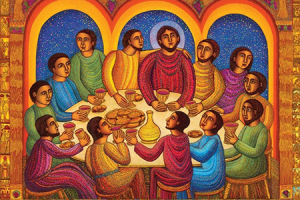
Washing feet, sharing bread and wine:
Love poured out in service
On this night we recall Jesus’ commandment to love one another, his washing of the disciples’ feet and the breaking of the bread of his own life, not just at table, but also on the altar of the Cross, for the healing and nourishment of the world.
The liturgy on Holy Thursday is a meditation on the essential connection between the Eucharist and Christian love expressed in serving one another.
Christ is not only present in the Eucharist but also in the deeds of loving kindness offered to others through us.
We are the ones who make ‘real’ the presence of Jesus in every smile, kind word and loving action.
Celebrating At Home - Palm Sunday
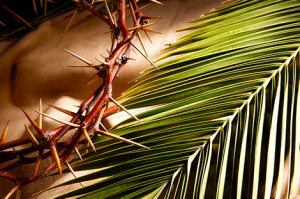
Love revealed
(Luke 23:1-49)
The Passion of Jesus according to Luke
Reader 1 The elders of the people and the chief priests and scribes rose, and they brought Jesus before Pilate.
They began their accusation, ‘We found this man inciting our people to revolt, opposing payment of tribute to Caesar, and claiming to be Christ, a king.’ Pilate put to him this question, ‘Are you the king of the Jews?’ ‘It is you who say it’.
Pilate then said to the chief priests and the crowd, ‘I find no case against this man.’ ‘He is inflaming the people with his teaching all over Judea; it has come all the way from Galilee, where he started, down to here.’ When Pilate heard this, he asked if the man were a Galilean; and finding that he came under Herod’s jurisdiction he passed him over to Herod who was also in Jerusalem at that time.
Reader 2 Herod was delighted to see Jesus; he had heard about him and had been wanting for a long time to set eyes on him; moreover, he was hoping to see some miracle worked by him. So he questioned him at some length; but without getting any reply. Meanwhile the chief priests and scribes were there, violently pressing their accusations.
Then Herod, together with his guards, treated him with contempt and made fun of him; he put a rich cloak on him and sent him back to Pilate. And though Herod and Pilate had been enemies before, they were reconciled that same day.
Reader 3 Pilate then summoned the chief priests and the leading men and the people. ‘You brought this man before me as a political agitator. Now I have gone into the matter myself in your presence and found no case against the man in respect of all the charges you bring against him. Nor has Herod either, since he has sent him back to us. As you can see, the man has done nothing that deserves death, so I shall have him flogged and then let go’.
But as one they howled, ‘Away with him! Give us Barabbas!’ (This man had been thrown into prison for causing a riot in the city and for murder.)
Reader 1 Pilate was anxious to set Jesus free and addressed them again, but they shouted back, ‘Crucify him! Crucify him!’ ‘But why? What harm has this man done? I have found no case against him that deserves death, so I shall have him punished and then let him go.’ But they kept on shouting at the top of their voices, demanding that he should be crucified. And their shouts were growing louder.
Pilate then gave his verdict: their demand was to be granted. He released the man they asked for, who had been imprisoned for rioting and murder, and handed Jesus over to them to deal with as they pleased.
Reader 2 As they were leading him away they seized on a man, Simon from Cyrene, who was coming in from the country, and made him shoulder the cross and carry it behind Jesus. Large numbers of people followed him, and of women too, who mourned and lamented for him. But Jesus turned to them and said, ‘Daughters of Jerusalem, do not weep for me; weep rather for yourselves and for your children. For the days will surely come when people will say, ‘Happy are those who are barren, the wombs that have never borne, the breasts that have never suckled!’ Then they will begin to say to the mountains, ‘Fall on us!’, to the hills, ‘Cover us!’ for if you use the green wood like this, what will happen when it is dry?’ Now with him there were also leading out two other criminals to be executed.
Reader 3 When they reached the place called the Skull, they crucified him there and the two criminals also, one on the right, the other on the left. Jesus said, ‘Father forgive them; they do not know what they are doing.’ Then they cast lots to share out his clothing.
Reader 1 The people stayed there watching him. As for the leaders, they jeered at him. ‘He saved others; let him save himself if he is the Christ of God, the Chosen One.’ The soldiers mocked him too and when they approached to offer him vinegar they said, ‘If you are the king of the Jews, save yourself.’ Above him there was an inscription: ‘This is the King of the Jews.’ Reader 2 One of the criminals hanging there abused him. ‘Are you not the Christ?’ he said. ‘Save yourself and us as well.’ But the other spoke up and rebuked him. ‘Have you no fear of God at all? You got the same sentence as he did, but in our case we deserved it; we are paying for what we did. But this man has done nothing wrong. Jesus, Remember me when you come into your kingdom.’ ‘Indeed, I promise you, today you will be with me in paradise.’ Reader 3 It was now about the sixth hour and, with the sun eclipsed, a darkness came over the whole land until the ninth hour. The veil of the Temple was torn right down the middle; and when Jesus had cried out with a loud voice, he said, ‘Father, into your hands I commit my spirit.’ With these words he breathed his last. [All pause for a moment] Reader 1 When the centurion saw what had taken place, he gave praise to God and said, ‘This was a great and good man.’ And when all the people who had gathered for the spectacle saw what had happened, they went home beating their breasts. All his friends stood at a distance, so also did the women who had accompanied him from Galilee, and they saw all this happen.
Consecration of Russia and Ukraine to Mary
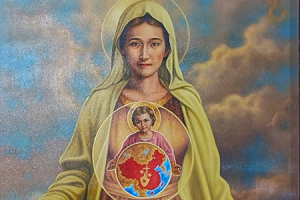
On March 25, in communion with Pope Francis and the entire Church, Carmelites and laity from around the world joined together to consecrate Russia and Ukraine to the Immaculate Heart of Mary.
The ceremony in the Carmelite basilica in Naples, Italy, was called for by the Archbishop Domenico Battaglia. He chose the Carmelite church as the place to celebrate the rosary and to consecrate Russia and Ukraine to Mary. The Archbishop himself led the prayer. He was assisted in the liturgy by the young men at the archdiocesan seminary. All the various groups of the diocese participated.
The sanctuary was crowded and reached its capacity with of around 500 people. Among those participating were the civil authorities and various other dignitaries. There were many intense reactions to the moments to the prayer. Those participating agreed that the beautiful Mother of Carmel looked down on her children with tender affection and that all those present felt enveloped by her maternal protection.
The sanctuary of Carmine Maggiore is the center of Neapolitan Marian devotion, the place of particular preference for the people who have invoked Our Lady down through the centuries, in all of their lives’ circumstances, calling Mary by the caring title “Mamma del Carmine.”
“We Carmelites were honored to have celebrated this important moment for the diocese under the loving gaze of the Madonna La Bruna,” said Alfredo Cerbo, commissary general. “We are confident that she will listen to our prayers at this very difficult moment in the entire world.”
At St. Agnes Parish and School in Phoenix, Arizona (USA)--where Carmelites have served since 1972--the whole community has been very concerned since the war began in Ukraine. At Sunday and weekday Masses the faithful have been encouraged to pray for peace. At the regular Friday School Masses, the children are asked to pray to God who loves everyone in the world to pray peace for the children and the parents of Ukraine. “The children from pre-school to eighth grade have taken this prayer in the church and their classrooms very seriously,” said Bradley Peterson, Carmelite pastor of the active parish.
When word came that Pope Francis would be consecrating all of humanity and especially Russia and the Ukraine to the Immaculate Heart of Mary and asking her to obtain for us the grace of peace, this seemed like a very concrete way for the children to join in prayer with the Pope and the Church throughout the world. The pastor shared the text of the consecration with the principal, Mrs. Kelly Aranowski, asking that the teachers use it prepare the students by praying a portion of prayer that Pope Francis would use as their daily meditation.
On the Solemnity of the Annunciation, many parishioners joined with all the students and teachers for Mass at 8:30 AM, with Jorge Monterroso, O. Carm. presiding. After Holy Communion, turning to the statue of Our Lady of Mount Carmel, Fr. Bradley led everyone present in the prayer of consecration.
When the students returned to their classrooms, their teachers joined the livestream from St. Peter’s Basilica in Rome and were able to pray along with Pope Francis. The 5th-8th grade students were together in the parish hall, each with the text of the consecration prayer so they could pray with the Pope on the big screen up above.
“We have continued to afford the children more time to pray by having them come to the church one day a week for silent prayer and adoration during Exposition of the Blessed Sacrament while the older children are participating the sacrament of reconciliation in preparation for Easter,” said Fr. Bradley.
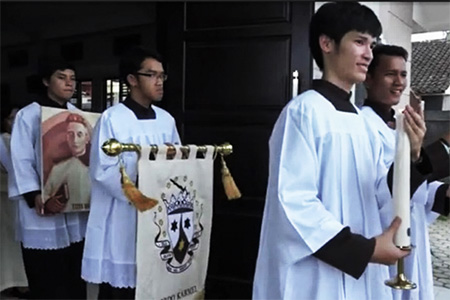
On Friday, March 25, during the celebration of the feast of Annunciation, the Indonesian Carmelites participated in the consecration of Russia and the Ukraine to Mary. As the Indonesian Bishop Conference urged the Indonesian Catholics to participate in the consecration, all Carmelite houses and parishes in the province dedicated the day to the consecration. In the Eucharistic celebration in every Carmelite house and parish, the prayer of the consecration was said.
The Indonesian province also had a special celebration of the Annunciation which was combined with the consecration. It took place at the Carmelite Prayer Garden in Malang. The celebration was started with the Via Dolorosa Devotion with the intention for peace in Russia and the Ukraine. After finishing the devotion, the Carmelites and the people walked to the hall to have a Eucharistic celebration. Beside the altar, they had put a painting of Our Lady of Mount Carmel with baby Jesus in front of her womb. At the opening of the Eucharistic celebration, the people offered candles to Mother Mary and prayed for the peace of Russia and Ukraine. The celebrants of the Eucharistic celebration were F.X. Hariwan Adji, the prior provincial of the Indonesian Province and Alexander Agung Prasetyo O. Carm.
At the end of the celebration, the prayer of the consecration was said together. Many people and Carmelites took the opportunity to participate in the celebration.
Learning Fraternity from Titus’s Life
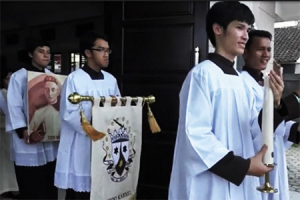
 Titus Brandsma left many writings, either in the form of books, articles or letters, but he never wrote about his teachings on fraternity. In spite of that, he lived a fraternal life.
Learning Fraternity from Titus’s Life
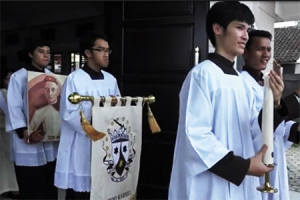
Titus Brandsma left many writings, either in the form of books, articles or letters, but he never wrote about his teachings on fraternity. In spite of that, he lived a fraternal life. We can learn how he valued fraternity from his life journey. For Titus, love is the foundation of fraternity. Fraternity is impossible without love. Titus' love for others grew from his close relationship with God. Titus realized that God loved him and that he loved God. This experience of love with God made Titus love his fellow human beings. When dealing with others, Titus realized that his main task was to love them. Titus lived the second Law of Love, namely: Love your neighbor as you love yourself. Titus believed that God was present in his fellow human beings. To love and serve them means to love and serve Jesus. His love is also shown in the form of generosity. Titus always told his brothers and sisters in the Order to share with those in need. He warned them not to be stingy in giving food and money to the poor, because they had the right to the food and money. He urged the brothers and the sister to live on charity. For him, the poor are God's friends. In order for us to be friends of God, we must be friends to his friends.
Titus's fraternity is not limited to certain circles or to his own group (ad intra) but penetrates group boundaries (ad extra). He never discriminated against people because of their religion, ethnicity, race, class, or nationality. Titus made friends with people regardless of their background. Titus also fought for equal rights for his neighbors regardless of their ethnicity, race, religion, and social class. True fraternity always transcends the boundaries of fit and unsuitability. True fraternity does not look at whether someone has the same views or backgrounds.
Fraternity for Titus not only includes being together in physical terms, although that is also important, but also being together in spiritual terms. Being together in the presence of God is no less important than doing something together and working together. Titus also paid attention to the spiritual development of his brothers. When Titus heard that there was a nursing home for the elderly people that needed a priest to celebrate the weekly mass, but was unable to provide the stipends, he asked permission from his prior to give them spiritual services. Likewise, when Titus was imprisoned by the Nazis, Titus always tried to provide spiritual service to other prisoners.
One of the shelters run by the Indonesian Carmelite NGO is dedicated to Titus Brandsma. The shelter was blessed on April 18, 2018. It is located in one of the slum areas in Malang. This shelter functions as a shelter for homeless poor people. These unfortunate people are taken care with love by the volunteers. Any person, regardless their religious background, ethnicity and affiliation, may live in the shelter but, of course, it depends on bed availability. The requirements to be accepted in those houses are that they are really poor and have nobody to takes care of them.
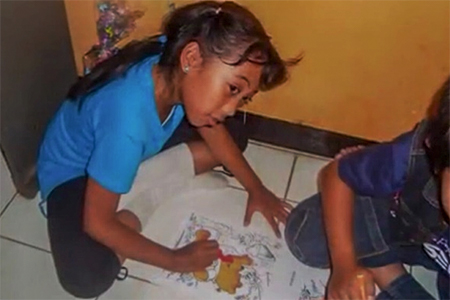
The shelter also functions as an informal school for children from poor families to develop their knowledge. Students with different religious backgrounds participate actively in this school. The subjects offered by this informal school are the usual subjects (mathematics, English, and general knowledge). The difference between this informal school and formal schools is the process of teaching is founded on love. Students are accepted as they are, with their strengths and weaknesses. Each student is taken care of without any judgement being made. Their competence is developed individually since we believe that every child is created uniquely. The students are happy to study here because they are respected as individuals. Thanks to God, most of the students studying in this informal will be successful when they go to a formal school. Moreover, this informal school offers character building and the Christian value of love. Students are invited to respect themselves, be open to others, accept differences and love their neighbors without knowing their backgrounds. Finally, this informal school also offers performance and creativity classes. The students are encouraged to develop themselves and to be independent.
There are some other done by the volunteers together with the local people. They cook together and share the meal with people living on the streets and poor people in the area. On certain occasion they cooperate with donors to get daily needs and then share them with the poor families who are affected by the Covid 19 pandemic.
Many people with different backgrounds love to come to that place since they may experience the love shared by the volunteers, the patients, the teachers and the students. Students from Islamic university in Malang often come to visit the patients and the students. They also become volunteers in some of the programs. The spirit of fraternity of Titus Brandsma really fills the atmosphere of this shelter. This place becomes a meeting place for people to celebrate fraternity.
Below are some pictures of the activities done in the Titus Brandsma Shelter, Malang.
The Carmelite NGO in Indonesia established Mercy House — dedicated to Blessed Titus Brandsma — in Malang in April 2018 to serve the elderly and children from families of all faiths. The elderly are provided a dignified place to live with food and care. The children are provided education and enrichment. It is a living example of Blessed Titus’ words “He who wants to win the world for Christ must have the courage to come in conflict with it."
You can see a short video on the Indonesian Mercy House Dedicated to Blessed Titus Brandsma below.
* Fr. Hariwan Adji, O. Carm., the author of this article, is the current prior provincial of the Indonesian Province of the Carmelite Order. He is a member of the Carmelite NGO and chair of the Indonesian Carmelite NGO. He holds a doctorate and is a lecturer on the Faculty of Humanities at Airlangga State University.
|
|
|
|
The blessing of the shelter |
The inauguration of the shelter |
|
|
|
|
One of the patients |
Patient with different religious backgrounds |
|
|
|
|
Students learning art |
Student with Islamic backgrounds |
|
|
|
|
Local people visit the house |
Volunteering Islamic university students |
|
|
|
|
Cooking for sharing with the poors |
Cooking for sharing with the poors |
|
|
|
|
Distributing free daily needs to the poors |
Distributing free meals to the poors |








Titus Brandsma and His Work With the Esperanto
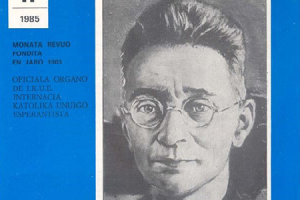
Marija Belošević is the current president of the Internazionale Union of Cattolica Esperantists (IKUE) which counted Fr. Titus Brandsma of Oss, Netherlands, among its early members. Aware of Fr. Titus’ upcoming canonization, Mrs. Belošević has been using digitized records and magazines from IKUE to research Fr. Titus’ connection to the language of Esperanto and to her Catholic organization which promotes it. Her research indicates that the Dutch professor was very involved with Esperanto earlier than previously thought.
Today’s very international city of Aia in the Netherlands hosted the Second Congress of the International Association of Catholic Esperantists on August 14-18, 1911. During that congress, a work group was formed to draw up an ecclesiastical (theological) dictionary in the Esperanto language. In the list of the 12 members of the work group is the name of Titus Brandsma.[1]
Naturally, the largest number of the members of this work group were professors and pastors in the Catholic Church. It is worth noting that the work group for the dictionary contains names of a number of experts in the Esperanto language. Most of these were active before the First Congress of the organization. That Congress was held in Paris in 1910 with some of the pioneers of the Esperanto movement attending.
It was already known that Fr. Titus celebrated a Mass in Esperanto in 1913. It was long thought that this liturgical celebration was his first activity in the Catholic Esperanto movement. However, this recent research by Mrs. Belošević proves that he started at least two years earlier, in the first half of 1911 or perhaps even before.
Studying old copies of the magazines Espero Katolika and Nederlanda katoliko, which are now digitized, Marija Belošević found a list of new members up to July 15, 1911 [Nederlanda Katoliko (n. 8/1911)]. In the section “Ordinary New Members” there is the listing for “Pro. Dr. Titus Brandsma, Klooster der Karmelieten, Oss.”
The name of the Carmelite saint is also found in the 1926 annual, the first of the group’s annual publications, as well as in those of 1928, and 1931/1932. His name is also listed in the annuals of the organization for 1937 and 1938.
The 1911 listing is the first known mention of Fr. Titus in connection to the Association of Catholic Esperantists. When one became a member of the Dutch Association one automatically became a member of the International Association of Catholic Esperantists.
The Internazionale Union of Cattolica Esperantists (Internacia Katolika Unuigo Esperantista in Esperanto) is a lay organization of the Catholic Church with an office in Rome. It strives to apply Christian ideals to everyday life and the spread the Gospel by means of Esperanto. The organization takes as its charge the command given in the Gospel of Mark: “Go out to the whole world; proclaim the Gospel to all creation.” (Mk 16:15)
There is a similar organization for Protestant Christians, Kristana Esperantista Ligo Internacia (KELI). The language Esperanto has many ties with the Christian Churches. The first book translated into Esperanto was the Old Testament. The magazine Espero Katolika (Catholic Hope) first appeared in 1903.
The Catholic Church continues to be closely networked with the movement as well. Pope John Paul II used Esperanto as one of the languages in his annual Urbi et Orbi blessing. Vatican Radio continues broadcasting programs in Esperanto regularly. Catholic or Ecumenical International Congresses are held almost every year. Because it is an officially recognized liturgical language, Catholic religious services continue to be held in Esperanto.
The first issue in 2018 of the Carmelite journal The Sword, Fr. Fernando Millán Romeral, O. Carm., the co-vice postulator for Fr. Titus Brandsma’s cause for canonization, published an article on Blessed Titus and the Esperanto language. The article explores the origins of the language as well as Fr. Titus’ promotion of its use and its value to him.
In recognition of the canonization of its famous member, the IKUE is preparing a prayer card with the official prayer for the canonization in Esperanto.
[1] Questa informazione l’ho trovata nella rivista "Espero Katolika" n. 78/1911.
Sankta Titus Brandsma Carmelite Preĝo
Dio de paco kaj justeco,
malfermu niajn korojn al amo
kaj al la ĝojo de la Evangelio
eĉ meze de sennombraj formoj de perforto
kiuj subpremas la dignon de niaj fratoj kaj fratinoj,
plenigu nin per Via graco,
por ke, samkiel sankta Titus Brandsma,
tenere, povu ni vidi preter la hororoj de malhomeco
kaj kontempli vian gloron
kiu brilas en la martiroj de ĉiu epoko,
kaj tiel iĝi viaj aŭtentaj atestantoj en la nuna mondo.
Amen
(traduzione: Marija Belošević)
Download the Prayer in Esperanto here
Tanzanian Carmelites Visit General Curia
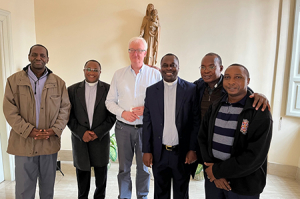
On Thursday, March 31, 2022, members of the General Commissariat of “La Bruna” who live and minister in Tanzania visited the General Curia. They were in Italy for the Chapter of the Commissariat which was held March 28-30 at Carmine Maggiore in Naples.
The house in Dar Es Salaam, Tanzania was founded in October 2009.
In the picture, from left to right are: Dominic M. Somola, recently elected 2nd Councilor of the Commissariat; Thomas M. Mtey; Míceál O’Neill, the prior general; Victor M. Biramata; Paul Innocent M. Kaigalura; and Paul M. Malewa.
Titus Brandsma: The Man of Our Time
 In 2018 I had the opportunity to attend the Carmelite formation course on Titus Brandsma in the Netherlands and Germany. Learning more about him made me realise that as an individual and the Order at large, we have a lot to learn from and imitate about Titus. As we approach the canonisation of Titus I have decided to outline how he can be a model of Carmelite life specifically in the context of the Zimbabwean Commissariate I belong to. I should highlight that this reflection was influenced by the works of scholars like Miguel Arribas, Boniface Hanley, Vanden Heuvel, and Leopold Glueckert.
Titus possessed a profound “practical insight” into situations which can be understood as discretion. This enabled him to deal exceptionally with problematic situations like misunderstandings in the community and elsewhere. In a general sense this means that conflict is inevitable wherever two or more people gather in the same space hence the need to be discreet in conflict solving. In his own right, Titus can be regarded as an embodiment of such a great trait which the Order and the Commissariat in Zimbabwe must emulate in word and in deed. For instance, Carmel in Zimbabwe finds itself in the midst of people who belong to different political parties, cultures, and religions. The Carmelite family in Zimbabwe consists of brothers and sisters who owe their being to such a diversified society. Conflict and other problems proper to community living are bound to arise. As such, Titus reminds us to be peacemakers braced with the weapon of “practical insight” so as to create an enabling environment for Carmelites in Zimbabwe to continue to live in allegiance to Jesus Christ (Carmelite Rule 2) as well as to help the people they serve to do likewise.
In light of the Carmelite charism which states that we are a contemplative fraternity in the midst of people, Titus reiterates the importance of guarding against mere externalization of spirituality which is void of an authentic mystical or inner spiritual life. In a way, Titus advocates a balanced Carmelite way of life, such that no pillar of our Charism should be overemphasized at the expense of the others. This also connects with the Order’s ability to read and interpret the signs of times in order to live our charism in a manner that is relevant to our context. Titus in his lecture on the Concept of God in 1932 emphasized the need to find new ways of conceiving God according to the “spirit of the age.” According to Titus, we have to continue finding new ways of making God known. Those forms should be in line with our modern culture. This is essential as new times require new forms of expression. The past seventy-five years of Carmelite presence in Zimbabwe chronicles how the Commissariat engaged the “spirit of the age” in its provisions of service. From the advent of Carmelites in Zimbabwe to the present day, the Commissariat partakes in various ministries such as pastoral work, chaplaincy, education, and retreat-giving. However, a further challenge from Titus is a need to venture into various apostolates relevant to the needs of our country and the local Church.
Titus comprehensively brings out the importance of our two models of inspiration namely Our Lady of Mt. Carmel and the Prophet Elijah. Titus talks about how Carmelites share in the double portion of the prophet Elijah. Experience enlightens us to understand that ‘inheritance’ is a portion of something given to the first child and in the Zimbabwe context, the first born son. So, the double portion of the spirit of Elijah is the inheritance given to Carmelites, the privileged children of Elijah in order to keep the tradition of the family and to follow in the footsteps of the prophet Elijah. For Titus, the double portion of the spirit of Elijah represents our contemplative and active participation in the life of the prophet Elijah, our father. God used to call him from his contemplative life to fulfill an active role in the society and thereafter he always returned to contemplation.
In the same manner, Carmelites are called to be active contemplatives who, in their active apostolates, should always fall back on contemplation. In fact, contemplation should be regarded as the higher and better part of Carmelite life. So, the double portion of the spirit of Elijah is the harmonious union of the human exercise of virtue and the divine infusion of mystical life; the union of the purgative and illuminative ways with the unitive way (Valabek 221). Thus Carmelites are reminded to live a life of uniting active and passive contemplation. There should be the union of human effort and the mystical life of God. Human challenges, sufferings or sacrifices in prayer and virtue will be rewarded by God “with the beautifying vision of His love and greatness” (224)
Furthermore, Titus helped in the founding of the Catholic University of Nijmegen. Titus valued religious education. He believed. A lack of religious education results in a lack of an attitude of reverence of all creation and especially for other people. I concur with Titus because religious education is essential if human beings are going to be treated with dignity as they are created in the image and likeness of God. Moreover, the inclusion of religion in education helps one to understand oneself, other people, and other societies. Titus' teaching about the reverence of all creation cements the contemporary, ever-growing realization that human beings and the ecology are connected. Today, Titus reminds the Order and the Carmelites in Zimbabwe of the pertinent need to contribute not only in shaping the future generations through the provision of integrated education, but also in practical ministries like environmental apostolates (clean-up campaigns and the placement of litter bins in key spots). This also serves as a practical witness to other people to reverence all creation.
As a journalist Titus unsparingly worked with the media and thus engaged in issues pertaining to social justice. In late 1935 he became the National Spiritual Adviser to the Union of Catholic Journalists. In this apostolate Titus gave his all, even to the point of losing his life, fighting for justice and the truth. In like manner, Carmelites of today have a responsibility like that of Prophet Elijah, which Titus epitomizes, to resolutely stand for the truth always. Standing for what is right comes with its challenges. For instance, during Titus' time some restrictions were imposed on the Catholic radio network so that it was suspended and its freedom of expression consequently thwarted such that it was hardly possible to speak of a Catholic Press.
While in prison at Scheveningen, Amersfoort, and Dachau, Titus faced difficult situations but he remained hopeful and also infused others with hope. Titus’ Good Friday talk shed light on his own approach to what was happening to him. Faith and hope made Titus strong and unrelenting even in the face of stern hostility. Even in great suffering, Titus remained in communion with God. Titus' believed that his sufferings were a participation in the passion of Christ such that in the like-manner as the resurrected Christ, Titus too will emerge victorious. Titus believed that it was only God who could enable him to sail through the darkness he was facing. For him, suffering is an opportunity to experience God’s love in us.
In the contemporary world, especially in Zimbabwe but elsewhere in the world as well, the Carmelite friars are ministering in difficult situations and to broken people whose sufferings are exacerbated by economic meltdown which is dwindling their sources of livelihood. Apart from economic constraints, war is one of the ravaging evils of our time. In recent times, the apocalyptic effects of war are apparent in Ukraine and other warzone countries worldwide. In such times, Titus postulates that faith and hope in God and in our capacity as human beings to revere life and all creation will one day triumph over such existential evils like war. The Order at this time and all times, should unapologetically remain a harbinger and repository of hope, peace, and reconciliation.
Finally, in Titus, Carmelites are reminded to be agents of unity since they serve people from all walks of life. Different ethnicities and religious and political affiliations should not take precedence over the fact that we are all human beings created in the image of God. Titus went a step further to defend the rights of the Jews and advocated for their admission to Catholic schools. Moreover, Titus' founding of an association called ‘Apostolate of Re-unification’ furthered his intention of uniting Catholics and our brethren from the Eastern Church. The question is what are we doing today as Carmelites in the area of ecumenism?
May the celebration of the canonisation of Titus Brandsma bring renewal to the whole Carmelite Order and the entire Church.
Underson Musina O. Carm
Read the original article in Shona pdf here (74 KB)
Titus Brandsma: The Man of Our Time
 In 2018 I had the opportunity to attend the Carmelite formation course on Titus Brandsma in the Netherlands and Germany. Learning more about him made me realise that as an individual and the Order at large, we have a lot to learn from and imitate about Titus.
Titus Brandsma: The Man of Our Time

In 2018 I had the opportunity to attend the Carmelite formation course on Titus Brandsma in the Netherlands and Germany. Learning more about him made me realise that as an individual and the Order at large, we have a lot to learn from and imitate about Titus. As we approach the canonisation of Titus I have decided to outline how he can be a model of Carmelite life specifically in the context of the Zimbabwean Commissariate I belong to. I should highlight that this reflection was influenced by the works of scholars like Miguel Arribas, Boniface Hanley, Vanden Heuvel, and Leopold Glueckert.
Titus possessed a profound “practical insight” into situations which can be understood as discretion. This enabled him to deal exceptionally with problematic situations like misunderstandings in the community and elsewhere. In a general sense this means that conflict is inevitable wherever two or more people gather in the same space hence the need to be discreet in conflict solving. In his own right, Titus can be regarded as an embodiment of such a great trait which the Order and the Commissariat in Zimbabwe must emulate in word and in deed. For instance, Carmel in Zimbabwe finds itself in the midst of people who belong to different political parties, cultures, and religions. The Carmelite family in Zimbabwe consists of brothers and sisters who owe their being to such a diversified society. Conflict and other problems proper to community living are bound to arise. As such, Titus reminds us to be peacemakers braced with the weapon of “practical insight” so as to create an enabling environment for Carmelites in Zimbabwe to continue to live in allegiance to Jesus Christ (Carmelite Rule 2) as well as to help the people they serve to do likewise.
In light of the Carmelite charism which states that we are a contemplative fraternity in the midst of people, Titus reiterates the importance of guarding against mere externalization of spirituality which is void of an authentic mystical or inner spiritual life. In a way, Titus advocates a balanced Carmelite way of life, such that no pillar of our Charism should be overemphasized at the expense of the others. This also connects with the Order’s ability to read and interpret the signs of times in order to live our charism in a manner that is relevant to our context. Titus in his lecture on the Concept of God in 1932 emphasized the need to find new ways of conceiving God according to the “spirit of the age.” According to Titus, we have to continue finding new ways of making God known. Those forms should be in line with our modern culture. This is essential as new times require new forms of expression. The past seventy-five years of Carmelite presence in Zimbabwe chronicles how the Commissariat engaged the “spirit of the age” in its provisions of service. From the advent of Carmelites in Zimbabwe to the present day, the Commissariat partakes in various ministries such as pastoral work, chaplaincy, education, and retreat-giving. However, a further challenge from Titus is a need to venture into various apostolates relevant to the needs of our country and the local Church.
Titus comprehensively brings out the importance of our two models of inspiration namely Our Lady of Mt. Carmel and the Prophet Elijah. Titus talks about how Carmelites share in the double portion of the prophet Elijah. Experience enlightens us to understand that ‘inheritance’ is a portion of something given to the first child and in the Zimbabwe context, the first born son. So, the double portion of the spirit of Elijah is the inheritance given to Carmelites, the privileged children of Elijah in order to keep the tradition of the family and to follow in the footsteps of the prophet Elijah. For Titus, the double portion of the spirit of Elijah represents our contemplative and active participation in the life of the prophet Elijah, our father. God used to call him from his contemplative life to fulfill an active role in the society and thereafter he always returned to contemplation.
In the same manner, Carmelites are called to be active contemplatives who, in their active apostolates, should always fall back on contemplation. In fact, contemplation should be regarded as the higher and better part of Carmelite life. So, the double portion of the spirit of Elijah is the harmonious union of the human exercise of virtue and the divine infusion of mystical life; the union of the purgative and illuminative ways with the unitive way (Valabek 221). Thus Carmelites are reminded to live a life of uniting active and passive contemplation. There should be the union of human effort and the mystical life of God. Human challenges, sufferings or sacrifices in prayer and virtue will be rewarded by God “with the beautifying vision of His love and greatness” (224)
Furthermore, Titus helped in the founding of the Catholic University of Nijmegen. Titus valued religious education. He believed. A lack of religious education results in a lack of an attitude of reverence of all creation and especially for other people. I concur with Titus because religious education is essential if human beings are going to be treated with dignity as they are created in the image and likeness of God. Moreover, the inclusion of religion in education helps one to understand oneself, other people, and other societies. Titus' teaching about the reverence of all creation cements the contemporary, ever-growing realization that human beings and the ecology are connected. Today, Titus reminds the Order and the Carmelites in Zimbabwe of the pertinent need to contribute not only in shaping the future generations through the provision of integrated education, but also in practical ministries like environmental apostolates (clean-up campaigns and the placement of litter bins in key spots). This also serves as a practical witness to other people to reverence all creation.
As a journalist Titus unsparingly worked with the media and thus engaged in issues pertaining to social justice. In late 1935 he became the National Spiritual Adviser to the Union of Catholic Journalists. In this apostolate Titus gave his all, even to the point of losing his life, fighting for justice and the truth. In like manner, Carmelites of today have a responsibility like that of Prophet Elijah, which Titus epitomizes, to resolutely stand for the truth always. Standing for what is right comes with its challenges. For instance, during Titus' time some restrictions were imposed on the Catholic radio network so that it was suspended and its freedom of expression consequently thwarted such that it was hardly possible to speak of a Catholic Press.
While in prison at Scheveningen, Amersfoort, and Dachau, Titus faced difficult situations but he remained hopeful and also infused others with hope. Titus’ Good Friday talk shed light on his own approach to what was happening to him. Faith and hope made Titus strong and unrelenting even in the face of stern hostility. Even in great suffering, Titus remained in communion with God. Titus' believed that his sufferings were a participation in the passion of Christ such that in the like-manner as the resurrected Christ, Titus too will emerge victorious. Titus believed that it was only God who could enable him to sail through the darkness he was facing. For him, suffering is an opportunity to experience God’s love in us.
In the contemporary world, especially in Zimbabwe but elsewhere in the world as well, the Carmelite friars are ministering in difficult situations and to broken people whose sufferings are exacerbated by economic meltdown which is dwindling their sources of livelihood. Apart from economic constraints, war is one of the ravaging evils of our time. In recent times, the apocalyptic effects of war are apparent in Ukraine and other warzone countries worldwide. In such times, Titus postulates that faith and hope in God and in our capacity as human beings to revere life and all creation will one day triumph over such existential evils like war. The Order at this time and all times, should unapologetically remain a harbinger and repository of hope, peace, and reconciliation.
Finally, in Titus, Carmelites are reminded to be agents of unity since they serve people from all walks of life. Different ethnicities and religious and political affiliations should not take precedence over the fact that we are all human beings created in the image of God. Titus went a step further to defend the rights of the Jews and advocated for their admission to Catholic schools. Moreover, Titus' founding of an association called ‘Apostolate of Re-unification’ furthered his intention of uniting Catholics and our brethren from the Eastern Church. The question is what are we doing today as Carmelites in the area of ecumenism?
May the celebration of the canonisation of Titus Brandsma bring renewal to the whole Carmelite Order and the entire Church.
Underson Musina O. Carm
Read the original article in Shona pdf here (74 KB)