





 Database containing a list of articles written by Titus and others written on him from 1985-2017.

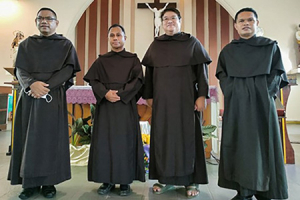
Elective Chapter of the Monastery of Ss.ma Trinità in Jesi

If nature and nurture determine one’s personality, I was predestined to become a Carmelite. Brought up with Carmelite friends of my parents in a Carmelite parish and at a Carmelite school, all of which stands for my upbringing and significant others in my childhood, my nurturing.

Nature and Nurture
If nature and nurture determine one’s personality, I was predestined to become a Carmelite. Brought up with Carmelite friends of my parents in a Carmelite parish and at a Carmelite school, all of which stands for my upbringing and significant others in my childhood, my nurturing. There was no escape. Consequently, in 2001, I became a member of the Carmelite family as a Third Order Carmelite: my ‘genetic print,’ my nature.
Father Titus and My Hometown
It all started in Oss, a small industrial town in the southern Dutch province of Brabant. I was born in 1957 in Oss. From 1909 till 1923 Father Titus lived in Oss in a Carmelite monastery and taught philosophy. He founded a secondary school, the Carmel College, where I studied for 8 years. A statue of Father Titus stood prominently in front of the college.
So there I was in Oss, 15 years after father Titus Brandsma was murdered in Dachau. We both have this connection with that small town called Oss. I grew up there. The old and new Carmelite monastery were a daily fact of life, a part of life, my family’s life, as well as the old and new friar’s church, the cemetery, and the schools.
Father Galema, who I knew as one of the Carmelite teachers at my college, was buried next to my sister Marike. She unfortunately passed away in 1978 after a long struggle with cancer at the age of 18 years. The local Carmelite community and Father Falco Thuis, the prior general from 1971-1983, were of great consolation for my parents who had just lost a child. Marike was a faithful young woman.
Facing death, she was full of hope and resigned herself to her destiny, believing she would be with God, with Jesus. My sister Marike gave me a spiritual boost at the time. Now, when I read his poem, she reminds me of Father Titus and how he suffered and kept his faith, experiencing Jesus as his good and close friend.
“Sweet Jesus, I in Thee and Thou In me shall never part……No grief shall fall my way but I Shall see thy grief-filled eyes; The lonely way that Thou once walked Has made me sorrow-wise.”
A Call
Together with my brothers and sisters I grew up in a Catholic family with loving and caring parents. Our mother made our house a home, warm and secure. Our father, who was a lawyer and later in life a judge at a Criminal Court, taught us about solidarity with the less fortunate and about justice and righteousness as the essence of our faith.
“Many and varied are the ways in which our saintly forefathers laid down how everyone, whatever his station or the kind of religious observance he has chosen, should live a life of allegiance to Jesus Christ — how, pure in heart and stout in conscience, he must be unswerving in the service of his Master.”
As a teenager, my dream was to become a priest and a missionary to live and work in Africa. I soon discovered celibacy was not my call. Instead of the seminary and monastery, I choose the university in Amsterdam and became a medical doctor. I married my Marlène and we moved to The Hague. We were both with busy jobs in a busy city with a busy family life. We hungered for silence, prayer and community.
During the early years of our marriage, Father Jos Boermans, also one of my former teachers at the Titus Brandsma college, has been a great support and inspiration for Marlène and myself developing our mutual Carmelite marital spirituality. In our correspondence and meetings, we teasingly referred to him as brother B. as in the first chapter of the Rule of Saint Albert.
“Albert, called by God’s favour to be Patriarch of the Church of Jerusalem, bids health in the Lord and the blessing of the Holy Spirit to his beloved sons in Christ, B. and the other hermits under obedience to him, who live near the spring on Mount Carmel.”
Catholic values, such as human dignity, solidarity, and service in the community for the common good, defined Father Titus’ life. In my own spiritual development, I realized more and more that the same values defined my life, in my choices as a medical doctor as well as my activities in the Church. Therefore, I decided (actually my wife came up with the idea) to start the diaconate formation program and was ordained as a deacon in 1995. In the diocese people joked: “Did God call Paul? We thought it was Marlène.”
“What makes society enjoyable, rather than organised rights and duties, are patience, mutual tolerance and mercifulness. In short: love.”
My Daily Focus and Inspiration
When choosing a password one tends to include a personal reference. For me a password helps me to focus whatever activity I perform. My many digital passwords for computer, apps, social media, websites, work related domains, and God knows what else, all of which are too complicated to remember properly, include a reference to Father Titus.
“Each one of you is to stay in his own cell or nearby, pondering the Lord’s law day and night and keeping watch at his prayer unless attending to some other duty.”
City of International Justice and Peace
During my study of medicine, my wife and I moved to The Hague, the city where the International Court of Justice for arbitrage in conflicts between countries (the Peace Palace) is located.
“The Nazi movement is regarded by the Dutch people not only as an insult to God in relation to his creatures, but a violation of the glorious traditions of the Dutch nation. God bless the Netherlands. God bless Germany. May God grant that both nations will soon be standing side by side in full peace and harmony.”
At the Nuremberg trials after the Second World War, individuals were tried for crimes of conspiracy, crimes against peace, war crimes, and crimes against humanity. In the 1990s the Tribunal for the former Yugoslavia was erected under the auspices of the United Nation’s Security Council.
At that time, I just started my medical practice as a general practitioner. With only a few patients my income was not sufficient to cover all expenses created by life in the city and a young family. Looking for a job to earn some extra money on the side, I began working as a prison doctor at the Scheveningen prison. In the early years I worked in the detention unit were Father Titus Brandsma had been held prisoner by the Nazis. A nickname for this prison during the Second World War was “the Orange Hotel” a reference to it as the prison of the resistance fighters in support of the Oranje, the Dutch royal house. During my rounds to visit detainees, I often passed the original “death” cell in which Father Titus must have stayed and wrote his poem.
During lock-up time I managed to visit the original death cell a few times. The most memorable visit was with Carmelite Father Constant Dölle [ed note: author of Encountering God in the Abyss, who met Fr. Titus when his family hosted Brandsma on several occasions at their home.] and a few other Carmelites. Later in life, Father Constant became seriously visually impaired. I took him by the hand and described to him the images I saw and red the texts on the wall. Thereafter, I brought his hand towards the subjects, he touched them and told me how he recognized Father Titus’ descriptions of his cell. Father Constant also spoke about the phrases carved into the walls such as “God is faithful” and “Stay courageous.”
Not in my wildest dreams could I have guessed that years later I would work for several International Criminal Tribunals as a fully trained penitentiary physician. Individuals, detained and accused of war crimes, crimes against humanity and genocide, are my patients. To be able to perform my duty as their doctor I have to set aside my knowledge about the accusations, their violence, and the victims. First of all “innocent until proven guilty” but more importantly is what Father Titus taught me:
God is present, hidden, in every human being and in all of creation. Every moment God creates everything that is, out of nothing. All is in God and God is in all.
And “Evil and unjust are temporarily. Finally, good wins through good choices and deeds by inspired people.”
In Summary
Walking my path in life, Father Titus Brandsma has always walked beside me. There were times I was not aware of his presence – like the disciples heading to Emmaus – although his influence and the presence of the Carmelite community moulded and sculpted my spirituality and my choices; At other times, and definitely later in life, Father Titus and the whole Carmelite community supported me in coming to recognize God’s face and how to stand before God.
“Search God in the depth of our own existence; resign in silence and peace… God, the Source, will approach us in ordinary things; We only need to open ourselves….. We only need to do ordinary things in an extra-ordinary way.
About the Author:
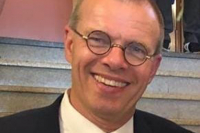
Paulus Falke is a medical doctor, a deacon of the Catholic Church, and a member of the Third Order of the Dutch Province of the Carmelite Order. He and his wife Marlene have four biological children: Marike (Maria), Guus (Gus), Sarah, and Zwaan (Swanny) and 5 “foster children” whom they looked after and are still in contact with: Monica, Max, Marilyn, Jamie and Sonja. The couple founded Saint Jacob’s Hospice for terminal ill patients in 1995. The hospice, located in The Hague, has the motto: “Every life is worth living, how vulnerable or disabled it may be.” In the Holy year 2000, two television documentaries were made about the family. One focused on Falke’s work as a family doctor and deacon. It was titled “Doctor Amongst the Poor.” The second told the story of the family—how they as parents were raising the children in a inner city are with many social problems and how faith was an essential part of their lives.