








Members of Schools & Young People's Commission
P. Raúl Maraví Cabrera (praeses)
P. Paul Cahill (Aus)
P. Miguel Ángel Díaz Moreno (Baet)
P. Carl Markelz (PCM)
P. David Oliver (Arag)
Sig. César Santa María (Peru – laico)
P. Michael Troy (Hib)
First Meeting of the International Commission for Carmelite Schools and Youth
From 26 to 29 June 2008, the new International Commission for Carmelite Schools and Youth held its first meeting in the General Curia house in Rome. Together with the Councillor General Fr. Raúl Maraví, there were representatives from Europe, North and South America and Oceania.
The Prior General, Fr. Fernando Millán Romeral, and the Vice Prior General, Fr. Christian Körner, greeted the members of the Commission. During the meeting various aspects of Carmelite education were discussed, as were the presence of Carmelite laity and the new challenges that we are facing in our school centres today. After exchanging views on a number of topics, the group discussed the preparations for an International Conference on Carmelite Schools, which had been suggested by the 2007 General Chapter. The meeting will be held from 8 to 14 April 2010 in Dublin, Ireland, to coincide with the 150th anniversary of the foundation of the Irish province school, Terenure College. It was also decided to send a questionnaire to all Carmelite schools, which will serve as a basis for the participants’ work in the congress.
The Commission will meet again in 2009 to continue preparations for the International Congress and to promote other events linked to it.
Theology
P. Mark Attard (Mel)
P. Carlo Cicconetti (Ita)
P. Giuseppe Midili (Ita)
P. Conrad Mutizamhepo (Hib – Zim)
P. Christopher O’Donnell (Hib)
P. Aureliano Pacciolla (Neap)
P. Henricus Pidyarto (Indo)
P. Christian Körner (comm. de communicatione)
P. Miguel Norbert Ubarri (comm. de laicatu)
P. Raúl Maravi Cebrera (comm. de disciplinis et iuvenibus)
P. Desiderio Garcia Martinez (comm. de formatione)
Rite for the Blessing of and Enrolment in the Scapular of the Blessed Virgin Mary of Mount Carmel
R/. Amen.
R/. And with your spirit.
R/. And with your spirit.
This Scapular of our Lady of Mount Carmel is a sign of the motherly love of the Virgin Mary, which reminds us of her care for the members of the Carmelite Family, especially in moments of great need. It is a love which seeks a reciprocal love.
This Scapular is a sign of communion with the Order of the Brothers of the Blessed Virgin Mary of Mount Carmel dedicated to the service of our Lady for the good of the whole Church. With this Scapular you express the desire to take part in the spirit and life of the Order.
The Scapular is a mirror of the humility and purity of Mary: through her simplicity she invites us to live modestly and in purity. By wearing the Scapular day and night, it becomes a sign of our constant prayer and of our special dedication to the love and service of the Virgin Mary.
By wearing the Scapular, you renew your baptismal vow to put on our Lord Jesus Christ. In Mary, your hope of salvation will be safeguarded, because in her the God of Life has made his abode.
Pr 8,17-21. I love those who love me.
Is 61,10-11. He has clothed me with a mantle of justice.
2K 2,7-13. The mantle of Elijah fell on Elisha.
Bar 5,1-5. Clothe yourselves with the beauty of God.
Ez 16,8-14. Your beauty was perfect.
Mk 5,25-34. The woman touched the garment of Jesus and was cured.
Lk 2,4-8. Mary wrapped her Firstborn in swaddling clothes.
Rm 12,1-2. This is your spiritual worship.
Gal 4,4-7. God sent his Son born of a woman.
Ep 4,17,20-24. Clothe yourselves with the new man.
Ep 6,10-17. Take strength from the Lord.
R/. Lord, grant that we may be clothed in Jesus Christ.
- grant that, by the intercession of the Virgin Mary, his perfect disciple, we may be clothed in his divinity.
- grant that, by the intercession of the Virgin Mary, we may imitate Christ and be pleasing to you in all our works.
- by the intercession of the Virgin Mary, clothe us with her active charity and her loving service.
- by the intercession of the Virgin, grant that we may be able to overcome the snares of the evil one in our life and in the world we live in.
- by the intercession of Mary, Virgin of the New Heart, purify our hearts and strengthen our faith.
- by the intercession of Mary, grant that we may be prophets of your Kingdom, that we may proclaim your mercy to every generation.
- by the intercession of the Virgin Mother, grant that we may love the poor and the marginalized, and that we may be united to them in building a world which is more just and fraternal.
- by the intercession of the Virgin Mary, sanctify us in Christ and make us generous collaborators in the work of the salvation of this world.
- by the intercession of the Virgin Mary, grant that we may happily pass from death to life.
R/. Amen.
R/. Amen.
Min. Having received the Scapular, you have been received into the family of Carmel, consecrated in a special way to the imitation and service of the Virgin Mother of God, that you may live for Christ and his Church in the contemplative and apostolic spirit of the Order of Carmel.
And that you may be able to follow this ideal perfectly, by the faculties entrusted to me, I admit you to participate in all the spiritual benefits of the Order of Carmel.
Closing Rite
Min. May the Father pour on you his merciful love given to us in Christ Jesus, son of the Virgin Mary.
R/. Amen.
R/. Amen.
Min. The Holy Spirit has inspired you to place yourselves under the mantle of Mary may he make you apostles in the way of justice and peace.
R/. Amen.
Or:
17. The celebration may end with an appropriate hymn to Our Lady, for instance, Flos Carmeli, Salve Regina, Sub tuum praesidium.
ALTERNATIVE RITE FOR
THE BLESSING OF AND ENROLMENT IN THE SCAPULAR
R/. Amen.
Min. The grace of our Lord Jesus Christ born of the Virgin Mary, the love of God the Father and the fellowship of the Holy Spirit be with you all.
R/. And with your spirit.
The Word of God
Pr 8,17-21. I love those who love me.
Is 61,10-11. He has clothed me with a mantle of justice.
2K 2,7-13. The mantle of Elijah fell on Elisha.
Bar 5,1-5. Clothe yourselves with the beauty of God.
Ez 16,8-14. Your beauty was perfect.
Mk 5,25-34. The woman touched the garment of Jesus and was cured.
Lk 2,4-8. Mary wrapped her Firstborn in swaddling clothes.
Pjn 12,1-2. This is your spiritual worship.
Gal 4,4-7. God sent his Son born of a woman.
Ep 4,17,20-24. Clothe yourselves with the new man.
Ep 6,10-17. Take strength from the Lord.
21. Let us pray to God our Father, by the intercession of the Virgin Mary:
Lord, hear us.
Lord, hear us.
Lord, hear us.
Lord, hear us.
Lord, hear us.
Lord, hear us.
Lord, hear us.
Lord, hear us.
Lord, hear us.
Prayer of Blessing
R/. Amen.
R/. Amen.
The minister explains the obligations and commitment involved in wearing the Scapular worthily and concludes with the blessing.
Min. May the blessing of almighty God, Father, Son and Holy Spirit descend upon you and remain with you forever.
R/. Amen.
R/. Amen.
A Sign of Christian Faith and Commitment
Signs in Ordinary Human Life
There are also, in every day life, experiences of relationships between human beings, express and symbolize deeper meanings such as sharing a meal (as a sign of friendship), taking part in a protest march (as a sign of solidarity), joining together in a national celebration (as a sign of our identity).
Signs in Christian Life
In the celebration of the Eucharist and the other sacraments (baptism, confirmation, reconciliation, matrimony, orders, the sacrament of the sick) the symbols (water, oil, the laying on of hands, the rings), all have their own meaning and bring us into communication with God, present in each of them.
As well as liturgical signs, the Church has others related to some event, to some tradition, or some person. One of these is the Brown Scapular of Our Lady of Mount Carmel.
The Scapular is a Sign of Mary
The word "scapular" indicates a form of clothing which monks wore when they were working. With the passage of time, people began to give symbolic meaning to it: the cross to be borne every day as disciples and followers of Christ. In some Religious Orders, such as the Carmelites, the Scapular turned into a sign of their way of life. The Scapular came to symbolize the special dedication of Carmelites to Mary, the Mother of God, and to express trust in her motherly protection as well as the desire to be like her in her commitment to Christ and to others. Thus it became a sign of Mary.
From Religious Orders to the People of God
The Spiritual Meaning of the Scapular
It stands for a commitment to follow Jesus, like Mary, the perfect model of all the disciples of Christ. This commitment finds its origin in baptism by which we become children of God.
The Blessed Virgin teaches us:
- to be open to God, and to His will, shown to us in the events of our lives;
- to listen to the Word of God in the Bible and in life, to believe in it and to put into practice its demands;
- to pray at all times, as a way of discovering the presence of God in all that is happening around us;
- to be involved with people, being attentive to their needs.
It leads us into the community of Carmel, a community of religious men and women, which has existed in the Church for over eight centuries. It calls on us to live out the ideal of this religious family: intimate friendship with God in prayer.
It reminds us of the example of the saints of Carmel, with whom we establish a close bond as brothers and sisters to one another.
It is an expression of our belief that we will meet God in eternal life, aided by the intercession and prayer of Mary.
Some practical rules
People are enroled in the Brown Scapular only once, by a priest or authorized person.
The Scapular can be replaced afterwards by a medal which has on one side the image of the Sacred Heart of Jesus and on the other, the image of Mary.
The Scapular holds us to live as authentic Christians in line with the teaching of the Gospel, to receive the sacraments, to profess our special devotion to the Blessed Virgin, which should be expressed each day - for example, by praying the Hail Mary, prayerful reading of the Scriptures, service to someone in need.
Short Form for Giving the Scapular
The Brown Scapular is not
a magical charm to protect you
an automatic guarantee of salvation
an excuse for not living up to the demands of the Christian life
The Brown Scapular is a sign which
has been approved by the Church for over seven centuries
stands for the decision to follow Jesus like Mary:
- open to God and to God's will
- guided by faith, hope and love
- close to the needs of people
- praying at all times
- discovering God present in all that happens around us
introduces people into the Family of Carmel
The Brown Scapular
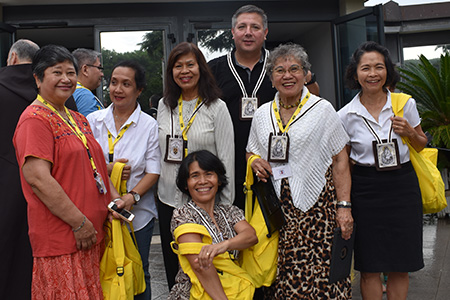 "The scapular is a sign of Mary’s permanent and constant motherly love for Carmelite brothers and sisters. By their devotion to the scapular, faithful to a tradition in the Order, especially since the 16th century, Carmelites express the loving closeness of Mary to the people of God; it is a sign of consecration to Mary, a means of uniting the faithful to the Order, and an effective and popular means of evangelization." (Carmelite Constitutions No. 27)
Signs in Ordinary Human Life
The world in which we live is full of material things which have symbolic meaning: light, fire, water.....
There are also, in every day life, experiences of relationships between human beings, express and symbolize deeper meanings such as sharing a meal (as a sign of friendship), taking part in a protest march (as a sign of solidarity), joining together in a national celebration (as a sign of our identity). We need signs and symbols to help us understand what is happening at present, or what happened before, and to give us an awareness of who we are, as individuals and as groups.
Signs in Christian Life
Jesus is the great sign and gift of the Father's love. He founded the Church as a sign and instrument of His love. Christian life also has its signs. Jesus used bread, wine and water to help us understand higher things which we can neither see nor touch. In the celebration of the Eucharist and the other sacraments (baptism, confirmation, reconciliation, matrimony, orders, the sacrament of the sick) the symbols (water, oil, the laying on of hands, the rings), all have their own meaning and bring us into communication with God, present in each of them. As well as liturgical signs, the Church has others related to some event, to some tradition, or some person. One of these is the Brown Scapular of Our Lady of Mount Carmel.
The Scapular is a Sign of Mary
One of the signs in the tradition of the Church from many centuries ago is the Brown Scapular of Our Lady of Mount Carmel. It is a sign approved by the Church and accepted by the Carmelite Order as an external sign of love for Mary, of the trust her children have in her, and of commitment to live like her.
The word "scapular" indicates a form of clothing which monks wore when they were working. With the passage of time, people began to give symbolic meaning to it: the cross to be borne every day as disciples and followers of Christ. In some Religious Orders, such as the Carmelites, the Scapular turned into a sign of their way of life. The Scapular came to symbolize the special dedication of Carmelites to Mary, the Mother of God, and to express trust in her motherly protection as well as the desire to be like her in her commitment to Christ and to others. Thus it became a sign of Mary.
From Religious Orders to the People of God
In the middle ages many Christians wanted to be associated with the Orders founded at that time: Franciscans, Dominicans, Augustinians and Carmelites. Groups of lay people began to emerge in associations, such as confraternities and sodalities. All the Religious Orders wanted to give these lay people a sign of affiliation and of participation in their spirit and apostolate. The sign was often a part of their habit: a cloak, a cord, a scapular. Among the Carmelites, the stage came when a smaller version of the Scapular was accepted as the sign of belonging to the Order and an expression of its spirituality.
The Spiritual Meaning of the Scapular
The Scapular finds its roots in the tradition of the Order, which has seen in it a sign of Mary's motherly protection. It has, therefore, a centuries' old spiritual meaning approved by the Catholic Church:
- It stands for a commitment to follow Jesus, like Mary, the perfect model of all the disciples of Christ. This commitment finds its origin in baptism by which we become children of God.
- The Blessed Virgin teaches us:
- to be open to God, and to His will, shown to us in the events of our lives;
- to listen to the Word of God in the Bible and in life, to believe in it and to put into practice its demands;
- to pray at all times, as a way of discovering the presence of God in all that is happening around us;
- to be involved with people, being attentive to their needs.
- It leads us into the community of Carmel, a community of religious men and women, which has existed in the Church for over eight centuries. It calls on us to live out the ideal of this religious family: intimate friendship with God in prayer.
- It reminds us of the example of the saints of Carmel, with whom we establish a close bond as brothers and sisters to one another.
- It is an expression of our belief that we will meet God in eternal life, aided by the intercession and prayer of Mary.
- Some practical rules
People are enroled in the Brown Scapular only once, by a priest or authorized person.
The Scapular can be replaced afterwards by a medal which has on one side the image of the Sacred Heart of Jesus and on the other, the image of Mary.
The Scapular holds us to live as authentic Christians in line with the teaching of the Gospel, to receive the sacraments, to profess our special devotion to the Blessed Virgin, which should be expressed each day - for example, by praying the Hail Mary, prayerful reading of the Scriptures, service to someone in need.
Short Form for Giving the Scapular
Receive this Scapular, a sign of your special relationship with Mary, the Mother of Jesus, whom you pledge to imitate. May it be a reminder to you of your dignity as a Christian, in serving others and imitating Mary. Wear it as a sign of her protection and of belonging to the Family of Carmel, voluntarily doing the will of God and devoting yourself to building a world true to his plan of community, justice and peace.
The Brown Scapular is not
- a magical charm to protect you
- an automatic guarantee of salvation
- an excuse for not living up to the demands of the Christian life
The Brown Scapular is a sign which
- has been approved by the Church for over seven centuries
- stands for the decision to follow Jesus like Mary:
- open to God and to God's will
- guided by faith, hope and love
- close to the needs of people
- praying at all times
- discovering God present in all that happens around us
- introduces people into the Family of Carmel
- points to a renewed hope of encountering God in eternal life with the help of Mary's protection and intercession.
Lectio Divina: Matthew 5:33-37
Ordinary Time
1) Opening prayer
God of wisdom and love,
source of all good,
send Your Spirit to teach us Your truth
and guide our actions
in Your way of peace.
We ask this through our Lord Jesus Christ, Your Son,
who lives and reigns with You and the Holy Spirit,
one God, for ever and ever. Amen.
2) Gospel Reading - Matthew 5:33-37
Jesus said to his disciples: "You have heard that it was said to your ancestors, Do not take a false oath, but make good to the Lord all that you vow. But I say to you, do not swear at all; not by heaven, for it is God's throne; nor by the earth, for it is his footstool; nor by Jerusalem, for it is the city of the great King. Do not swear by your head, for you cannot make a single hair white or black. Let your 'Yes' mean 'Yes,' and your 'No' mean 'No.' Anything more is from the Evil One."
3) Reflection
• In today’s Gospel, Jesus rereads the commandment: “Do not commit perjury.” And here also He surpasses the letter, concerning the spirit of the law, and seeks to indicate the ultimate goal of this commandment: to attain total transparency in relationships among people. Here we can apply what we said concerning the two commandments “Do not kill” and “Do not commit adultery.” It is a question of a new way of interpreting and setting into practice the law of Moses, starting from the new experience of God the Father which Jesus has brought to us. He rereads the law beginning with the intention that God had in proclaiming it centuries ago on Mount Sinai.
• Matthew 5:33: It was said to our ancestors: you must not swear. The Law of the Old Testament said, “Do not commit perjury” and it added that the person should swear for the Lord. In the Psalms it is said that “one can go up to the Mountain of Yahweh and reach the holy place, if he has innocent hands and a pure heart, and does not confide in idols, nor swear in order to deceive”(Ps 24:4). The same thing is said in other parts of the Old Testament (Eccl 5:3-4), because one must be able to trust the words of others. In order to promote this reciprocal trust, tradition had invented the help of the oath. In order to strengthen one’s own word, the person would swear on someone or on something which was greater than he and who could punish him if he did not do what he had promised. Things continue to be like this up to the present time. Whether in the Church or in society, there are some moments and occasions which demand a solemn oath from people. In the final analysis, the oath is the expression of the conviction that nobody can completely trust the word of another.
• Matthew 5:34-36: But I say to you: do not swear. Jesus wants to heal this defect. It is not enough “not to swear.” He goes beyond and affirms: “But I say to you: do not swear at all: either by heaven, since that is God’s throne; or by earth, since that is His footstool, or by Jerusalem, since that is the city of the great King. Do not swear by your own head either, since you cannot turn a single hair white or black. All you need to say is ‘Yes’ if you mean yes, and ‘No’ if you mean no. Anything more than this comes from the Evil One.”
They would swear on heaven and on earth, on the city of Jerusalem, on their own head. Jesus shows that all that does not cure the pain and suffering from the lack of transparency and trust among people. What is the solution which He proposes?
• Matthew 5:37: Let your speech be yes, yes; no, no. The solution which God proposes is the following: Let your speech be yes, yes; no, no; anything more than this comes from the Evil One. He proposes a radical and total honesty. Nothing more. Anything more that you say comes from the Evil One. Here again, we are confronted with an objective which will always remain in our mind and which we will never succeed in fulfilling completely. It is another expression of the new ideal of justice which Jesus proposes: “to be perfect like the Heavenly Father is perfect” (Mt 5:48). Jesus uproots any attempt to create the conviction that I am saved because I observe the law. Nobody can merit God’s grace, because otherwise it would not be a grace. We observe the Law, not in order to merit salvation, but in order to thank with all our heart for the immense gratuitous goodness of God, who accepts us and saves us without any merit on our part.
4) Personal questions
• How honest is my speech? How honest am I with myself as I answer that?
• Is Jesus addressing intent in this instruction, to be trustworthy without external aids?
• Or is He addressing the hypocrisy of having one truth when speaking and another when under oath?
• Or is He giving instructions to not do a physical act, as one might be asked to do in a modern courtroom?
5) Concluding Prayer
I bless Yahweh who is my counselor,
even at night my heart instructs me.
I keep Yahweh before me always,
for with Him at my right hand, nothing can shake me.
(Ps 16:7-8)
Lectio Divina: Christ the King (C)
Jesus the King of the Jews
A King different from the kings of the earth
Luke 23:35-43
Opening prayer
Holy One, God of the mountain,
You who make of our fragile life
the rock of Your dwelling place,
lead our mind
to strike the rock of the desert,
so that water may gush to quench our thirst.
May the poverty of our feelings
cover us as with a mantle in the darkness of the night
and may it open our heart to hear the echo of silence
until the dawn,
wrapping us with the light of the new morning,
may bring us,
with the spent embers of the fire of the shepherds of the Absolute
who have kept vigil for us close to the divine Master,
the flavor of the holy memory.
1. LECTIO

a) The text :
The rulers sneered at Jesus and said, "He saved others, let him save himself if he is the chosen one, the Christ of God." Even the soldiers jeered at him. As they approached to offer him wine they called out, "If you are King of the Jews, save yourself." Above him there was an inscription that read, "This is the King of the Jews." Now one of the criminals hanging there reviled Jesus, saying, "Are you not the Christ? Save yourself and us." The other, however, rebuking him, said in reply, "Have you no fear of God, for you are subject to the same condemnation? And indeed, we have been condemned justly, for the sentence we received corresponds to our crimes, but this man has done nothing criminal." Then he said, "Jesus, remember me when you come into your kingdom." He replied to him, "Amen, I say to you, today you will be with me in Paradise."
b) A moment of silence:
Let us allow the voice of the Word to resonate within us.
2) MEDITATIO
a) Questions:
- The people stayed there watching. Why do you never take a stand concerning the events? Everything that you have lived, listened to, seen… you cannot just throw it away only because an obstacle seems to make it difficult! Move, do something!
“If You are the King of the Jews, save Yourself”. How many attempts and threats do we make with God in prayer? If You are God why do You not intervene? There are so many innocent people who suffer. If You love me, do what I tell You and I will believe You… When will you ever stop dealing with the Lord as if you knew more than He what is good and what is not?
Jesus, remember me. When will you see in Christ the only TODAY who gives you life?
b) Key for the reading:
Solemnity of Christ, King of the Universe. We would expect a passage of the Gospel of those which are more luminous, and instead we find ourselves before one of the darkest passages… The amazement of the unexpected is the most suitable sentiment to enter into the heart of today’s feast, the amazement of the one who knows that he cannot understand the infinite mystery of the Son of God.
v. 35. The people stayed there watching, as for the leaders, they jeered at Him with these words: “He saved others, let Him save Himself if He is the Christ of God, the Chosen One.” Around the Cross are gathered together many of those who have met Jesus during the three years of His public life. And, here, before a Word nailed on the wood, are revealed the secrets of the heart. The people who had listened to and followed the Rabbi of Galilee, who had seen miracles and wonders, are there watching: the perplexity on the faces, thousands of questions in the heart, the disillusionment and the perception that everything ends like this! The leaders go through all that has happened while they say the truth concerning the person of Jesus: the Christ of God, the Chosen One. They ignore God’s logic even if they are faithful observers of the Hebrew law. That very despicable invitation: Let Him save Himself… indicates the hidden purpose of their actions: salvation is won by oneself by the observance of the commandments of God.
vv. 36-37. The soldiers mocked Him too, coming up to Him, offering Him vinegar, and saying, “If You are the King of the Jews, save Yourself”. The soldiers, who have nothing to lose in the religious field, get fierce against Him. What do they have in common with that man? What have they received from Him? Nothing. The possibility to exercise, even if for a short time, power over someone cannot be allowed to fall! The power of possession is intertwined with evil and they claim the right of derision. The other one, defenseless, becomes the object of their enjoyment.
v. 38. Above Him was an inscription: This is the King of the Jews. Truly, a mockery of their own guilt: Jesus is guilty for being the King of the Jews, a guilt which in reality is no guilt. In spite of what the leaders had intended, in all their ways, to crush the royalty of Christ, the truth is written by itself: This is the King of the Jews! This one, not any other! It is a royalty which goes across the centuries and asks those going by to stop and fix their thought on the novelty of the Gospel. Man needs someone to govern him, and this someone can be only a man crucified out of love, capable to stand on the wood of condemnation so as to be found alive at the dawn of the eighth day: A King without a scepter, a King capable of being considered by all a criminal but without rejecting His love for man.
v. 39. One of the criminals hanging there abused Him: Are You not the Christ? Save Yourself and us as well!” One can be on the cross for various reasons just as one can be with Christ for various reasons. Being near to the cross divides or unites. One of the two who were near Christ insults, provokes, ridicules or derides. The objective is always the same: Save yourself and us as well! Salvation is invoked as a flight from the cross. A sterile salvation, deprived of life, already dead in itself. Jesus is nailed to the cross, this criminal is hung on the cross. Jesus has become one same thing with the wood, because the cross is for Him the scroll of the book which unfolds to narrate the wonders of the divine life which is surrendered, given without any conditions. The other one is hung as a fruit, rotten by evil and ready to be thrown away.
v. 40. But the other spoke up and rebuked him: “Have you no fear of God at all? You got the same sentence as He did.” The other one, being close to Jesus, acquires again the holy fear and makes a judgment. Can the one who lives next to Jesus reproach one who is there, two steps away from life and does not see it, and continues to waste it to the end? Everything has a limit, and in this case the limit is not fixed by Christ who is there, but by His companion. Christ does not respond; the other one responds in His place, recognizing his responsibility and helping the other one to read the present moment as an opportunity for salvation.
v. 41. “In our case, we deserve it. We are paying for what we did. But this man has done nothing wrong”. Evil leads to the cross, the serpent had guided to the forbidden fruit hanging on the tree. But which cross: the cross of one’s own “reward” or the cross of the good fruit? Christ is the fruit which every man or woman can get from the tree of life, which is in the middle of the garden of the world, the just one who has never done any evil except love until ad finem.
v. 42. And then he said: “Jesus, remember me when You come into Your kingdom”. It is a life which is fulfilled and is enclosed in an invocation incredibly dense in significance. A man, a sinner, conscious of his own sin and of the just condemnation, accepts the mystery of the cross. At the feet of that throne of glory he asks to be remembered in the Kingdom of Christ. He sees an innocent who is crucified and he recognizes and sees beyond what appears exteriorly, the life of the eternal Kingdom. What an acknowledgement! The eyes of the one who has known, in one instant, to get the life which was passing by and which was proclaiming a message of salvation even if in a shocking way. That culprit, criminal deserving death, insulted and ridiculed by all those who had had the possibility of knowing Him closely and for a long time, receives His first subject, the first one He wins over. The scripture says, damned is the one hanging on the wood. The damned innocent becomes blessing for the one who deserved condemnation. A political and earthly tribunal, that of Pilate, a divine tribunal, that of the cross, where the one condemned is saved in virtue of the consuming love of the innocent Lamb.
v. 43. He answered him: “In truth I tell you, today you will be with Me in paradise”. Today: the only word which bursts into the new life of the Gospel. Salvation has been accomplished; it is no longer necessary to wait for any Messiah to save the people from their sins. Today, salvation is here, on the cross. Christ does not enter into His Kingdom alone. He takes with Him the first one who has been saved: the same humanity, the same judgment, the same luck, the same victory. Jesus is not jealous of His filial prerogatives, immediately He has pulled away from the distance separating Him from the Father and from the death which could not escape nor had a way out. Wonderful the kingdom which was inaugurated on Golgotha. Someone has said that the good thief committed the last robbery of his life; he robbed salvation. And so it is, for those who move with the things of God! How much truth, instead, in contemplating the gift which Christ gives to His companion of the cross. No robbery, no theft! All is a gift: the presence of God is not bargained or traded! Faith is what opens the door of the Kingdom to the good thief. Good because he knew how to name justly what his existence had been and saw the Savior in Christ. Was the other one evil? Neither more nor less than the other one perhaps, but he remained beyond faith: he was looking for the strong and powerful God, the powerful God in battle, a God who places things in their place and he did not know how to recognize him in the eyes of Christ, he stopped at his powerlessness.
c) Reflection
Christ dies on the Cross. He is not alone. He is surrounded by the people, by the strangest persons, the hostile ones who throw on Him their responsibility of lack of understanding, the indifferent ones who do not get involved except for personal interest, those who do not understand as yet but who, perhaps, are better disposed to allow themselves to be questioned, since they think they have nothing to lose, like one of the two criminals. If death is to fall into nothingness, then human time becomes anguish. If, instead, it is to wait for the light, then human time becomes hope, and the space of the finite opens a passage to tomorrow, to the new dawn of the Resurrection. I am the way, the truth and the life. How true are these words, the words of Jesus, words which enlighten the darkness of death. The way does not stop, the truth is not turned off. Life does not die. In those words “I AM” is enclosed the royalty of Christ. We journey toward a goal, and to attain it cannot mean to lose it… I am the way… We live from truth, and truth is not an object, but something which exists: “Truth is the splendor of reality – says Simon Weil – and to desire truth is to desire a direct contact with reality in order to love it”. “I am the truth… Nobody wants to die, we feel deprived of something which belongs to us: life, and then, if life does not form part of us, it can not hold us to itself… I am the life… Jesus has said it: “He who wants to save his life, will lose it, but the one who loses his life for Me, will find it”. Is there some contradiction in the terms or rather secrets hidden to be revealed? Do we remove the veil from what we see in order to enjoy what we do not see? Christ on the cross is the object of everybody’s attention. Many think of Him or are even at His side. But this is not sufficient. The closeness which saves is not that of those who are there to deride or to mock. The closeness which saves is that of the one who humbly asks to be remembered not in the fleeing time but in the eternal Kingdom.
3. ORATIO
Psalm 145
I shall praise You to the heights, God my King,
I shall bless Your name for ever and ever.
Day after day I shall bless You,
I shall praise Your name for ever and ever.
Great is Yahweh and worthy of all praise,
his greatness beyond all reckoning.
Each age will praise Your deeds to the next,
proclaiming Your mighty works.
Your renown is the splendor of Your glory,
I will ponder the story of Your wonders.
They will speak of Your awesome power,
and I shall recount Your greatness.
They will bring out the memory of Your great generosity,
and joyfully acclaim Your saving justice.
Yahweh is tenderness and pity,
slow to anger, full of faithful love.
Yahweh is generous to all.
His tenderness embraces all His creatures.
All Your creatures shall thank You, Yahweh,
and Your faithful shall bless You.
They shall speak of the glory of Your kingship
and tell of Your might,
making known Your mighty deeds to the children of Adam,
the glory and majesty of Your kingship.
Your kingship is a kingship forever,
Your reign lasts from age to age.
Yahweh is trustworthy in all His words,
and upright in all His deeds.
Yahweh supports all who stumble,
lifts up those who are bowed down.
All look to You in hope
and You feed them with the food of the season.
And, with generous hand,
You satisfy the desires of every living creature.
Upright in all that He does,
Yahweh acts only in faithful love.
He is close to all who call upon Him,
all who call on Him from the heart.
He fulfills the desires of all who fear Him,
He hears their cry and He saves them.
Yahweh guards all who love Him,
but all the wicked He destroys.
My mouth shall always praise Yahweh,
let every creature bless His holy name for ever and ever.
4. CONTEMPLATIO
Lord, it sounds strange to call You King. One does not get close to a King easily. And, instead, today I find You sitting beside me, in the ditch of sin, here, where I would never have thought to find You. Kings are in palaces, far from the difficulties of the poor people. You, instead, live Your Lordship wearing the worn out clothes of our poverty. What a great feast for me to see You here where I went to hide myself so as not to feel the indiscreet looks of human judgment. On the edge of my failures, whom have I found if not You? The only one who could reproach me for my incoherence comes to look for me to sustain me in my anguish and in my humiliation! What great illusion when we think that we should come to You only when we have attained perfection… I would want to think that You do not like what I am, but perhaps, it is not exactly like that: I do not like what I am, but for You, I am all right, because Your love is something special which respects everything in me and makes of every instant of my life a space of encounter and of gift. Lord, teach me not to get down from the cross with the absurd pretension of saving myself! Grant that I may know how to wait, at Your side, the TODAY of Your Kingdom in my life.


