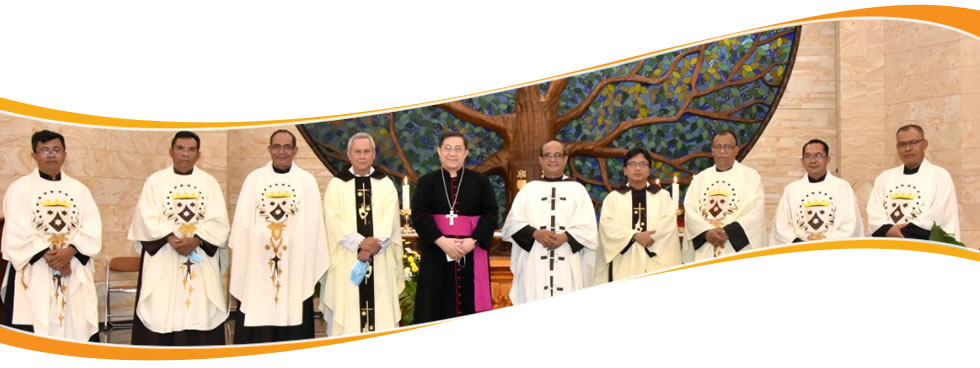
Discalced Carmelite Renewal Course at Stella Maris, Mount Carmel, Haifa, Israel.
The Discalced Carmelites (OCD) are holding a renewal course for Carmelite Friars in the Spanish language, beginning at the end of November 2011 and concluding in February 2012. They have kindly left a few places for O.Carm. friars and in their letter of invitation they state: "Our aim is to place at the disposal of the whole Carmelite family Mount Carmel, the Cradle of the Order and its unique context of the Holy Bible for our spiritual renewal and nourishment. The Course will harmoniously blend the Biblical and Carmelite dimensions of the spiritual life though prayer, study, Lectio Divina and pilgrimage." Those friars interested should make contact directly with Secretariat for Formation of the Casa Generalizia dei Carmelitani Scalzi Questo indirizzo email è protetto dagli spambots. È necessario abilitare JavaScript per vederlo. or Questo indirizzo email è protetto dagli spambots. È necessario abilitare JavaScript per vederlo.. For those requiring a Visa for entry to Israel they will need at least three months to receive it. Contact ought to be made immediately with the Secretariat for Formation (OCD) by those friars interested in joining this programme.
A Meeting of the Formation Directors of the Carmelite Family in Brazil
From the 27th of June to the 2nd of July, a meeting of the formation directors, men and women, of the Carmelite Family in Brazil took place in Belo Horizonte, Minas Gerais. The sessions were directed by Fr. Jaldemir Vitorio, S.J. and Frei Carlos Mesters, O.Carm. The theme of the meeting was, The challenge of coming under the spell of Jesus Christ and the mission of the formation director in this calling. The days were intense with formation, prayer, fraternity, and, above all, the time to take a good look at what is happening in Carmelite Formation in Brazil. The meeting was attended by members of the Carmelite Province of St. Elias, the Carmelite Province of Pernambuco, the Commissariat of Paraná, the Carmelite Missionary Sisters, the Carmelite Sisters Daughters of St. Teresa, the Carmelite Sisters of Divine Providence and the Carmelite Missionary Sisters of St. Therese of the Child Jesus.
From July 4 to 8 July around 40 members of the Carmelite Family gathered in the ODC house in Karen, Nairobi, Kenya to take part in a seminar on “Carmel and Mary:
Carmel’s Marian Spirituality and its Importance for the Church and World Today”. The participants came from Kenya, Uganda and Tanzania and included OCarm. and OCD friars, OCD active sisters, OCarm. nuns and a number of lay people. The seminar was organised by Fr Steven Payne OCD, director of the Institute of Spirituality at Tangaza College, Nairobi, and led by Fr Kevin Alban O. Carm., Bursar General and lecturer in mariology in Rome and London.
Final Information regarding the Meeting of Carmelite Youth, Madrid 2011
In Villareal on the 25th of June last, the preparatory team for the Carmelite Youth Meeting met: Fr. David del Carpio, Fr. John Keating, Fr. David Oliver, Bro. Luca Sciarelli, Marco Blanquer Rodríguez, Daniel Egido Simón, María José García de la Barrera Trujillo, Pedro Marqués Cabezas, Juan José Seva Ruíz y María José Varella Monzonís, they met to decide on the final details for the meeting which will take place on the 17th of August, 2011, in Madrid, in the college of the Marianists, Calle Joaquín Turina 37, Metro Carabanchel Alto, Línea 11. The programme may be seen on the web site: www.ocarm.org/madrid2011 This meeting is intended for young people who belong to the Carmelite Order/Family: Friars, Sisters, Cloistered Nuns, Third Order a nd other lay people associated with Carmel.
As things stand, 397 young people registered by the 18th of June, along with their respective leaders, from a variety of places: Canada, Great Britain, Ireland, Italy, Spain, Puerto Rico, USA, Malta and Venezuela. In order to make it possible for young men and women Carmelites to take part in this event, taking advantage of the fact that they will be attending the World Youth Day in Madrid, we have extended the period for inscription up to the 16th of July, bearing in mind that people have to inscribe through the web page, in order to ensure the fullest attendance and the best possible organisation of the meeting.
For further information or for the purpose of inscribing, consult the website: http://www.ocarm.org/madrid2011, or contact us by email at, Questo indirizzo email è protetto dagli spambots. È necessario abilitare JavaScript per vederlo..
The Elective Chapter of the Carmelite Monastery of Seville, Spain, was held 25 June 2011. The following were elected:
- Prioress: Sr. M. de Cristo Rey Mora Pérez, O.Carm.
- 1st Councilor: Sr. Reinhild Maschke, O.Carm.
- 2nd Councilor: Sr. Milagros Cabrilla Aranda, O.Carm.
- 3rd Councilor: Sr. M. Isabel Moreno de la Torre, O.Carm.
- 4th Couniclor: Sr. Hermelinda de Mª Guadalupe Bal Pichiyá, O.Carm.
- Director of Novices: Sr. Reinhild Maschke, O.Carm.
- Treasurer: Sr. M. Isabel Moreno de la Torre, O.Carm.
- Sacristan: Sr. Blanca de Jesús Toro Sierra, O.Carm.
The Assembly of the Federation "Verge, Flor del Carmel" (Catalonia), was held 22 June 2011. The following were elected for the sexennium 2011-2014:
- President: Sr. Anna Maria Xirinacs Damians, O.Carm.
- Secretary: Sr. Josefina Amigó Canet, O.Carm.
- Treasurer: Sr. Maria Roser Ferrer Camps, O.Carm.
On the 14th of June 2011, Frei Celestino Lui, O.Carm., of the Province of St. Elías in Brasil, celebrated his 100th birthday. This special occasion was marked by a solemn celebration of the Eucharist in the city of Unaí, Minas Gerais. Leonardo de Pereira, bishop of Paracatu, Paolo Cardoso, O.Carm. bishop of Petrolina, Antonio Muniz, O.Carm. Archbishop of Maceiò, Raul Maraví, O.Carm. Concilor General, Geraldo Maciel, O.Carm. Prior Provincial, all took part in the celebration along with many other friars, sisters and a great host of lay people. During the Mass, the Councilor General read a beautiful letter written especially for the occasion by our Prior General, Fernando Millán Romeral, O.Carm. Frei Celestino is the oldest member of our Order.
During the Provincial Chapter of the Neapolitan Province held on 13-16 June 2011 were elected:
- Prior Provincial: Fr. Enrico Ronzini, O.Carm.
- First Councilor: Fr. Nicola Barbarello, O.Carm.
- Second Councilor: Fr. Antonio Calvieri, O.Carm.
- Third Councilor: Fr. Cosimo Pagliara, O.Carm.
- Fourth Councilor: Fr. Riccardo Brandi, O.Carm.
more info about the chapter, please go to: http://www.vitacarmelitana.org/home
The Elective Chapter of the Carmelite Monastery of Villalba, Spain, was held 9 June 2011. The following were elected:
- Prioress: Sr. M. Pilar Martín Gómez, O.Carm.
- 1st Councilor: Sr. M. del Carmen del Toro Medina, O.Carm.
- 2nd Councilor: Sr. M. Inés Vázquez Gallardo, O.Carm.
- 3rd Councilor: Sr. Juana de Jesús Corchero Sánchez, O.Carm.
- 4th Couniclor: Sr. M. Mercedes Martín Gómez, O.Carm.
- Director of Novices: Sr. M. del Carmen del Toro Medina, O.Carm.
- Treasurer: Sr. M. Inés Vázquez Gallardo, O.Carm.
more info:
Monasterio de S. Juan Bautista
Avenida Francisco Alcalá, 9
21860 Villalba del Alcor (Huelva).
Tel. 959-421063 Fax 959-420144
e mail: info@ carmelitasenvillalba.es
e mail: monjasvillalba@ telefonica.net
The Commission for the Laity met for the third time from the 30th May–1st June at Sassone. The meeting was chaired by the General Delegate for the Laity, Fr. Josef Jancar.
Members discussed the organization of the next International Congress of Lay Carmelites to be held in Sassone next year. The conference, whose theme is "The Formation of Lay Carmelites for the Apostolate, " will begin on Sunday, 16th September and end on Friday, 21st September 2012. It went on to develop the Commentary on the Guidelines for the Formation of Lay Carmelites, with which it wishes to provide a tool to be used for training at an international level. Among other topics on the agenda, the Commission also attempted to offer concrete suggestions on how to finance the Permanent Secretariat for the Laity in particular, and other initiatives for our laity at the international level; finally, a structure for mor e effective communication was set up.
More...
As part of the recent meeting of the Carmelite Family, the first meeting of the Secretariat for the nuns, an advisory body of the Delegate General for the nuns, was held on the 21st May 2011 in the Curia residence in Rome. At that meeting, chaired by the delegate Fr. Josef Jancar, O. Carm., nuns appointed by the General Council took part: Sr. Liliana de la R. Campos Rosa (ANT), Sr. Maria Pilar Simon i Blasco (BAR), Sr. M. Elena Tolentino Zarzuela (BUR), Sr. Maria Caprio (VET). The Prior General greeted them at the beginning of the meeting, stressing the importance of their work in helping the General Council in matters pertaining to the nuns, and he expressed his good wishes for their work.
In addition to the tasks set out in the six-year plan of the General Council, several issues relating to the cloistered life were discussed: vocations and formation, government, canonical visitations, criteria for foundations and the enclosure, the role of religious assistants of the Federations and provincial delegates to the nuns. The idea of organizing a meeting for the assistants and delegates in order to clarify their respective roles and share experiences was accepted. The need to revise the Constitutions and the Directory and to draw up an international economic directory was recognized. It was thus decided that the Secretariat should present suggestions to the general delegate, to be sent to all communities for study and the sharing of observations, before presenting everything to the General Council and to the Apostolic See for approval. Because of the particular situation of the cloist ered nuns, the work of the Secretariat will continue online, except when there is need for face-to-face meetings, always with the consent of the Holy See.
The International Formation Commission of the Order met in Rome from the 7th to 9th June, 2011 under the presidency of John Keating, O,Carm., Councillor General for formation. The commission, which meets annually, reviewed the issues facing formation in the Order today and finalized the updated text of the Ratio Institutionis Vitae Carmelitana (RIVC) taking into account the recommendations made by the formators of the Order during their meeting in Camocim, Brazil in 2010. They prepared for the forthcoming on-going formation course in the Holy Land in September 2012 and reflected on the report on formation to be presented at the General Congregation of the Order in Niagara, Canada in September 2011. Finally, they prepared for the next meeting of the commission which will specifically address the role and structure of the pre-novitiate, the five-year period of formation in the post solemn profes sion/ordination period, the Order’s rites of profession and the emerging needs for both regional and international centres of formation across the Order.

- Friday, July 1, 2011
- Saturday, July 2, 2011
- Sunday, July 3, 2011
- Monday, July 4, 2011
- Tuesday, July 5, 2011
- Wednesday, July 6, 2011
- Thursday, July 7, 2011
- Friday, July 8, 2011
- Saturday, July 9, 2011
- Sunday, July 10, 2011
- Monday, July 11, 2011
- Tuesday, July 12, 2011
- Wednesday, July 13, 2011
- Thursday, July 14, 2011
- Friday, July 15, 2011
- Saturday, July 16, 2011
- Sunday, July 17, 2011
- Monday, July 18, 2011
- Tuesday, July 19, 2011
- Wednesday, July 20, 2011
- Thursday, July 21, 2011
- Friday, July 22, 2011
- Saturday, July 23, 2011
- Sunday, July 24, 2011
- Monday, July 25, 2011
- Tuesday, July 26, 2011
- Wednesday, July 27, 2011
- Thursday, July 28, 2011
- Friday, July 29, 2011
- Saturday, July 30, 2011
- Sunday, July 31, 2011
Ordinary Time
1) Opening prayer
Lord,
be merciful to your people.
Fill us with your gifts
and make us always eager to serve you
in faith, hope and love.
You live and reign with the Father and the Holy Spirit,
one God, for ever and ever. Amen.
2) Gospel Reading - Matthew 13,24-30
Jesus put another parable before them, 'The kingdom of Heaven may be compared to a man who sowed good seed in his field. While everybody was asleep his enemy came, sowed darnel all among the wheat, and made off.
When the new wheat sprouted and ripened, then the darnel appeared as well. The owner's labourers went to him and said, "Sir, was it not good seed that you sowed in your field? If so, where does the darnel come from?"
He said to them, "Some enemy has done this." And the labourers said, "Do you want us to go and weed it out?" But he said, "No, because when you weed out the darnel you might pull up the wheat with it. Let them both grow till the harvest; and at harvest time I shall say to the reapers: First collect the darnel and tie it in bundles to be burnt, then gather the wheat into my barn." '
3) Reflection
• Today’s Gospel speaks to us about the parable of the seed. Whether in society or in the community or in our family and personal life, there is a mixture of good qualities and of incoherencies, limitations and errors. Persons of diverse origins, each one with her own story, with her own lived experience, her own opinion, her own yearnings, her own differences, meet in community There are some persons who do not know how to live with differences. They want to be the judges of others. They think that they are the only ones who are right, and that others are in error. The parable of the seed and the darnel helps us not to fall into the temptation of excluding from the community those who do not think like us.
•The background of the parable of the seed and the darnel. During centuries, because of the observance of the laws of purity, the Jews lived separated from other nations. This isolation had marked them. Even after being converted, some continued to follow this observance which separated them from others. They wanted total purity! Any sign of impurity had to be eradicated in the name of God. “Sin cannot be tolerated” some would say. But others, as for example Paul, taught that the new law which Jesus asked them to observe said the contrary! “Sin cannot be tolerated, but it is necessary to be tolerant with the sinner!”
• Matthews 13,24-26: The situation: the darnel and the wheat grain grow together. The Word of God causes communities to be formed and this is good seed, but within the communities there are always things which are contrary to the Word of God. From where do these come? This was the discussion, or mystery which led to keep the parable of the darnel and the wheat.
• Matthew 13, 27-28a: The origin of the mixture which exists in life. The labourers asked the owner, the sower: “Sir, was it not good seed that you sowed in your field? If so, where does the darnel come from?” The owner responded: Some enemy has done this. Who is this enemy? The enemy, the adversary, Satan or the Devil (Mt 13,39), is the one who divides, who takes away from the right path. The tendency to division exists in the community and in each one of us. The desire to dominate, to take advantage of the community in order to be more important and so many other interested desires divide, they are the enemy which sleeps in each one of us.
• Matthew 13,28b-30: The diverse reaction before ambiguity. In the face of this mixture of good and of evil, the labourers want to eliminate the darnel. They thought: "If we leave everything in the community, we lose our reason for being! We lose our identity!” They wanted to send away those whom they thought were diverse. But this is not the decision of the owner of the land. He says: “Let both the darnel and the wheat grow together till the harvest!” What is decisive is not what each one says, but that which each one lives and does. God will judge us according to the fruit which we will produce (Mt 12,33). The force and the dynamism of the Kingdom will manifest themselves in the community. Even if it is small and full of contradictions, it is a sign of the Kingdom. But it is not the master or the owner of the Kingdom, neither can it consider itself totally just. The parable of the seed and of the darnel explains the way in which the force of the Kingdom acts in history. It is necessary to make a clear option for the justice of the Kingdom, and at the same time, together fight for justice, have patience and learn to live and to dialogue with differences and with contradictions. When harvest comes then there will be the division, the separation.
• The teaching in Parables. The parable is a pedagogical instrument which uses the daily life to indicate that life speaks to us of God. It becomes a reality and renders the look of people contemplative. A parable tends towards the things of life, and because of this it is an open teaching, because we all have some experience of things of life. The teaching in parables makes the person start from the experience that she has: seed, light, sheep, flowers, birds, father, net, little children, fish, etc. In this way daily life becomes transparent, revealing the presence and the action of God. Jesus did not usually explain the parables. He left the sense open, he did not determine it. This was a sign that he believed in the capacity of the people to discover the sense of the parable beginning from the experience of life. Some times, at the request from the disciples, he would explain the sense (Mt 13,10.36). For example, this is what he did with the parable of the seed and the darnel (Mt 13,36-43).
4) Personal questions
• How is the mixture between the seed and the darnel manifested in our community? Which are the consequences of this for our life?
• Looking into the mirror of the parable, with whom do I feel more in agreement: with the labourers who want to cut away the darnel, or with the owner of the field who orders to wait until the time of the harvest?
5) Concluding Prayer
My whole being yearns and pines
for Yahweh's courts,
My heart and my body cry out
for joy to the living God. (Ps 84,2)


