


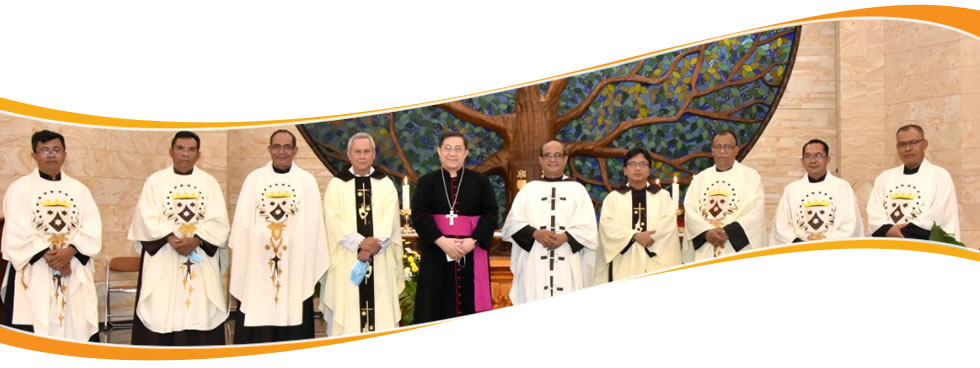







A change of date for the memorial of St. Nuno Alvarez Pereira, from the 1st of April to the 6th of November.
The Congregation for Divine Worship and the Discipline of the Sacraments recently approved the changing of the date of the memorial of St. Nuno Alvarez Pereira from the 1st of April to the 6th of November. This change to the liturgical calendar of the Order is to take effect immediately. Now that he has been canonised, this change provides the possibility of celebrating the memorial of St. Nuno. The fact that the previous date coincided normally with Lent or with the Octave of Easter often meant that it was not celebrated. Now everyone is in line with the date already followed in Portugal. Unfortunately, the Congregation did not grant the raising of the memorial to a feast for the whole Order.
Rejection & Detachment
By Steven Riddle
Once again Disputations provides some excellent food for thought. Would that my thoughts were so good as the food that engenders them. Nevertheless, please accept these meagre ruminations for what they are--a kind of riff spun off a more substantial discussion.
The excerpt that caused this spin-off:
(from Disputations)
But there's nothing in this model of the intellect that requires the concepts to be concepts relating to beauty. They can be concepts related to race, or to risk, or to toxicity. An absolute mistrust of perceivable beauty -- of that which is beautiful -- amounts to an absolute mistrust of perceivable creation, which ought to be unthinkable for a Christian. There is no barb in beauty, unless the Author of Beauty placed it there.
It may be, though, that a mistrust of the human intellect, a recognition of the frequency with which it makes mistakes regarding beauty, is expressed as what might be called a prudential mistrust of beauty. If we can't make the intellect work better, we can at least avoid giving it things it works poorly on.
What occurred to me, and what I started to spell out in the comments there is that there is another form of distrust of beauty that occurs in religious circles. That form might be called the seduction of beauty.
The chain of reason goes something like this. To become more like God, we are called to detachment. Detachment is difficult enough in itself, and far more difficult when the good we are attached to is beautiful, therefore as a step in detachment, we must reject what is beautiful even though it might be good because we are held bound by it.
The response to this is multiple. First, detachment is the means to an end, not an end in itself. It is the path travelled, and frankly may be only one of many such paths to travel, whose destination is intimacy with God. To treat detachment as an end is to the miss the point, and to align all things in life to achieve an end which is only a means redefines the means as an end equal to the true end. That's a complicated way of saying that if you do this you are missing the point of detachment.
What I didn't say in my comment, and what is by far the more subtle error in this type of reasoning is that when one does this one has become attached to the idea of rejection. That is, we substitute attachment to a real thing (one that grace can more readily conquer) for attachment to an idea or an ideal (a far more hazardous and difficult a barrier).
If, as a Christian, you think you are being called to reject the beauty and goodness of God's creation my best advice to you would be to seek out a wise spiritual advisor to help you discern what is really going on. God did not put all of the beauty He has on the Earth to be ignored. Detachment from that beauty does not mean rejection of it or lack of recognition of it. There may be some beauty that we are called to prudentially restrain our interest in. (For most males I know, the beauty of the female form is something like this.) Nevertheless, what a miserable and small place the world would be if we did not recognize and relish this beauty as is licit and correct.
So my only real response is that it is a distorted understanding of detachment to suggest that it would require rejection of beauty. (And let me make explicitly clear, this was in no way implied by what Tom wrote--but I respond to what he writes as the person I am and express the interests that I have.) Now, it is possible that particular vulnerability to a type of beauty (aforementioned feminine pulchritude) may prudentially require not so much a rejection but a careful screening of such beauty (If thine right eye offend thee, pluck it out.) But it would be nonsense, and dangerous nonsense, to claim that what is good and truly beautiful is not so. It would be equally dangerous to reject all of God's beauty because some part of it particularly appeals, or because a distortion in our own view and character makes of the object of beauty an object of temptation.
In short, detachment does not require rejection of beauty. In fact, to be able to even consider attachment, immersion in the beauty of the world seems a salutary thing. You would come to realize that you cannot own it, hold on to it, keep it, or even remember it as lovely as it is outside of the moment. It teaches you to appreciate the good things of God and to let them go freely, always knowing that God's goodness ever exceeds His goodness as we come to know and love Him.
from http://floscarmeli.stblogs.org
Learning to Become Detached--Training in Love
By Steven Riddle
It seems ridiculous to talk about training in love. We all know what it is, we all know how it goes. Well, true and false. We all know what the emotional aspect of love looks like, but as a fallen people we rarely live out what the emotional aspect calls for.
We all know, intellectually, that love is a movement of will, not merely an emotion. Love can act without an emotion necessarily being attached. More importantly, one of the tremendous pieces of doctrine that St. Thérèse of Lisieux left with us is that love without works is dead. This is a natural outgrowth of the understanding in the Letter of James that faith without works is dead. Faith, Hope, and Love grow together or die together. When one is supported and nurtured, all three thrive. That is why love is so important in approaching God. Love causes faith to thrive and gives birth to new hope that sustains us through the long languors of love.
Training in love seems a good idea. How do we begin to love God passionately if we do not already do so?
Pardon a brief digression here. Wittgenstein is reported by some to have intimated that words shape reality. I do not know if he actually said this, but if it is true, the man obviously needed a psychiatrist. Reality is. The Ground of Being that reifies all that is, is unchangeable, so too the reality built upon His constant attention. That is not to say that things do not change, but that reality is and is discernable and understandable to some extent to the human intellect. (Good thing Wittgensteinian disciples didn't promulgate their nonsense until after we had a firm foundation in the sciences.) At any rate, words do not shape reality. However, they do shape our perceptions of reality. How we talk about or describe something shapes our feelings about that thing. How we talk about or to a person shapes our feelings about the person. Talk is not everything, but it is a powerful way to shape perception. (Hence, part of James's further admonition to "bridle the tongue.")
So my first suggestion for training in love is to change or enhance the way we talk to God. In addition to formal written prayers or spontaneous prayer it might be good to add to our daily routine a litany of thanksgiving. Perhaps the first prayer in the morning could start with a line from Psalms--"This is the day the Lord has made, let us be glad and rejoice in it." From there we could move to a simple litany of thanksgiving, being mindful of the presence of God in morning ablutions and preparations. We thank Him for our own being, for another day, for our spouses and children (if any), for our lack of spouses and children (if we lack them), for our material goods, for our health, and then we move on to thank Him even for the challenges of the day--poor health, difficult tasks, even worries. We hand them all over in thanksgiving, knowing that He will support us through them all. The litany of thanksgiving puts us in the mindframe to be grateful and to perceive God's hand in the events of the day. A very wise Jesuit once said, "A grateful heart finds it hard to be unhappy." And a happy heart finds it easier to love the Person who gave it so much happiness.
Thus my first suggestion--start the day with a litany of thanksgiving. Everything you can think of to praise and thank God for say or sing in your own private litany. Thank Him for all that you have, all that you are, and all that is around you. Thank Him for being present to preserve it all. Thank Him for the guidance He gives and the love He pours out.
Perhaps this starts as mere words, but as the practice develops and continues it grows into a yearning to do something to express thanksgiving, to share with others the fantastic joy of knowing God. This is a first step in the dance of love. We are moved to do something, however small, however seemingly meaningless. We are moved to DO something beautiful for God.
Yet a Little More About Detachment
Steven Riddle
Incrementally, the discussion continues. Please bear with me. As people bring up points, it seems that there is more to say.
Today's point--detachment is not a comfortable or easy exercise.
Below a commenter says that "it is easy to slip from detachment to indifference when it is difficult for you to form attachments anyway." Part of that statement evokes a certain misunderstanding of what detachment is. First to repeat: the point of detachment is to love God and the love of God needs some expression. That expression is found in love of neighbor and self. Proper exercise of detachment becomes a discipline of self-giving.
The desire or habit of not forming relationships is an attachment itself. There is something that has proven successful about not forming relationships. So detachment forces one out of this stable mode and into the mode of loving God through loving neighbhor. Love without works is dead (as St. Therese implies). And Jesus tells us, if we love Him, we will keep His Commandments. One of His commandments is feed the hungry, clothe the naked, etc. When becoming detached from our own preferences and our own desires, the road to indifference is a temptation, but not when the way of detachment is clearly the way of the cross.
Detachment is uncomfortable. It is a source of constant unease. It is constantly against the grain. If we would rather not become involved, then we are attached to the concept of non-involvement. And it is from this that we may have to work particularly hard to escape.
This is where detachment becomes really difficult. It's hard to identify what the attachments are. Sometimes they are defense mechanisms so thoroughly ingrained we can't see them. Sometimes they are participation in a really good thing. For example, if you absolutely must go to a Latin Mass--you wrench your schedule, the schedule of your friends and family, and generally discomfit and discombobulate everyone and everything around you in the search for a Latin Mass, that is a pretty certain sign of attachment. If you go to a Mass in English that, except for being in English, is otherwise properly conducted and carp about the music, the way the prayers are said, whether one is standing or kneeling, etc.--you are probably attached. When you cannot see Jesus for want of your preferences, attachment is indicated. John of the Cross says that even when you prefer your food prepared a certain way and will not eat otherwise, that is an attachment. (Obviously this is aside from doctor's orders. In fact, the unwillingness to follow a doctor's orders with respect to food indicates attachment.)
So, one of the difficulties is identifying the attachments. That is where prayer, patience, and focus help. If our eyes are on Jesus and we truly love and adore Him, everything else fades into the distance. Jesus truly becomes Lord of our life, and detachment from created things is a natural corollary. We might start by working at detachment, but unless our eyes are firmly set on Christ and Him Crucified, we will quickly lose our way.
from http://floscarmeli.stblogs.org
Why is spiritual detachment necessary?
Connie Rossini
In my last post we defined spiritual detachment as getting rid of our selfish clinging to things or persons other than God in response to His love for us. Today I would like to address why detachment is necessary.
St. John of the Cross, co-founder of the Order of Discalced Carmelites and a doctor of the Church, wrote, “The soul that desires God to surrender Himself to it entirely must surrender itself to Him without keeping anything for itself.” Wouldn’t you like to have God completely give Himself to you, holding nothing back? Then you must give yourself completely to Him. When you keep God at arm’s length, you cannot grow very close to Him!
Likewise, if your soul is full of earthly things, you leave no room for God. Consuming spiritual junk food leaves no room for what really nourishes us. Only God can satisfy our longing for happiness. The more we try to make ourselves happy through material things and other people, the less happy we will be. We were made for union with God. Nothing less will suffice.
Disordered attachments equal idols
Attachments are a kind of idolatry. When we are unwilling to let go of our grasp on things, even for the sake of God, we have made a little god out of them. We are implicitly saying that they are at least as important to us as God is.
Are you often distracted during prayer? When a friend or family member speaks to you, do you find your mind wandering to your own concerns? Sometimes this is a result of wrong attachments.
We have not learned how to trust God with our lives, so we are not at peace. We have constant worries and preoccupations. They sap our energy and weaken our relationships with God and other people.
You can’t see God (or anything) clearly with a log in your eye
Attachments also cloud our vision. Jesus said we need to remove the plank from our eye in order to see clearly. That plank might be sin, or it might be attachments. Our ability to give good advice and real help to other people is jeopardized by them. (See Matthew 7:3-5.)
Finally, no one can see God face-to-face in Heaven, if he is attached to something else. We must be absolutely pure and God-focused first. Being purged from our inordinate attachments is not optional. That is where Purgatory comes in. The more tightly we cling to things while on earth, the longer and harder our Purgatory will be. Since we have to be purged sooner or later, why not—as St. Teresa of Ávila was fond of saying—make a virtue of necessity, and start the process now? Wouldn’t being at peace immediately after death be worth the price of letting go of things that can never make us happy anyway?
Are there things that are holding you back from God? What would be difficult for you to give up? It might be as small as a cup of coffee or as big as a close friendship. Take some time today to meditate on this. Now is the moment to start letting go, so you can grasp more firmly onto God.
"Connie Rossini is the author of the Free ebook Five Lessons from the Carmelite Saints That Will Change Your Life. Her full-length book, Trusting God with St. Therese, is due out this summer. Connie lives with her husband and four sons in New Ulm, Minnesota, USA. This article originally appeared on her blog http://contemplativehomeschool.com and is used with permission.
Copyright 2014 Connie Rossini."
With New Eyes: True Happiness & Carmel
Bill McGarvey
One of my new favorite paintings is a scene painted by Filippo Lippi called, “The Confirmation of the Carmelite Rule.” Filippo Lippi was a Carmelite painter from the early renaissance period whose works hang in many of the major art museums today. The painting itself isn’t particularly beautiful to be honest, but there is something in it that draws me to it. The scene involves a young brother who is apparently professing his vows to his superior. The superior happens to have a very distinct smile on his face. It is this smile that is so interesting to me. According to some writers, this might in fact be one of the first instances of a smile being depicted in renaissance art.
If you look up Filippo Lippi in the art history books, you would soon discover that he was not the holiest Carmelite that ever lived, in fact some might even be scandalized by certain aspects of his life. However, I believe that Lippi was on to an extremely important point concerning the spiritual life – in fact life itself. It is the fact that our internal desire for happiness must be taken seriously. Many of the ancient philosophers spoke about our need for happiness. Also, central to the Christian faith is the belief that the very reason for our existence is to be happy with God. Nevertheless, I think that in our daily lives we can lose sight of what really makes us happy. True happiness I do not think is getting the latest iPhone – although that joy is truly awesome! – or other passing satisfactions. But there is a happiness that lasts – a happiness that comes when you know that you are doing something you were meant to do.
I taught high school for four years in an all-girls inner city school. Although I enjoyed teaching, I soon came to realize that teaching teenagers was not my vocation in life. I did not have the patience to deal with the numerous disciplinary problems that came up every day. What was even more frustrating was that the parents simply didn’t seem to care about their daughters. A few of my students ended up in extremely unfortunate circumstances that could have possibly been avoided if their parents had actually shown interest in them. In my frustration, I realized that if I wanted to make a real difference in the lives of those girls, and other persons like them, I probably would be better able to do it as a religious. As a religious I believe that I would be able to dedicate myself fulltime to helping those in need. Additionally, it would most likely even enable me to work directly with troubled families, where the root of many of the problems I encountered while teaching seemed to arise.
About a year after I stopped teaching I went back to visit some of my old colleagues and to follow up on the progress of some of my past students. As soon as I entered the staffroom one of my friends, who hadn’t seen me since I left, said quite bluntly, “Brent you look different. You look happy!” What my friend said was very true, I was in fact happy. However, what was interesting to me was that I didn’t realize that my unhappiness while working there was so evident. I thought I did a good job plastering on my fake smile, but I guess that those who knew me well could recognize a real change.
I do not think that doing what one is meant to do will mean that you will always be in a state of ecstatic joy. However, being true to what is deep within one’s heart brings a happiness that you really can’t explain –you simply know it when you experience it. I do not have many religious pictures in my room but I do have two. The first is a picture of the painting by Filippo Lippi that I mentioned, and the second is a picture of Thomas Merton with a distinctly serene smile while standing in the midst of an open field. I placed those two pictures where I could see them every day because I wanted to be able to remember to daily ask myself the question, “Am I truly happy?” Thankfully, at the moment there is a smile on my face as I answer, “Yes!”
from http://www.carmelites.net/blog/
With New Eyes: Detachment
Brent Alexis, O.Carm.
Over this past Christmas season there was an interesting series of reflections and other activities that focused on St. Thérèse’s “Christmas conversion” on this website. This concerned the moment in St. Thérèse’s life when she made the decision not to react in an immature manner when her family stopped placing Christmas presents for her in her Christmas stocking – a practice which was common in France at that time with children. I believe that St. Thérèse’s actions that Christmas reflects a spiritual practice that I have come to discover is essential to the Carmelite way of life – and in fact a key element to anyone wanting to live a spiritually mature life – the practice of detachment.
One of the most famous Carmelite Saints that even predates St. Thérèse is St. John of the Cross. A key spiritual teaching for which he is known is his emphasis on “nada” – which means ‘nothing.’ For St. John, he believed that attachment to created things is what prevents us from truly encountering God – we need to have nothing between us and God. This is a spiritual truth that I have come to discover transcends religious boundaries. I remember a few years ago while chatting with a very old Muslim Imam at a function I mentioned to him that I was a Carmelite. The Imam immediately exclaimed, “Ah yes, St. John of the Cross! I love his writings. Nada, nada, nada.”
In my own life detachment is something with which I continuously struggle. I think some of the biggest things that I have struggled to give up are the various images of what “my happy self” ought to look like. Before I entered the Carmelites, to be happy involved the image of me driving a new RX8 sports car, working for a dynamic company and dating a beautiful and intelligent woman, among other things. While I was in the process of making some of those goals a reality, I eventually realized that my true happiness did not reside in those accomplishments. In spite of this realization, it was still extremely difficult giving up this image of myself. While in religious life I still every so often start developing new images of what “my happy self” should look like. Now, however, it involves images such as working for a church based non-profit or attaining particular qualifications which I believe would be necessary for effective ministry. In spite of these things being very noble, I know that I can also become too attached to them as well.
But why detach in the first place? I believe that it is only by freeing ourselves of attachments that God’s grace can enter our lives in a dynamic way. One summer ago I had a very concrete experience of this. A few months before that summer period I was heavily involved in planning a conference in Trinidad for the Carmelite family there. I spent several hours developing schedules and communicating with the facilitator and other planners of the event – all including the fact that I would be there in a few months to help execute some of my plans.
A few weeks before the conference I was told that my superior wanted me to work in a hospital that summer! Naturally I was frustrated since it meant that I was not able to follow all of the plans which I had been working on for the previous months. In spite of my disappointment, I felt that God was calling me to practice detachment – but of course I was sure that it meant I would have had an absolutely miserable summer. To my amazement it was quite the opposite! That summer was a period of great growth for me as a future religious minister and as an individual as well. During my time there I also developed friendships with colleagues which have also proven to be invaluable. And, to top it all off, in spite of my absence, the conference was a great success. I guess St. Thérèse and St. John of the Cross were on to something after all.
* from http://www.carmelites.net/blog/
Provincial Chapter of the Province of India
During the Provincial Chapter of the Province of India held on 13-15 February 2014 were elected:
- Prior Provincial: Fr. Robert Thomas Puthussery, O.Carm.
- First Councilor: Fr. Jose Alex Valavanattu, O.Carm.
- Second Councilor: Fr. Thankachan Njaliath, O.Carm.
- Third Councilor: Fr. Boby Sebastian Tharakunnel, O.Carm.
- Fourth Councilor: Fr. Regi Jacob Pullan, O.Carm.
Course in English Language for friars at Aylesford: 1st July – 16th August 2014
As publicised at the General Chapter 2013, there will be a basic course in English language at Aylesford, England. At the end of the experience, participants will have the fundamental tools and confidence to begin developing communication skills in English.
This opportunity is open to all friars of the Order who will live and pray with the Carmelite Community at the Order’s iconic priory, which is intimately linked with the Brown Scapular of Our Lady of Mount Carmel and the Order’s first General Chapter.
The cost of the course and accommodation will be covered by the British Province on a donation only basis. To be successful the programme requires 5-8 participants. Participants will be expected to have some knowledge of English already and will be responsible for the cost of their travel to and personal expenses during the programme.
To register your interest, please contact
Brendan Grady, O.Carm. Questo indirizzo email è protetto dagli spambots. È necessario abilitare JavaScript per vederlo.
by 31st March 2014
Primacy of the contemplative spirit
A direct and intimate experience with God is the basis of Carmel spirituality. Therefore, before any Rule, and in order that the Rule may be lived when it is formulated, a contemplative spirit and a deep sense of God are required of those who wish to lead the life of Carmel.
Of one who understands how to stay before God, no special activity, no special practical disposition is required. While, on the contrary, this sense of God, this thirst to remain in His presence does not belong to that category of realities that a Rule or a technique can call into being. Nor can they be developed in any way ascertainable by the sense. They must exist prior to the realization of a contemplative religious life. God Himself has placed them in the soul's very center and ceaselessly maintains them by means of His grace and His Holy Spirit.
This enables us to understand how, although it is not an institution in the western meaning of the term but only a place for the election of a spiritual reality, Carmel has long been able to exist in a free, spontaneous, elementary way and to subsist through the sheer power of its "spirit".
This primacy of "spirit", necessary in every religious institute seems even more necessary in Carmel.
No exterior activity, whatever be its form, not even fidelity to the Rule, jealously guarded though this must be, can ever take the place of what ought to be the soul of Carmel, we mean the divine current that reaches the depths of man's being and impels the Carmelite to return constantly to his center.
This search for God, so essential and so secret, leads of itself to simplicity and spiritual poverty. Instinctively the soul seeking God longs to be disencumbered, to be delivered from all things spiritual and material, in order to think of God alone, to be freed from things of the flesh in order to attain to life in the spirit, and to become altogether spiritual.
An idea like this necessarily leads to a spiritual conception of religious life. In fact, nowhere as much as in Carmel must life and observances be vivified by the spirit.
That is why a religious as familiar with the origins of Carmel as John of Saint-Samson could write in "De la perfection et decadence de la vie religieuse":
"I say that in the days of these first patriarchs and founders, religious life (at Carmel) was a body strongly and excellently animated by spirit, or rather it was all spirit, and all fervent spirit."
In fact the ideal of Carmel was always, according to the expression of this same author in "Le vrai esprit du Carmel," "to live in a state of great purity... and to enter into God with all one's strength".
It is obvious that John of Saint-Samson here refers to the "Institution des premiers moines," a text highly representative of the spirit of Carmel and of its oldest and purest mystical traditions. In it we read these lines in which the author seeks to describe the life of the first hermits of Carmel.
"This life has a double end. The first is ours as the result of our virtuous work and effort, divine grace aiding us. It consists in offering God a holy heart, freed from all stain of actual sin. We attain this end when we are perfect and in Carith (which means ' hidden in charity ')... The second end of this life is communicated to us as God's pure gift. I mean that not only after death but here in this mortal life we can in some way in our hearts taste and experience in spirit the power of the divine presence and the sweetness of heavenly glory. This is called drinking from the torrent of divine pleasure."
At Carmel, purity of heart is never disassociated from delight in things divine. The illusion most to be dreaded has always been to aspire to the highest gifts while disdaining or underestimating the necessary publications. There is another and equally dangerous snare: to try to live a life of high perfection for its own sake and not to aspire to receive the communication of divine life. Carmelite spirituality consists of a supernatural balance which is only possible where there is habitual recourse to the spirit with humility of heart. Although Carmel can see the weakness of its children without astonishment or pessimism, and because it counts on the abundance of divine mercy to remain undisturbed, it has no pity for the slightest shadow that soils the soul. A man who voluntarily harbors some vain attachment in his heart is not a spiritual man. But of what price is purity without spiritual fruitfulness? A detachment in which there is no love?
In fact theological primacy makes it impossible for the Carmelite soul to deviate in his pursuit of his double goal. If he aspires to love with the love of God Himself, it is because he is strong in his hope, resolute in his faith, docile in all things to the invitations of the Spirit; it is because he depends on God alone.


