








Opening Address at the Lay Carmelite Conference in Atlanta
Fernando Millán Romeral, O.Carm.,
I am very happy to be here and to meet again so many good friends of the Carmelite Family. More than 450 people reflecting together on the spiritual journey of Carmel is quite impressive, especially for our times.
The theme of this gathering is not something I have expertise in. My ‘academic’ field is (or was before my election) dogmatic sacramental theology. I used to talk about Thomas Aquinas, the Council of Trent, Martin Luther and many other boring things! But I am a Carmelite and this theme, Carmelite Transformation: A Lifelong Journey, is for me very important and a rather fascinating topic to explore.
Let me tell you something I saw a few weeks ago when I was carrying out a ‘Canonical Visitation’ to the ancient Carmelite Church of Saint Gallo in Prague. This church was ours for many years and it is full of some wonderful baroque Carmelite iconography.
In the right aisle of the Church, one is able to walk forward, towards the tabernacle. The Carmelite saints (on both sides of the aisle) seem to be showing the way. They indicate how to get to the tabernacle to meet the Lord in the Holy Eucharist. At the tabernacle one finds two more Carmelite figures, a painting of Mary and a statue of the Infant Jesus, in addition to the tabernacle. This representation of the Christ-Child is a very popular devotion in Prague, best known as the ‘Child of Prague’. There are many aspects to comment on and to study, but I want to underline just one idea. The Carmelite saints (Carmelite spirituality) bring us to an encounter with God, and, therefore, to a genuine transformation of ourselves.
Encountering God presupposes a change in our lives. This change is not only psychological, even if this psychological aspect is quite important and this type of transformation has consequences in the psychological realm. Nor is this change only in the sociological sphere, even if the sociological aspect is quite important and this type of transformation also has consequences in the sociological realm. The change we are speaking about is deeper and broader. The whole person is invited to a new understanding, to a new praxis, to new behaviour, to enjoy life as a gift lived in thankfulness and gratitude.
But we should not be too naïve or simplistic about this. Except in the case of the great saints or in strong mystical experiences, this encounter with God is not usually so clear nor so evident. The path that leads us to God is very long. It is not straight. Many times we choose other paths, or we return to where we are. That is why I really like the title you have chosen for this convocation: Carmelite Transformation: A Lifelong Journey.
For many years (even when it was not so fashionable) I have been a long distance runner. I have completed several marathons. Many times I have suggested that the marathon is a very good metaphor of our spiritual journey. You cannot give up. Sometimes you go slowly. Or you might suffer a new pain in your knee. Or you need to drink something. Or you might be presented with a myriad of other problems and difficulties that come with running. But the philosophy of the marathon man or woman is to never give up. It doesn’t matter too much how well you are running, what your record is, or what your position will be at the goal. The important part is to arrive.
‘Perseverance’ seems to me to be a very old fashioned word. It seems to be a word for old novice directors in cloistered monasteries. But, more and more, I am aware of the importance of this value: perseverance, loyalty, to be able to stay with something, ‘determinada determinación’ (in St Teresa’s vocabulary). Perseverance is not just ‘endurance’ (something for heroes or strong people); perseverance has to do with wisdom, hope and humility. We keep on going in the spiritual life, because we know (wisdom), that even though we are weak and fragile (humility), God is waiting for us on the goal line to hug us and to give us the gold medal (hope).
Another difficulty comes from the fact that the encounter with God cannot be direct or immediate in this life. Only in heaven will we meet God face to face. We will look at him and He will look back at us in a tender and loving way.
But in this life, the encounter with God only comes through mediations. That further complicates the whole experience significantly. We have to find him in the little, fragile, humble and, many times, contradictory signs of his presence among us. It is a wonderful challenge, but it is not easy. We need to bring some ‘attitudes’ (the ‘dispositions’ of the classical spiritual writers) to the journey. Let me underline just three:
- Discernment: this is a classical topic in the history of spirituality. Many times we try to manipulate God. Or we have the false illusion that something comes from God or that it only comes from ourselves. Remember the terrible suffering of Teresa over her mystical experiences and “mental prayer”: do they come from God or from the devil? She speaks with many people about this. That’s why we have to be careful in discernment. God always has to be God. He is near, but He is also beyond any human expectation, idea, or definition. We have to be careful not to convert God into a puppet who says what we want to hear.
- Capacity for contemplation (a very Carmelite value). Many times I have defended my belief that the contemplative person is not the one who is always looking up to heaven, or watching the cloud. The contemplative person looks around and tries to perceive those humble signs of the presence of God. We have to open our eyes, focus, and be attentive.
- Courage, because that experience of God may change our ideas, our routine, and/or our prejudices. Let me express this in another way: it changes our lives. Pope Francis often and very strongly insists on this. We cannot observe life from the outside, like we are spectators. We must be involved, especially with the suffering of our brothers and sisters. Remember the criticism of the ‘balconear’ (a neologism in Spanish) who just watches life from the balcony.
We find these three attitudes in a wonderful text in Scripture. Remember the Gospel of John, Chapter 21 in the story of the miraculous catch of fish which occurs on the Lake of Galilee. John presents a very idyllic image in Galilee. This takes place immediately after the scenes filled with dust, blood, cries, arms, crosses, and death. The Apostles return to Galilee as if nothing had happened.
It is also a chapter rich with symbols: the numbers, the fishing, the signs, etc. John plays with real, historical elements in the story but those elements take on a deeper meaning, a sort of ‘semantic ambiguity’. For example, the whole story takes place very early in the morning (at dawn, early in the morning). It is the right moment for fishing on the lake of Galilee (the fishermen still follow this practice today), but at the same time, it perhaps means something else. It is the time of the day in which you see yet you do not see. It is a time for discernment. John, from the boat, sees that strange character on the shore.
There is a dialogue and, after a while, John, the beloved disciple, says ‘It is the Lord’. John is the model contemplative. He is able to see the presence of the Lord in our lives.
But they do not stay inactive; they do not contemplate in a way that is cold, distant, and antiseptic. They jumped into the water and they swam to the beach to meet the Lord (courage).
Journey
In the title of our gathering you have included also the word ‘journey’. It is also an important image, not just in the history of spirituality, but also in the Carmelite symbolic universe.
- The first Carmelites probably went to the Holy Land as individual pilgrims and were nourished by this kind of spirituality.
- The Carmelite Rule speaks of ‘journeys’ and ‘ways’. Albert or whomever takes it for granted that the Carmelites would be walkers:
- Since you must more frequently beg on journeys (c. 17)
- This is a good and holy way: follow it (c. 20)
- The Institution of the First Monks presents the spiritual life as a four-step journey by which we “ascend to the peak of prophetic perfection” (1, 2). It is a journey that we undertake at God’s command. In fact, the book sees the whole spiritual journey contained in God’s words to Elijah, ‘Depart from here and go towards the East...’ (1Kings 17:2-4).
- Many other Carmelites have written about the ‘way’ or the ‘journey’ of Carmel. Allow me to cite a couple of examples:
- In the writings of St Teresa of Jesus the word ‘way’ occurs five hundred times.
- St John of the Cross conceives of the spiritual life as the ascent of a mountain, with the peak as the place where we are united with God in love. This ascent is essentially a journey of transformation in God.
- St Thérèse of Lisieux discovered “a little way that is completely new, straight, and very short”.
- In recent times the Ratio Institutionis Vitae Carmelitanae (RIVC) has developed this image. But in its latest edition, the entire Ratio appears as a ‘way of transformation’. According to the Ratio, formation is a lifelong process of ongoing transformation until we reach full maturity in Christ (RIVC, 14.63.114).
Pope Francis, in his November 2014 meeting with the Union of General Superiors (USG), invited the religious superiors to walk with their communities: to walk ahead of the group (to lead them giving witness, to open up new ways); to walk within the group (to be a brother); to walk behind the group (to take care of those who need help, or perhaps with humility to learn from the group).
Conclusion
Let me finish with a rather strange and contradictory sentence as well as with an invitation: The strange sentence would be this: there are as many ‘ways’ for people, but nevertheless there is only one way.
Every human life is unique: our conditions, our background, our family roots, our prejudices, our lights, and our shadow. Every human being, every believer, every follower of the Lord, every Carmelite has to find his or her own way. It is a responsibility that we cannot ignore or avoid. Of course, there are methods, programmes, and various examples but sooner or later, each person has to find their own way to God.
Some ways and processes are quite strange. Let me tell you something I was reading in a magazine in the plane coming here from Rome. Emmanuel Carrère, a French writer who has just published his book Le Royaume (The Kingdom), tells his personal story about religion: sociologically catholic, he left the Church, had a conversion, then he had a sort of psychological crisis and so on. After experiencing the terrible sickness of a four-year-old child, he wrote: ‘I leave you, I leave you, but, Lord, you don’t leave me’.
This is why I don’t rely very much on the programmes of formation that try to evaluate every candidate using the same criteria. Every human being is a mystery and there is no taxonomy, no single classification. Formation does not take place in a factory. We are not dealing with building cars, or writing books, or creating bricks. There are as many journeys as there are persons.
But at the same time, there is only one way, and that is Jesus Christ. He calls every body to the plenitude of life and to salvation. In different ways, He is the only way: ‘I am the way, the truth and the life’ (John 14:6).
Clarification and Invitation
Some of you may be surprised that I have not mentioned Titus Brandsma in this talk. Actually, in a very authentic and heroic way, he persevered in his own journey of transformation. His ‘way’ took him from Bolsward in Friesland, the Netherlands, to the Carmelite Order which was not very well known at the time in the Netherlands. From Nijmegen he went to Rome and from Rome he began his frenetic activity in the fields of education and press. From his teaching in the university he went on to confront the Nazi power in Holland and that led from one jail to another, and finally to the concentration camp in Dachau.
The last stage of his journey took place in a terrible train, one of those animal and cargo trains that travelled all around the continent in the so-called ‘night of Europe’. But at the same time Titus was travelling towards the Lord, growing in faith, in hope, and in tenderness for everybody, even to the nurse who give him the injection that would finish his life.
Titus created his seventh mansion in a concentration camp, in a terrible infirmary where people were killed day after day. Twenty years later, that same nurse went to Rome and testified in the beatification process for Titus. Among many other things, she said, ‘That little man looked at me with compassion’. That was the goal of his journey.
As St Albert did to the first Carmelites, I dare to invite you to follow this ‘holy and good way’. If you are in a moment of joy, enthusiasm and commitment… try to share that with all who walk with you. If you are tired or if you are in a period of discouragement, disappointment or sorrow for any reason: Courage! Move forward. Don’t give up.
May Our Lady of Mount Carmel, Star of the Sea, and all the saints of Carmel help us in our ‘way’ of transformation and salvation.
Second booklet from the International Commission of the order for Evangelization and Mission
The International Commission for Evangelization and Mission of the Order met at the Casa Generalizia in Rome from the 27th to the 29th April 2016. On the agenda for the meeting was the feedback from the Order regarding the booklet “To be a Carmelite today: A joy ever new, a joy to be shared”. It was distributed to the provinces, all members of the Carmelite Family via CITOC-online and on the Order’s website. It was noted that the booklet was used in many different parts of the world by different communities and evoked a positive response. The Commission is most grateful for the feedback. The second booklet entitled “Joy in being contemplative Community” is now available on our website https://s3.amazonaws.com/ocarm.org/ebooks/evaen.pdf
The intention of the commission is to engage with communities, groups belonging to the Carmelite Family and individuals so as to reflect on the relationship between the Apostolic Exhortation of Pope Francis, Evangelii Gaudium, and the spiritual tradition of the Order. The third booklet for the year 2017 will have the theme “Joy in Proclaiming the Word.” It is hoped that these booklets, containing seven moments of reflection would be of value for community meetings of friars, nuns, affiliated sisters, Carmelite institutes, local chapters of Third Order groups and all connected with our spirituality and charism.
During the meeting, the commission was addressed by Mr. Jean Luc Moens (Emmanuel Community) on different approaches to evangelization. They also began initial preparations for a special international workshop on the Proclamation of the Gospel as outlined in chapter three of Evangelii Gaudium (110-175). Further details of this workshop will be communicated in the coming year.
Electronic newsletter for the Lay Carmelites III-No1-MMXVI
We are delighted to offer you the latest issue of the Lay Carmelite E-Bulletin. This is a special issue since this year we celebrate the 450th anniversary of the birth of Saint Mary Magdalene de’ Pazzi, a Carmelite nun from Italy, who was a renowned spiritual writer of her times. Through different and varied articles, this edition gives us an opportunity to learn more about the life and spirituality of St. Mary Magdalene de’ Pazzi, as well as about the different celebrations and activities organized for this special anniversary.
We cannot forget our Church is celebrating the Year of Mercy, and in this issue we can read an article encouraging us all to live this year of grace as a community, and moreover as Carmelites.
We also find two interesting articles and wonderful news from the Philippines. On the one hand, about 90 members of the Carmelite Youth, a quite active group in this country, renewed their vows in our Carmelite Order. On the other hand, a group of seminarians, most of them outstanding students from their own dioceses, made their promises to become TOC members, founding their own TOC community.
As usual, we find a nice and inspiring testimony. This time it is a woman from Kenya, who shares with us why she became a TOC member.
We would like to remind you about the new official website of the Lay Carmelites, which provides the latest news, activities, and events of the Carmelite Laity around the world, and also features many articles and lectures from and for the laity. Please bookmark and visit it at www.ocarm.org/lay
We welcome your comments and suggestions, and would like to ask you to contribute news, articles and activities from your different communities to enrich this website.
Please click here to download the E-bulletin
The Feast of St. Mary Magdalen de’Pazzi in Florence
On the 25th of May, the Prior General led the celebration of the Eucharist for the feast of St. Mary Magdalen de’Pazzi at the Hermitage of Santa Maria degli Angeli, in Scandicci (Florence). This monastery was founded n 1987 in the hills opposite where Careggi is situated where the remains of the saint are kept. The Mass, and the banquet afterwards, took place in a festive and fraternal setting. Along with the Prior General, there was a number of Carmelites and three postulants from the Italian province present. There was also a large number of diocesan priests, including the Vicar for that area, priests from the Community of San Leolino and of the “Opera Madonnina del Grappa”. The celebrations were enriched by the presence of the sisters of the Instituto di Nostra Signora del Monte Carmelo, members of the Third Order and many friends of the nuns.
Photos of the Feast of St. Mary Magdalen de’Pazzi in Florence
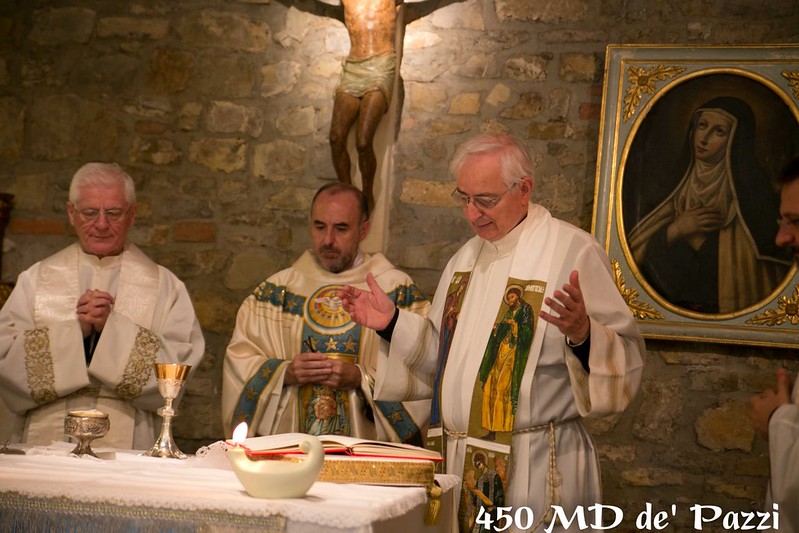
On the 25th of May, the Prior General led the celebration of the Eucharist for the feast of St. Mary Magdalen de’Pazzi at the Hermitage of Santa Maria degli Angeli, in Scandicci (Florence). This monastery was founded n 1987 in the hills opposite where Careggi is situated where the remains of the saint are kept. The Mass, and the banquet afterwards, took place in a festive and fraternal setting. Along with the Prior General, there was a number of Carmelites and three postulants from the Italian province present.
Lectio Divina June 2016
The Pope's Prayer for June 2016
Universal: Human Solidarity - That the aged, marginalized, and those who have no one may find–even within the huge cities of the world–opportunities for encounter and solidarity.
Evangelization: Seminarians and Novices - That seminarians and men and women entering religious life may have mentors who live the joy of the Gospel and prepare them wisely for their mission.
Lectio Divina June - Junio - Giugno 2016
 IPAD-IPHONE IPAD-IPHONE |  KINDLE KINDLE |  PDF PDF | |
| ENGLISH | Download iBook | Download Kindle | Download PDF |
| ESPAÑOL | Descargar iBook | Descargar Kindle | Descargar PDF |
| ITALIANO | Scarica iBook | Scarica Kindle | Scarica PDF |
- Wednesday, June 1, 2016
- Thursday, June 2, 2016
- Friday, June 3, 2016
- Saturday, June 4, 2016
- Sunday, June 5, 2016
- Monday, June 6, 2016
- Tuesday, June 7, 2016
- Wednesday, June 8, 2016
- Thursday, June 9, 2016
- Friday, June 10, 2016
- Saturday, June 11, 2016
- Sunday, June 12, 2016
- Monday, June 13, 2016
- Tuesday, June 14, 2016
- Wednesday, June 15, 2016
- Thursday, June 16, 2016
- Friday, June 17, 2016
- Saturday, June 18, 2016
- Sunday, June 19, 2016
- Monday, June 20, 2016
- Tuesday, June 21, 2016
- Wednesday, June 22, 2016
- Thursday, June 23, 2016
- Friday, June 24, 2016
- Saturday, June 25, 2016
- Sunday, June 26, 2016
- Monday, June 27, 2016
- Tuesday, June 28, 2016
- Wednesday, June 29, 2016
- Thursday, June 30, 2016
Fr. Paul Horan O.Carm.: New Carmelite Bishop
The Carmelite Order is delighted to announce today, 28th May 2016, that the Holy Father, Pope Francis has nominated bishop of the diocese of Mutare, in Zimbabwe, Fr. Paul Horan O.Carm., of the Irish Province. Fr. Paul was born at Drangan in Ireland, on 17th October 1962. Following his profession in the Order on 1st September 1990, he was ordained priest on 7th June 1997. During these past years he has worked in Zimbabwe and is presently the Prior of the Pre-Novitiate house in Nyazure, Rusape in Zimbabwe.
To Fr. Paul we offer our warmest congratulations on behalf of the whole Carmelite Family.
Diocese of Mutare, Zimbabwe
The Diocese of Mutare is situated in the Eastern part of Zimbabwe along the border with Mozambique. It corresponds to the Province of Manicaland and is centred around the Cathedral City of Mutare which is 170 miles east of Harare, the Capital of Zimbabwe.
The Prefecture Apostolic of Umtali (Mutare) was erected on 2nd February 1953 and was confided to the care of the Carmelites of the Irish Province. On 15th February 1957 the Prefecture was raised to the status of a Diocese with the Rt. Rev. Donal Lamont O.Carm (born in Ballycastle, Co. Antrim) as its first Bishop.
Biographical Note
Father Paul Horan was born on 17th October 1962. Having attended the Convent of Mercy Primary School in Drangan (Co. Tipperary, Ireland) and the Presentation Sisters Secondary School (Ballingarry) he qualified as a Certified Accountant (ACCA) and worked in Ireland and London. Fr. Paul was received into the Carmelite Order at the novitiate in Kinsale in 1989, making his first profession there on 1st September 1990. After completing his Baccalaureate in Philosophy and Bachelor of Divinity degrees (Milltown Institute) he was ordained a priest on 7th June 1997.
Fr. Paul was appointed to Terenure College where he held various roles including teaching at both primary and secondary level, head chaplain and head of the Province’s Vocations Team. He went for further studies and completed a M.A. in Theology (specialising in Carmelite Studies) in May 2001 (Washington Theological Union) in the USA.
In September 2001, Fr. Paul was appointed to work in Zimbabwe where he held various roles including Director of Pre-Novices, Director of Novices, School Manager (Kriste Mambo High School), and he served at St. Kilian’s Mission, Makoni. He was elected to serve for two terms on the Zimbabwean Carmelite Commissary Council in 2009 and 2012. Fr. Paul was highly instrumental in getting the first Carmelite (enclosed) Nuns to Zimbabwe who arrived there from the Monastery of Our Lady of Mount Carmel (Machakos, Kenya) in February 2015. Fr. Paul was also been appointed by the Carmelite General Council to the International Commission for Carmelite Schools and Youth. Currently, he is the Prior of the new Carmelite Community in Prophet Elijah Priory, Nyazura, Rusape.
Blessed Titus Brandsma, a model for the Year of Mercy
On account of the extraordinary Jubilee of Mercy, proclaimed by Pope Francis in the bull, Misericordia Vultus (April 11, 2015) the Pontifical Council for the promotion of new evangelisation has been publishing a series of aids to help local churches in their celebration of the jubilee. In the sixth publication, under the title, “The Saints in Mercy”, the council offers a series of figures that may give inspiration in living out this fundamental dimension of faith. Among others, the Pontifical Council proposes two carmelite figures, the witness of St. Therese of Lisieux (under the title of “Gratitude for the Just and Merciful God”) highlighting the rich teaching of Therese in relation to mercy, and Blessed Titus Brandsma, under the title, “A Strong and Merciful Father”, representing a man who could combine a strenuous opposition to Naziism with compassion and mercy towards all, including the nurse who gave him the injection that took his life away.
May Blessed Titus, St. Therese and all the saints of Carmel help us to accept this special year in the life of the Church with joy and commitment.


