








Today’s Contemplative Prayer Forms: Are They Contemplation?
Ernest E. Larkin, O.Carm.
A simpler title could be:
Contemplation and today’s contemplative prayer—are they the same or different? And, if different, what is their content and how are they related? This paper attempts a clarification of terms.
But more than semantics is involved. The deeper question at issue is: What are we doing when we practice contemporary forms of contemplative prayer, such as centering prayer or the “Christian Meditation” of John Main? Are we praying actively, calling on our human resources under the impulse of grace, or are we submitting passively to some presumed action of God within us, such as infused contemplation that is too subtle to recognize? Do these prayer forms presume we have reached a state of contemplation beyond the level of ordinary meditation? Or may anyone, beginner or experienced, take them up? Or, bluntly, could our silence and quietude, our disengagement from the work of imagination and intellect in our prayer, be an exercise in woolgathering, daydreaming, spinning our wheels, and thus wasting time by willful inactivity? Worse still, could we be falling into the error of quietism, cultivating idleness and passivity, with nothing going on inside? This error gave contemplative prayer a bad name from the 17th century to the beginning of the 20th. It could crop up again today.
What do we mean by contemplative prayer and contemplation? For many writers the two terms are interchangeable and their content is variable, running the gamut of mental prayer from ordinary meditation to infused contemplation. John Main, the architect of Christian Meditation, begins a series of talks by saying, “I am using the term meditation as synonymous with contemplation, contemplative prayer, meditative prayer, and so forth.”[i] Sometimes the two terms mean infused contemplation, the classical mystical experience of the felt presence of God, as in the following: “Whenever I experienced contemplative prayer, there was absolutely no doubt that I was in God’s presence. The silence was of varying degrees, sometimes so deep that the mind could not even think, other times a bit more shallow as in the prayer of quiet.”[ii] In other places the words are used more fluidly and less restrictively, as in the very title of William H. Shannon’s article— ’’Contemplative Prayer, Contemplation”—in the New Dictionary of Catholic Spirituality. This article equates the two and surveys their historical development in a variety of meanings. Thomas Keating follows this usage in referring to centering prayer, perhaps the most popular form of contemplative prayer in the United States today, equating the two as a resting in God that is open to all seekers of goodwill.
As a step toward defining the two terms in their contemporary context, I propose a distinction between contemplative prayer and contemplation: Contemplative prayer is the way, contemplation the terminus. The distinction is an inadequate one, for there is certainly an intimate and organic connection between the way and the goal; one includes the other. Contemplative prayer is designed to achieve contemplation; what begins as contemplative prayer quickly becomes contemplation. But I make the distinction for clarity’s sake, not just to be splitting hairs.
Contemplative prayer begins with one’s own activity, however simple and non discursive; and it seeks silence before God, silent presence beyond thinking, imagining, and making affections. Edwina Gateley has seized the genius of this contemplative prayer in the following psalm titled “Let Your God Love You”:[iii]
Be silent Be still Alone. Empty. Before your God Say nothing Ask nothing. Be silent. Be still | Let your God Look upon you. That is all. He knows. He understands. He loves you with An enormous love. | He only wants to Look upon you With his love. Quiet. Still. Be. Let your God Love you.
|
This poetic catalogue intimates what happens when people practice centering prayer or Christian Meditation. Are these prayer forms contemplation? Yes; they seek and find the experience of God’s love and presence, and this is contemplation in the general sense. Neither prayer form directly describes the experience of classical infused contemplation.
William Johnston shows great insight in seeing the typical forms of today’s contemplative prayer as neither Eastern nor Western, but something new in the world, “a third way, a tertium quid,... the Gospel of Jesus Christ in a new world.” He lists some of the methods and then relates them to mystical prayer in the strict sense: For the fact is that everywhere we see Christians of all ages and cultures sitting quietly in meditation. Some sit before a crucifix or an ikon in one-pointed meditation. Others sit and breathe as they look at the tabernacle. Others practice mindfulness, awareness of God in their surroundings. Others recite the mantra to the rhythm of their own breath. Others, influenced by Zen or yoga or vipassana, open their minds and hearts to the presence of God in the universe. Others just talk to God. ... Assuredly these ways cannot immediately be called mystical. But they are gateways to mysticism. They all lead to silence and to the wordless state that St. Teresa calls the prayer of quiet [and] to the higher mansions.[iv] William Johnston has thus related contemplative prayer to contemplation in a heuristic fashion and with a distinction. Today’s methods of contemplative prayer are not automatically mystical, but are steps in that direction. The word contemplation has no clear boundaries in common usage today.
Contemplation is generally a broader and less precise category than infused contemplation in the strict sense. Contemplation in the Spiritual Exercises of St. Ignatius, for example, is more inclusive than Teresa’s prayer of quiet or John of the Cross’s infused knowledge and love. William McNamara’s well-known description of contemplation as “a long, loving look at the real” fits the contemplative prayer forms Johnston refers to above (and fits infused contemplation as well). The phrase appealed to the Jesuit Walter Burghardt because of its down-to-earth, fully human, and existential quality. It became the title of his famous article on contemplation, which is a moving reflection, not on the contemplation of Teresa or John, but about the bodily, emotional, and spiritual awareness of concrete singulars in creation and their rootedness in God.[v] It is the “mindfulness” Johnston mentions.
Infused Contemplation
There are exceptions to this generic usage. In the Carmelite and Dominican traditions, contemplation means infused contemplation. Occasionally, of course, writers within these traditions use the term in a broader sense. But, in Teresa of Avila and John of the Cross, contemplation is specific and exclusive. It is the general, loving, obscure experience of God that begins with the passive dark night of the senses. It is infused knowledge and love; it is mystical; it is a pure gift of God that cannot be achieved by human effort under the ordinary working of grace. There are other forms of infused contemplation in the strict sense besides this apophatic experience, but all of them have in common their passive and mystical quality.
In today’s spiritual theology the distinction between active and passive prayer tends to be down played. Long ago Thomas Merton rejected the distinction between infused and acquired contemplation as being irrelevant. The experience is the thing, not an abstract explanation of its principles.
Moreover, the mystical or grace character of the entire spiritual life is being emphasized in many sectors, for example, in twelve-step spirituality and in writings inspired by Karl Rahner’s theology.
For Karl Rahner, all experience of God is the expression of faith and love, all of it is rightly called mystical, and all knowledge and love of God are infused. Not only prayer experiences, but even the mundane experiences of average Christians which are products of faith are movements of the Holy Spirit and constitute “ordinary mysticism” or the “mysticism of everyday life.” In Rahner’s view, what has been designated as infused contemplation in the tradition is a high degree of the one basic experience of a loving faith.
The classical mystical experience of the saints remains “extraordinary,” not because of its principles, but because of its perfection and rarity. Theologically, the experience of God in meditation or in human activity or in classical infused contemplation is the same one gift of God working within us, the same one reality, different not in kind but in degree.
In the light of this Rahnerian theology, the question raised in this paper is less urgent: the contemplative prayer forms are contemplation in one or the other sense, broad or strict, ordinary or extraordinary, and the two outcomes are only different degrees of the same one gift of God. Our question remains valid, however, because the two kinds of contemplation remain distinct experiences. Rahner’s theology does not erase the considerable differences between the two on the experiential level, and this is the terrain of our inquiry. We are asking questions that are important for spiritual direction, whatever the explanations offered by systematic theology.
Rahner does make the immense contribution of helping us to see the spiritual life as a unity and to think in terms of process, development, and transitions. Contemplative prayer and contemplation fit into the four steps of lectio divina. The first three steps— reading, meditation, prayer—are obviously active; and the fourth step, contemplation, indicates rest, quiet, and passivity. Where does the contemplative prayer we are discussing, fit in this conspectus? I like to locate it between the third and fourth steps. It is a specially designed form of active prayer, consisting in simplified efforts to quiet down, to be attentive, and to be open to the divine influence. But it is rightly called “contemplative,” since it anticipates and moves as quickly as possible to its terminus of resting in the Lord. In this perspective it is easy to see why most writers identify contemplative prayer and contemplation as the same thing. One of the classic definitions of the fourth step of lectio divina comes from the 12th-century Ladder of the Monks by Guigo II, which describes contemplation as happening “when the mind is in some sort lifted up to God and held above itself, so that it tastes the joys of everlasting sweetness.”[vi] This flowery language can well be describing infused contemplation; but it is also obvious that, as the term of the process of lectio divina, it is an ordinary experience at prayer.[vii]
Meditation and Contemplation
Further light can be thrown on the nature of contemporary contemplative prayer if we look at the traditional Catholic teaching about meditation and contemplation. Does contemplative prayer in the form of centering prayer or Christian Meditation belong to meditation or to contemplation as these words are used in the Catholic tradition? Meditation is active prayer, discursive in method, controlled by the practitioner, and available to all persons of goodwill. Contemplation is knowledge by way of love, the fruit of a search, the experience of God’s love poured forth in our hearts by the Holy Spirit who is given us (see Rm 5:5). Contemplation is given, as pure gift, when the person is disposed to receive it. These descriptions leave intact what we have said about the two kinds of contemplation.
Jurgen Moltmann offers an analysis of meditation and contemplation that clarifies the distinction. Meditation, for Moltmann, is reflection on the cross, the paschal mystery, the gospel message of Christ-for-us. Contemplation too is biblical and Christological because it is the awareness of the knowledge and love evoked in oneself by this reflection, and hence it is a return to selfawareness. Contemplation is the awareness of Christ-in-us. He writes:
I understand by meditation the loving, sympathetic, and participatory recognition of something, and by contemplation the reflecting coming to awareness of oneself in this meditation. He who meditates sinks himself in the object of his meditation. He is absorbed in it and “forgets himself.” The object of his meditation in turn sinks itself in him. Then in contemplation he comes again to self-awareness. He registers the changes in himself.[viii]
Contemplation, accordingly, is the experience of what God is doing in my own being in Christ. It is what is left over in my body, soul, and spirit as the aftermath of my meditation. There are moments of contemplation in every meditation. Such moments, prolonged and deliberately indulged to the exclusion of further meditation (that is, further thinking, imagining, or making affections), are what the contemporary methods mean by contemplation. They are the fourth act in lectio divina, pursued directly and immediately as the total intent of the prayer.
In this frame of reference, we can see that centering prayer and Christian Meditation do not fit handily in the category of either meditation or contemplation. They are something new in contemplative prayer practice. Thomas Keating has emphasized that centering prayer is not lectio divina, but a form of prayer designed to give new life to lectio and to the whole Christian life.
Centering prayer is one’s own doing, but it is contemplative in its very structure. It is ordered directly to the heart of the matter, contemplation itself. It depends on but it is contemplative the prior endowment of grace, the divine indwelling, and the presence of faith, hope, and charity. One needs to have put on the Lord Jesus Christ through the word of God heard, appropriated, and welcomed through the agency of meditation in its many forms, through liturgy and common prayer, through community, and through spiritual discipline. Centering prayer or any legitimate form of contemplative prayer comes along to harvest the fruits, fine-tune the process of Christian living, highlight the gift aspect of the whole journey, and give one rest and enjoyment in this new life in Christ.
Centering prayer pulls the spiritual life together and goes far beyond “morsels of spirituality,” John of the Cross’s phrase for the moments of contemplation that are the fruit of active meditation or are the underlying grace in psychic phenomena like visions and locutions.
Teresa of Avila and John of the Cross
How does this analysis relate to the teaching of Teresa of Avila and John of the Cross? Teresa’s “active recollection,” which she developed out of her own life experience and, in The Way of Perfection (chaps. 28-29), described in doctrinal terms as simple presence to God, is a transitional prayer formthat is between meditation and contemplation and is very similar to modern contemplative prayer.[ix] Active recollection is the equivalent of centering prayer, the image or memory from the gospel focusing, for Teresa, a person’s attention, just as the mantra does in centering prayer. For Teresa, in the Fourth Mansions, contemplation begins with passive recollection or the prayer of quiet, both of which are mystical. In the imagery of the waters, contemplation happens when the bucket or aqueduct is no longer necessary because the water bubbles up from an inner spring. Active recollection is the personal cultivation and enjoyment of the divine presence through one’s own efforts. It is the door to the mystical prayer of quiet and union, as indeed are centering prayer and Christian Meditation in due time.
John of the Cross has no explicit counterpart to Teresa’s active recollection or to the new forms of contemplative prayer. For him, the first fruits of contemplation are experienced in the passive dark night of the senses, when the person cannot pray in the old ways, finds no satisfaction in any particular goods, and has a profound yearning for God. Before that time one is to use one’s faculties in the practice of meditation. John has no transitional form between meditation and contemplation; the pray-er is praying one or the other. He does counsel simple attention or loving awareness at the onset of the dark night. While it is tempting to identify this practice with our contemplative prayer, the advice applies to a different situation. The simple attention presupposes the presence of God’s special action infusing light and love in a subtle way, at times so subtle that the divine action may go unrecognized.[x] We are dealing with the beginning of infused contemplation in the strict sense. The three signs will validate its presence, and the person gives a loving attention that is passive, “without efforts ... as a person who opens his eyes with loving attention.”[xi] For John of the Cross, contemplation is pure gift and simply received; there is no room for active collaboration. John’s contemplation is not the immediate horizon of contemporary contemplative prayer forms.[xii]
Concluding Observations
Throughout this paper we have seen that contemplative prayer and contemplation have two levels or degrees of perfection, which we have designated as ordinary and extraordinary, or general and infused. Their identity depends on how fully they emanate from the human heart, which is the seat of all valid prayer. The Catechism of the Catholic Church describes the role of the heart in these words:
The heart is our hidden center, beyond the grasp of our reason and of others; only the Spirit of God can fathom the human heart and know it fully. The heart is the place of decision, deeper than our psychic drives. It is the place of truth, where we choose life or death. It is the place of encounter, because as image of God we live in relation; it is the place of covenant. (§2563)
In John of the Cross, the level of the heart is the realm of the spirit (as opposed to the sensibility). It is the ground of our being, the fine point of the soul, the center that holds our whole being, the place where God dwells within us. It is not a physical place, but a level of our operation in which God is the agent and we are receivers. God comes in fullness when we are empty and pure of heart. God comes in proportion to our openness, our freedom, our poverty of spirit. God as Holy Spirit possesses us and forms us in the image of the Son. This is the work of grace within us. The Spirit is operative in all good actions and completely takes over when we are acting on the level of the spirit, when we let go of ourselves in some complete fashion. This action of God within us is contemplation, and it takes place in proportion to our poverty of spirit. This poverty of spirit is practically the same thing as the contemplation itself.
Centering prayer and Christian Meditation are more fully prayer from the heart than discursive prayer is. They attempt to move the spiritual life to deeper levels than exterior, psychic, or conceptual activity. They take their practitioners to the center, to true, authentic, and mature spirituality beyond mere sensibility. But, unlike infused contemplation in the strict sense, they are not mystical or fully passive forms; they have an active element, and they depend on human collaboration.
The dynamics of centering prayer and Christian Meditation are similar, but they differ in emphasis. Both call the person to enter within, to move to the realm of silence and solitude, the level of the heart, to let go of thinking and imagining or controlling and to cultivate simple presence to the Divine Presence. One is lovingly attentive to the Divine Indwelling.
Centering prayer suggests the saying of the mantra, some simple word like Jesus, as a way to express consent to God’s working in the soul. It is the response to God’s love, accepting and welcoming the action of God. The mantra as a sign of consent is to be used to focus attention as needed.
In Christian Meditation, the mantra— which is usually the word Ma-ra-na-tha (“Come, Lord Jesus”) - is spoken throughout the prayer as an effort, not only to be totally attentive, but to be empty and silent and alone before God. The mantra is the instrument that creates the emptiness; it hollows out the soul.
Meditation takes seriously the teaching of the masters that creating silence and emptiness is the best invitation to the Spirit. In the dyad of poverty and contemplation, Christian Meditation goes through the door of poverty. Centering prayer takes the other door of simple, loving presence to God. In the end the two methods are searching for the same fullness and emptiness.
My sense is that other popular forms of contemplative prayer follow the same lines that we have drawn for the two exemplars. These prayer forms are gifts for our time, making more available the entrance to a deeper life with God. A figure from twelve- step experience may help us understand the widespread attraction of these new forms of contemplative prayer and at the same time serve as a bridge to St. John of the Cross. The figure is this: It used to be said that a person had to “hit bottom” before he or she would be a candidate for the twelve-step program. Today, I am told, clients are advised to “raise the bottom” and begin the program before a crisis occurs. Something like this may be working in contemplative prayer today. The forms do not presuppose infused contemplation or even an advanced spiritual state. They teach the person to be appropriately active in the prayer, and they promise a fuller outpouring of the Spirit. In this time of ours, contemporary contemplative prayer forms are a providential gift of the Holy Spirit.
[i] Talks on Meditation (Montreal, 1979), p. 10.
[ii] Philip St. Romain, in the newsletter “Christian Prayer and Contemplation Forum,” no. 8 (April 1997): 4. Address: Chiloquin, Oregon 97624.
[iii] From There Was No Path So I Trod One: Poems (page 17) by Edwina Gateley, copyright @ 1996 by Edwina Gateley. Reprinted with permission of the publisher: Source Books; Box 794; Trabuco Canyon, California 92678.
[iv] Mystical Theology (London: Harper Collins, 1995), p. 134.
[v] Walter J Burghardt, “Contemplation, a Long, Loving Look at the Real,” in Church 5 (Winter 1989): 14-17.
[vi] Cited in Lawrence S. Cunningham and Keith J. Egan, Christian Spirituality (New York: Paulist Press, 1996), pp. 93-94.
[vii] A Monk of New Clairvaux, Don’t You Belong to Me? (New York: Paulist Press, 1979), pp. 114-149.
[viii] “Theology of Mystical Experience,” Scottish Journal of Theology 32 (1980): 505. Moltmann cites Thomas Merton, Contemplation in a World of Action, and The Cloud of Unknowing for these distinctions, and also J.V. Taylor, The Go-Between God (London, 1972), whose revealing thesis is that “the thought of the awareness of awareness [is] an experience of the Holy Spirit.”
[ix] The present author has discussed Teresa's early personal prayer style in "St. Teresa of Avila and Centering Prayer," Carmelite Studies 3 (Washington: Institute of Carmelite Studies, 1984), pp. 191-211.
[x] According to Max Huot de Longchamp, the subtlety of the grace of infused contemplation is partially due to the fact that the infused light and love go directly to the object without any return to the self. Huot gives a convincing analysis of St. John of the Cros s for this opinion. Infused contemplation in this view does not find its full explanation in the analysis of Moltmann above. See Saint Jean de la Croix: Pour Lire le Docteur Mystique (Paris: Fac-editions, 1991), p. 164.
[xi] Living Flame 3.33.
[xii] The dark night is the entree to the infused contemplation of John of the Cross. But even the dark night has a wide sense that does not include the presence of contemplation as described in the third sign of The Ascent of Mount Carmel 2.13.4, according to James Arraj in a tape titled “Are There Contemplatives Today?” and published by his own Inner Growth Ministries in Chiloquin, Oregon. Without that express contemplation, the person experiencing the dark night needs to make acts of faith and love and not be simply idle in the prayer. This is to avoid the error of quietism. There is no contradiction here to the conclusions of this paper.
All Africa Carmelite Family Conference
Representative members of the Carmelite Family in Africa (O.Carm), met at St Teresa of Avila Spiritual Centre, Boko, Dar es Salaam, Tanzania from 21-28 July 2016. The 38 participants were drawn from the following countries: Burkina Faso, Cameroun, the Democratic Republic of Congo, Kenya, Mozambique, Tanzania and Zimbabwe. All branches of Carmel were represented: laity, consecrated religious sisters and the friars. The theme of the Conference was: “United, Heart and Soul (Acts 4:32): Being Carmelite in Africa – One Rule, Multiple Expressions”. The Conference consisted of expert input, personal and group reflection. Sanny Bruijns from the Dutch Province led three of the reflections: 1. The Historical Origins of the Carmelite Rule and Its Spirituality; 2. The Rule in relation to Mary in Carmelite Spirituality; 3. The Rise of Women (Nuns and Laity) in the Carmelite Tradition and Its impact on Carmelite Spirituality Today.
Fr. Conrad Mutizamhepo, General Councillor for Africa, spoke to the theme of the meeting. On this he stressed what it means to be Carmelite in Africa. He pointed out that the modern challenges in Africa – socio-economic, political and religious realities affecting every facet of Carmel. Carmelites ought to journey into the reality of globalization with a contemplative attitude expressed through deep and sincere prayer, growth in communion and witnessing to the Church’s call to evangelization. Fr. Míceál O’Neill (Prior of CISA) helped with the Conference and was the main translator.
The excursion to the historical town of Bagamoyo, a centre of slave trade in 18th century as well as the first Catholic mission established in East Africa by the Spiritans, brought to the fore the long struggle for justice and peace in Africa.
The participants expressed their vision for the future to be a contemplative fraternity at the service of our societies by witnessing to lives of prayer, fraternity and service according to our station in life. The experience of the Conference set challenges to develop stronger bonds of cooperation and collaboration through communication, other means of sharing and to share in the areas of initial and ongoing formation, and also the fostering of financial self-reliance mechanism for the cultivation of an authentic African Carmel.
Lectio Divina September 2016
Universal: Centrality of the Human Person
That each may contribute to the common good and to the building of a society that places the human person at the center.
Evangelization: Mission to Evangelize
That by participating in the Sacraments and meditating on Scripture, Christians may become more aware of their mission to evangelize.
Lectio Divina September - septiembre - settembre 2016
 IPAD-IPHONE IPAD-IPHONE |  KINDLE KINDLE |  PDF PDF | |
| ENGLISH | Download iBook | Download Kindle | Download PDF |
| ESPAÑOL | Descargar iBook | Descargar Kindle | Descargar PDF |
| ITALIANO | Scarica iBook | Scarica Kindle | Scarica PDF |
- Thursday, September 1, 2016
- Friday, September 2, 2016
- Saturday, September 3, 2016
- Sunday, September 4, 2016
- Monday, September 5, 2016
- Tuesday, September 6, 2016
- Wednesday, September 7, 2016
- Thursday, September 8, 2016
- Friday, September 9, 2016
- Saturday, September 10, 2016
- Sunday, September 11, 2016
- Monday, September 12, 2016
- Tuesday, September 13, 2016 - 09
- Wednesday, September 14, 2016
- Thursday, September 15, 2016
- Friday, September 16, 2016
- Saturday, September 17, 2016
- Sunday, September 18, 2016
- Monday, September 19, 2016
- Tuesday, September 20, 2016
- Wednesday, September 21, 2016
- Thursday, September 22, 2016
- Friday, September 23, 2016
- Saturday, September 24, 2016
- Sunday, September 25, 2016
- Monday, September 26, 2016
- Tuesday, September 27, 2016
- Wednesday, September 28, 2016
- Thursday, September 29, 2016
- Friday, September 30, 2016
The Episcopal Ordination of Henricus Pidyarto Gunawan, O.Carm.
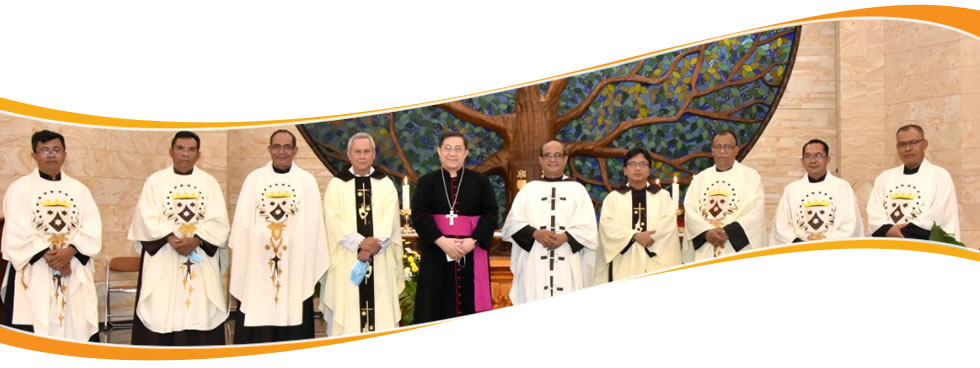
On Saturday, the 3rd of September, in Gajayana Stadium in Malang – Indonesia, the episcopal ordination of Fr. Henricus Pidyarto Gunawan, O.Carm. took place. This solemn mass was attended by 38 bishops from all over Indonesia, one Indonesian Cardinal and the Apostolic Nuncio, Antonio Guido Filipazzi; also around 15.000 faithful from all over the diocese of Malang and from outside. The main celebrant was Mgr. Ignasius Suharyo, the Archbishop of Jakarta. The concelebrants included a large number of priests from within the diocese and from other dioceses, among them were Fr. Benny Phang Khong Wing, O.Carm., the General Councillor of Asia-Australia-Oceania, the Provincial of Indonesian Province, Fr. Ignasius Budiono, O.Carm., the Provincial Commissary of Eastern Indonesia, Fr. Yohanes Bosco Djawa, O.Carm. and many Carmelites from Indonesia and Hong Kong.
The solemn and joyful celebration included the attendance of Carmelite students, different groups of lay Carmelites, the Hermanas Carmelitas, Putri Karmel, Carmelites of St. Elijah, and the cloistered nuns from the monastery of Flos Carmeli – Batu. The dignitaries from the local, provincial and national government were also present after the mass to congratulate the new bishop and to show their support.
The following day, the 4th of September, Bishop Henricus took possession of the diocese of Malang, replacing the now emeritus Bishop H.J.S. Pandoyoputro, O.Carm., forming part of the celebration of the Eucharist in the Malang cathedral.
The motto chosen by the new bishop is, “Fideliter praedicare evangelium Christi.” Congratulations Bishop Henricus, ad multos annos!
St. Therese and Mother Teresa: The Little Way
Blessed Mother Teresa of Calcutta chose the name of “Teresa” because she was inspired by St. Therese of Lisieux’s capability to do ordinary things with extraordinary love. Both of these women are beautiful examples about how we are used as instruments of God’s love.
Mother Teresa was born in Albania in 1910. She felt her calling to religious life at the age of 18. She joined the Loreto Sisters of Dublin and spent her novitiate years teaching in India. It is there that she felt a deeper call to form her own religious order. She spent more than a year lobbying for permission to start her order.
She formed the Missionaries of Charity, they went into the slums of India and helped the poorest of poor. These sisters established hospices, orphanages, and homes for those with disabilities. Mother Teresa wanted to serve the unwanted, unnoticed, and unloved.
Mother Teresa and her fellow Sisters of Charity made major strides to help those in need. The order now has a presence in more than 100 countries. Mother Teresa even received the Nobel Peace Prize for her work. In 1997, at age 87, Mother Teresa entered into Heaven.
This woman of faith is to be canonized as a saint sometime in 2016.
Mother Teresa believed that we must love and care for everyone, especially those who are hardest to love. She tried to see the Lord’s face in everyone she served. She believed doing any action with love was fulfilling God’s will.
St. Therese of Lisieux lived a secluded life as a cloistered sister in France. She entered the Carmelite religious order at the age of 15 after begging the pope for permission.
St. Therese believed that her actions were let God’s love work through her, no matter how big or small. This philosophy is known as the Little Way and aided St. Therese in becoming a Doctor of the Church.
Therese’s greatest desire was to serve God as a missionary in what is now Vietnam. Only her poor health prevented her from fulfilling this dream. She may have lived an unremarkable life but she lived with missionary zeal by performing all actions, great or small, steeped in God’s love. St. Therese and her Little Way is what led her to be the co-patroness of the Missions.
These two women let God use them as an instruments of his love. They both have shared how He used them:
“I am a little pencil in the hand of God who is sending a love letter to the world.”
-Mother Teresa
“I’m a little brush that Jesus has chosen in order to paint His own image in the souls entrusted to my care.” –St. Therese of Lisieux
Therese and Teresa also stated that if they did an action without love it did not mean a thing:
“In this life we cannot do great things. We can only do small things with great love.”
–Mother Teresa
“Without love, deeds, even the most brilliant count as nothing.”
–St. Therese of Lisieux
Mother Teresa and St. Therese both were given the vocation to love with our God’s love:
“Our vocation is the love of Jesus.”
– Mother Teresa
“My vocation is love.”
–St. Therese of Lisieux
Both of these women are excellent examples of how we can be used to serve our Lord. Through them we can see how to practice St. Therese’s Little Way and be used to love even more than can be imagined.
from http://blog.littleflower.org
Citoc Magazine VI-No. 2-2016
On the cover of this issue of CITOC-magazine you will see a beautiful photo of the pilgrimage to the Holy Door made recently by the two General Councils, O.Carm. and O.C.D. on the 11th of June. Among the many joint initiatives of this year, this was certainly one of great significance, and a unique experience of communion, This finds expression in the message addressed to the Carmelite Family by the two Generals, that focuses on the witness of some of our own saints. Among them is Titus Brandsma about whom there is here an article related to the Jubilee of Mercy. This Dutch Carmelite, a “Strong and Merciful Father” is so presented in a book published by the Pontifical Council for the Promotion of New Evangelisation entitled, “The Saints of Mercy”. This is a reminder to us of his witness: a man who was able to be firm in his opposition to nazism and compassionate and merciful towards everyone at the same time, including the nurse who gave him the lethal injection that ended his life.
As we are celebrating the 450th anniversary of the birth of St. Mary Magdalene de’ Pazzi, at the centre of this new issue of CITOC-magazine there is a section dedicated to this occurrence. A short biography tells us who she was, while another article gives us information about the celebrations and activities that mark the anniversary. We then find something very original in the form of a letter written by nuns to St. Mary Magdalene de’Pazzi.
We also wish to mark two other anniversaries, much more recent. This year Karit, Solidarios por la Paz (Karit, Working in Solidarity for Peace) the Carmelite NGO, is celebrating its 20th birthday. An article by its President lets us see the great witness of the Carmelite Family in the Iberian Region. Lastly, one year after the publication of the encyclical, Laudato si, we present an interesting reflection on the ecological originality of Pope Francis. A number of other items offer a wide range of information on what is happening in the Order. Among these we would like to mention two new missions begun recently, one in the Ukraine and the other in Hong Kong.
Along with these articles and other items of information we offer a selection of the main news items, some of which have already appeared in CITOC-online.
We hope that you will enjoy reading this lastest issue of CITOC-magazine. Please click here to download the magazine.
Future saint? Who is Blessed Titus Brandsma?
by Linda Reeves
Along with the Article "A Miracle Story for a Priest with Great Faith" Linda Reeves also wrote this article to introduce who Bl. Titus Brandsma is in the Miracle of Fr. Driscoll.
PALM BEACH | Anno Sjoerd Brandsma, later known as Father Titus Brandsma, was born Feb. 23, 1881, in Oegeklooster, near Hartwerd, in the province of Friesland in the Netherlands. He was one of Holland’s leading churchmen and a great Carmelite priest arrested by the Nazis and imprisoned in Germany. He died a martyr July 26, 1942, was beatified in 1985, and became “blessed.” In order for him to become a saint, one bona fide miracle is needed.
Anno Brandsma was born to farmers Titus Brandsma and Tjitsje Postma. In 1892 at age 11, he entered the Franciscan Minor Seminary for boys in Megen. After six years of studies and living the Franciscan life, young Anno felt called elsewhere. On Sept. 17, 1898, he entered the Carmelite monastery in Boxmeer, Holland, and professed first vows the following year.
In a letter, he told his parents, “I am happy now. I believe God called me here.” Anno took his father’s name, Titus, when he entered the novitiate. He completed studies and formation and was ordained June 17, 1905.
He wrote a few words from Luke 12:48 on his ordination cards. “When a man has had a great deal given him, a great deal will be demanded of him.” These words clearly represent the true spirit of this man, who eventually gave everything, even his life, for the good of God and Church.
Father Brandsma entered the Gregorian University in Rome, where he studied philosophy. He received a doctorate in philosophy Oct. 25, 1909, and returned to the Netherlands to begin ministry. He began teaching at various schools in Holland, becoming known as “The Professor.” In 1923, he joined Catholic University of Nijmegen, which he helped establish. The man, who was a prominent philosopher, poet and writer in mystical theology, was appointed rector of the Catholic institute in 1932. He was noted for his constant availability to everyone.
Writing and the Catholic press were his passion. When he entered the Carmelite monastery, Father Brandsma began writing and working on poetry. In 1916, he led a project focused on translating the writings of St. Teresa of Avila into Dutch. He also wrote a series of meditations on the Stations of the Cross and a magazine for the Carmelite community in the Netherlands. In 1935, he was appointed ecclesiastical adviser to Catholic journalists and Catholic newspapers.
An article appeared in the April 10, 1942, issue of the Florida Catholic, which read, “The Rev. Dr. Titus Brandsma, one of Holland’s leading churchmen and one of the outstanding Carmelites in the world today, has been arrested by the Nazis and imprisoned somewhere in Germany, according to dispatches from London received at the Carmelite headquarters of the Scapular Bureau here.”
Gestapo agents arrested Father Brandsma and he was taken to a prison at Scheveningen, where he remained for six weeks and was constantly interrogated. He was transferred to a prison in Amersfoort and then in Cleves, and finally to Dachau concentration camp in Germany.
He wrote about prison life while at Dachau: “Blessed solitude. I am quite at home in this small cell. I never get bored here, just the contrary. I am certainly alone, but never was Our Lord so near to me. I could shout for joy because now, when I cannot go to the people nor the people come to me, he reveals himself to me so often. Now, he is my only refuge, and I feel so secure and happy. If he ordered it, I would stay here forever.”
Pope John Paul II beatified Father Brandsma Nov. 3, 1985. His feast day is July 27, and is observed by the Carmelite community worldwide.
A Miracle Story for a Priest with Great Faith
by Linda Reeves
BOCA RATON | Retired Carmelite Father Michael Driscoll of St. Jude Parish became emotional when he shared his near-death story, but smiled from ear to ear when he talked about his extraordinary healing, which he credits to prayer and the help of a man, who today, needs a miracle of his own.
It was 12 years ago when Father Driscoll, former pastor of St. Jude Parish in Boca Raton and diocesan director of liturgy, visited his doctor for his annual skin exam. Father Driscoll remembers the appointment like it was yesterday. First there was the checkup, and then there were tests. After the scans, x-rays, and MRI came the doctor’s grim diagnosis.
“It was fourth-stage and fifth-stage cancer in some parts,” said Father Driscoll, then 62, about the aggressive malignant melanoma attacking his neck area behind the ear and spreading to other parts of the body. “I didn’t know how serious it was.”
Melanoma is a cancer that usually starts in a certain type of skin cell. With early detection and proper treatment, the cure rate for the cancer is good. However, melanoma can quickly spread to almost any organ and can target the lungs, bones, liver and brain. Stage 5 cancer is the most advanced form of cancer and often the most difficult to treat.
Medical data states that when cancer has spread to organs of the body and lymph nodes, there is a higher risk that the cancer might come back after surgery. Rarely do patients survive a long period of time following surgery.
In the July 22, 2004, issue of the Florida Catholic, a prayer plea appeared titled “St. Jude pastor needs prayers of healing.” The article read, “Father Michael Driscoll, OCarm, pastor of St. Jude Parish and director of liturgy for the diocese, is awaiting surgery at Massachusetts General Hospital in Boston. St. Jude parishioners and staff members of the Diocese of Palm Beach ask all to keep Father Driscoll in prayers of healing through the intercession of Father Titus Brandsma, a Dutch Carmelite, who was beatified in 1985.”
“We were all praying for him,” said Barbara Batchelder, a parishioner of St. Jude, where Father Driscoll continues to serve and live with a community of Carmelite priests there. “It was touch and go for him. We all came together in prayer as a community.”
The cancer had spread to 10 lymph nodes. The salivary gland was also attacked. Father Driscoll came through surgery with flying colors, but next came 35 aggressive radiation treatments at a cancer clinic in Peabody, Mass.
Members of the Carmelite order, who have a great devotion to Blessed Titus Brandsma, continued to pray for his intercession for Father Driscoll. Parishioners of St. Jude, friends and people from around the diocese continued to pray and ask for Father Brandsma’s help.
Margaret Owers, a former diocesan staff member who worked in the diocesan Liturgy Office with Father Driscoll and is now retired, clearly recalled the news of Father’s Driscoll’s diagnoses and surgery.
“It was very bad,” she said. “I had the impression that it was the worst. He gave me a stack of holy cards and he asked me to distribute them. There were about 30 to 40 prayer cards. I gave them out to people. I kept a card, and I continued to pray as I thought of him.”
The prayer on the card was short, but many believe very powerful and just the healing medicine needed: “God Our Father, your servant, Blessed Titus Brandsma, labored zealously in your vineyard and gave his life freely because of his faith in you. Through his intercession, I ask for your mercy and help. Father Titus never refused when he was asked for help by your people. In his name, I come to you for Father Michael Driscoll’s cure of his cancer. Lord, help me always to imitate the great faith, generous love and burning zeal of Blessed Titus Brandsma. Glorify your servant as he strove to glorify you. Amen.”
Father Driscoll made it through surgery. Then, following the procedure, he successfully came through the harsh treatments that first year. He continued milder treatments the next year and the year that followed. Father Driscoll said most melanomas “come back after two to five years.”
“I buried six people in our parish who had it after I was diagnosed,” he said. “The doctors said I was clear. After 10 years, they dismissed me.”
When asked about any fears of losing the battle with cancer, Father Driscoll firmly stated, “I prayed and I was determined to fight. The people around me were all praying.”
Father Driscoll was born in the Bronx, N.Y. He told us that he first learned about the life of Father Titus Brandsma when he studied at St. Albert Junior Seminary in Middletown, N.Y. “A teacher told us about him and the devotion,” he said. “I went over for his beatification.”
Father Titus Brandsma was a prominent educator, philosopher, poet and writer in mystical theology. He was a true Carmelite, committed to Mary, prayer and the mission of the Church. He served as president and as a faculty member of the Catholic University of Nijmegen. He also served as an adviser for Catholic editors and newspapers in Holland. The Nazi occupation in Holland came in 1940. Father Brandsma, committed to the Church and standing up for freedom of religion and the Catholic press, was arrested Jan. 19, 1942. He was later sent to Dachau concentration camp in Germany where he joined 2,700 other imprisoned clergy. Six months after arriving at the camp, he was killed by lethal injection July 26, 1942.
Father Brandsma was declared a martyr of the Catholic Church and beatified in Rome by John Paul II in November 1985. Events took place around the world in honor of the beatification of the man who gave great witness of his faith and love of Church and God up until he died — praying, reaching out with the love of Christ even to his torturers and trying to spread the good news.
J. Albert Johnson, a Boca Raton attorney and St. Jude parishioner, is a good friend of Father Driscoll. Johnson was there for him when he was going through surgery and treatments. He also prayed for Father Driscoll.
“His recovery to me was a divine intervention,” Johnson said. “He taught me how to pray to Blessed Titus Brandsma, to whom he had a great devotion. Father Driscoll would tell me, ‘I am OK because Titus is going to take care of me.’ His recovery, I am sure, was through the power of prayer.”
Father Driscoll said he prayed and was “determined to fight.”
“The people around me were all praying. Prayer is powerful because Jesus said, ‘Ask and you shall receive,’” he said. “We are not arm-twisting God through prayer. We are just putting ourselves in God’s hands and he decides. We trust in God and trust in God’s will for us.”
In October, Father Driscoll turns 75, and celebrates 50 years in the priesthoodin 2017. He believes that he still has “work to do” for Jesus now that he has a new lease on life. He continues to serve St. Jude Parish and helps out at St. Joan of Arc in Boca Raton. Many are inspired by Father Driscoll’s miraculous recovery that beats all odds, and his strong faith in the power of prayer through the intercession of Blessed Titus Brandsma, a man of faith, who now needs a miracle attributed to him to proceed to canonization and sainthood.
Father Driscoll encourages all those fighting the battle against cancer or carrying other heavy crosses to pray and have faith. “I would say have hope that this illness or misfortune is not going to discourage you. God does love you. Just say no. I am going to fight. I am going to make every day count.”
from http://www.thefloridacatholic.org
The Episcopal Ordination of Paul Horan, O.Carm.
On Saturday, the 17th of August, in Marymount Teachers College in Mutare, (Zimbabwe) the episcopal ordination of Fr. Paul Horan, O.Carm., named as bishop of the diocese of Mutare, took place. It happens that in the same place in 1957, Donal Lamont, O.Carm., was ordained as the first bishop of that diocese.
The celebration was led by the Archbishop of Harare, Robert Christopher Ndlovu, the principal ordaining prelate. The concelebrants included the Apostolic Nuntio, Marek Zalewski, all the active bishops of Zimbabwe, the Prior General, Fr. Fernando Millán Romeral, O.Carm., the Councillor General for Africa, Fr. Conrad Mutizamhepo, O.Carm., the Provincial of the Irish province, Fr. Richard Byrne, O.Carm., the Provincial Commissary of Zimbabue, Fr. Vitalis Benza, O.Carm., the Delegate General for Kenya, Fr. Boniface Kimondolo, O.Carm., and several Carmelites from Zimbabwe and from elsewhere in Africa, along with a large number of priests from the different diocese.
The very joyful celebration included typical African dancing and singing, with an enormous attendance of which different groups of lay Carmelites, the Handmaids of Our Lady of Mount Carmel, (a congregation of sisters founded by Bishop Donal Lamont) and the cloistered nuns from the new monastery of the Holy Family were part.
The following day, the 28th of August. Bishop Paul took possession of his diocese, as part of the celebration of the Eucharist in the Mutare cathedral. The motto chosen by the new bishop is, “Ad unum, cum Maria”.
Electoral Chapter of the Monastery of Montegnacco di Cassacco, Italy
The Elective Chapter of the Carmelite Monastery of Montegnacco di Cassacco, Italy, was held 22 August 2016. The following were elected:
- Prioress: Sr. M. Cecilia Pante, O.Carm.
- 1st Councilor: Sr. M. Margareta Cochior, O.Carm.
- 2nd Councilor: Sr. M. Cristina Cochior, O.Carm.
- 3rd Councilor: Sr. M. Elisabetta Ciliberti, O.Carm.
- Treasurers: Sr. M. Margareta Cochior, O.Carm.
- Sacristan: Sr. M. Cristina Cochior, O.Carm.


