








The Senior of the Order
Sanny Bruijns, O.Carm.
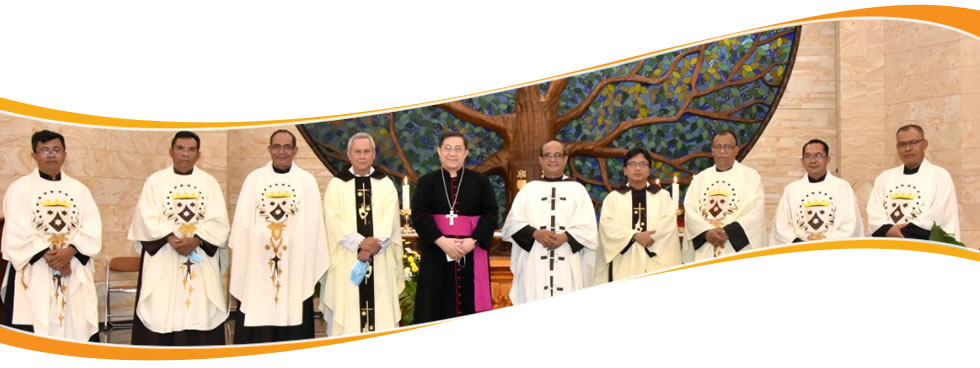
On January 12, Fr. Constant Dölle, O. Carm., of the Dutch Province, celebrated his 100th birthday at his present Carmelite convent in Zenderen. Father Constant is currently the oldest member of the Carmelite Order. The celebration began with a Mass of Thanksgiving in the community chapel, after which there was a reception for family and friends who wanted to offer congratulations.
Along with the Prior Provincial of the Netherlands, Fr. Jan Brouns, O. Carm., there were many Carmelites in attendance. The Mayor of Borne, Mr. R. Welten, also joined in the celebration. During this reception, Fr. Edgar Koning, O.Carm., the prior of Zenderen, read two letters: one from the Prior General and another from the King and the Queen of the Netherlands.
Father Constant was born in the north of the Netherlands in 1916. As a young boy his family house was next to the house of the family Hillesum, where Etty Hillesum (1914-1943) grew up. She died in Auschwitz and left impressive diaries and letters of her spiritual way. Pope Benedict XVI referred to her in his general audience on Ash Wednesday [13 February 2013], saying:
“...I am also thinking of Etty Hillesum, a young Dutch girl of Jewish origin who died in Auschwitz. At first far from God, she discovered him looking deep within her and she wrote: “There is a really deep well inside me. In it dwells God. Sometimes I am there, too. But more often stones and grit block the well, and God is buried beneath. Then he must be dug out again” (Diaries, 97). In her disrupted, restless life she found God in the very midst of the great tragedy of the 20th century: the Shoah. This frail and dissatisfied young woman, transfigured by faith, became a woman full of love and inner peace who was able to declare: “I live in constant intimacy with God”...”
Although they were neighbours in the city of Winschoten, Constant cannot remember this girl next door, because he was fascinated by the neighbour on the other side of the house who introduced the little Constant to playing the piano. Probably Titus Brandsma and Etty Hillesum saw each other in 1923, when Titus visited the school, the parish priest, and the Dölle family in Winschoten. Father Constant was seven years old when he met Titus Brandsma for the first time. He liked him at a first sight and felt he could trust this man. After his entry in the Carmelite Order Constant met father Titus several times in Zenderen and Merkelbeek. The last time they met was in the beginning of January 1942, shortly before Titus was arrested. After 74 years, Father Constant still remembers the inward smile of Titus, a smile with a presence of pure light. After World War II, Constant became a teacher in classical languages (Greek) and a parish priest. During the war he experienced the liberation of his city with shootings while he was saying mass and gave his lent meditations. This experience made him realize that liberation and death are very close to each other. For this reason he gave his new church the title of Christus Resurgens, when he was asked to build a new church in the city of Dordrecht in the west of the Netherlands. This title emphasises the Rising Christ and not the Risen Christ, because rising is a process that God gives us each and every day.
Because Constant knew Blessed Titus Brandsma personally, he wrote a book on the spiritual journey of Blessed Titus: Encountering the Abyss – Titus Brandsma’s Spiritual Journey (Louvaine, Peeters 2002). The book recounts Blessed Titus’ story with particular emphasis on his spirituality.
Although he can be called a senior of the Order and is facing his 80th jubilee as a Carmelite, he still feels inspired by the Carmelite Rule. Together with members of the Carmelite Family he forms a group, who meets on a monthly basis for reflection on the meaning of the Rule for daily life in the 21st century. This keeps him mentally young and makes him a gift for his community and for the Dutch province.
The Ecological Originality of Pope Francis
Fr. Eduardo Agosta Scarel, O.Carm.
Soon we will reach the first anniversary of the launching of the much awaited and much critiqued encyclical Laudato Sì (hereafter LS) of Pope Francis, on the care of the earth, our common home. It turned out to be the first document of the universal Church entirely devoted to the question of care for creation. Some might ask at this point what was it that might be new about what Pope Francis brought to our understanding of nature and of the relationship that human beings have with it. There is no doubt that the present Pope stood on the shoulders of his predecessors, beginning with the seminal address on ecology by Bl. Paul VI, and moving through the letters of St. John Paul II and ending with the magnificent Caritas in Veritate of Benedict XVI.
Following from giants such as these, Francisco saw his ecological itinerary develop, resting on three strong pillars. He is fully convinced that we have to say no to, 1) the dominant global economy, as an economy that looks for immediate returns, denying any possible economic relations that included the logic of gift and gratuitousness; 2) a culture of voracious consumerism associated with this, that makes nothing of any kind of fraternal relations among people, and 3) the environmental deterioration that is a serious threat to the most disadvantaged of the world today and of future generations.
With this road map, the journey began. In line with his style, he seemed to have no reservations. With a reference to the saint from Assisi, he invites women and men everywhere to look at the earth not only as a home, but also as “our sister and mother earth” (LS1) establishing a kind of family intimacy with nature, something not seen before with such mystical nuances. He thinks of the earth as having a certain subjectivity, given that she, nature-earth is in crisis, and has a voice that cries out on account of the damage done by human beings. (LS 2) It is clear that this metaphor finds support in the Bible. That is why the Pope reminds us that the land that is oppressed by human beings “groans and suffers the pains of delivery (Rm 8,22). The Bible also offers support to our origins: “we too are earth”, Francis reminds us. (cf. Gen 2,7) This metaphorical language, coming from the mystics and from the Bible, allows Francis to talk about catholic thought in harmony with the environmental sciences and ecology.
From here on, the encyclical will be an appeal for an environmental enlightenment and an understanding of the problems of the environment based on the sciences. Francis, from the beginning, rejects the biblical language of “domination” and in its place offers a metaphorical understanding using the concept of “integral ecology” that demands new categories that go beyond “the language of mathematics, or of biology and connect us to the essence of what is human.” (LS 11) I believe that here Francis is opening the door to the language of the spirit. In other words, integral ecology is a way of living in a kingdom vein.
Thus, an integral ecology connects human beings with their environment, as part of an overall process of evolution, and with the Creator. This supposes a threefold connection between God, humanity and the earth. We read in no. 83 of the encyclical:
The ultimate destiny of the universe is in the fullness of God, which has already been attained by the risen Christ, the measure of the maturity of all things. Here we can add yet another argument for rejecting every tyrannical and irresponsible domination of human beings over other creatures. The ultimate purpose of other creatures is not to be found in us. Rather, all creatures are moving forward with us and through us towards a common point of arrival, which is God, in that transcendent fullness where the risen Christ embraces and illumines all things. Human beings, endowed with intelligence and love, and drawn by the fullness of Christ, are called to lead all creatures back to their Creator.
This text, in the context of the ecclesial magisterium concerning the relation between nature and human beings is revolutionary. It is in line with the evolutionary approach of the natural sciences, that we find already in Paul VI, and with the language of the spirit. In a certain sense it gives new value to creatures who tend towards God, with and through the whole of humanity. Nature is not there just to be at the service of humans for them to use and abuse it in whatever way they like, but rather the human person has the responsibility to take care of nature and orient it and orient humanity itself in the direction of the transcendent. Here we are talking about the “spirituality” of the cosmos. In the text we can detect signs of the influence of the thinking of Teilhard de Chardin, Jesuit, anthropologist and theologian, a thinker for whom the “grammar of the earth” is expressed by means of the evolutionary unfolding of the present potentialities of created material.
Integral ecology finds its niche in the fact that “everything is intimately related”. Therefore, ecology and social justice are intrinsically united (LS 137). For Francis, with integral ecology a new paradigm of justice comes into view, since every true ecological approach always becomes a social approach; it must integrate questions of justice in debates on the environment, so as to hear both the cry of the earth and the cry of the poor.” (LS 49) and it could not be otherwise: it is the key to the Kingdom!
As a metaphor the concept of integral ecology would seem to connect two planes, one immanent and the other transcendent. On the immanent plane it means that the ecological integrity in a particular geography and social justice in that concrete place are two faces of the one coin. They are united because human beings and nature are part of interdependent and nourishing systems of life. On the transcendent plane, integral ecology connects the exercise of care for the natural world with the exercise of justice towards the poorest and most disadvantaged people of the earth, who represent God’s option of preference in revealed history, those with whom he identified. For that reason, the exercise of care for creation could become a way of expressing or indeed of cultivating my connection with God. Integral ecology indicates that my faith and my eschatological hope in new heavens and new earth (Ap 21,1) may be seen as the same as the present moment in terms of the Gospel: “as often as you did this to my little ones you did it to me” (Mt 25,40), including creatures.
This is the point at which we see the duty of our faith communities. Our charismatic identity could help us recover the spiritual bond that there is between humans, the environment and God as a way of supporting the initiative proposed by Pope Francis in the final chapter:
By spirituality I mean that way of living that is shaped by values and beliefs that guide the fundamental options and decisions of life, a new way, that gives rise to an alternative life-style, distinct from the dominant culture of consumerism and waste. This connection at first sight does not look like a very simple undertaking. It demands, first of all, confidence in the future and in the human person (faith in the Resurrection).
The Pope recognises that the human person of today is a descendent of the biblical paradise where sin upset human freedom. Just as the human person, so also nature is damaged by human sin, which is responsible for cosmic consequences (imbalances). It is clear that our care for the environment is far from being perfect, but, every time that we show that care, we demonstrate our faith in the redemption of all creatures.
Beginning with the Book of Genesis we know that God did not give man an instruction manual as to how to use and care for the natural world. He simply said, “Take care of it and cultivate it”. This duty could not be fulfilled in any way other than with the gift of God that is human intelligence, however imperfect. That much is clear. That is why the Pope has great hope in this quality of the human person (LS 78,164,192). In No. 124 he tells us explicitly:
Any approach to an integral ecology, which by definition does not exclude human beings, needs to take account of the value of labour, as Saint John Paul II wisely noted in his Encyclical Laborem Exercens. According to the biblical account of creation, God placed man and woman in the garden he had created (cf. Gen 2:15) not only to preserve it (“keep”) but also to make it fruitful (“till”). Labourers and craftsmen thus “maintain the fabric of the world” (Sir 38:34). Developing the created world in a prudent way is the best way of caring for it, as this means that we ourselves become the instrument used by God to bring out the potential which he himself inscribed in things: “The Lord created medicines out of the earth, and a sensible man will not despise them” (Sir 38:4).
Francis is one who is happy to believe in human dignity and in our creative capacity to meet all challenges. Above all he trusts in human beings and in God’s help. This fundamental trust is his spirituality which is so attractive to people at the present time. “Let us walk on, and sing” is what he writes towards the end of the encyclical. May our struggles and worries for this planet not take away the joy of our hope”(LS 244).
Letter of Carmelite Nuns to St. Mary Magdalene de’ Pazzi
Carmelite Monastery of Janua Coeli
Dearest Maddalena,
we have written a few lines for you. We speak to you as sisters to sister, crossing the boundaries of time to reach you right there where your are now, in the bosom of the Trinity. In your life on earth you longed for this encounter and you burned with the desire to set the whole Church on fire, with this same passion. You had the feeling that God was driving you to run around “waking up the world”. You know, that today Pope Francis is asking us, the consecrated to wake the world up by the way we live. So it comes naturally to us to think of you, and your concern for evangelisation, your great need to communicate to everyone the love of God, the way you called on the sisters in the monastery, to use their eyes and hands in such a way that these “new” nuns, “might not remain resting all the time in the heart, or the secret bedroom of the spouse, or in his wounded side, but, having spent time in the bedroom, every so often they would run to the window, that is, the wound in his side, and look out and find so many men and women that are in danger of being lost; and that is something that must be done with an anxious and loving desire for their salvation”. (Probations I 259)
We can imagine you, with your frail physical constitution, still almost a child, taking on the ways of God, choosing the Carmelite monastery from among the many that were there in Florence, because at that time it was the only one in which the nuns could receive Holy Communion every day. This was a grace, that you, at sixteen years of age, understood in all its significance.
Forgive us, if to our way of seeing things, your way of understanding and seeing the monastic life seems unusual, so coloured by a negative theology, the fruits of this being only severe mortification and austere penance. You were of course a child of your time. Nonetheless this does not put a distance between us, rather it spurs us into finding in the languages of today, the expression of an asceticism that corresponds to our being Carmelites, nuns, contemplatives totally involved in the constructive dialectic of memory and prophecy of a charism that is still alive and life-giving.
We look at you and see you as a nun, fully part of the life of the community, being very familiar with it and knowing how to appreciate its spiritual strength and its fragility. You had to deal with significant changes. Early on you were accustomed to managing the time that you gave to your own personal prayer, and now it seems to you that time is gone, until you see that you are now part of a dimension of life that grips your whole person, day and night and that gradually makes your existence a continuous prayer. Your days play out, marked by the same rhythm of choir, work, meditation, cell, all in the kind of silence that surrounds everything, because, now as it was then, the life of a contemplative nun unfolds in ordinariness, in the “empty and apparently useless” that in silence opens up to contemplation and that little by little transforms life into prayer.
It is very consoling for us to see these aspects of your life as ones in which we can see ourselves mirrored, in the assurance that comes from the beauty of a charism that does not wear out, and of a vocation that does not lose either power or attraction with the passage of time.
We see you as one who is anxious to live fully and deeply what you are called to be. You are tried by illness, but you also enjoy gifts of mysticism, ecstasy, and rapture. For you too darkness becomes a reality. You too pass through the hour of shadow, trial and pure faith. “All I ask of you O Word, is that you give me light and that the light by which you oblige me to keep moving forward be a true light. O loving word, the time is getting near when the light will not be there and the darkness will come. Here comes the dark brightness and the bright darkness” (Revelations and Intelligences, 294).
You are submerged in temptations, scruples, interior and exterior pain, but the thing that afflicts you most is sin in its darkest effect, the sin that gets inside every human experience, and distances the person from the heart of God. This is a time of purification for you. God brings you to the experience of the pain of even the smallest thing that might be out of tune with your relationship with him. It is the time to lose yourself in order to find yourself even more, a woman in a unique relationship. Your faith is strengthened and that crucifix that you hold so close makes you more like him to the point of allowing his heart to beat in yours and release that uncontainable love that he has for every human being and for the Church, ever holy and sinful.
We can still see in your profile traces of our own. We too, led into the aura of solitude by an Eternal Love, sooner or later, come to taste the bitter flavour of the struggle. How difficult it is to change, to be converted in heart and in mind. For each one of us too every day is a step further towards a full, conscious and mature adherence to the stature of Christ. We grow every day in the awareness of our littleness, our limits, our sin, and as that continues the cry for mercy that rises from every kind of existential periphery becomes an ever greater provocation.
You lived in the years that followed the Council of Trent. We are daughters of the beginnings of the third millennium and we would love if everyone could truly experience the love of Jesus. Really, this present time seems to be a time of confusion, of a great ethical relativism and of corruption at every level. Sometimes it looks like as if the bad is getting the upper hand and peace is merely a utopia and that Christ’s agony goes on and on without a break all over the world.
You had a desire in your heart to see a Church that was pure, a Church Spouse, a Church mother and that is our desire too. “May the flame that comes out of their monastery be such as to set on fire all the hearts that are frozen in love of self, in seeking their own will, in the desire for worldly things”. (Renewal of the Church 105)
Just like you, we would love Jesus to find a welcome in every human heart. And yet how many arguments and contradictions there are. You know how we live on the margins of the world and it would seem that we are not called by God to get involved on the frontlines like many witnesses to the faith. Nevertheless, we, like you, feel that we are fully part of what is going on in the world as women, as contemplatives and as Carmelites, and we know that we are called to jog the consciences of people at every level, the secular and the ecclesiastical.
Your earthly life teaches us that in the first place our task is to become part of the sacrifice of Jesus. He gave his life out of love and in order to do this we have everyday to become more him, take on his DNA, and become accustomed to living in the Spirit.
In the concrete situation in which you live, you cultivate more and more the consciousness that God is calling you to an active engagement in the renewal of the Church, not an easy task, but one that is made necessary by what you call, “the sweet will of God”. Your cry reaches into our day, just like an echo of the voice of God, in God’s constant search for his children.
What happens in your life and the contagious desire to make his love known that burns in our hearts also, makes us believe that in spite of the continual failure of humanity, God does not abandon the hope of bringing “fire upon the earth”. Adam and Cain, the generation of the flood, and the generation of the tower of Babel, your time, our time ....
As we write, we are thinking of the ideological wars of this present time, and the violence incited by extremists that in the name of religion threaten and attack our peace and the security of the world, and life itself. We think about the thousands of refugees, abandoned in the sea, trafficked illegally, without any certainty of reaching our shores, stripped of every dignity behind the alibi of surviving. The stories are many, too many stories of failures and revolts. Yet God does not abandon anyone, and hoping against all hope, continues to call people and to love people.
As we read your works, we are overjoyed to see that even though the women of your time might not have had much access to the Scriptures, you cultivated a great love for the Word and you understood that even going back to the people of Israel, faith is not the result of human searching for God but rather of God’s movement towards humans, as the expression of a nostalgia for the original beauty of the work of his hands that we are. Then, like a little bell, you wanted to remind the Church that it belongs to Christ.
“My Word has a little bell in his left hand. O God, how I admire seeing you like that, but there is some great thing hidden from us and it is there to teach me. With this you are thinking that I should understand that I have to remind the spouses of the perfection for which you have called us, and you want this little bell to give out a deep sound but make noise, because I have to act gently and meekly in announcing and encouraging, and with no bitterness, getting more good out of speaking gently and sweetly than by being sharp and severe. You hold it on the left side because that is the side where your heart is, to show me that the words that I will say have to come from the heart, I mean from a deep love of God and of my neighbour, and I must not say things that have not first had an effect on me”. (Probations, 1 251)
All of this seems to be perfectly in tune with the Jubilee Year of Mercy, because of which the Holy Father wishes in practical terms to remind everyone that we belong to Christ through the Church.
With a style that was typical of you, you stretch our vision and help us to see, as contemplatives, that our experience of communion with the Church is not the result of any kind of abstract love. You transmit a love for her that is so strong, that it broadens and deepens the interior awareness of our calling and of our task in the Church: we are to seek God, in truth and humility, beginning with the renewal of our life, with a greater and purer fidelity to the Gospel, and for us, there is a constant demand to be humble intercessors of mercy for all.
We remain in our monasteries, but we know that to seek God in truth will lead us to encounter him in the brothers and sisters that in a variety of ways come to us and in those whom perhaps we will never meet, but for whom every instant of our lives is offered so that they too may recognise themselves as beloved children of the same Father.
Yes, in this face of a Church that humbly intercedes before God we recognise our duty for today: to always seek the truth, open to understanding the pain of others with great compassion, in following the greatest of all Truth, Christ crucified and risen.
Quaerere veritatem: our community’s journey lies in searching for the truth, through dialogue and encounter, facing up to reality, listening, under the sign of the cross of Jesus and with our eyes fixed on the resurrection.
Magdalen, like many other sisters, you helped the story of Carmel to advance, along the path of witnessing to the faith in the total handing over of your life. In many ways, and all of them praiseworthy. We think of our fathers long ago on Mount Carmel, who out of a desire for the restoration of holy Jerusalem, pitched the tent of their lives in the style of a total and exclusive belonging to God alone. Then we begin to think about the great Teresa, inspired and driven by apostolic zeal to found monasteries in which lives would be spent in prayer for the salvation of the world.
What should we say about the sixteen sisters of Compèigne, who died in defence of the faith that was being threatened by pseudo liberal ideologies, or the young Thérèse of Lisieux who with her little way, from her cell and from her bed of pain, won the prize of being proclaimed the patroness of the missions... And again, a little closer to us, the great Edith Stein, Jewish convert and then Carmelite, aware that she was contributing, by the offering of her life to the good of the Jewish people. Now you are all there, the crown of Mary, interceding for us and rooting for us. We look at you all, we cherish your spiritual legacy and from it we feel encouraged to follow the courageous paths of witnessing to love.
Dear Magdalen, before we leave you, we beg your forgiveness for having kept you so long with our chattering. We ask you as our big sister and companion on the journey; help us to keep our hearts always turned towards God, in listening to him, and in being constantly purified, and help us so that we can always renew our acceptance of the will of God the Father, so that from the margins of the street, where our vocation is located, our life may be an eloquent and contagious witness to love, and so help to renew the face of the Church making it shine with a feminine geniality.
With deepest affection, in oneness and hope.
Your sisters in Cerreto Carmel,
“God of Infinite Mercy” in the Mystical Writings of St. Mary Magdalene de’ Pazzi
Fr. Charlò Camilleri, O.Carm.
The anniversary of the birth of St Mary Magdalene de’ Pazzi, 450 years ago, could not be celebrated in a more appropriate year than this Jubilee Year of Mercy! We can truly call this saint as being the singer of Divine Mercy: “O God, most merciful and high, your mercy is without limits! It is true that you love your creatures! You are more interested in attracting man to You than man comes towards you!
From where is this saint’s hymn on divine mercy coming? Firstly, she realised that God cast His eyes upon her since her conception in her mother’s womb and even though she did nothing to be worthy of this choice, God, in His love and mercy, wanted her for Himself. In this sense, the saint realises that when God shows mercy, He is loving. Moreover, God’s love is His mercy and His mercy is love. Mercy does not emerge from the emotional capacity of pitying someone but it emerges from love. God has mercy on us because we are dear to Him. In Maltese, this seems to be more the union between love and mercy. Someone dear to me, familiar, equal to me, is referred to as ‘dear’, a derivative of ‘mercy, love.’
In her mystic experience, explained clearly in her mystical writings, Mary Magdalene de’ Pazzi mentions mercy in an explicit and direct way for about 1,020 times when speaking about God. Her main writings are in fact a transcript by her fellow sisters of all that she used to vocally experience while in ecstasy. Thus these writings see to be characterised by the announcing of the mystery that opened before her and which she announces in the Church through preaching. These teachings are found in five volumes of manuscripts: The Forty Days, The Colloquies, Revelations and Intelligences and The Probation. To these, we have to add other writings of a different genre like the personal letters to members of her family and friends as well as counsels that she used to give to her fellow nuns and which they gathered into a book.
We here going to glance at some thematic considerations about mercy in the saint’s writings.
Mercy as a remedy of indifference
If there is something which Mary Magdalene preaches in there writings, this is surely Divine Mercy in contrast with man’s indifference and ingratitude. She reflects very often on man’s indifference towards God, and asks in an astonishing way what is wanted from God by man to be attracted to Him: “What is needed from You, O great Love?” Is it knowledge? Is it goodness, kindness? Is it Mercy? Is it Gentleness or Love? She asks these questions, to try and understand why man reacts so badly with God, while meditating on the Passion of Jesus Christ, who is ‘God’s olive branch of peace and mercy,’ and the sufferings He underwent in the hands of the unjust. Christ’s wounds on the Cross ooze in an abundant way mercy so that the soul drinks from it and becomes “in all humility so merciful in a generous way towards her brethren in their spiritual and material needs.”
So it is through this mercy that the malady of indifference is healed. For indifference and a cold heart, God gives the medicine of mercy that unwinds the heart (miseri-cordiai) and moves us towards God and towards our brethren. The soul that drinks from the mercy that oozes from the wounds of Christ feels lighter from holding tight to the material things of this world and with great agility she becomes dedicated to help God and man. In other words, the soul becomes like Christ, lives up to His name.
His Name is Mercy
Maddalena de’ Pazzi reflects also on the meaning of Christ’s name. Christ’s name “in heaven is beauty, on earth is mercy and love, in hell justice.” For us and our salvation, His name is mercy, because He “in everything acts in a merciful way, which mercy is brought about by the great love that He has towards all creatures.” In fact creation is the result of His mercy, redemption emerges from His mercy, the giving of His Body and Blood in the Eucharist is brought about through His mercy, because “His name is mercy,” as expressed by Pope Francis in his book His Name is Mercy.
Since His name is mercy, His identity is Mercy, in the saint’s words “His very own beingis Mercy” insisting that “No one can really understand this Mercy, except God Himself.” We cannot understand God completely. We recognise that He is mercy through His conduct towards us. In His conduct towards us, in this way, God shows His Justice towards us even when He scolds us. He does this to us to improve our lives and stay away from that which hurts us, others and our relationship with Him. His scolding, brought about by mercy, brings us back to our senses and towards Him, so much so that we are ready to receive the forgiveness that is given us through our union with Him.
De’ Pazzi insists that the one who is in hell “God reacts in a merciful and just way”, because mercy does not go against that which is just and right, and justice is not justice if it does not reflect God’s lovingness towards us, but it becomes a vindictive punishment, which is not so with God, as the saint says “With so much mercy you keep inwards and you do not take revenge on the offences that we commit towards you.” Interesting to note is that the saint teaches that our perception that there is opposition between Justice and Divine Mercy is brought about through Lucifer. The saint imagines that through this, the devil puts the stairs which we use to lift ourselves towards God, like spiky creatures, that make it difficult for us to climb up in a hurried pace towards this God of Mercy as we forget that God destroyed this non-existent opposition between Mercy and Justice because through the love that He has towards us, He gave us His Only Son who became man. This love which is expressed in just mercy and in loving justice pushes us to always live in the truth and love of God, embraced in His mercy:
“O my gentle God, what mercy can I receive from You if I don’t abandon myself completely on You? Have mercy on me, my God. I really know that I am not worth this mercy but a thousand hells. However I can really pray for mercy, O God, because in that which is yours, ............... (your intention) So my God, all I can do is pray for mercy, and please release me not from places where many curse You.”
St. Mary Magdalene de’ Pazzi - Biographical profile
Sr. Marianna di Caprio, O.Carm.
The second of four children, Caterina was born in Florence on the second of April, 1566, to Camilo de’ Pazzi and Maria Buondelmonti. In the comfortable setting of a noble family, that began to call her Lucrezia, after her paternal grandmother, the young girl grew up peacefully and with a certain sensitivity to the aesthetic side of her social condition. Her heart was open to God, and to the promptings of the Holy Spirit, in great simplicity, which is something we can see in the way she might share her lunch pack with a needy person, out of compassion, or the way she would help the children of the poor by gently offering them the first truths of faith. Her mother’s deep piety, and the visits to her home by the Jesuit Fathers, that her parents invited regularly, helped to stamp on Caterina’s soul that sense of Church, “sensus ecclesiae,” that in later life would appeal so much to her conscience.
At eight years of age, she was sent as a pupil to the nuns at San Giovannino. The nuns, who noticed the contemplative nature of the child, prepared her for First Holy Communion and not many weeks later, Caterina was sufficiently mature to offer her virginity to God. She was ten years old, and now she didn’t need anymore to get the scent of Jesus, by standing near her mother when she had received Holy Communion, now she began to meditate on the humanity of Jesus. As she was learning to read she came across the Athanasian Creed, and she was very taken by it. In the same way she grew to like the meditations of St. Augustine, and the Lord’s passion by Loarte, whiche she read on the advice of Fr. Andrea Rossi who was her spiritual director.
She had not yet reached the age of seventeen when she showed her desire to be consecrated to God in religious life. Having overcome the initial opposition of her family, she entered the monastery in Borgo San Frediano, to join the Carmelite community of Santa Maria degli Angeli who were very happy to have her. They allowed her to begin as a postulant on the 8th of December, 1582. This community, that was well known to and highly regarded by the bishop of Florence, was attractive to the young girl principally because of the possibility of receiving Holy Communon every day.
Two months after entering, on the 30th of January, 1853, Caterina received the Carmelite habit, and with it, the name, Sr. Maria Maddalena. At the end of the novitiate year it was decided that she would put her profession back until there were other novices ready to join her. Maria Maddalena, however, got very sick in the following months, to the point of almost dying. With little hope of recovery - even the best doctors in the city had failed to diagnose what today we would call pneuomonia - the prioress decided to have her make her profession in danger of death, in articulo mortis.
About one hour after her profession, something happened to Maddalena. It was an experience of rapture in God. The sisters tell us that when they went to visit her in the infirmary, they came upon the young eighteen year old patient, transfigured, and looking very beautiful. From that day onwards, it was the 27th of May, 1584, the feast of the Most Holy Trinity, the Lord visited her every morning for forty days, and revealed the depth of his love to her. These frequent episodes gave rise to many misgivings in the young girl whose only desire was to live in the hiddenness of her life in Carmel, but it was obvious that this kind of grace had to be recognised and preserved. For that reason, the sisters began very soon to take notes, writing down what Maddalena would say while in ecstasy and what she would say, out of obedience, to the prioress and mistress.
Towards the end of that same year a new period of divine favour began for her. This time, Jesus, the “humanified” Word, held her in intense conversation (reported in I Colloqui) that revealed increasingly, the bridal relationship that Christ had formed with her. It was in one of those ecstasies that Christ brought her into his passion and death. It was Holy Week in 1585: her experiences included the stigmata impresssed on her soul, the crown of thorns, the cruifixion, and every scene from the Gospel was acted out as if it was happening live in that slender tormented body. Then, on the Sunday after Easter, she received from her divine Bridegroom the ring of her mystical marriage.
The manuscript titled, Revelazioni e Intelligenze, gives a faithful account of the communication of God’s grace, that in the days between the vigil of Pentecost and the Sunday of the Blessed Trinity, gave Maddalena an entry into the revelation of the inner dimensions of her Trinitarian life. What was communicated to her was what goes on between the divine persons, and how the human person can fulfil a supernatural vocation by allowing this mystery dwelling within to do its work.
The central element in this understanding, is the saving mission of the Word, Love, made flesh in the most pure womb of the Virgin Mary, and the intuition of “dead love” as the highest expression of the ultimate gift of self.
On the last day of this intense octave of Pentecost, Maddalena began to see with some clarity that the moment had arrived when God, as he had made know to her already on a few occasions, was about to take away from her the enjoyment of his presence. That was the beginning of five very difficulty years of torment and temptation, to the point where she felt like as if she had been thrown into the “lions’ den”, and reduced to “nothing”. In these interior trials, described in the Probazione, Jesus continues to support her, but without lessening the radical purification that striped her bare, made her more simple and extremely receptive to his visits. In the heart of the crucible, however, Maddalena also received lights from God concerning the condition of the Church of her time - so slow to implement the renewal sought by the Council of Trent - and she felt that she was being drawn by the Truth to be involved in a practical way in calling to order prelates, cardinals and even the pope, Sixtus V. The twelve letters that she dictated in ecstasy, in the Summer of 1586 are collected in the volume titled, Rinnovamento della Chiesa, The five years of trial restored to us a Maddalena transformed. The Lord had brought her through a divinising process, around which today she could well be considered a master and guide.
After Pentecost 1590, she returned to the normality of ordinary life, something she had always wanted. Apart from just a few, and important, moments of ecstasy (reported in the second part of the Probazione) her days passed quietly as she went about the jobs she had to do (on account of her spiritual maturity she was put in charge of the young sisters in formation), and all the other forms of humble service that she tended to seek. Then the experience of “naked suffering” took hold of her and this would unite her once and for all to the crucified Bridegroom.
The symptoms of tuberculosis began to appear in 1603. As her strength declined, she suffered the added pain of not being able to feel anything of the Lord’s presence. Just her presence in the community, in the eyes of the sisters, had become a vision of God’s work of art about to be completed. On the 25th of May, 1607, at 3 p.m. in the afternoon, Sr. Maria Maddalena, at the age of forty one gave up her spirit.
450th Anniversary of the Birth of St. Mary MagdalenE de’ Pazzi
On 2nd of April, 2016, the date of Mary Magdalene’s birth in 1566, the solemn opening of the 450th Anniversary of the Birth of St. Mary Magdalene de’ Pazzi was marked with the solemn celebrations took place at the monastery of Careggi (Florence, Italy), where her body is venerated.
The Cardinal Archbishop of Florence, Giuseppe Betori, led the celebration of the Eucharist that was concelebrated by several priests. The concelebrants included, the Prior General, Fr. Fernando Millán Romeral, along with other members of the General Curia, the Vice-Prior General, Fr. Christian Körner, the Councilor General for Europe, Fr. John Keating, the Procurator General, Fr. Michael Farrugia, the Bursar General, Fr. Carl Markelz, and the Delegate General for the Nuns, Fr. Mario Alfarano. The Carmelite Family was present in great numbers, with friars from the different houses in Florence and Castellina, the sisters of the Istituto di Nostra Signora del Monte Carmelo, and very many lay Carmelites.
In his homily the Cardinal pointed to the example of the saint in her cultivation of the transforming knowledge of the Risen Lord, just as the readings in the liturgy suggested. He read a telegram from the Pope, signed by the Secretary of State, Card. Pietro Parolin, in which he “joined in thanksgiving to the Lord for giving to the Church such a significant disciple of the Gospel and master of spirituality.” He ended by imparting an Apostolic Blessing and granting the corresponding plenary indulgence.
At the end of the celebration the Prior General thanked all those who were present and in particular the nuns, who, although they are just a small community, continue to keep alive the spirit and teaching of St. Mary Magdalene de’ Pazzi.
On the 25th of May, feast of St. Mary Magdalene de’ Pazzi, the Prior General led the celebration of the Eucharist at the Hermitage of Santa Maria degli Angeli, in Scandicci (Florence). This monastery was founded n 1987 in the hills opposite where Careggi is situated where the remains of the saint are kept. The Mass, and the banquet afterwards, took place in a festive and fraternal setting. Along with the Prior General, there was a number of Carmelites and three postulants from the Italian province present. There was also a large number of diocesan priests, including the Vicar for that area, priests from the Community of San Leolino and of the “Opera Madonnina del Grappa”. The celebrations were enriched by the presence of the sisters of the Instituto di Nostra Signora del Monte Carmelo, members of the Third Order and many friends of the nuns.
In different places of the Carmelite monasteries, parishes, and schools in the world, among the friars, nuns, and laity, activities of retreats, exhibitions, conferences, and seminars continue to appear to commemorate the 450th anniversary of the birth in Florence of St. Mary Magdalene de’ Pazzi.
On account of the 450th anniversary of the birth of St. Mary Magdalene de’ Pazzi, the Apostolic Penitentiary has granted that all Carmelite monasteries be places where people may obtain a plenary indulgence throughout this year, beginning on the 2nd of April, 2016 and ending on the 25th of May, 2017. The same applies to churches and chapels dedicated to her.
For more information and latest news regarding the 450th anniversary of the birth of St. Mary Magdalene de’ Pazzi, please visit the official website of the order at www.ocarm.org/mmp450 to read and learn more the life and works of the saint.
Mary’s motherhood teaches us humility, tenderness
Pope Francis
HOLY MASS ON THE SOLEMNITY OF MARY, THE HOLY MOTHER OF GOD
HOMILY OF HIS HOLINESS POPE FRANCIS
“Mary treasured all these things and pondered them in her heart! (Lk 2:19). In these words, Luke describes the attitude with which Mary took in all that they had experienced in those days. Far from trying to understand or master the situation, Mary is the woman who can treasure, that is to say, protect and guard in her heart, the passage of God in the life of his people. Deep within, she had learned to listen to the heartbeat of her Son, and that in turn taught her, throughout her life, to discover God’s heartbeat in history. She learned how to be a mother, and in that learning process she gave Jesus the beautiful experience of knowing what it is to be a Son. In Mary, the eternal Word not only became flesh, but also learned to recognize the maternal tenderness of God. With Mary, the God-Child learned to listen to the yearnings, the troubles, the joys and the hopes of the people of the promise. With Mary, he discovered himself a Son of God’s faithful people.
In the Gospels, Mary appears as a woman of few words, with no great speeches or deeds, but with an attentive gaze capable of guarding the life and mission of her Son, and for this reason, of everything that he loves. She was able to watch over the beginnings of the first Christian community, and in this way she learned to be the mother of a multitude. She drew near to the most diverse situations in order to sow hope. She accompanied the crosses borne in the silence of her children’s hearts. How many devotions, shrines and chapels in the most far-off places, how many pictures in our homes, remind us of this great truth. Mary gave us a mother’s warmth, the warmth that shelters us amid troubles, the maternal warmth that keeps anything or anyone from extinguishing in the heart of the Church the revolution of tenderness inaugurated by her Son. Where there is a mother, there is tenderness. By her motherhood, Mary shows us that humility and tenderness are not virtues of the weak but of the strong. She teaches us that we do not have to mistreat others in order to feel important (cf. Evangelii Gaudium, 288). God’s holy people has always acknowledged and hailed her as the Holy Mother of God.
To celebrate Mary as Mother of God and our mother at the beginning of the new year means recalling a certainty that will accompany our days: we are a people with a Mother; we are not orphans.
Mothers are the strongest antidote to our individualistic and egotistic tendencies, to our lack of openness and our indifference. A society without mothers would not only be a cold society, but a society that has lost its heart, lost the “feel of home”. A society without mothers would be a merciless society, one that has room only for calculation and speculation. Because mothers, even at the worst times, are capable of testifying to tenderness, unconditional self-sacrifice and the strength of hope. I have learned much from those mothers whose children are in prison, or lying in hospital beds, or in bondage to drugs, yet, come cold or heat, rain or draught, never stop fighting for what is best for them. Or those mothers who in refugee camps, or even the midst of war, unfailingly embrace and support their children’s sufferings. Mothers who literally give their lives so that none of their children will perish. Where there is a mother, there is unity, there is belonging, belonging as children.
To begin the year by recalling God’s goodness in the maternal face of Mary, in the maternal face of the Church, in the faces of our own mothers, protects us from the corrosive disease of being “spiritual orphans”. It is the sense of being orphaned that the soul experiences when it feels motherless and lacking the tenderness of God, when the sense of belonging to a family, a people, a land, to our God, grows dim. This sense of being orphaned lodges in a narcissistic heart capable of looking only to itself and its own interests. It grows when what we forget that life is a gift we have received – and owe to others – a gift we are called to share in this common home.
It was such a self-centred orphanhood that led Cain to ask: “Am I my brother's keeper?” (Gen 4:9). It was as if to say: he doesn’t belong to me; I do not recognize him. This attitude of spiritual orphanhood is a cancer that silently eats away at and debases the soul. We become all the more debased, inasmuch as nobody belongs to us and we belong to no one. I debase the earth because it does not belong to me; I debase others because they do not belong to me; I debase God because I do not belong to him, and in the end we debase our very selves, since we forget who we are and the divine “family name” we bear. The loss of the ties that bind us, so typical of our fragmented and divided culture, increases this sense of orphanhood and, as a result, of great emptiness and loneliness. The lack of physical (and not virtual) contact is cauterizing our hearts (cf. Laudato Si’, 49) and making us lose the capacity for tenderness and wonder, for pity and compassion. Spiritual orphanhood makes us forget what it means to be children, grandchildren, parents, grandparents, friends and believers. It makes us forget the importance of playing, of singing, of a smile, of rest, of gratitude.
Celebrating the feast of the Holy Mother of God makes us smile once more as we realize that we are a people, that we belong, that only within a community, within a family, can we as persons find the “climate”, the “warmth” that enables us to grow in humanity, and not merely as objects meant to “consume and be consumed”. To celebrate the feast of the Holy Mother of God reminds us that we are not interchangeable items of merchandise or information processors. We are children, we are family, we are God’s People.
Celebrating the Holy Mother of God leads us to create and care for common places that can give us a sense of belonging, of being rooted, of feeling at home in our cities, in communities that unite and support us (cf. Laudato Si’, 151).
Jesus, at the moment of his ultimate self-sacrifice, on the cross, sought to keep nothing for himself, and in handing over his life, he also handed over to us his Mother. He told Mary: Here is your son; here are your children. We too want to receive her into our homes, our families, our communities and nations. We want to meet her maternal gaze. The gaze that frees us from being orphans; the gaze that reminds us that we are brothers and sisters, that I belong to you, that you belong to me, that we are of the same flesh. The gaze that teaches us that we have to learn how to care for life in the same way and with the same tenderness that she did: by sowing hope, by sowing a sense of belonging and of fraternity.
Celebrating the Holy Mother of God reminds us that we have a Mother. We are not orphans. We have a Mother. Together let us all confess this truth. I invite you to acclaim it three times, standing [all stand], like the faithful of Ephesus: Holy Mother of God, Holy Mother of God, Holy Mother of God.
Pope on New Year’s Day: Mary’s motherhood teaches us humility, tenderness
http://www.catholicnewsagency.com
At the start of the new year, Pope Francis said that celebrating Mary, the Mother of God, highlights a beautiful aspect of our faith: that Mary is our mother too, and that by her example we can learn to practice virtue and self-sacrifice in our own lives.
“By her motherhood, Mary shows us that humility and tenderness are not virtues of the weak but of the strong,” Francis said Jan. 1.
“To celebrate Mary as Mother of God and our mother at the beginning of the new year means recalling a certainty that will accompany our days: we are a people with a Mother; we are not orphans.”
Pope Francis celebrated Mass in St. Peter’s Basilica for the Solemnity of the Blessed Virgin Mary, the Mother of God Jan. 1, reflecting on the line in Luke’s Gospel that says “Mary treasured all these things and pondered them in her heart.”
Despite everything that was happening in the days surrounding the birth of Jesus and after, Mary did not try to “understand” or to “master the situation,” the Pope pointed out, but instead, she treasured what happened, protecting and guarding “in her heart, the passage of God.”
“Deep within, she had learned to listen to the heartbeat of her Son, and that in turn taught her, throughout her life, to discover God’s heartbeat in history,” he continued.
Mary does not say much in the Gospels, and she does not make any big speeches or perform amazing deeds, but what she does have, Pope Francis said, is “an attentive gaze capable of guarding the life and mission of her Son, and for this reason, of everything that he loves.”
“Where there is a mother, there is tenderness,” he said: the many shrines, images and chapels around the world dedicated to Mary remind us of this. And celebrating the Holy Mother of God reminds us that we are not orphans, that we all have a mother.
“To begin the year by recalling God’s goodness in the maternal face of Mary, in the maternal face of the Church, in the faces of our own mothers, protects us from the corrosive disease of being ‘spiritual orphans,’” he said.
We experience this sense of being spiritually orphaned when we feel motherless and without the tenderness of God, the Pope noted, or when we feel like we don’t belong to God’s family. When this sense grows, it makes us more narcissistic and concerned with our own interests.
“It grows,” he said, “when we forget that life is a gift we have received – and owe to others – a gift we are called to share in this common home.”
But Mary, by comparison, “gave us a mother’s warmth,” he said. A “warmth that shelters us amid troubles, the maternal warmth that keeps anything or anyone from extinguishing in the heart of the Church the revolution of tenderness inaugurated by her Son.”
In our society, mothers are “the strongest antidote to our individualistic and egotistic tendencies, to our lack of openness and our indifference,” Pope Francis said. Mothers are capable of testifying to tenderness and self-sacrifice and hope in our society.
“Celebrating the feast of the Holy Mother of God makes us smile once more as we realize that we are a people, that we belong, that only within a community, within a family, can we as persons find the ‘climate,’ the ‘warmth’ that enables us to grow in humanity, and not merely as objects meant to ‘consume and be consumed,’” the Pope said.
“To celebrate the feast of the Holy Mother of God reminds us that we are not interchangeable items of merchandise or information processors. We are children, we are family, we are God’s People.”
LITURGICAL CALENDAR 2017 with Carmelite Feastdays
The calendar is based upon the General Roman Calendar, promulgated by Pope Paul VI on February 14, 1969, subsequently amended by Pope John Paul II, and with the supplement of the Carmelite Feast-days. This calendar has been updated to reflect the names and titles of the various liturgical days in conformity with the Roman Missal.
download PDF file
LITURGICAL CALENDAR 2017
with Carmelite Feastdays
Feast of Mary, Mother of God
Fr Jack Larkin, O.Carm
Today's feast of Mary, the Mother of God is the oldest Marian feast in the church. The title is so easily accepted by us today, it is part of our lives, it rolls off off our tongue so easily. At one time it was the center of controversy. Jesus' divinity was being questioned in the early church. There was a fierce debate about calling her Mother of God. The Council of Ephesus defined Mary Theotokos - God Bearer. But this was more a statement of Jesus' divinity than of Mary's maternity. Through the years there was a tragic division in Christianity over the title: Mary, Mother of God. It does not mean that Mary existed before God or that she is equal to God. She is totally human as we are, born as we are of two human parents. We do not worship Mary (as some even today believe). We adore God alone. We honor Mary who was first honored by God. And we venerate Mary as the Mother of God and our Mother, too.
Our devotion to Mary is very romantic, perhaps epitomized in the words of the Christmas carol: All is calm, all is bright. Our Christmas cards depict a peaceful family in a stable with words of encouragement and good will and happiness. True, it is a testimony to the joy of the season, it is the message of Christmas. But it overlooks the turmoil and confusion that Mary endured: a family far away from home, poor, and in need of adequate shelter. The shepherds arrive with their story of the star and its meaning. And Mary continues to ponder the meaning of it all. In medieval times painters put a small but distinct crucifix in their nativity scenes. Perhaps only when she sees her son die on the cross that she realizes the full meaning of her title: Mother of God.
One of my favorite Christmas stories is the one about the sisters who were captives of the Japanese in the Philippines in World War II. They were allowed to have their services. They were celebrating a novena leading up to Christmas, bringing up the infant in procession and placing him on the altar. The Japanese guard watched all this with great interest. About the fifth day he figured it out and asked Mother McCarthy a question. "Same one?" he asked, pointing to the Infant and to the crucifix nearby. "Yes," she replied. "Same one." and he said: "Sorry." The story shows the intimate connection between Christmas and the cross.
There is a new crib on the market. It comes with painted landscape in the background of rolling hills and trees - the kind you see in many renaissance nativity scenes. The new product moves gently at all times. It comes with a sound track that mimics the steady heart beat of a mother, with the wound of waves in the background. All of The first reading tells the Jews and us too, today: "May the Lord bless you and keep you." As we begin a new year we ask for a special blessing from God for each other and for the whole world under the tender gaze of Mary, Mother of God and our Mother, too. Mary's role is central. She is an example of mature, joyful, spontaneous faith in action. As Jesus is true man, Mary is true woman. As with us, she journeyed in faith. Today we celebrate her as the Mother of God. In this feast, once the only Marian feast in Rome, we recall the part she played in the fulfillment of the ancient blessing promised to Israel. And we give thanks for that blessing which has been bestowed upon us all.


