






Displaying items by tag: carmelite nuns africa
Mass Attendance Skyrocketing Brings Troubles in Kenya
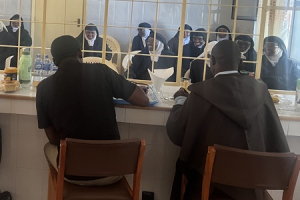
Skyrocketing Increase in Catholics at Mass Brings Troubles for the Carmelites Making Hosts in Kenya
According to Aid to the Church in Need (ACN), an international Catholic charity since 1947, the number of people returning to Church in Kenya is skyrocketing, while the equipment used by the Carmelite nuns for baking Eucharistic wafers has broken down.
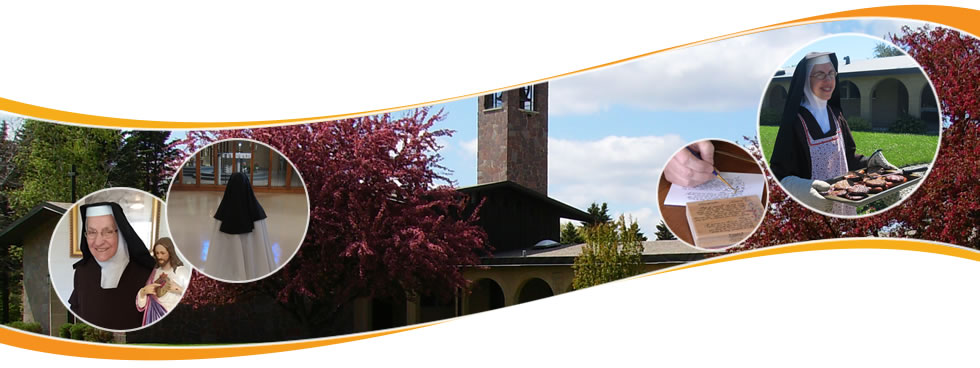
The 26 Carmelite Sisters, who live in the Monastery of Our Lady of Mount Carmel in the Machakos Diocese, support themselves through their work. While their principal vocation is prayer, the nuns bake unleavened communion wafers and create liturgical items, including vestments, for the local Church. The Machakos Carmelite monastery, the first in Kenya, was established by Sisters from Utrera, Spain, in 1999. There are now three Carmelite monasteries in the country.
The prioress of the monastery, Sr. Mary Thérèse Ndinda, believes the increase in participation is due to covid. “The experience of the pandemic has led many people to come back to Church.”
The wafer-baking equipment at the monastery is quite old and frequently breaks down. So the work has become especially difficult. Sr. Mary Thérèse said the nuns, who come from many countries including Spain, Burkina Faso, Cameroon and Tanzania, could not afford new equipment, since their earnings barely cover their own very modest needs.
Kenya has a population of more than 55,300,000 which is 82.5 percent Christian, according to CAN’s 2025 Religious Freedom in the World report.
Elective Chapter Held in Machakos, Kenya

Elective Chapter Held in the Monastery of Our Lady of Mt Carmel in Machakos, Kenya on June 10, 2025
On June 10, 2025, the Carmelite nuns of the Monastery of Our Lady of Mount Carmel in Machakos, Kenya held their elective chapter.
The monastery was founded in 1999 by sisters from the Carmelite monasteries in Utrera, Spain and Santo Domingo. It was the first Carmelite monastery in Kenya. Two other enclosed monasteries now exist in the country: Juja Farm and Kitui.
The following nuns were elected to leadership:
Prioress | Priora | Priora:
Sr. Mary Winifred Katunge Mbui
1st Councilor | 1ª Consejera | 1ª Consigliera:
Sr. Mary Therese Ndinda
2nd Councilor | 2ª Consejera | 2ª Consigliera:
Sr. Mary Jacinta Wayua
3rd Councilor | 3ª Consejera | 3ª Consigliera:
Sr. Mary Lucy of St. Joseph
4th Councilor | 4ª Consejera | 4ª Consigliera:
Sr. Mary Dorothee Ndomo
Treasurer | Ecónoma | Economa
Sr. Mary Therese Ndinda
Formator | Formadora | Formatrice
Sr. Mary Therese Ndina Mutisya
Sacristan | Sacristán | Sacrestana:
Sr. Mary Jacinta
Carmelite Order Celebrates Day of the Cloistered Nuns

Carmelite Order Celebrates Day of the Cloistered Nuns, Pro orantibus. Prior General Sends Letter
In recognition of Pro orantibus, the day the Church dedicated to contemplative nuns, Fr. Míceál O’Neill, the prior general of the Carmelite Order, wrote to the monasteries of the Order. The letter focuses on 2024 being the Year of Prayer, as announced by Pope Francis at the beginning of the year. The prior general connects this year of prayer to the Carmelite charism, writing to those “who incarnate the Carmelite charism to think about our vocation to pray, to pray more intensely ourselves and to help other to pray.”
Reflecting on the Gospel read in the celebrations of both St. Thérèse of Lisieux and St. Francis of Assisi, he finds that God reveals “truths to children like us” in prayer. “Prayer is a communication between persons divine and human who are united in love.” The great Carmelite nun, St. Mary Magdalene de’ Pazzi, teaches us about the moment after Holy Communion when she began to think about the Gospel she had heard in the Eucharist. “There was no better place for her to be at the moment.”
Fr. Míceál also explores the Order’s tradition of prayer and contemplation as recorded in the Order’s Constitutions for the nuns. He points out that the revision of those for the men in 2019 focused the most attention on contemplation. Recalling that the nuns are well into the process revising their own Constitutions, he points out that proposed revisions clearly recognize the gift of contemplation is the nuns’ “charism and calling in a way that allows you to live out that vocation yourselves and explain it to the Church of today and to those who will approach you in the future …”
The prior general notes that liturgical prayer “is the privileged place desired by Christ for our encounter with him.” He senses movement in the Order today “to recover and enhance our rich liturgical tradition.” He highlights a recent publication and the scheduled Liturgical Congress in May. He asks that the liturgies celebrated during the Jubilee Year “contribute to … enlightenment and moving us to seek reconciliation in families, in the Church, in communities.”
Finally, Fr. Míceál speaks of prayer as “discernment, discernment alone in the cell, nourished and completed by discernment in the community and vice versa.” He writes that “a community that comes together to pray and engage in communal discernment is a community that is capable of growing in maturity and responding each day, more fully, to the call to holiness which is union with God.” He concludes “union with God does not exist without union with neighbor, union with our families, union with our religious community.”
He concludes wishing that this day of Pro orantibus be an experience of joy for the sisters and a moment of renewal of love for prayer in their lives.
Message for the World Day of Cloistered Life

Fr. Míċeál O’Neill, O. Carm., the prior general, has sent a letter to each enclosed Carmelite monastery in the world on the occasion of the Church’s celebration of World Day of Cloistered Life or Pro Orantibus Day (For Those Who Pray).
In the letter, dated November 18, 2022, the prior general says:
“By your dedication to God, you adorn and strengthen the Carmelite Order throughout the world and you offer to the Carmelite family, amid the many gifts that express Carmel’s love for silence and solitude, the example of cloistered life, as a way of making space for God in our lives and deepening our love for God.” He then reflects on family life today and calls on their communities to become one that “stands before God and finds its dignity in responding everyday not with marvels beyond us, but with the simple knowledge that God is love and in him we find love.”
This annual celebration on November 21 is connected to the Feast of the Presentation of Mary. The day is intended to support—both spiritually and materially—the gift of the cloistered and monastic life. Pope Francis has spoken of the day as “an opportune occasion to thank the Lord for the gift of so many people who, in monasteries and hermitages, dedicate themselves to God in prayer and in silent work.
In 1953 Pius XII first introduced the idea of the Church reflecting on those who have answered the vocation to cloistered life. It is celebrated locally in the monasteries of men and women. In 2018, Pope Francis held a convention organized by the Congregation for Institutes of Consecrated Life and Societies of Apostolic Life at the Pontifical Lateran University. Entitled “Deepening Vultum Dei Quaerere and Cor Orans,” the gathering of 300 cloistered women, studied the two relatively recent Church documents. Vultum Dei Quaerere, was written by Pope Francis and issued on June 29, 2016. The implementing instruction, entitled Cor Orans, was written by the Vatican Dicastery for Consecrated Life and issued on April 1, 2018.
These two documents introduce new aspects for the living out of this state of life in the Church. They also emphasize the importance of this vocation for the Church and the world. Pope Francis reminded contemplatives in Vultum Dei Quaerere that they intercede for the world like Moses. “Now, as then,” the Pope wrote, “we can conclude that the fate of humanity is decided by the prayerful hearts and uplifted hands of contemplative women." He has also said that those who devote the whole of their lives to the contemplation of God “are a living sign and witness of the fidelity with which God, amid the events of history, continues to sustain His people.”
Read the Letter pdf here(136 KB)