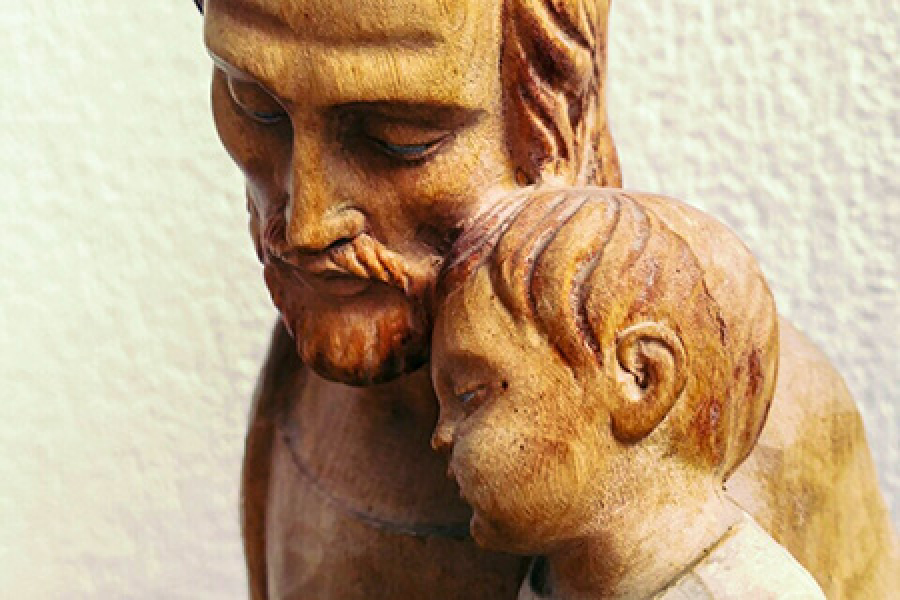
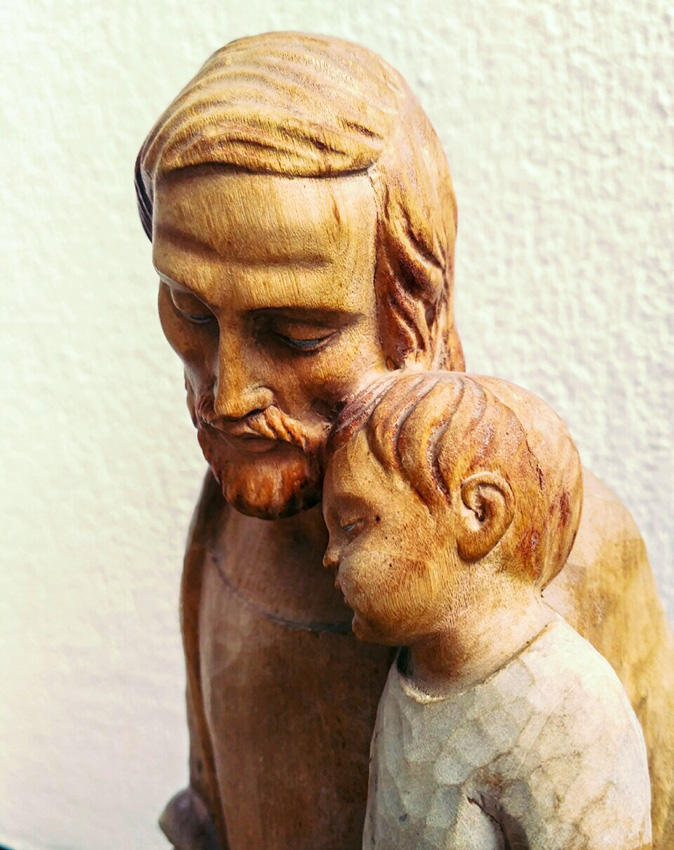
On 19 March, we celebrate the Solemnity of St. Joseph, Principal Patron of the Order.
It does us good to think about St. Joseph, to meditate on him as one whom our tradition has recognized as a patron and a model of Carmelite life.
The veneration of St. Joseph is an integral part of our Christian formation, tradition, and culture. We are so accustomed to placing St. Joseph alongside Jesus and Mary, that we tend to think that the Church has always attributed to him, whose life was one of intimacy with the mystery of the incarnation, the dignity and the honors that we normally associate with him, but in reality, it was not always so. In the first millennium, the traces of a theological reflection on St. Joseph, or of any particular homage given to him are very rare. It was only with the advent of the mendicant orders that devotion to St. Joseph began to develop. A decisive contribution was given by the Franciscans and by the Carmelites.
For Carmelites, interest in St. Joseph was a natural offshoot of its fundamental Marian orientation. Every member of the wider family of Mary (her parents, Joachim and Anne, the secondary protectors of Carmel, and his alleged sisters and brothers, Mary of James and Mary of Salome) were the recipients of particular attention in Carmel. In that context, Joseph, Mary’s spouse, could not be ignored.
The proper of the liturgy in honor of St. Joseph in the Carmelite tradition is thought by historians and liturgists to be the first monument of the Latin Church to the dignity of St. Joseph.
In that same ancient liturgy we can detect a wealth of Carmelite spirituality under the image of St. Joseph: 1) puritas cordis that makes it possible to have a vision of God, 2) union with Mary, and 3) the fruitfulness of the mystical life understood in terms of the conception and birth of the incarnate Word in the soul that is pure. St. Joseph for that reason is celebrated as the image and reflection of the Carmelite mystical life in God.
We are living now in a period in which the Church is not so concerned with defending itself from an outside enemy but seeks to recognize its mission of giving authentic witness to the truth of the Gospel. Thus, in a world where there is need for “concreteness and the sense of mystery,” in a world in which we tend to flee from the bonds of stable relationships and commitments and to revert to a kind of sterile narcissism, Joseph shows us the way of self-denial, daily responsibility, the silent dedication to the care and growth of family. Any father of a family will want to heal the wounds of his own home. Our patron helps us to see the need to heal the wounds of humanity, and the wounds of the Church. There is no Church, there is no Carmel without people, who, forgetting themselves work day and night to give others a sure foundation in which they can trust. These people work away from the limelight, bearing in their own hearts all their own concerns and anxieties, very often, not seeing the fruits or even see the goal, trusting only in the one from whom their paternity comes and takes its name (Eph 3:15) These are the people who will always find in St. Joseph their patron and model, “their father and lord.”
Saint Joseph protects Carmel, not only because he protects it from hostile attack and from every adversity, but also because he helps Carmel to remain firm in the simplicity and profundity of its identity. With his being just he points the way that we must follow and the goal for which we must strive. In this sense, there is no doubt that our veneration of Saint Joseph is not only a devotion or pious practice, but rather a life plan, that is an integral part of the charismatic heritage of Carmel. Together with Mary, Joseph is the gospel icon in which we Carmelites may see and understand what it means to live “in allegiance to Jesus Christ.” It is right then that we continue to turn to him as our father and patron, but also as a faithful friend and reliable guide in our following in the footsteps of Jesus.