







Warning: Creating default object from empty value in /home/jtthoc/public_html/ocarm.org/components/com_k2/views/itemlist/view.html.php on line 743
Way of the Cross
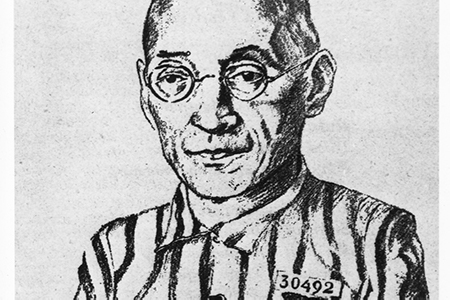
by Titus Brandsma, O. Carm.
I DO NOT KNOW WHAT AWAITS ME, BUT I KNOW MYSELF TO BE ENTIRELY IN GOD'S HANDS
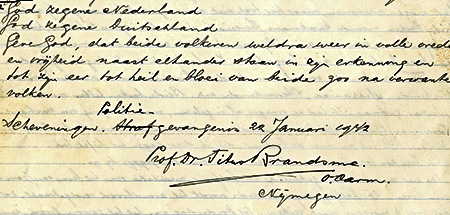
Scheveningen, January 1942
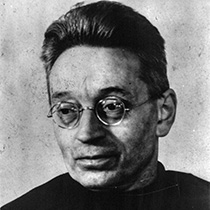 Station I - 19 January 1942
Titus Brandsma arrested by the Gestapo at the Karmelklooster in Nijmegen.
Titus: "Yes, yes, it is something to be in prison at the age of sixty.” Policeman: "Yes, Professor, You're right. But if it's your own fault, then you shouldn't have accepted the Archbishop's commission!" Titus: "I consider that an honor."
Notes: Titus Brandsma, O. Carm.
 Station 2 - 20 January 1942
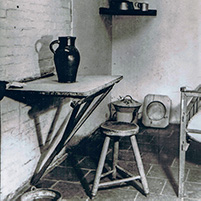
Titus is transferred to the prison of Scheveningen, the 'Oranjehotel', cell 577.
"It was no Inferno, my cell no. 577. And when I entered it, I didn't read above it: 'Let those who enter here now abandon all hope'. It did not look ominous and when the prison officer, who was helping the guard, apparently pointed out to the soldier that the cell was not ready, he said: "It's only for one night."
Notes: Titus Brandsma, O. Carm.
 Station 3 - 21 January 1942
Beginning of the interrogation by SS Hauptscharführer, P. Hardegen.
"The attitude of the Dutch Episcopate, I make it mine as well.”
Notes: Titus Brandsma, O. Carm.
 Station 4 - 12 March 1942
Titus is transferred to the Polizeiliches Durchgangslager Amersfoort.
"Between the evening meal and the moment the lights went out, you had half an hour for yourself. But you were not allowed to leave the barracks. That was strictly forbidden. Titus did it anyway. While others were spending those paltry thirty minutes on themselves, he risked his life to see if anyone else needed his spiritual support. In particular, he looked for prisoners of whom it was known would be executed shortly afterwards. That made a big impression on me as well. He was a true shepherd of souls.
Prisoner: Max Kohnstamm
 Station 5 - 3 April 1942
Good Friday. Titus offers an instruction on suffering in Dutch mysticism.
"Titus' words made an enormous impression on all present. That someone in those bizarre circumstances could talk about something like that - not about hunger, not about pain, not about exhaustion, but about mysticism. That was amazing! He taught you that even in inhuman circumstances you could keep “embrace” your humanity.”
Prisoner: E. Wellenstijn
 Station 6 - 28 April 1942
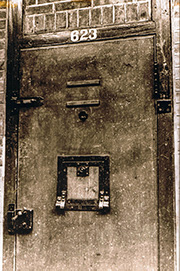
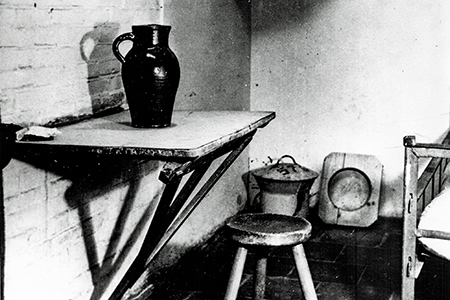
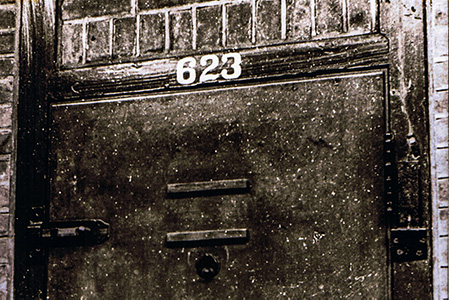
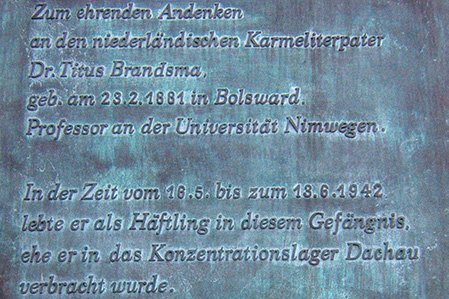
At the prison in Scheveningen, cell 623.
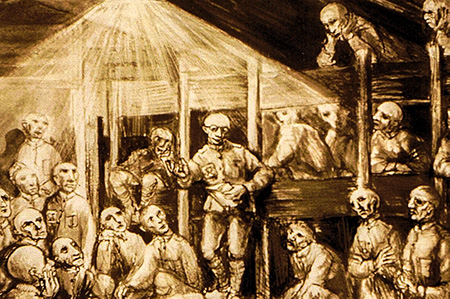
"Late in the evening one day in April, our cell door no. 623 in the barracks is thrown open and with a "Los, Los! (Come on. Come on)
In the evening, after dinner, we would always play cards for an hour. During that time, the professor would pray again, and it was time to forget our worries in our sleep. On Sunday mornings, we had a meditation and prayer. Also, on Ascension Day, the professor held a service. Those were really great moments in our lives."
Prisoner: Cornelis de Graaf
 Station 7 - 6 May 1942
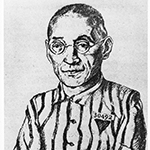
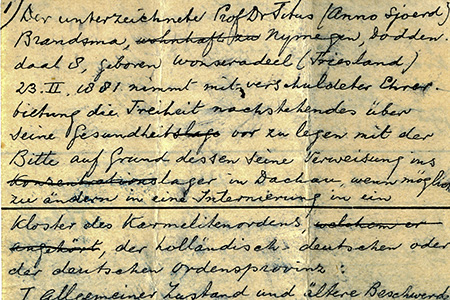
Sentence: deportation to Dachau, Germany, for the duration of the war.
When Titus heard his verdict he was allowed to call his monastery. "Yes, Father Prior ,this really is Father Titus! At the moment I am at the SD-office in The Hague. I've been interrogated again. They have decided to send me to Dachau, one of the biggest concentration camps in Germany. This means that I will be kept there until the end of the war. (...) No, don't worry about me.
Testimony: Prior Verhallen
 Station 8 - 16 May 1942
Titus is transferred to the prison in Kleve.
"His virtue had nothing striking about it, but seemed to be self-evident. It did not give the impression that he had to make an effort to be equable, patient, content, cheerful and just in his judgement. I am convinced that Father Titus considered heaven as the only goal of his life, that he always had eternity in mind. Otherwise his whole attitude cannot be explained."
Prison Chaplain: L. Deimel
 Station 9 - 13 June 1942
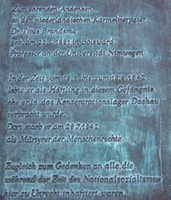
Departure from Kleve to Dachau concentration camp, via Frankfurt and Nüremberg - a five day’s journey.
"On the Friday before his departure for Dacha the following Saturday, I gave him Holy Communion for the last time. I was very impressed to have been able to give the Body of the Lord to such a special person,so full of holiness."
Prison Chaplain: L. Deimel
 Station 10 - 19 June 1942
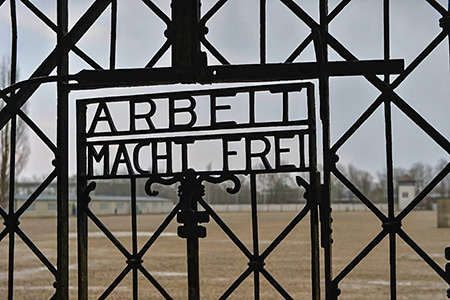
Arrival at the concentration camp, Dachau.
"The anger of the Stubeälteste knew no bounds, he hit and kicked Titus wherever he could, so that he rolled over on the ground and tried to crawl to the threshold of the dormitory. (...) But Titus doesn't want a word of comfort. He looks at me, smiling, and says in a whisper: "Oh brother, I knew who I was carrying. He points to the glasses box, in which a piece of the consecrated host is hidden."
Prisoner: Raphael Tijhuis, O. Carm
 Station 11 - 18 July 1942
Titus is transferred to the sick barracks due to weakness and total exhaustion.
"I say goodbye to Titus, who thanks me for all the help and gives me greetings for the others on our block. "It's only for a few days," he says. "By the way, brother, by August we'll all be back home," he adds, laughing. This was always his saying. They were the last words I heard out of his mouth. We did not see him again."
Prisoner: Raphael Tijhuis, O. Carm.
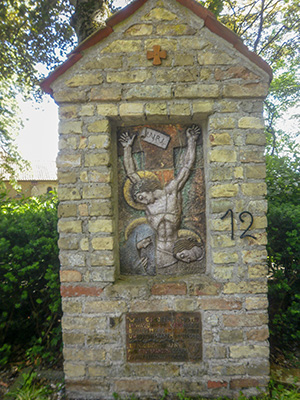
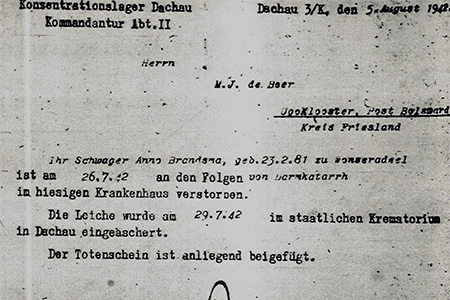
 Station 12 - 26 July 1942
Notice of death, signed at 2 p.m.

https://www.ocarm.org/en/press-kit?start=1110#sigProIdae90e48823
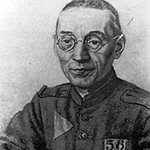 Way of the Cross with Titus Brandsma, O. Carm.
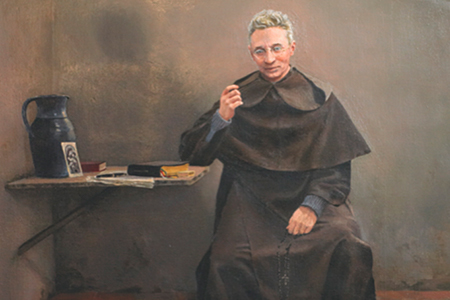 Hidden God
Many of us experience God as hidden. There is nothing new in this. It is not something unique to our time. Already, two and a half thousand years ago, Isaiah sighed in exile: “Truly, You are a hidden God”. (Is 45:15). Throughout the centuries, people of faith have repeated such words to the Lord, up to and including Titus Brandsma. For Titus, the hiddenness of God was a deeply lived reality.
In his prison cell at Scheveningen, Titus prayed the well-known hymn Adoro Te after lunch. In his account of his time in prison, 'My Cell', he tells us about this: “The Adoro Te has become my favourite prayer. Frequently I sing it softly and this helps me to make a spiritual communion”.
Titus knew this song by heart. He prayed it daily and every Saturday evening he sang it with his fellow brothers during the Saturday Station of Our Lady. The hymn touched Titus deeply. He was familiar with it. He carried it with him into prison. There Titus sang it ‘softly’, on his knees, after his lunch of soup and bread. Prayerfully it dawned on him: really, God is hidden. Not now and then. Not here and there. Always and everywhere, God is hidden.
After this moment of worship, Titus lit a pipe, walked to and fro in his small cell, and filed his nails, which by now had become “too long and I could not find the scissors.” God, for Titus, is hidden in the most ordinary things: a pipe of tobacco, walking to and fro, filing his nails.
God’s hidden presence is hopeful for those who have come to know it and to live from it. Seeing his hiddenness can even become so familiar to us that it makes us happy. Our God does not come like a jack-in-the-box. He is not an Easter egg hidden somewhere or a magic trick.
In the Dachau concentration camp, Titus’ hidden relationship with God is severely tested. Adoro Te drags him through it. When the camp guard has beaten him, he prays the Adoro Te together with his fellow brother, Rafaël Tijhuis. Hurt in his frail body, he remained standing in God’s hidden presence.
Adoro Te
Godhead here in hiding whom I do adore
Masked by these bare shadows,
shape and nothing more.
See, Lord, at thy service low lies here a heart
Lost, all lost in wonder at the God thou art.
Seeing, touching, tasting are in thee deceived;
How says trusty hearing? that shall be believed;
What God's Son has told me, take for truth I do;
Truth himself speaks truly or there's nothing true.
On the cross thy godhead made no sign to men;
Here thy very manhood steals from human ken:
Both are my confession, both are my belief,
And I pray the prayer made by the dying thief.
I am not like Thomas, wounds I cannot see,
But I plainly call thee Lord and God as he:
This faith each day deeper be my holding of,
Daily make me harder hope and dearer love.
O thou, our reminder of the Crucified,
Living Bread, the life of us for whom he died,
Lend this life to me, then; feed and feast my mind,
There be thou the sweetness man was meant to find.
Like what tender tales tell of the Pelican,
Bathe me, Jesus Lord, in what thy bosom ran--
Blood that but one drop of has the pow'r to win
All the world forgiveness of its world of sin.
Jesus whom I look at shrouded here below,
I beseech thee, send me what I thirst for so,
Some day to gaze on thee face to face in light
And be blest forever with thy glory's sight.
Attributed to St Thomas Aquinas; translation G.M. Hopkins.
Prayer
We ask you, Lord,
that, in the imitation of Saint Titus Brandsma,
we may know how to be close to you, near to the cross,
and that we may always feel you near to us in our crosses, both large and small,
as our Friend, our Companion on the journey, and our Redeemer.
May the cross always be for us a sign of love,
of generous and total surrender to the cause of life,
of solidarity and compassion for all.
May we always say, in all the circumstances of life,
with joy and full confidence in you…
Ave Crux Spes Unica…
Amen.
Mary, Mother of Carmel, pray for us.
Titus Brandsma, Carmelite martyr, intercede for us.

Download the Leaflet 6. Adoro Te - Hidden God pdf here (4.23 MB)
 Titus’ Education
Titus was a good student who understood from early on the value of education. As a child he read widely and had a particular liking for literature and history.
After entering the Carmelite Order in 1898, Titus continued to read widely and began to publish. Taking his doctorate in philosophy at Rome’s Gregorian University, he also took courses in modern sociology.
Catholic Education
Titus reformed the programme of studies for Carmelites in the Netherlands. Education for the laity was a priority for Titus. At Oss a library with attached reading room and lecture hall was established which was open to the general public. Through Titus’ efforts, two Carmelite schools became the very first private schools in Holland to receive government support. He founded the Union of Secondary Schools in 1925, serving as its President.
University Professor
With the founding of the Catholic University at Nijmegen in 1923, Titus was nominated Professor of Philosophy and the History of Mysticism. In 1932 he became its Rector Magnificus. Titus’ courses left an ‘unforgetable’ impression; he was effectively rediscovering the spirituality of their country. Titus was kind and students at the university constantly sought him out. He sought scholarship funding for the less well off. Titus subjected National Socialism to rigorous critique as part of his university teaching. He kept his feet firmly on the ground. Titus was known to assist an old man in pushing his junk wagon up the hill between the university and the Carmel, placing his professorial briefcase on top while he did it.
Education in the Call to Mysticism
Titus was always keen to educate people regarding their call to be mystics. He defined mysticism as: ‘a special union of God with human beings, whereby they become aware of God's presence and also become one with God.’ Titus understood mysticism as a call directed to all and spoke of an everyday mysticism, convinced that God is the ground of our being and can be encountered always and everywhere and in our neighbour. His lectures on Carmelite mysticism, delivered in the United States in 1935, are a true classic of twentieth-century spirituality.
The Journalist as Educator
Titus undoubtedly saw journalism as a form of education. His accessible articles in the Catholic press were effectively ‘short courses’ of their own.
Titus’ Philosophy of Education
For Titus it was important for the educator to respect each student individually: ‘…people are not simply all alike and do not comply with a casual construction or idea. The human being, and even the child, is in each person different in nature and it does not help us when we would like to see beyond all the differences…We must take young people as they are.’ It was important for Titus that students thought for themselves, saying to one group: ‘We do not impart philosophical knowledge to you, because you must first and foremost develop it in yourselves… We do not ram the truth or knowledge of the truth into you, we only draw on the wondrous passion for knowledge of what is true, which lies hidden in you.’
Resourcing Education
Titus was convinced of the importance of the proper resourcing of education. He also underlined the need for the continuous professional development of teachers: ‘a justified ideal for the teacher is continuous further development… A trained teacher is a blessing.’ Titus had a particular concern for providing for children from underprivileged backgrounds: ‘Attention at school to the underprivileged child, that is where true love reveals itself.’
Titus’ care for Jewish Students
Titus took a particular stand on Jewish students, refusing to remain silent when they were excluded from attending Catholic schools, even making enquiries about placing them in the care of the Carmelites in Brazil.
The Apostolate of Carmelite Mysticism - Carmel as School
The Apostolate of Carmelite Mysticism - Carmel as School Titus speaks of ‘the apostolate of Carmelite mysticism’, using the image of a school. Carmelites are to teach people to pray, helping them know they have been found and loved by God. For Titus, Carmel is like a school, ‘a school of mystical life’, and insists: ‘in the spiritual life, no more than in ordinary life, can we dispense with education, with teachers and with guidance.’
Prayer to Titus Brandsma
God our Father, your servant, Titus Brandsma, laboured zealously in your vineyard
and gave his life freely because of his faith in you.
Through his intercession I ask for your mercy and help.
Father Titus never refused when he was asked for help by your people.
In his name, I come to you with my needs...
Lord, help me always to imitate the great faith, generous love and burning zeal of Titus.
Glorify your servant as he strove to glorify you.
Amen.
Mary, Mother of Carmel, pray for us.
Titus Brandsma, Carmelite martyr, intercede for us.
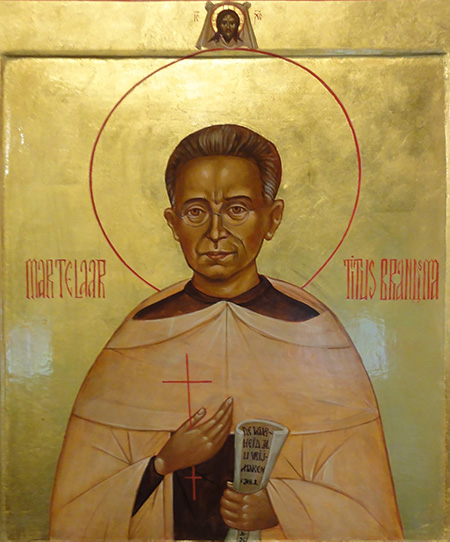
Download the Leaflet 2. Education pdf here (3.46 MB)
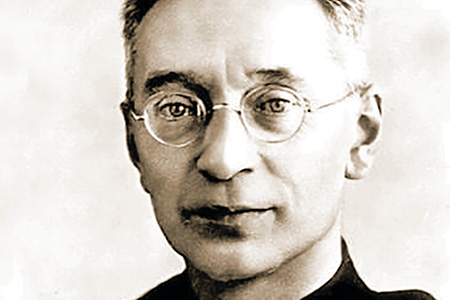 ‘In the Blessed Sacrament He gives us Himself again, and not only Himself as the Second Person of the Holy Trinity, no, He tells us that all three Persons will take up their residence in our hearts, if we are united with Him.’
Titus Brandsma
The Eucharistic Life of Carmel
Being of central importance to the Christian life, it is no surprise to find the Eucharist at the heart of Carmelite life from its earliest beginnings. The first Carmelites built an oratory in the midst of their cells on Mount Carmel to facilitate common prayer and common celebration of the Eucharist. This sacred space was to be a focal point for encounter with one another and with the risen Lord. Until the reforms of Pope Pius X in the early twentieth century, daily receiving of Holy Communion was unusual. However, taking inspiration from the Rule of Carmel, daily reception of the Sacrament was already common in Carmelite communities long before this and was to be a constant of the life and spirituality of Titus Brandsma who entered the Carmelite Order in 1898 at Boxmeer, in the Netherlands, a town long associated with Eucharistic devotion.
Food for the Journey
Titus was convinced that our spiritual life, just as our physical life, requires food. He saw in Elijah, Prophet of Carmel, the pattern of the Carmelite life. Just as Elijah was sustained for his journey through the desert to Mount Horeb by miraculous food from heaven, so we too are strengthened by the gift of the Eucharist as we ‘walk in life’s journey here below.’ Imprisoned on account of his fearless defence of the freedom of the Catholic press and basic human rights in the Nazi-occupied Netherlands, ‘walking in the strength of the divine bread’ was ultimately tested for Titus between January and July 1942 as he followed his own ‘way of the cross’ all the way to Dachau concentration camp.
Frequent Communion
Titus’ conviction concerning the importance of frequent celebration of the Eucharist was confirmed in reading Carmelite saints such as Mary Magdalene de’Pazzi and Teresa of Avila. Titus also draws out the importance of daily reception of Holy Communion when presenting the life and message of Saint Lidwina of Schiedam, one of the national saints of the Netherlands.
Prayer after Communion
In continuity with another key aspect of the Carmelite tradition, Titus emphasised the importance of taking time to pray after receiving Holy Communion. This is a true contemplative moment when, having received the risen Lord into ourselves, we seek to open ourselves to his accomplishing great things in us. Titus reflectively links prayer after Communion to the figure of Elijah: ‘In the caves of Horeb God spoke to the Prophet by the voice of the gentle, whispering wind.
The Lord was not in the storm nor in the earthquake, but in the gentle wind. So, after Communion we must contemplate under the Eucharistic species and in the depths of our spirit; for now God passes.’
Spiritual Communion
St Teresa of Avila often recommends acts of spiritual communion when reception of the sacrament is not possible. Perhaps early on Titus might not have realised how important this would prove to be in his own life, just as readers of St Teresa in our own time might not have realised how important spiritual communion would become in time of pandemic.
While Titus was able to receive Holy Communion at Dachau (including on the day of his death), there were times this was not possible. Unable to celebrate Mass at Scheveningen prison Titus describes how ‘each morning I kneel down and say the prayers of daily Mass, spiritual communion.’ In the camp at Amersfoort Titus led communal acts of spiritual communion with his fellow prisoners.
The Eucharist and Contemplation
An often-repeated spiritual teaching of Titus Brandsma is that ‘the mystical contemplative life is a fruit of the Eucharistic life.’ The Eucharist is what strengthens us to receive the gift of contemplation from God. And such contemplation leads to action.
Titus told a group of young people: ‘Good deeds no longer suffice; they must originate in the consciousness that our union with God obliges us to perform them.’
Adoro Te
In his prison cell at Scheveningen, Titus prayed the well-known hymn Adoro Te after lunch. In his account of his time in prison, 'My Cell', he tells us about this: 'The Adoro Te has become my favourite prayer. Frequently I sing it softly and this helps me to make a spiritual communion'. The first and last verses read as follows:
I devoutly worship Thee,
Hidden Godhead,
Who among these signs are
truly hidden.
O may I behold Thee
with unveiled face
and taste the happiness
to see Your glory.

Download the Leaflet 3. Eucharist pdf here (3.70 MB)