



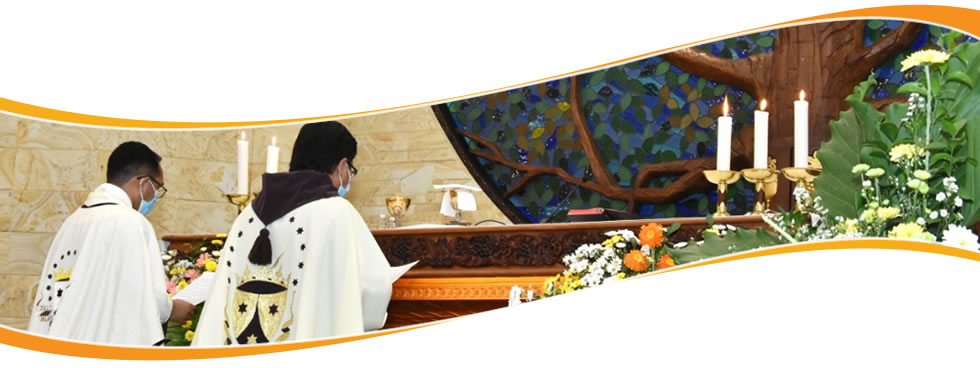


Displaying items by tag: 2025 General Chapter
How Do You Spend Free Days at a General Chapter?
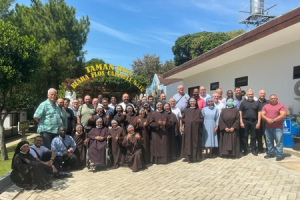
Many of those attending the recently concluded General Chapter in Malang, Indonesia, found themselves with a bit of time to explore the area. Some arrived a few days in advance to adjust to the time difference. Most took part in the scheduled Sunday free day at the end of the first week. All the excursions involved meals at local restaurants, courtesy of donors to the Indonesian province.
Those who arrived early were treated to a walking tour of Tumpang Valley with its Javenese statues and Koi fishponds on Saturday, September 6. Following that members took a journey up the mountain to the province’s retreat house—Carmel Mount of Peace—where they were again treated to a wonderful meal prepared by the sisters. While they ate, they enjoyed the incredible views.
The majority departed a few hours later for the monastery of Carmelite nuns in Batu. We then crossed the street to the Carmelite parish where Carmelite Bishop Henricus Pidyardo had just finished confirmation and was now with the parishioners celebrating the 90th anniversary of the parish. The Chapter members were invited to join in. This was followed by a short drive to the Carmelite novitiate in Batu with Mass and lunch together with the community.
Then it was off to the East Java Park and the Batu Secret Zoo. The group’s fascination with the animals could not overcome the heat and humidity (and perhaps jet lag for some) so most of the group waited on the steps while a few hearty souls ventured into the museum section of the zoo. This was followed by a welcome meal and drinks at a local restaurant owned by supporters of the Order in Indonesia.
On Sunday, September 13, a few members set out to celebrate Mass with the residents of the Indonesian province’s House of Mercy, a residence in Batu for elderly who have no family to take care of them. Two buses departed a few hours later with the other members to visit some of the cultural-historical sites of Malang and the Carmelites. Among these was the Cathedral of Our Lady of Mount Carmel where the closing Mass and signing of the Acts of the Chapter would be held, the original Carmelite church in Malang, and the original dwelling of the Carmelites when they arrived from the Netherlands over 100 years ago. That building is currently being remodeled to hold the provincial offices and living quarters fo the Indonesian province.
But probably the highlight for everyone was the group’s experience at the Kolumbarium—a multi-purpose facility of the province. Visitors toured the guest house, the residence for the Carmelites stationed on the property, a museum of the province, a chapel containing the tomb of Bishop Franciscus Hadisumarta, O. Carm., and several areas dedicated to reserving the ashes of deceased Catholics as well as many of the members of the province. It provides a lot of open space and has become a popular spot for families to come and spend part of the day.
But it was when the Carmelite students as well as members of the St Albert’s Senior School community performed a Balinese dance based on the ancient Indian epic of Ramayana, that all the beauty of the Indonesian culture— its sounds, colors, and dance—came together. The epic of Ramayana narrates the life of Rama, the seventh avatar of the Hindu deity Vishnu, who is a prince of Ayodhya in the kingdom of Kosala. The epic follows his 14-year exile to the forest urged by his father on the request of Rama’s stepmother. His travels across the forests in the Indian subcontinent with his wife Sinta and brother; the kidnapping of Sinta by the king of Lanka; and Rama’s eventual return to Ayodhya along with Sinta to be crowned as a king amidst jubilation and celebration.
The master of ceremony for the show was Dimas Pele Alu, a member of the province’s formation team and well-known performer. Dimas introduced the characters and action of the epic in a humorous fashion and in a variety of languages. There were many references to the action parallelling religious life. All the hard work of the performers and musicians made for a memorable experience for the Chapter members. The evening concluded with a buffet dinner at a local restaurant which afforded some of the braver souls in the group to perform with the local band.
On Saturday, September 27, following the Chapter’s conclusion, those members flying out in subsequent days adjourned to the main house of the Hermanas Carmelitas de Oriuela in Malang for a lunch of local dishes and a bit of singing and dancing.
Final Message of the Chapter to the Carmelite Family
From the General Chapter | September 9-26, 2025
The Members Send a Message to the Carmelite Family at the Conclusion of the 2025 General Chapter
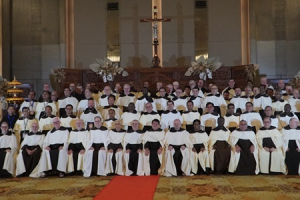
The Members of the General Chapter celebrated Morning Prayer together and then moved to the Chapter Hall for a final session. First order of business was the reading of the proposed Message of the Chapter to the Carmelite Family. Following its reading in the three languages of the Order, the members made some suggestions and then the message was unanimously approved.
Following a talk by the new prior general, Desiderio García Martínez, the Chapter was adjourned.
Later today the members will travel to the Cathedral of Malang for Mass with Bishop Henricus Pidyardo Gunawan, O. Carm. There they will sign the Acts of the Chapter.
pdf To Read the Final Message of the Chapter to the Carmelite Family(127 KB)
Inter-religious Dialogue with the Muslim Faith
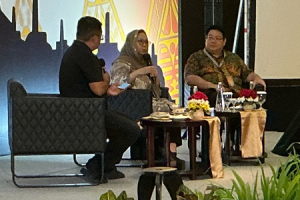
Sunday morning the Chapter members met in the Chapter Hall to hear a discussion on Inter-Religious Dialogue with Alyssa Wahid and FX Hariawan Adji, the recently elected Vice General of the Order. Hariawan holds a doctorate in Inter-Religious Studies (2017) and has much experience and interest in this topic. Alyssa Wahid is the founder of the Gusdurian Network Indonesia, a nationwide network that promotes democracy, human rights, interfaith dialogue, and advocates for minority rights. It was established to emulate the work of her father, President Abdurrahman Wahid, the fourth president of Indonesia.
Much of the discussion encouraged people to get out of their own comfort zone and get to know people of other cultures and faiths. If you stay just within what your are familiar with and comfortable with, then there is little possibility of finding points of common ground with others.
Huub Welzen, prior provincial of the Dutch province, wrote a short summary back to his members which is quoted here: The moderator asked both participants how more tolerance between religions could be achieved. I found Alyssa Wahid's answer interesting. She talked about the purpose of the Muslim faith. Islam is not there for the benefit of Islam. Islam is there for the benefit of the entire universe … Fundamentalism and extremism naturally lead to intolerance. Within one's own faith, those who do not share the same views are considered lesser Christians or lesser Muslims. Intolerance towards other faiths is even greater. They must be destroyed. Religious leaders have a major task here to show that this kind of extremism is not part of the inclusive nature of most religions.
Remaining Schedule of the General Chapter
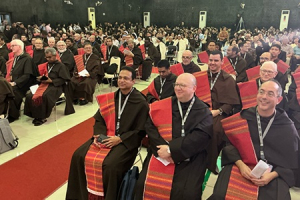
The business portion of the General Chapter finished on Wednesday, September 24. The members were given a free day on Thursday, September 25. But the Chapter will officially conclude on Friday, September 26, with a closing Mass at the Cathedral of Our Lady of Mount Carmel in the Diocese of Malang. The Chapter Acts will be signed at that time as well.
As announced previously, the Closing Mass will be live streamed beginning at 4:30PM (GMT 7+) by the Indonesian Communications Office. In order to watch, go to https://www.youtube.com/live/hyoJCFPeaZI?si=D0aDgd8Ppup_55UH
Sunday Celebration with Carmelite Family
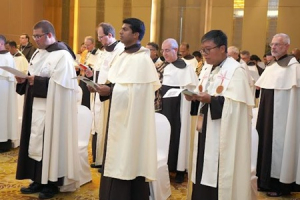
Sunday Celebration with Carmelite Family for the General Chapter
On the afternoon of September 21, the members of the General Chapter were bused to St. Albert’s High School in Malang to celebrated Sunday Eucharist with representatives of the various branches of the Carmelite Family in Indonesia.
The members of the General Chapter were welcomed by the Indonesian Carmelites in a colorful, traditional welcoming ceremony. The video of parts of this welcome can be seen at: https://youtu.be/cODUx5HiNas
The Mass was televised by the Indonesian Media Office. It can be viewed online at: https://www.youtube.com/live/nZn7fvRHhCk?si=1GCUXyaldp82wjnR Mass begins shortly after 36:00 on the video.
The Eucharist was followed by a multi-course banquet of local dishes accompanied by song, dance, and short theatrical productions telling the 100 year history of the Carmelites in Indonesia.
Chapter work began again on Monday, September 22 with Mass, followed by sharing sessions with members from different branches of the Carmelite Family in the Chapter Hall. Later in the morning, the Chapter was addressed via livestream from Rome by Fr. Miguel Márquez Calle, the superior general of the Discalced Carmelites.
The General Chapter officially closes on Friday, September 26, with a Mass of the Holy Spirit celebrated at the Cathedral of the Diocese of Malang, Our Lady of Mount Carmel. During the closing Mass, the Acts of the General Chapter will be signed. The Mass will be live streamed at 4:30 (GMT 7+) by the Indonesian Communications Office. Go to https://www.youtube.com/live/hyoJCFPeaZI?si=D0aDgd8Ppup_55UH in order to participate.
The 2025 General Chapter Elects General Councilors
From the General Chapter | September 9-26, 2025
Elections for General Councilors for Africa, America, Asia/Australia/Oceania and Europe Held at General Chapter
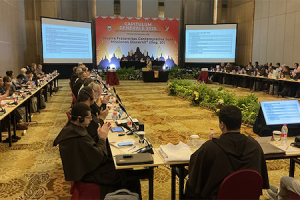
Following the elections of the prior general and the vice prior general, procurator general, and general bursar on Friday, the General Chapter turned its attention to the election of the General Councilors who work in the four geographical areas of the Order.
The day began with Morning Prayer and Mass. The members of the Chapter then assembled in the Chapter Aula.
The elections were as follows:
General Councilor for Africa:
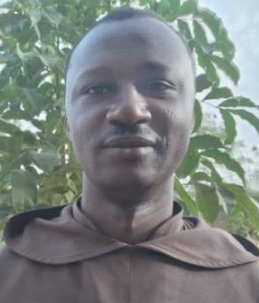
Born in Koudougou, Burkina Faso, Eric Chrisostome N'Do entered Carmel in Bobo Dioulasso. On 16 July 2008, he made his simple profession and on July 4, 2011. After his ordination, he was assigned to the Postulancy House in Ouagadougou. In September 2013, he was sent to the community in Madrid to undertake a specialized studies in philosophy with the topic of Humanism and Transcendence at the Pontifical University of Comillas.
After completing a thesis on Edith Stein in June 2017, he returned to the community in Ouagadougou, where he is teaching philosophy at the Catholic University of Saint Thomas Aquinas and at the Private Institute of Philosophy, where Carmelite postulants attend classes.
General Councilor for the Americas:
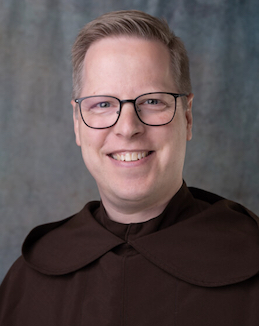
Rolf Nepomuk (Nepi) Willemsen, O. Carm., originally from Germany, is a member of the Province of the Most Pure Heart of Mary (PCM) and serves as First Counselor of the Province.
He is also prior and Director of Formation at Whitefriars Hall in Washington, D.C. Nepi has professional experience in social work, community organizing, and international health. Within the Order, he previously taught theology for six years and now oversees the Carmelitana Collection, promoting research on Carmelite spirituality. His ministry focuses on formation, theological education, and vocational accompaniment.
General Councilor for Asia, Australia, and Oceania:
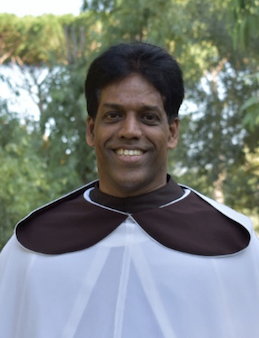
Robert Thomas Puthussery was born in Kerala, India. He had his schooling in his home town Mookkannoor in Kerala. After his philosophy and theology studies he was ordained a priest in 1994.
He did a Bachelor’s degree (B.A. 1990-93) and a Master of Arts (M.A. 1994-96) in English Literature and taught as an Assistant professor (1996-97) at Christ College Bangalore, India. From 1997-2000 he served as prior and rector for the Carmelite minor seminary at Carmel Nivas, Kothamangalam. From 2000-2002 he did a Masters Degree in Applied Theology at the University of Middlesex, London. Thereafter he served as Chaplain to the immigrant Syro-Malabar Catholic communities in London, Liverpool, and Manchester, United Kingdom. From 2006-2007 he served as the student director of the British Province of the Carmelites. While serving as the sub-prior of the international Carmelite community at East Finchley, London he completed his doctorate (PhD 2006-2010) at the University of Liverpool in pastoral psychology.
After his return from the United Kingdom in 2011, he served as prior and spiritual director of the Carmelite major seminary at Carmeljyoti Study house while lecturing at Christ University (2011-2014) Bangalore, as an Assistant Professor in the Department of Language and Media Studies and the School of Law.
General Councilor for Europe:
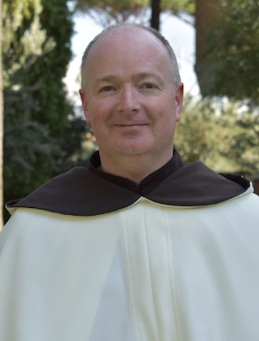
Richard was born in Dublin and was educated by the Carmelites in Terenure College. Following his philosophical and theological studies at the Milltown Institute, he was ordained a priest in 1996. He was a member of the Terenure College Carmelite Community for over twenty years holding a variety of roles: subject teacher of accounting and religious education, school chaplain, rugby coach, and school principal. During those years, in University College Dublin, Fr. Richard also completed his Bachelor of Commerce degree (BComm) and his Doctoral Studies (PhD) on the distinctiveness of Catholic education.
In 2015, he was elected prior provincial of the Irish Province and was re-elected provincial in 2018. In Ireland, Richard was appointed as the chairperson of the Catholic Schools Partnership which provided a national service of support for Catholic schooling in Ireland. In his spare time in Dublin, he was a rugby referee and refereed school and adult matches all over his home province of Leinster.
At the General Chapter in 2019, he was elected General Councilor of Europe to serve for a six year term 2019-2025. His areas of responsibility are the Commission for Liturgy and Prayer and the International Communications Commission.
Fr. Desiderio (ACV) Elected as Prior General

The General Chapter has elected Desiderio García Martínez as Prior General for the next six years. Congratulations to Fr. Desiderio!
More information on the other elections for members of the Council will follow when all the elections have been completed.
Chapter Members Debate on Today's Challenges
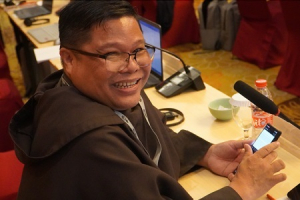
Chapter Members Receive and Discuss Input on the Chapter Theme
The Chapter changed its direction from over the last several days of receiving reports. On Tuesday, members began looking at the implications of the theme for the General Chapter and Order. The first of the two inputs was given by Sr. Pat Murray, IBVM. Entitled “Today’s Social and Ecclesial Context” the presentation was followed by synodal style sharing in the small groups following the lunch break. On Wednesday, Carmelite Bishop Wilmar Santin spoke on Carmelite Missions “Ad gentes.” His presentation was followed by a reflection and discussion in language groups. On Thursday, September 18, Bishop Henricus Pidyarto Gunawan, O. Carm., bishop of Malang where the Chapter is taking place, joined the Carmelites for Mass and then gave the Chapter retreat and led the discernment for leadership.
Summaries of the presentations are below, followed by brief biographies of the presenters.
Today’s Social and Ecclesial Context
Sr Pat Murray, IBVM
Sister began her presentation by noting that the theme for the Chapter is challenging both communally and personally: You must have some sort of work to do? Our Contemplative Fraternity Discerns its Mission. In fact, she would repeat “You must have some work to do” at various times throughout the talk.
She observed that life has become increasingly polarized, and it is often hard to find the middle ground. We hear the cries of children separated from their parents along borders or the voices of migrants calling from boats left adrift at sea for days. It is a season of darkness. The winter of despair is in the eyes of the hungry, the homeless, the naked, and the thirsty.
She offered three images to spark the imagination of her listeners as they reflect on their mission today.
1) Leave the Safe House—Go forth to encounter people. “Leave your nests” as Pope Francis said. “Step out from the confines of your respective Institutes and work together at the local and global levels.”
2) Engage in Web-watching and Web-weaving—Sister quoted the Mennonite theologian and peace activist John Paul Lederach. He uses the term “moral imagination” to describe something “which calls people beyond things that are immediately apparent and visible.” For Lederach, moral imagination is “the capacity to give birth to something new” to refuse “to be bound by what the existing views of perceived reality suggest” but to seek to uncover possibilities not yet dreamed of.
3) Widen the Tent of Your Heart— The quote from the prophet Isaiah “to enlarge the place of your tent, stretch your tent curtains wide, do not hold back; lengthen your cords, strengthen your stakes” is a wonderful image for religious life today because it speaks of both flexibility and rootedness, unbounded hospitality and secure identity.
Bishop Santin’s first presentation was a review of the history of Carmelite missions around the world, pointing out that from the origin of the Order until the 16th century there was no missionary spirit. All pastoral and evangelizing work was carried out in Western and Eastern Europe. When the so-called New World opened up to Europeans, the Carmelites were not interested, although they did make a few failed attempts.
He presented the history of the Carmelites in Brazil and especially in the Amazon. He pointed out that one of the hallmarks of the Carmelite’ catechesis was their Marian devotion. They seemed have been patient and treated the indigenous people relatively well. Quoting Arthur Reis “The Carmelites thus achieved more results than the military expeditions, marked in blood and negatives in the civilization of the savages.” The Carmelites set up the first school in Amazonia for the indigenous children to be educated. The Carmelite “held music and singling classes, taking advantage of the catechumens’ abilities and inclinations for the arts.” Almost a third of the villages had Our Lady as their patron saint. Among the patron saints of the villages, half are Carmelite saints with an apparent preference for the Prophet Elijah. Martyrdom was a part of life for the Carmelites however, with several being killed by the natives.
Criticisms are leveled at the Carmelite missionary efforts in Brazil. Some are of an economic nature and some of a political nature. The question is asked: what made these men leave the comfort of the cities and [their religious houses] to immerse themselves in the Amazon jungles?
He then reviewed the various provinces of the Order and their contribution to establish new missions around the world.
Bishop Santin’s second presentation reviewed Church teaching on evangelization beginning with Pope Paul VI’s Evangelii nuntiandi and Perfectae caritatis of the Second Vatican Council. The 1965 decree on the missionary activity of the Church, Ad gentes, the Medellin Statement (1968), and that of Puebla (1979) were reviewed with the points that speak about religious and their responsibility for the effectiveness of the Church’s mission being highlighted. Religious are called to be prophetic witnessed in the midst of God’s people.
He then moved to review what the Order’s Constitutions have to say about the Carmelite mission, especially numbers 94-97. They call for us to share in the mission of Jesus and that ministry is an integral part of the charism. The mission ad gentes—the task of announcing the Gospel in places where it is not known—is one of the fundamental activities of the Church. He pointed out the missionary work requires a specific spirituality and a process of inculturation.
The General Chapter has engaged in thoughtful discussion about the current state of the Order and the future Order we envision, one that is responsive to the needs of both the Church and the world. While doing that discernment, the Chapter members will consider who are the suitable candidates to lead the Order in the future, individuals who can effectively implement the decision made by the General Chapter. These are the two areas he addressed. In this first part, Bishop Henricus offered some ideas related to the theme of the Chapter and the summary of discussions on the Instumentum laboris.
The documents make it clear that the Carmelite charism, as a gift from God for the Church and the world, is a reoccurring theme. The letter of convocation underlines the close connection between charism and our apostolic works. As the Constitutions say “Our ministry as Carmelites is, therefore, an integral part of our charism.”
The Magisterium repeatedly teaches that religious life is an extraordinary gift to the Church and the world. Religious men and women become a precious gift to the Church and the world, not only because of their spiritual union with Jesus Christ in the evangelical counsels but due to their embodiment of a specific charism that the Holy Spirit has bestowed upon their respective religious institution.
History shows that most religious orders were born to respond to real needs of the times. Many orders came about as a reaction to specific situations in the Church and society. A charism that is not in line with the needs of the times is less attractive to people. Therefore, our apostolic works must both preserve our charism and to see what the needs of the Church and society are.
The bishop stressed that we must work contemplatively, fraternally, and prophetically in the midst of the people. He then went on to outline what each type of work would involve. He then entered into a presentation on discerning our apostolic work for the future. He encouraged us to maintain works that are in line with the Order’s charism but also to encourage scholarship in Mariology and the Bible. He offered a table indicating that in both the XIV and XV centuries at Paris and Oxford, the Carmelites led in providing commentators on the Scriptures.
Bishop Henricus started by reminding us that we believe that through this General Chapter the Holy Spirit will choose some of our brothers to leadership roles in the Order. He then outlined two working definitions of religious leadership: the capacity and will to rally people to a common purpose, and the character which inspires confidence and, secondly, a person with a God-given capacity and with God-given responsibility who is influencing a specific group of God’s people toward God’s purpose for the group.
Christian leadership uniquely blends natural and spiritual leadership, combining human talent with the work of God’s grace. He then went through examples in the Scriptures of God’s “calling” leaders forth—specifically Moses, Jesus, and Paul and the need they each had for self-preparation.
Religious leaders should have a clear vision with a common goal. The ultimate goal for all religious leadership is to lead God’s people to their God and to achieve the purpose God has set for them. Using the example of Jesus, Bishop Henricus stressed that a religious leader must clearly know the shared vision but also be able to convince their followers of its importance. Only those who truly see their shared vision and believe it to be a worthy value will persevere.
A religious leader must also nurture their followers. Citing several authorities on leadership, he concluded that leadership is no longer seen solely as an effort to move subordinates to pursue a common goal or make subordinated carry out orders. A religious leader prioritizes the humanity of their subordinates.
Leadership is about influencing others. So, they need authority. Highlighting the ten leadership models that St. Paul described were used according to the situation and the spiritual maturity of the congregation. If a leader is called by God to represent God, then he must depend on God who sends him. We see this is Moses, Elijah, Queen Esther, Judith John the Baptist, Jeus and the apostles as well as many others. Their strength lies in their prayfulness.
The remainder of the time was spent on Nehemiah as a model leader—as the biblical story contains many of the qualities of a religious leader. Nehemiah faced enemies (repeatedly) but he relied on God’s power and not his own strength. A good leader doesn’t rush but studies the situation. Another of Nehemiah’s leadership skills was involving many groups, including families. He did not listen to those mocking him but stayed on task. As a leader, one must endure criticism, obstacles, and enemies. True leaders are resilient.
Bishop Henricus concluded expressing the hope that his reflection on biblical leadership might contribute to the reflection of the members of the Chapter in their election of the government of the Order for the next six years.
Bishop Wilmar Santin, O. Carm., is the bishop of Itaituba, Brazil, appointed in December 2010 and installed in April 2011. He is a native of Paranavaí and a member of the German Province of the Order. He served six years as General Councilor of the Order for Latin America and Commissary Provincial of Paranavaí from 1990 to 1995. From 2005 until 2008 he was prior of Centro Internazionale S. Alberto (CISA) in Rome.
Bishop Henricus Pidyarto Gunawan, O. Carm., is a member of the Indonesian Province, having been born in Malang. He is of Chinese Indonesian descent. His brother Antonius, also a Carmelite priest, died in 2015. He studied Scripture at the Pontifical Biblical Institute in Rome and received his doctorate from the Pontifical University of St. Thomas Aquinas, both in Rome. He continues to teach Scripture at the Philosophical and Theological Institute of ‘Widya Sasana’. He was nominated bishop of Malang by Pope Francis in June 2016.
Condolence Letter for the Four Carmelite Nuns
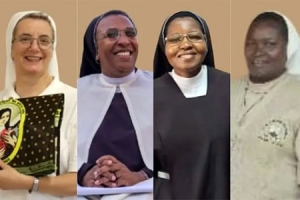
Letter of Condolences and Support Sent to Santa Marinella Sisters from General Chapter
Four sisters from the Congregation of Carmelite Missionary Sisters of St. Thérèse of the Child Jesus (Congregazione Suore Carmelitane Missionarie di S. Teresa del Bambino Gesù) and their driver were tragically killed in an automobile accident in Tanzania. A fifth sister remains in very serious condition in the hospital.
More details have become available. The sisters were on their way to the airport for a flight to Dar es Salaam. They had participated in the perpetual profession of three sisters on Saturday and visited the local bishop on Sunday morning. The accident occured around 11PM in Mwanza, Tanzania.
The deceased are Sr. Lilian Gladson Kapongo, general superior of the Congregation; Sr. Maria Nerina De Simone, a general councilor and the general secretary; Sr. Damaris Matheka, provincial councilor for the Province of East Africa; Sr. Stellamaris Muthini; and their driver, Mr. Boniphace Msonola. Sr. Paulina Crisante Mipata is in hospital and is in serious condition.
We remember the sisters, their families, their co-workers and the Sisters of the Congregation in prayer during this time.
pdf Read the letter of the General Chapter to the Congregation(358 KB)
After Celebrating Culture on Sunday, Work Resumes
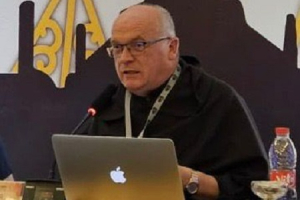
Sunday Day Off Becomes a Celebration of Culture. Monday Is Back to Work Completing the Reports to the General Chapter
Sunday was officially a day off, but the members of the Indonesian Province offered a tour of sites around the city and a show by the Carmelite students and representatives of the school. Included in the tour was the Cathedral of Malang. The diocese has had only Carmelite bishops since its establishment as a Apostolic Prefecture in 1927. There was also a visit to Masjid Jamik, the oldest mosque in Malang. It is located in the heart of Malang which is almost 90% Muslim. Not far away is Sacred Heart Catholic church, originally built by the Jesuits but turned over to the Carmelites in 1923. The complex is the site of the original Carmelite provincial office which is being restored to once again house the offices. The group then traveled to Karmel Paranti Jati Prayer Garden and Kolumbarium. This site also contains two residences with one Carmelite community as well as the Padmawlyata Museum, a prayer garden, and the chapel with the tomb of Bishop F.X. Hadisumarta, former bishop of Malang and Sorong and the ashes of many of the Carmelites who served in the province.
The Padmawlyata Museum has displays of items from the early days of the Indonesian missions and a story board explaining the history of the Carmelite in Indonesia.
In the afternoon, students from St. Albert’s Carmelite High School welcomed the Chapter members with a Balinese dance. Later the Carmelite students presented a Balinese meditative dance inspired by the ancient Indian epic of Ramayana. (A separate CITOC article will cover this beautiful welcome.) The day finished with a festive meal at the Batavia Reso, a vintage restaurant which serves traditional Javanese food.
A few Chapter members left the Chapter site early to celebrate Mass at the House of Mercy for abandoned elderly. Afterwards, they visited the hospice for the poor in Gempol operated by the Indonesian NGO before meeting up with the other Chapter members for lunch.
On Monday morning, the Chapter members reunited for Morning Prayer and Mass in the Chapel, followed by four more reports, including that of the International Formation Commission, the General Commission for the Coordination of New Foundations, the Delegate for the Affiliated Congregations, and the General Delegate for the Nuns. The reports were completed by prior of CISA, the student house in the city of Rome.
International Formation Commission
First up to report was the Vice Prior General, Benny Phang Khong Wing, who has responsibility for formation. The International Formation Commission highlighted formation as a lifelong process, “a continual process of conversion of heart and spiritual transformation, love being the driving force.” It should be done within the Carmelite tradition and grounded in the socio-anthropological-cultural context were the persons live.
The report has three parts: an evaluation of the six-year plan, the programs held, and the future and concerns to be addressed. With regards to the six-year plan, the only part not achieved was to introduce the idea of a General Delegate for Formation. Two people were appointed but neither worked out.
As of June 2025, there were 150 pre-novices, 100 novices, 322 simply professed, and 234 solemnly professed with the last five years. While the total number of young Carmelites is 796, Asia-Oceania counts 387 of them. The Order as a whole has 2038 members.
Among the activities of the Formation Commission were: an international program on how to engage Generation Z; a course for new provincials; a course on St. Titus Brandsma in the Netherlands and Germany; a formators gathering dedicated to the revision of the RIVC; and the revision and updating of the RIVC 2013. Benny was also invited to give a talk at FOCAM in 2021 and 2023. He was also invited to speak in Vietnam at the Asia-Oceania student and formator gathering.
The Commission is encouraged by the presence of young Carmelites and good vocations. It is also hopeful that there are dedicated your formators. The Constitutions of 2019 call for community-based formation—so that the formation is based on real life rather than on theory. Those in formation experience and follow the Carmelite lifestyle witnessed by the older, solemnly professed brothers living in community. There is also concern that the life as lived in the formation houses starkly contrasts with how life in lived in the non-formation communities. There is also concern about the family no longer providing strong faith formation, much less the idea of a religious vocation. So there is a tremendous need to evangelize the family as a way of promoting religious vocations to the youth. There is also a call to form the students as being brothers—fratres—brothers who can assume the different roles necessary for a good community life. There is also a need for formation to stress one belongs to the Order and not to a province or country or house. Now it is essential that one learn one of the three official languages of the Order.
International Community of CISA
Saint Albert International Center in Rome “is an expression of the unity of the whole Order.” All Carmelites living there are appointed by the General Council and are under the jurisdiction of the Prior General. In 2021, several changes were made, especially regarding the length of time and conditions for admission to the CISA community.
CISA government is a prior, vice prior, bursar, and regens studiorum. Tadeusz Popiela, of the Polish province, is the current prior and delivered the report to the Chapter. Also residing at CISA are the president and secretary of the Institutum Carmelitanum, the General Archivist, the Archivist of the General Curia, and the Librarian. These members are considered the “stable” community. The community also includes students from different provinces and geographical areas of the Order. Since 2019, the number of students in the community has been between 6 and 16.
Studies completed include theology (4), biblical studies (2), philosophy (1), psychology (1), formation (1). In progress are theology (3), biblical studies (2) and liturgy (1).
Various activities took place between 2019-2025 including the Carmelite School, a formation course in September for new members to the community but open to other members of the Carmelite Family in Rome; members doing formation courses for novices in Salamance; various retreats to religious communities in Rome; pastoral work in the area; and language courses in locations around Europe.
CISA hosts many meetings and provides accommodations for scholars using the Carmelite library or archives. It is estimated that the community has welcomed around 2,000 people during the sexennium.
A number of renovations have taken place or are currently taking place including restoration of bedrooms and bathrooms; new furniture in the kitchen, laudry room, and bursar’s office; renovation of the air conditioning and heating systems as well as an upgrade to the electrical system, separating it and the water and gas from the hotel portion of the building.
General Commission for the Coordination of New Foundations
This International Commission was created by the 2019 General Chapter for the purpose of maintaining a close relationship between the General Council and the superiors responsible for the new foundations. The main objective was to study the new presences (less than twenty-five years old), evaluating the resources and real needs of each.
During the six-year period, four meetings were held, all in early 2021. Luis Maza, the chair of the commission, summarized the Commissions work into four areas. A study project was elaborated to show where areas of collaboration between the Order and the new foundations could take place. However, a survey sent to the new foundations received only three responses. Finally, criteria were drawn up for possible financial aid to the missions.
As addressed in the Bursar General’s report earlier, a fund has been established to assist in the Order’s development and formation.
General Delegate for the Affiliated Congregations
Luis Maza also worked with the Congregations and Institutes affiliated to the Order. Currently there are 15 women’s and 1 men’s congregations present in 46 countries. Their presence contributes significantly to the richness of our family. They work in a variety of ministries including missions, schools, spirituality houses, nursing homes, and vicarages.
Many of these religious men and women belong to Congregations that are in the existential and geographical peripheries, where they are dedicated to evangelization and social justice.
The Delegate General was involved in various activities: the centenary of the Carmelite Sisters of the Sacred Heart, the centenary of the Carmelite Sisters of Mother Candelaria, the bicentenary of the birth of Blessed Maria Teresa Scrilli, as well as some events with the Carmelite Missionary Sisters of St. Teresa of the Child Jesus. During visits to America and India, he also visited some of the sisters. In May 2023, the sexennial meeting of the Superiors General was held in Rome. Twenty religious men and women participated.
The members of the Curia have maintained a friendly relationship with the members of the affiliated congregations. The Order has provided some assistance in the area of Canon Law as well as participation in some General Chapters.
Having completed the reports from the various geographica areas and international commissions of the Order as well as from the directors offices under the General Curia, the General Chapter now moves to another phase. On Monday afternoon, two sessions with members in language groups for one, discussed the Instrumentum laboris.
On Tuesday and Wednesdays, the days were dedicated to outside presenters. On Tuesday was Sr. Patricia Murry, IBVM, speaking on Today’s Social and Eccledial Context. On Wednesday, Carmelite bishop and former member of the General Council, Wilmar Santin, spoke on Carmelite Missions “Ad Gentes.”