





Message from Desiderio García Martínez, O. Carm., Prior General
‘All Tears Reach Heaven’
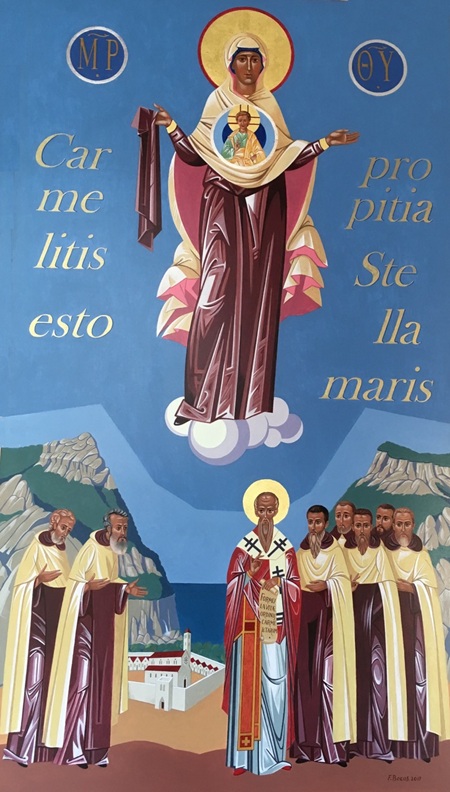
Dear Carmelite family: Happy Feast of Our Lady of Mount Carmel!
Once again, the Solemnity of Our Lady of Mount Carmel is fast approaching. This year we recall that, on September 24, 1726, Benedict XIII extended the celebration of the feast of Our Lady of Mount Carmel to the whole of Christendom. We give thanks to God for all the blessings our Order has received during these eight centuries of history, especially for having a Mother to whom we can turn and who cares for us. St Thérèse of the Child Jesus, with some surprise, acknowledged this: “For I have, Blessed Virgin, two mothers to whom I can turn, one on earth and the other in Heaven, whereas you have no Mother in Heaven to love, for you are the Mother yourself.”
1. Mary fills us with gratitude. In Bethlehem, Mary wrapped her Son in swaddling clothes (cf. Lk 2:12). That gesture reminds us that Jesus, as well as being true God and true man, was cared for and loved from the moment of his birth. In Sacred Scripture, “being wrapped in swaddling clothes” is a sign of protection and maternal love: “When I was born […] the first thing I did, like everyone else, was to cry. I was brought up with tender care and swaddling clothes …” (Wis 7:3–4); on the contrary, nakedness, “not being wrapped in swaddling clothes,” indicates vulnerability and helplessness: “No one took an interest in her […] No one bathed her, nor rubbed her with salt, nor wrapped her in swaddling clothes […] they abandoned her…” (cf. Ezek 16:4–5). How difficult it is to care for the lives of others without first, with gratitude, recognising one’s own as a miracle and an undeserved gift! Kierkegaard noted that gratitude is, apart from being the noblest feeling that can spring from the human heart, the “deepest spiritual response to the gift of one’s own existence.” Gratitude is, in fact, a good gauge for measuring our human and spiritual quality. Grateful people make everything easy and a blessing; instead of complaining about what they lack, they value what they have; they shun facile criticism and gossip... Mary, our Mother, teaches us to make our lives a Magnificat, a song of thanksgiving.
2. Mary clothes us in light. The Carmelite Order was founded in the Holy Land at the end of the 12th century. Amidst great danger, we were forced to migrate to Europe. To whom do we turn in the midst of adversity and tribulation? To our Mother. She defended us. We celebrate with joy the 775th anniversary–according to Carmelite tradition–of the presentation of the Holy Scapular to Saint Simon Stock. This is not an amulet that guarantees our salvation, but a sacramental that reminds us of our responsibility to wear the garment of baptism. A very special garment, made of linen, which, according to Scripture, represents the “good works” of the saints (cf. Rev 19:8). Linen is extracted from a plant, which must be beaten, again and again, until it is softened and the whiteness of its fibres is extracted. The Holy Scapular is a suit of armor that defends us from the blows (like the linen) that we receive in the battles of this life. Mary defends us and shows us how to persevere in always doing good. As a Hebrew epitaph once prayed: “A good deed done on earth causes a thread of light to be born in heaven. Many good deeds done on earth cause many threads of light to be born in heaven. For what purpose? To weave and knit together a garment. A garment of light that gives glory to the Master of all works.” Mary earnestly teaches us to clothe ourselves in this armor (cf. Rule 19), woven from many “threads of light”: mercy, gentleness, peace, justice, forgiveness, joy, hope, love, etc.
3. Mary clothes us in humanity. On the May 25, Pope Leo XIV’s first encyclical, Magnifica Humanitas, was published, addressing the protection of human dignity in the age of artificial intelligence. He has asked the whole Church to read and reflect upon it. In the face of the growing link between technology, power and violence, a new civilisation of love is proposed to us as an alternative. Pope Leo XIV invites us to invoke Mary, Mother of Life, who looks upon us with mercy. We could cite many testimonies that would compel us to bow down before the suffering of the innocent: those who struggle to find work and make ends meet; those who emigrate from their countries without access to education and healthcare; war, famine, broken love. One example is sufficient. It is that of a prominent figure in French culture, Emmanuel Mounier, the believing philosopher, who felt the weight of his young daughter’s irreversible illness, as she lived in a vegetative state:
As I approached this silent cradle, I felt as though I were approaching an altar, a sacred place where God spoke through a sign. A piercing and profound sadness; profound, yet light and transfigured. And, around it, a sense of adoration… I have no other word for it. Never have I known so intensely what prayer is as when I spoke to that forehead which gave no reply, when my eyes ventured towards that lost gaze that looked towards the infinite behind me. Mystery… and it can only be a mystery of goodness. One must dare to say: a grace too lofty, a living host among us, silent as the Host, resplendent as She… – Mounier says to his wife –: For how many months did we wish she would die if she was going to remain like this! But… is this not mere bourgeois sentimentality? What does “being unhappy” mean to her? Who can assure us that she is? Who knows if we are not being asked to keep and adore this host among us…? My little Françoise, to me you are the very image of faith [Letter to Paulette Mounier, 1964, 671].
His testimony is deeply moving. Let us implore the Mother and Beauty of Carmel to teach us to see God’s invisible work and to view the world from below, from the perspective of the most vulnerable. The Joys of Our Lady of Mount Carmel are very old and popular poems, composed mainly to honour the Virgin Mary. They bring together ancient stories from the Carmelite tradition: “For you are our comfort, the most powerful means. Be our loving refuge, Mother of God of Mount Carmel.” The biblical scholar Miguel Aiguani, O. Carm. (1320–1400), affirmed that Mary is an “impregnable castle,” a secure stronghold in which to take refuge when we feel that life is threatened by death. St John Chrysostom insisted that “there is no motherhood without tears.” Tears nourish the soul. God gathers those tears, as the psalmist says, in His “skin flask.” Not a single tear is lost; they all go straight to the heart of God (cf. Ps 55). Tears intercede so that the Church’s mission may be more fruitful. Weeping for the pain of our neighbor or for the rejection we have suffered has a sanctifying and restorative power.
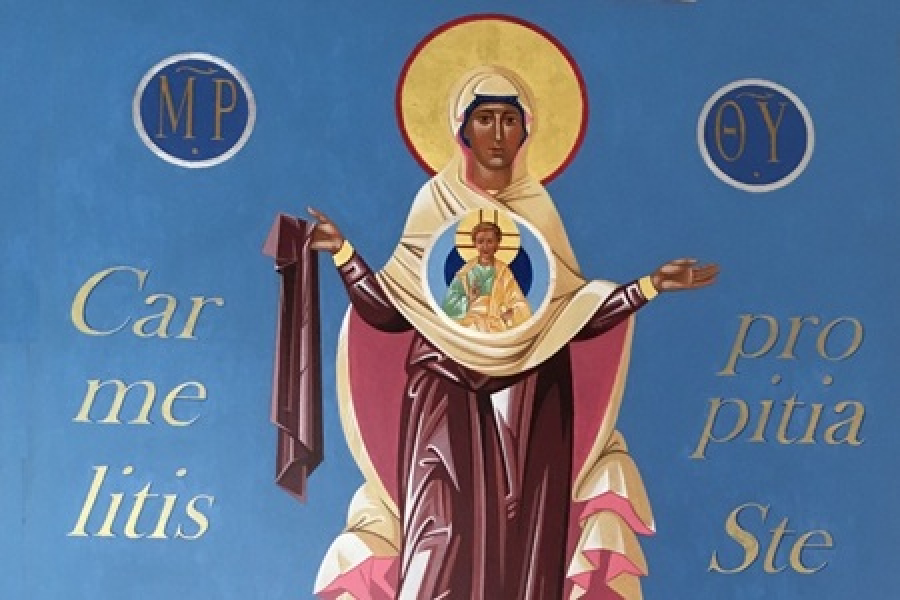
May Our Lady, whom we proclaim Mater et Decor Carmeli, protect us and, through her heavenly intercession, grant us the strength, hope and joy we need to reflect God’s goodness as we serve humanity.
Fraternally in Carmel,