








Warning: Creating default object from empty value in /home/jtthoc/public_html/ocarm.org/components/com_k2/views/itemlist/view.html.php on line 743

The Parable of the Prodigal Son
Luke 15:1-3, 11-32
1. LECTIO
a) Opening prayer:
Come, Spirit Creator, reveal to us the great mystery of God the Father and of the Son united in one love. Grant that we may see the great day of God, resplendent with light: the dawn of a new world born in the blood of Christ. The prodigal son comes home, the blind sees the bright light; the pardoned good thief dissolves the ancient fear. Dying on the cross, Christ destroys death; death brings forth life, love conquers fear and sin seeks pardon. Amen.
b) Gospel reading
Tax collectors and sinners were all drawing near to listen to Jesus, but the Pharisees and scribes began to complain, saying, “This man welcomes sinners and eats with them.” So to them Jesus addressed this parable: “A man had two sons, and the younger son said to his father, ‘Father give me the share of your estate that should come to me.’ So the father divided the property between them. After a few days, the younger son collected all his belongings and set off to a distant country where he squandered his inheritance on a life of dissipation. When he had freely spent everything, a severe famine struck that country, and he found himself in dire need. So he hired himself out to one of the local citizens who sent him to his farm to tend the swine. And he longed to eat his fill of the pods on which the swine fed, but nobody gave him any. Coming to his senses he thought, ‘How many of my father’s hired workers have more than enough food to eat, but here am I, dying from hunger. I shall get up and go to my father and I shall say to him, “Father, I have sinned against heaven and against you. I no longer deserve to be called your son; treat me as you would treat one of your hired workers.”’ So he got up and went back to his father. While he was still a long way off, his father caught sight of him, and was filled with compassion. He ran to his son, embraced him and kissed him. His son said to him, ‘Father, I have sinned against heaven and against you; I no longer deserve to be called your son.’ But his father ordered his servants, ‘Quickly bring the finest robe and put it on him; put a ring on his finger and sandals on his feet. Take the fattened calf and slaughter it. Then let us celebrate with a feast, because this son of mine was dead, and has come to life again; he was lost, and has been found.’ Then the celebration began. Now the older son had been out in the field and, on his way back, as he neared the house, he heard the sound of music and dancing. He called one of the servants and asked what this might mean. The servant said to him, ‘Your brother has returned and your father has slaughtered the fattened calf because he has him back safe and sound.’ He became angry, and when he refused to enter the house, his father came out and pleaded with him. He said to his father in reply, ‘Look, all these years I served you and not once did I disobey your orders; yet you never gave me even a young goat to feast on with my friends. But when your son returns who swallowed up your property with prostitutes, for him you slaughter the fattened calf.’ He said to him, ‘My son, you are here with me always; everything I have is yours. But now we must celebrate and rejoice, because your brother was dead and has come to life again; he was lost and has been found.’”
c) Prayerful silent time:
that the Word of God may enter into our hearts and enlighten our life.
2. MEDITATIO
a) A key to the reading:
Dante says that Luke is the ‹‹scriba mansuetudinis Christi››. Indeed, he is the Evangelist who loves to emphasize the mercy of the Master towards sinners and presents us with scenes of forgiveness (Lk 7:36-50;23:39-43). In Luke’s Gospel the mercy of God is manifested in Jesus Christ. We can say that Jesus is the incarnation of the merciful presence of God among us. “Be compassionate as your Father is compassionate” (Lk 6:36). Luke focuses on an image of God already revealed in the Old Testament (Ex 34:6), but which, unfortunately, seems to have been ignored by the scribes and Pharisees who stressed the image of a God “who visits the sins of the fathers on the children” (Ex 34:7). Indeed, the Pharisees and the scribes boasted about being just in the eyes of God because they did not break the law. Jesus criticizes this attitude in His teaching and by His actions. He, the “Just One” of God (1Pet 3:18), “receives sinners and eats with them” (Lk 15:2). Think of the parable of the publican who goes home from the temple justified in contrast with the Pharisee who praised himself before God while passing judgment on his neighbors (Lk 18:9-14). Jesus points out to us that God’s way of thinking and acting is quite different from ours. God is different, and His transcendence is revealed in the mercy that forgives sins. “My heart recoils from it, My whole being trembles at the thought. I will not give rein to my fierce anger… for I am God, not man; I am the Holy One in your midst and have no wish to destroy” (Hos 11:8-9).
This parable of the “prodigal son” brings out this merciful aspect of God the Father. That is why some people refer to this story as “the parable of the father who is prodigal with mercy and forgiveness”. The Gospel passage is part of a series of three parables on mercy and has a preamble that leads us to contemplate “all the publicans and sinners” who approach Jesus to listen to Him (Lk 15:1). These are reflected in the attitude of the younger son who comes to his senses and begins to think about his state and to ponder what he lost when he left his father’s house (Lk 15:17-20). It is interesting to note the use of the verb “to listen”, which recalls the scene with Mary, Martha’s sister, “who sat down at the Lord’s feet and listened to Him speaking” (Lk 10:39); or the great crowd of people “who had come to hear Him and to be cured of their diseases” (Lk 6:18). Jesus acknowledges His relatives, not by their blood relationship, but from their listening attitude: “My mother and My brothers are those who hear the word of God and put it into practice” (Lk 8:21). Luke seems to place importance on this attitude of listening. Mary, the mother of Jesus, is praised for having a contemplative listening attitude, she who “stored up all these things in her heart” (Lk 2:19,51). Elizabeth proclaims her blessed because “she has believed that the promise made by the Lord would be fulfilled” (Lk 1:45), revealed at the time of the annunciation (Lk 1:26-38).
The mercy of the compassionate father (Lk 15:20), is in contrast with the severe attitude of the older son, who will not accept his brother as such and who, in the dialogue with the father, refers to him as: “this son of yours comes back after swallowing up your property – he and his women…” (Lk 15:30). In this we can see the attitude of the scribes and Pharisees who “murmured: 'This man receives sinners and eats with them'.” They do not associate with “sinners” whom they consider unclean, but rather distance themselves from them. Jesus’ attitude is different and, in their sight, it is scandalous. He likes to associate with sinners and sometimes invites Himself into their houses to eat with them (Lk 19:1-10). The murmuring of the scribes and Pharisees prevents them from listening to the Word.
The contrast between the two brothers is quite evocative. The younger brother recognizes his misery and fault and returns home saying: “Father, I have sinned against heaven and against you. I no longer deserve to be called your son” (Lk 15:18-19,21). The older brother takes an attitude of arrogance not only towards his brother but also towards his father! His scolding is in great contrast with the tenderness of the father who comes out of the house and goes to meet him to “entreat” him to go into the house (Lk 15:20,28). This is an image of God the Father who invites us to conversion, to return to Him: “Come back, disloyal Israel – it is Yahweh who speaks – I shall frown on you no more, since I am merciful – it is Yahweh who speaks. I shall not keep my resentment for ever. Only acknowledge your guilt: how you have apostatized from Yahweh your God, how you have flirted with strangers and have not listened to my voice – it is Yahweh who speaks. Come back disloyal children –it is Yahweh who speaks – for I alone am your Master” (Jer 3:12-14).
b) A few questions:
to direct our meditation and practice.
i) Luke focuses on an image of God already revealed in the Old Testament (Ex 34:6), which unfortunately seems to have been ignored by the scribes and Pharisees who stressed the image of a God “who visits the sins of the fathers on the children” (Ex 34:7). What image of God do I have?
ii) The Pharisees and scribes boast that they are just in the sight of God because they do not break the law. Jesus criticizes their attitude in His teaching and by His actions. He, the “Just One” of God (1Pet 3:18), “receives sinners and eats with them” (Lk 15: 2). Do I consider myself more just than others, perhaps because I try to observe the commandments of God? What are the motives that drive me to live a “just” life? Is it the love of God or personal satisfaction?
iii) “All the publicans and sinners” approached Jesus to listen to Him (Lk 15:1). Luke seems to place importance on this attitude of listening, reflection, entering into oneself, meditating, and storing up the Word in our hearts. What place do I give to the contemplative listening of the Word of God in my daily life?
iv) The scribes and Pharisees do not associate with “sinners” whom they consider unclean, but rather distance themselves from them. Jesus’ attitude is different and, in their sight, it is scandalous. He loves to be with sinners and sometimes invites Himself to their houses to eat with them (Lk 19:1-10). Do I judge others or do I try to pass on feelings of mercy and forgiveness, thus reflecting the tenderness of God the Father-Mother?
v) “Bring the calf we have been fattening, and kill it; we are going to have a feast, a celebration, because this son of mine was dead and has come back to life; he was lost and is found.” And they began to celebrate. (Lk 15:23). In the image of the father who celebrates the return to life of his son, we recognize God the Father who has loved us so much “that He gave His only Son, so that everyone who believes in Him may not be lost but may have eternal life” (Jn 3:16). In the killed “fattened calf”, we can see the Christ, the Lamb of God who offers Himself as a victim of expiation for the redemption of sin. I take part in the Eucharistic banquet full of grateful feelings for this infinite love of God who gives Himself to us in His crucified and risen beloved Son.
3. ORATIO
a) Psalm 32 (31):
Blessed is he whose transgression is forgiven,
whose sin is covered.
Blessed is the man to whom the Lord imputes no iniquity,
and in whose spirit there is no deceit.
When I declared not my sin,
my body wasted away through my groaning all day long.
For day and night Thy hand was heavy upon me;
my strength was dried up as by the heat of summer.
I acknowledged my sin to Thee,
and I did not hide my iniquity; I said,
"I will confess my transgressions to the Lord";
then Thou didst forgive the guilt of my sin.
Thou art a hiding place for me,
Thou preservest me from trouble;
Thou dost encompass me with deliverance.
Be glad in the Lord, and rejoice,
O righteous, and shout for joy,
all you upright in heart!
b) Closing prayer:
O God, who rewards the just and will not deny pardon to repentant sinners, listen to our plea: may the humble confession of our faults obtain for us Your mercy.
4. CONTEMPLATIO
Contemplation is knowing how to adhere with one’s mind and heart to the Lord who by His Word transforms us into new beings who always do His will. “Knowing these things, you will be blessed if you do them.” (Jn 13:17)

Jesus comments on the events of the day
How to interpret the signs of the times
Luke 13:1-9
1. Opening prayer
Lord Jesus, send Your Spirit to help us to read the scriptures with the same mind that You read them to the disciples on the way to Emmaus. In the light of the Word, written in the bible, You helped them to discover the presence of God in the disturbing events of Your sentence and death. Thus, the cross that seemed to be the end of all hope became for them the source of life and of resurrection.
Create silence in us so that we may listen to Your voice in creation and in the scriptures, in events and in people, above all in the poor and suffering. May Your word guide us so that we too, like the two disciples on the way to Emmaus, may experience the force of Your resurrection and witness to others that You are alive in our midst as source of fraternity, justice and peace. We ask this of You, Jesus, son of Mary, who revealed the Father to us and sent us Your Spirit. Amen.
2. Reading
a) A key to the reading:
The text of the third Sunday of Lent puts before us two different but related facts: Jesus comments on the events of the day and He narrates a parable. Luke 13:1-5: At the people’s request, Jesus comments on the events of the day: the massacre of pilgrims by Pilate and the massacre at the tower of Siloam where eighteen people were killed. Luke 13:-9: Jesus tells a parable about the fig tree that bore no fruit.
As you read, it is good to note two things: (i) see how Jesus contradicts the popular interpretation of what is happening (ii) see whether there is a connection between the parable and the comment on the events of the day.
b) A division of the text to help with the reading:
Luke 13:1: The people tell Jesus about the massacre of the Galileans
Luke 13:2-3: Jesus comments on the massacre and draws a lesson from there for the people
Luke 13:4-5: To support His thinking, Jesus comments on another event
Luke 13:6-9: The parable of the fig tree that did not bear fruit
c) Text:
Some people told Jesus about the Galileans whose blood Pilate had mingled with the blood of their sacrifices. Jesus said to them in reply, "Do you think that because these Galileans suffered in this way they were greater sinners than all other Galileans? By no means! But I tell you, if you do not repent, you will all perish as they did! Or those eighteen people who were killed when the tower at Siloam fell on them— do you think they were more guilty than everyone else who lived in Jerusalem? By no means! But I tell you, if you do not repent, you will all perish as they did!" And he told them this parable: "There once was a person who had a fig tree planted in his orchard, and when he came in search of fruit on it but found none, he said to the gardener, 'For three years now I have come in search of fruit on this fig tree but have found none. So cut it down. Why should it exhaust the soil?' He said to him in reply, 'Sir, leave it for this year also, and I shall cultivate the ground around it and fertilize it; it may bear fruit in the future. If not you can cut it down.'"
3. A moment of prayerful silence
so that the Word of God may penetrate and enlighten our life.
4. Some questions
to help us in our personal reflection.
a) What struck or pleased you most in this text? Why?
b) What was the popular interpretation of these two events?
c) How does Jesus disagree with the popular interpretation of the events?
d) What is the meaning of the parable? Is there a connection between the parable and the comments on the events?
e) What is this text’s message for us who have to interpret the signs of the times today?
5. For those who wish to go deeper into the theme
a) The literary and historical context of then and now:
Luke writes his Gospel about 85 A.D. for the Christian communities in Greece. Generally, he follows the narrative in Mark’s Gospel. Here and there he introduces some minor differences or changes some words so as to adapt the narrative to his purpose. Apart from Mark’s Gospel, Luke also consults other books and has access to other sources: eye witnesses and ministers of the Word (Lk 1:2). All the material that is not found in Mark, Luke organizes into a literary form: Jesus is on a long journey from Galilee to Jerusalem. There is a description of the journey in Luke 9:51 to 19:28 and this includes ten chapters or one third of the Gospel!
In these chapters, Luke constantly reminds his readers that Jesus is on a journey. He rarely tells us where Jesus is, but he lets us know clearly that Jesus is traveling, and that the end of the journey is Jerusalem where He will die in accordance with what the prophets had foretold (Lk 9:51,53,57;10:1,38;11:1;13:22,33;14:25;17:11;18:31,35;19:1,11,28). And even after Jesus reaches Jerusalem, Luke goes on talking of a journey to the center (Lk 19:29,41,45; 20:1). Just before the journey begins, on the occasion of the Transfiguration with Moses and Elijah on the mountain, the journey to Jerusalem is considered as an exodus for Jesus (Lk 9:31) and as an ascension or climbing up to heaven (Lk 9:51). In the Old Testament, Moses had led the first exodus liberating people from Pharaoh’s oppression (Ex 3:10-12) and the prophet Elijah went up to heaven (2 Kings 2:11). Jesus is the new Moses who comes to liberate people from the oppression of the law. He is the new Elijah who comes to prepare the coming of the Kingdom.
The description of Jesus’ long journey to Jerusalem is not just a literary device to introduce the material proper to Luke. It also reflects the long and arduous journey that the communities in Greece were going through in their daily lives in Luke’s time: passing from a rural world in Palestine to a cosmopolitan environment in the Greek culture at the edges of the great cities of Asia and Europe. This passage or inculturation was marked by a strong tension between the Christians from Judaism and the new converts who came from other ethnic and cultural groups. Indeed, the description of the long journey to Jerusalem reflects the painful process of conversion that people connected to Judaism had to make: to leave the world of the observance of the law that accused and condemned them, to go towards a world of the gratuitous love of God to all peoples, to the certainty that in Christ all peoples meld into one before God; to leave the closed world of a race to go towards the universal territory of humanity. This is also the journey of our lives. Are we capable of transforming the crosses of life into an exodus of liberation?
b) A commentary on the text:
Luke 13:1: The people inform Jesus of the massacre of the Galileans.
Like today, people pass on comments on the events that happen and want to hear comments from those who can form public opinion. That is why some people went to Jesus to tell Him of the massacre of some Galileans whose blood Pilate had mingled with that of their sacrifices. It was probably the assassination that took place on Mount Gerazim, which was still a place of pilgrimage and where people went to offer sacrifices. This event underlines the ferocity and stupidity of some Roman rulers in Palestine who provoked the religious sensibility of the Jews through irrational actions such as this.
Luke 13:2-3: Jesus comments on the massacre and draws a lesson for the people.
Asked to give an opinion, Jesus asks: “Do you suppose that these Galileans were worse sinners than any others that this should happen to them?” Jesus’ question reflects the popular interpretation common then: suffering and violent death are punishment from God for some sin committed by that person. Jesus’ reaction is categorical: “They were not I tell you. No!” He denies the popular interpretation and transforms the event into an examination of conscience: “unless you repent you will all perish as they did”. In other words, unless there is a real and proper change, the same massacre will overtake all. Later history confirmed Jesus’ foresight. The change did not take place. They were not converted and forty years later, in 70, Jerusalem was destroyed by the Romans. Many people were massacred. Jesus saw the gravity of the political situation of His country. On the one hand, there was the ever heavier and unbearable Roman domination. On the other, there was the official religion, which was growing more and more alienated without understanding the importance of the faith in Yahweh in the lives of the people.
Luke 13:4-5: In support of His thinking, Jesus comments on more than one event.
Jesus takes the initiative of commenting on another event. A blizzard causes the tower of Siloam to crumble and eighteen people are crushed by the stones. People thought that it was “a punishment from God!” Jesus’ comment is: “No, I tell you, but unless you repent you will all perish as they did”. His concern is to interpret events in such a way that God’s call to change and conversion becomes transparent. Jesus is a mystic, a contemplative. He reads events in a different way. He can read and interpret the signs of the times. For Him, the world is transparent, revealing the presence and call of God.
Luke 13:6-9: The parable of the fig tree that bears no fruit.
Jesus then tells the parable of the fig tree that bears no fruit. A man had planted a fig tree in his vineyard. For three years the tree bore no fruit. So he says to his vinedresser: “Cut it down”. But the vinedresser replies: “Leave it one more year….it may bear fruit next year; if not, then you can cut it down”. We do not know whether Jesus told this parable immediately after His comments on the massacre and the crumbling of the tower of Siloam. It was probably Luke who placed this parable here, because Luke sees a connection between the comments on the events and the parable of the fig tree. Luke does not say what this connection is. He leaves us to discover this. What meaning does Luke see? I shall dare to give an opinion. You may discover another meaning. The owner of the vineyard and of the fig tree is God. The fig tree represents the people. Jesus is the vinedresser. The owner of the vineyard has grown tired of looking for fruit from the fig tree and finding none. He decides to uproot the tree. Thus there will be more room for another plant that may bear fruit. The chosen people were not producing the fruit that God expected. He wants to pass on the Good News to the pagans. Jesus is the vinedresser who asks that the fig tree be spared a little longer. He will redouble His efforts to obtain a change and a conversion. Later in the Gospel, Jesus recognizes that His redoubled efforts have borne no result. They will not be converted. Jesus mourns the lack of conversion and weeps over the city of Jerusalem. (Lk 19:41-44).
c) Further information:
A short history of the popular resistance against the Romans in Jesus’ time
In this Sunday’s Gospel, Luke makes clear allusions to the repression of the Roman legions against the popular resistance of the Galileans. Hence we give a schematic overview of the popular resistance of Judeans against the Roman domination. Over the years this resistance grew deeper and took root in the faith of the people. Here is an outline that runs parallel with Jesus’ life:
i) From 63 to 37 before Christ: A popular revolt without any clear direction. In 63 before Christ, the Roman Empire invaded Palestine and imposed a peasant tribute. From 57 to 37, in just 20 years, six rebellions broke out in Galilee! The people, aimless, followed anyone who promised to liberate them from the Roman tribute.
ii) From 37 to 4 before Christ: Repression and dislocation. This is the time of the government of Herod, called The Great. He is the one who killed the innocents in Bethlehem (Mt 2:16). Brutal repression prevented any kind of popular manifestation. Herod thus promoted the so-called Pax Romana. This peace gave the Empire a certain economic stability, but for the oppressed people it was the peace of a cemetery.
iii) From 4 to 6 after Christ: Messianic revolutions. This is the period of Archelaus’ government in Judea. On the day he took power, he massacred 3000 people in the Temple square. The revolution exploded all over the country, but it was aimless. The popular leaders at this time were seeking for motives connected with ancient tradition and presented themselves as messianic kings. The Roman repression destroyed Seforis, the capital of Galilee. Violence was the mark of Jesus’ childhood. In the ten years of Archelaus’ government, He saw Palestine go through one of the most violent periods of its history.
iv) From 6 to 27: Zeal for the law: A time for revision. In the year 6, Romulus deposed Archelaus and transformed Judea into a Roman Province, decreeing a census so as to make sure that the tribute was paid. The census produced a strong popular reaction inspired by Zeal for the Law. This Zeal (hence the term zealots) urged people to boycott and not pay the tribute. This was a new form of resistance, a kind of civil disobedience that spread like a repressed fire under embers. However, Zeal had a limited vision. The "zealots" ran the danger of reducing the observance of the Law to opposition to the Romans. It was precisely during this period that Jesus grew in awareness of His mission.
v) From 27 to 69: The prophets reappear. After these 20 years, from 6 to 26, the revision of the aim of the journey appears with the preaching of the prophets who represented a step forward in the popular movement. The prophets called the people together and invited them to conversion and change. They wanted to reform history from its origins. They gathered the people in the desert (Mk 1:4), to begin a new exodus, proclaimed by Isaiah (Isa 43:16-21). The first was John the Baptist (Mt 11:9; 14:5; Lk 1:76), who drew many people (Mt 3:5-7). Soon after, Jesus came on the scene and was considered by the people to be a prophet (Mt 16:14;21:11,46; Lk 7:16). Jesus, like Moses, proclaimed the New Law on the mountain (Mt 5:1) and nourished the people in the desert (Mk 6:30-44). Like the fall of the walls of Jericho towards the end of the forty years in the desert (Is 6:20), so also, Jesus proclaimed the fall of the walls of Jerusalem (Lk 19:44; Mt 24:2). Like the prophets of old, Jesus proclaimed the liberation of the oppressed and the beginning of a new jubilee year (Lk 4:18-19), and asked for a change in the way of life (Mk 1:15; Lk 13:3.5).
There are other prophets after Jesus. That is why revolution, messianism and zeal continue to exist simultaneously. The authorities of the time, Romans and Herodians, as also priests, scribes and Pharisees, all concerned with the security of the temple and the nation (Jn 11:48) and with the observance of the law (Mt 23:1-23), could not see the difference between prophets and other popular leaders. For them they were all the same. They mistook Jesus for a messianic king (Lk 23:2.5). Gamaliel, the great doctor of the law, for instance, compared Jesus with Judas, leader of the revolutionaries (Acts 5:35-37). Flavius Josephus himself, the historian, mistook the prophets for "thieves and impostors". Today we would say that they were all "good for nothing"!
6. Praying Psalm 82 (81)
God warns human authorities
God takes His stand in the divine assembly,
surrounded by the gods He gives judgment.
'How much longer will you give unjust judgments
and uphold the prestige of the wicked?
Let the weak and the orphan have justice,
be fair to the wretched and the destitute.
'Rescue the weak and the needy,
save them from the clutches of the wicked.
'Ignorant and uncomprehending,
they wander in darkness,
while the foundations of the world are tottering.
I had thought, "Are you gods,
are all of you sons of the Most High?"
No! you will die as human beings do,
as one man, princes, you will fall.'
Arise, God,
judge the world,
for all nations belong to You.
7. Final Prayer
Lord Jesus, we thank You for the word that has enabled us to understand better the will of the Father. May Your Spirit enlighten our actions and grant us the strength to practice what Your Word has revealed to us. May we, like Mary, Your mother, not only listen to but also practice the Word. You who live and reign with the Father in the unity of the Holy Spirit forever and ever. Amen.

The Transfiguration of Jesus
A new way of fulfilling the prophecies
Luke 9:28-36
1. Opening prayer
Lord Jesus, send Your Spirit to help us read the scriptures with the same mind that You read them to the disciples on the way to Emmaus. In the light of the Word, written in the bible, You helped them to discover the presence of God in the disturbing events of Your sentence and death. Thus, the cross that seemed to be the end of all hope became for them the source of life and of resurrection.
Create silence in us so that we may listen to Your voice in creation and in the scriptures, in events and in people, above all, in the poor and suffering. May Your word guide us so that we too, like the two disciples on the way to Emmaus, may experience the force of Your resurrection and witness to others that You are alive in our midst as source of fraternity, justice and peace. We ask this of You, Jesus, son of Mary, who revealed the Father to us and sent us Your Spirit. Amen.
2. Reading
a) A key to the reading:
A few days earlier, Jesus had said that He, the Son of Man, had to be tried and crucified by the authorities (Lk 9:22; Mk 8:31). According to the information in the gospels of Mark and Matthew, the disciples, especially Peter, did not understand what Jesus had said and were scandalized by the news (Mt 16:22; Mk 8:32). Jesus reacted strongly and turned to Peter calling him Satan (Mt 16:23; Mk 8:33). This was because Jesus’ words did not correspond with the ideal of the glorious Messiah whom they imagined. Luke does not mention Peter’s reaction and Jesus’ strong reply, but he does describe, as do the other Evangelists, the episode of the Transfiguration. Luke sees the Transfiguration as an aid to the disciples so that they may be able to get over the scandal and change their idea of the Messiah (Lk 9:28-36). Taking the three disciples with Him, Jesus goes up the mountain to pray, and while He is praying, is transfigured. As we read the text, it is good to note what follows: “Who appears with Jesus on the mountain to converse with Him? What is the theme of their conversation? What is the disciples’ attitude?”
b) A division of the text as an aid to the reading:
i) Luke 9:28: The moment of crisis
ii) Luke 9:29: The change that takes place during the prayer
iii) Luke 9:30-31: The appearance of the two men and their conversation with Jesus
iv) Luke 9:32-34: The disciples’ reaction
v) Luke 9:35-36: The Father’s voice
c) The text:
Jesus took Peter, John, and James and went up the mountain to pray. While he was praying his face changed in appearance and his clothing became dazzling white. And behold, two men were conversing with him, Moses and Elijah, who appeared in glory and spoke of his exodus that he was going to accomplish in Jerusalem. Peter and his companions had been overcome by sleep, but becoming fully awake, they saw his glory and the two men standing with him. As they were about to part from him, Peter said to Jesus, "Master, it is good that we are here; let us make three tents, one for you, one for Moses, and one for Elijah." But he did not know what he was saying. While he was still speaking, a cloud came and cast a shadow over them, and they became frightened when they entered the cloud. Then from the cloud came a voice that said, "This is my chosen Son; listen to him." After the voice had spoken, Jesus was found alone. They fell silent and did not at that time tell anyone what they had seen.
3. A moment of prayerful silence
so that the Word of God may penetrate and enlighten our life.
4. Some questions
to help us in our personal reflection.
a) What did you like most in this episode of the Transfiguration? Why?
b) Who are those who go to the mountain with Jesus? Why do they go?
c) Moses and Elijah appear on the mountain next to Jesus. What is the significance of these two people from the Old Testament for Jesus, for the disciples, for the community in the 80s and for us today?
d) Which prophecy from the Old Testament is fulfilled in the words of the Father concerning Jesus?
e) What is the disciples’ attitude during this episode?
f) Has there been a transfiguration in your life? How have such experiences of transfiguration helped you to fulfill your mission better?
g) Compare Luke’s description of the Transfiguration of Jesus (Lk 9:28-36) with his description of the agony of Jesus in the Garden (Lk 22:39-46). Try to see whether there are any similarities. What is the significance of these similarities?
5. A key to the reading
for those who wish to go deeper into the theme.
a) The context of Jesus’ discourse:
In the two previous chapters of Luke’s Gospel, the innovation brought by Jesus highlights the tensions between the New and the Old Testaments. In the end, Jesus realized that no one had understood His meaning, much less His person. People thought that He was like John the Baptist, Elijah or some other prophet (Lk 9:18-19). The disciples accepted Him as the Messiah, but a glorious Messiah, according to the expectations issued by the government and the official religion of the temple (Lk 9:20-21). Jesus tried to explain to His disciples that the journey foreseen by the prophets was one of suffering because of its commitment to the excluded, and that a disciple could only be a disciple if he/she took up his/her cross (Lk 9:22-26). But Jesus did not meet with much success. It is in such a context of crisis that the Transfiguration takes place.
In the 30s, the experience of the Transfiguration had a very important significance in the life of Jesus and the disciples. It helped them overcome the crisis of faith and to change their ideals concerning the Messiah. In the 80s, when Luke was writing for the Christian communities in Greece, the meaning of the Transfiguration had already been deepened and broadened. In the light of Jesus’ resurrection and of the spread of the Good News among the pagans in almost every country, from Palestine to Italy, the experience of the Transfiguration began to be seen as a confirmation of the faith of the Christian communities in Jesus, Son of God. The two meanings are present in the description and interpretation of the Transfiguration in Luke’s Gospel.
b) A commentary on the text:
Luke 9:28: The moment of crisis.
On several occasions Jesus entered into conflict with the people and the religious and civil authorities of his time (Lk 4:28-29;5:21-20;6:2-11;7:30.39;8:37;9:9). He knew they would not allow Him to do the things He did. Sooner or later they would catch Him. Besides, in that society, the proclamation of the Kingdom, as Jesus did, was not to be tolerated. He either had to withdraw or face death! There were no other alternatives. Jesus did not withdraw. Hence the cross appears on the horizon, not just as a possibility but as a certainty (Lk 9:22). Together with the cross there also appears the temptation to go on with the idea of the Glorious Messiah and not of the Crucified, suffering servant, announced by the prophet Isaiah (Mk 8:32-33). At this difficult moment Jesus goes up the mountain to pray, taking with Him Peter, James and John. Through His prayer, Jesus seeks strength not to lose sense of direction in His mission (cf. Mk 1:35).
Luke 9:29: The change that takes place during the prayer.
As soon as Jesus starts praying, His appearance changes and He appears glorious. His face changes and His clothes become white and shining. It is the glory that the disciples imagined for the Messiah. This transformation told them clearly that Jesus was indeed the Messiah expected by all. But what follows the episode of the Transfiguration will point out that the way to glory is quite different from what they imagined. The Transfiguration will be a call to conversion.
Luke 9:30-31: Two men appear speaking with Jesus.
Together with Jesus and in the same glorious state there appear Moses and Elijah, the two major exponents of the Old Testament, representing the Law and the Prophets. They speak with Jesus about “the Exodus brought to fulfilment in Jerusalem”. Thus, in front of the disciples, the Law and the Prophets confirm that Jesus is truly the glorious Messiah, promised in the Old Testament and awaited by the whole people. They further confirm that the way to glory is through the painful way of the exodus. Jesus’ exodus is His passion, death and resurrection. Through His “exodus” Jesus breaks the dominion of the false idea concerning the Messiah spread by the government and by the official religion and that held all ensnared in the vision of a glorious, nationalistic messiah. The experience of the Transfiguration confirmed that Jesus as Messiah Servant constituted an aid to free them from their wrong ideas concerning the Messiah and to discover the real meaning of the Kingdom of God.
Luke 9:32-34: The disciples’ reaction.
The disciples were in deep sleep. When they woke up, they saw Jesus in His glory and the two men with Him. But Peter’s reaction shows that they were not aware of the real meaning of the glory in which Jesus appeared to them. As often happens with us, they were only aware of what concerned them. The rest escapes their attention. “Master, it is good for us to be here!” And they do not want to get off the mountain any more! When it is question of the cross, whether on the Mount of the Transfiguration or on the Mount of Olives (Lk 22:45), they sleep! They prefer the glory to the cross! They do not like to speak or hear of the cross. They want to make sure of the moment of glory on the mountain, to extend it, and they offer to build three tents. Peter did not know what he was saying.
While Peter was speaking, a cloud descended from on high and covered them with its shadow. Luke says that the disciples became afraid when the cloud enfolded them. The cloud is the symbol of the presence of God. The cloud accompanied the multitude on their journey through the desert (Ex 40:34-38; Num 10:11-12). When Jesus ascended into heaven, He was covered by a cloud and they no longer saw Him (Acts 1:9). This was a sign that Jesus had entered forever into God’s world.
Luke 9:35-36: The Father’s voice.
A voice is heard from the cloud that says: “This is My Son, the Chosen, listen to Him”. With this same sentence the prophet Isaiah had proclaimed the Messiah-Servant (Isa 42:1). First Moses and Elijah, now God Himself presents Jesus as the Messiah-Servant who will come to glory through the cross. The voice ends with a final admonition: “Listen to Him!” As the heavenly voice speaks, Moses and Elijah disappear and only Jesus is left. This signifies that from now on only He will interpret the scriptures and the will of God. He is the Word of God for the disciples: “Listen to Him!”
The proclamation “This is My Son, the Chosen; listen to Him” was very important for the community of the late 80s. Through this assertion God the Father confirmed the faith of Christians in Jesus as Son of God. In Jesus’ time, that is, in the 30s, the expression Son of Man pointed to a very high dignity and mission. Jesus Himself gave a relative meaning to the term by saying that all were children of God (cf. John 10:33-35). But for some the title Son of God became a resume of all titles, over one hundred that the first Christians gave Jesus in the second half of the first century. In succeeding centuries, it was the title of Son of God that the Church concentrated all its faith in the person of Jesus.
c) A deepening:
i) The Transfiguration is told in three of the Gospels: Matthew (Mt 17:1-9), Mark (Mk 9:2-8) and Luke (Lk 9:28-36). This is a sign that this episode contained a very important message. As we said, it was a matter of great help to Jesus, to His disciples and to the first communities. It confirmed Jesus in His mission as Messiah-Servant. It helped the disciples to overcome the crisis that the cross and suffering caused them. It led the communities to deepen their faith in Jesus, Son of God, the One who revealed the Father and who became the new key to the interpretation of the Law and the Prophets. The Transfiguration continues to be of help in overcoming the crisis that the cross and suffering provoke today. The three sleeping disciples are a reflection of all of us. The voice of the Father is directed to us as it was to them: “This is My Son, the Chosen; listen to Him!”
ii) In Luke’s Gospel there is a great similarity between the scene of the Transfiguration (Lk 9:28-36) and the scene of the agony of Jesus in the Garden of Olives (Lk 22:39-46). We may note the following: in both scenes Jesus goes up the mountain to pray and takes with Him three disciples, Peter, James and John. On both occasions, Jesus’ appearance is transformed and He is transfigured before them; glorious at the Transfiguration, perspiring blood in the Garden of Olives. Both times heavenly figures appear to comfort Him, Moses and Elijah and an angel from heaven. Both in the Transfiguration and in the Agony, the disciples sleep, they seem to be outside the event and they seem not to understand anything. At the end of both episodes, Jesus is reunited with His disciples. Doubtless, Luke intended to emphasize the resemblance between these two episodes. What would that be? Perhaps it is to show that understanding takes time and effort, even for the Apostles, so we should persevere and not be asleep, especially at those crucial moments in our lives when He is revealing Himself to us personally. It is in meditating and praying that we shall come to understand the meaning that goes beyond words, and to perceive the intention of the author. The Holy Spirit will guide us.
iii) Luke describes the Transfiguration. There are times in our life when suffering is such that we might think: “God has abandoned me! He is no longer with me!” And then suddenly we realize that He has never deserted us, but that we had our eyes bandaged and were not aware of the presence of God. Then everything is changed and transfigured. It is the transfiguration! This happens every day in our lives.
6. Psalm 42 (41)
“My soul thirsts for the living God!”
As a dear longs for flowing streams,
so longs my soul for Thee, O God.
My soul thirsts for God, for the living God.
When shall I come and behold the face of God?
My tears have been my food day and night,
while men say to me continually, "Where is your God?"
These things I remember, as I pour out my soul:
how I went with the throng,
and led them in procession to the house of God,
with glad shouts and songs of thanksgiving,
a multitude keeping festival.
Why are you cast down, O my soul,
and why are you disquieted within me?
Hope in God; for I shall again praise Him,
my help and my God.
My soul is cast down within me;
therefore I remember Thee from the land of Jordan
and of Hermon, from Mount Mizar.
Deep calls to deep at the roar of Your torrents;
all Thy waves and breakers have gone over me.
By day the Lord commands His steadfast love;
and at night His song is with me,
a prayer to the God of my life.
I say to God, my rock:
"Why hast Thou forgotten me?
Why do I go mourning because of the oppression of the enemy?"
As with a deadly wound in my body,
my adversaries taunt me,
while they say to me continually,
"Where is your God?"
Why are you cast down, O my soul,
and why are you disquieted within me?
Hope in God; for I shall again praise Him,
my help and my God.
7. Final Prayer
Lord Jesus, we thank You for the word that has enabled us to understand better the will of the Father. May Your Spirit enlighten our actions and grant us the strength to practice what Your Word has revealed to us. May we, like Mary, Your mother, not only listen to but also practice the Word. You who live and reign with the Father in the unity of the Holy Spirit forever and ever. Amen.

The temptations of Jesus.
Victory by means of prayer and the Bible
Luke 4:1-13
1. LECTIO
a) Initial Prayer
Oh Lord, at the beginning of this Lenten time You invite me to meditate, once more, on the account of the temptations, so that I may discover the heart of the spiritual struggle and, above all, so that I may experience victory over evil.
Holy Spirit, “visit our minds” because frequently, many thoughts proliferate in our mind which make us feel that we are in the power of the uproar of many voices. The fire of love also purifies our senses and our heart so that they may be docile and available to the voice of Your Word. Enlighten us (accende lumen sensibus, infunde amorem cordibus) so that our senses may be ready to dialogue with You. If the fire of Your love blazes up in our heart, over and above our aridity, it can flood the true life, which is fullness of joy.
b) Reading of the Gospel:
Filled with the Holy Spirit, Jesus returned from the Jordan and was led by the Spirit into the desert for forty days, to be tempted by the devil. He ate nothing during those days, and when they were over he was hungry. The devil said to him, "If you are the Son of God, command this stone to become bread." Jesus answered him, "It is written, One does not live on bread alone." Then he took him up and showed him all the kingdoms of the world in a single instant. The devil said to him, "I shall give to you all this power and glory; for it has been handed over to me, and I may give it to whomever I wish. All this will be yours, if you worship me." Jesus said to him in reply, "It is written: You shall worship the Lord, your God, and him alone shall you serve." Then he led him to Jerusalem, made him stand on the parapet of the temple, and said to him, "If you are the Son of God, throw yourself down from here, for it is written: He will command his angels concerning you, to guard you, and: With their hands they will support you, lest you dash your foot against a stone." Jesus said to him in reply, "It also says, You shall not put the Lord, your God, to the test." When the devil had finished every temptation, he departed from him for a time.
c) Moment of prayerful silence:
To listen, silence is necessary: of the soul, of the spirit, of the senses, and also exterior silence, with the purpose of listening to what the Word of God intends to communicate.
2. MEDITATIO
a) Key for the reading:
Luke, with the refinement of a narrator, mentions in 4:1-44 some aspects of the ministry of Jesus after His baptism, among them the temptations of the devil. In fact, he says that Jesus, “Filled with the Holy Spirit, left the Jordan and was led by the Spirit into the desert, for forty days” (Lk 4:1-2). Such an episode in the life of Jesus is something preliminary to His ministry, but it can also be understood as the moment of transition from the ministry of John the Baptist to that of Jesus. In Mark such an account of the temptations is more generic. In Matthew, it is said that Jesus “was led by the Spirit into the desert to be tempted by the devil” (Mt 4:1), these last words attribute the experience of the temptations to an influence which is at the same time heavenly and diabolical. The Lukan account modifies Matthew’s text in such a way as to show that Jesus, “filled with the Holy Spirit”, leaves the Jordan on His own initiative and is led by the Spirit into the desert for forty days, where “He is tempted by the devil” (4:2). The meaning which Luke wants to give to the temptations of Jesus is that those were an initiative of the devil and not a programmed experience of the Holy Spirit (S. Brown). It is as if Luke wanted to keep clearly distinct the person of the devil from the person of the Holy Spirit.
Another element to be kept in mind is the order in which Luke places the temptations: desert – sight of the kingdoms of the world – pinnacle of Jerusalem. In Matthew, instead, the order varies: desert – pinnacle – high mountain. Exegetes discuss which is the original disposition, but they have not arrived at a unanimous opinion. The difference could be explained beginning with the third temptation (the culminating one): for Matthew the “mountain” is the summit of the temptation because in his Gospel he places all his interest on the theme of the mountain (we just have to remember the Sermon on the Mount, the presentation of Jesus as “the new Moses”); for Luke, instead, the last temptation takes place on the pinnacle of the temple of Jerusalem because one of the great interests of his Gospel is the city of Jerusalem (Jesus in Luke’s account is on the way toward Jerusalem where salvation is definitively fulfilled) (Fitzmyer).
The reader can legitimately ask himself, “In Luke, just as in Matthew, were there possible witnesses to the temptations of Jesus?” The answer is certainly negative. From the account of Luke it appears clearly that Jesus and the devil are completely alone. Jesus’ answers to the devil are taken from Sacred Scripture; they are quotations from the Old Testament. Jesus faces the temptations, and particularly that of the worship which the devil intends from Jesus Himself, having recourse to the Word of God as bread of life, as protection from God. The recourse to the Word of God contained in the book of Deuteronomy, considered by exegetes as a long meditation on the law, shows Luke’s intention to recall this episode in the life of Jesus with God’s plan, who wishes to save the human race.
Did these temptations take place historically? Why do some, among believers and non-believers, hold that such temptations are only some fantasy about Jesus, some invention of a story? Such questions are extremely important. Certainly, it is not possible to give a literal and unsophisticated explanation, or perhaps to think that these could have happened in an external way. Dupont’s explanation seems to offer an alternative: “Jesus speaks about an experience which He has lived, but translated into a figurative language, adapted to strike the minds of His listeners” (Les Tentations de Jesus au Desert, 128). More than considering them as an external fact, the temptations are considered as a concrete experience in the life of Jesus. It seems to me that this is the principal reason which has guided Luke and the other evangelists in transmitting those scenes. The opinions of those who hold that the temptations of Jesus are fictitious or invented are deprived of foundation, neither is it possible to share the opinion of Dupont himself, when he says that these were “a purely spiritual dialogue that Jesus had with the devil” (Dupont, 125). Looking within the New Testament (Jn 6:26-34; 7:1-4; Heb 4:15;5,2;2,17a) it is clear that the temptations were an evident truth in the life of Jesus. The explanation of Raymond Brown is interesting and can be shared: “Matthew and Luke would have done no injustice to historical reality by dramatizing such temptations within a scene, and by masking the true tempter by placing this provocation on his lips” (the Gospel According to John, 308). In synthesis we could say that the historicity of the temptations of Jesus or the taking root of these in the experience of Jesus might be described with a “figurative language” (Dupont) or “dramatized” (Raymond Brown). One must distinguish the content (the temptations in the experience of Jesus) from its container (the figurative or dramatized language). It is possible that these two interpretations are much more correct than those which interpret them in a purely literal sense.
An additional key to the reading:
However, these intellectual interpretations, that this episode in Jesus’ life as transmitted to us through the gospel, are “dramatizations” or speaking figuratively, also fall short and can be misleading. In the book “On Heaven and Earth,” Pope Francis, the then-Cardinal Jorge Mario Bergoglio, said, “I believe that the devil exists” and “his greatest achievement in these times has been to make us believe he doesn’t exist.” As for the existence of the devil, theologian Monsignor Corrado Balducci points out that "Satan is mentioned about 300 times in the New Testament, much more than the Holy Spirit.”
In a week we will celebrate Jesus' Transfiguration on the mountain. This is not an abstract dramatization, but rather that Moses and Elijah appeared and the three disciples actually heard the voice of God, yet to accept that the Son of God might actually and verbally turn away Satan, we find it incredulous. In Pope Francis' Apostolic Exhortation Gaudete Et Exsultate, we read: "Hence, we should not think of the devil as a myth, a representation, a symbol, a figure of speech or an idea" (161).
Without witnesses to the event, Dupont and Brown resort to examining the event in terms of modern empirical standards. Yet, turning to Gaudete Et Exsultate again, we read "We will not admit the existence of the devil if we insist on regarding life by empirical standards alone, without a supernatural understanding. It is precisely the conviction that this malign power is present in our midst that enables us to understand how evil can at times have so much destructive force." (160) This represents the old Gnostic desire to shape events according to what the human intellect can easily and completely grasp, and to replace divine mystery with something more easily understood or identified with. While the three temptations do have symbolic meaning, it should not detract from its realism as well. "Evil is not only an abstract idea or the absence of good. Evil is a person, Satan: the Evil One. Satan is the angel who opposes God and who desires to disrupt the power of God in our lives." - Bishop James Conley, Southern Nebraska Register.
Jesus himself identifies Satan as someone He has seen: “I saw Satan fall like lightning from heaven” (Lk 10:18). “The prince of this world is coming,” he says, “against me he can do nothing” (Jn 14:30), as well as in Jn 16:11 and Jn 12:31. By claiming that the evangelist must be "dramatizing" these events, or merely using figurative descriptions, Dupont and Brown enter into a form of rationalism that denies how Jesus spoke at other times. From a literary style point of view, we would not expect every event to be transmitted as a quotation, nor would we expect Him to return to the disciples saying "guess what happened to me in the desert..." In that age, with its cultural and religious obsession with sin and Satan, this direct exchange would have been treated respectfully as it was passed down. We cannot directly infer it to be figurative merely because it isn't a direct quotation or is without human witnesses.
The temptations do share a common theme though, one of division. To separate Jesus from the Father, from His disciples, and from His mission should He accept his (Satan's) proposals. In his address to new bishops in missionary territories in 2016, Pope Francis advised: "Divisions are the weapon that the devil has most at hand to destroy the Church from within.” These divisions are at play today once we move our understanding of gospel events from faith to rationalism or pragmatism.
Father Raniero Cantalamessa, OFM Cap, the Pontifical Household preacher, puts it well in his 1st Lenten homily in 2008: If many people find belief in demons absurd, it is because they take their beliefs from books, they pass their lives in libraries and at desks... How could a person know anything about Satan if he has never encountered the reality of Satan, but only the idea of Satan in cultural, religious and ethnological traditions? They treat this question with great certainty and a feeling of superiority, doing away with it all as so much "medieval obscurantism." But it is a false certainty.
It is like someone who brags about not being afraid of lions and proves this by pointing out that he has seen many paintings and pictures of lions and was never frightened by them. On the other hand, it is entirely normal and consistent for those who do not believe in God to not believe in the devil. The episode of Jesus’ temptations in the desert that is read on the First Sunday of Lent helps us to have some clarity on this subject.
First of all, do demons exist? That is, does the word “demon” truly indicate some personal being with intelligence and will, or is it simply a symbol, a manner of speaking that refers to the sum of the world’s moral evil, the collective unconscious, collective alienation, etc.? Many intellectuals do not believe in demons in the first sense. But it must be noted that many great writers, such as Goethe and Dostoyevsky, took Satan’s existence very seriously. Baudelaire, who was certainly no angel, said that “the demon’s greatest trick is to make people believe that he does not exist.” - Translation by Joseph G. Trabbic .
St Teresa, who battled Satan, and St John of the Cross, firmly believed in Satan as a being, as did Pope Paul VI: "one of the greatest needs is the defense from that evil which is called the Devil. Evil is not merely a lack of something but an effective agent, a living spiritual being, perverted and perverting. A terrible reality, mysterious and frightening..."
Thus, we don't have to abandon a literal or historical view of these events merely because it defies our modernist senses. Moreover, it would be overly presumptive to redefine Luke's narrative, of an interaction between the Son of God and the Prince of Evil, as something that must have occurred on merely human terms or in the imagination.
To continue:
Luke intends to remind us in these scenes that the temptations were addressed to Jesus by an external agent. They are not the result of a psychological crisis or because He finds Himself in a personal conflict with someone. The temptations, rather, lead back to the “temptations” which Jesus experienced in His ministry: hostility, opposition, rejection. Such “temptations” were real and concrete in His life. He had no recourse to His divine power to solve them. These trials were a form of “diabolical seducing” (Fitzmyer), a provocation to use His divine power to change the stones into bread and to manifest Himself in eccentric ways.
The temptations end with this expression: “Having exhausted every way of putting Him to the test, the devil left Jesus (4:13). Therefore, the three scenes which contain the temptations are to be considered as the expression of all temptations or trials which Jesus had to face. But the fundamental point is that Jesus, insofar as He is the Son, faced and overcame the “temptation”. Furthermore, He was tested and tried in His fidelity to the Father and was found to be faithful.
A last consideration regarding the third temptation. In the first two temptations the devil provoked Jesus to use His divine Sonship to deny His human finiteness, to avoid providing for Himself bread like all men, requiring from Him an illusory omnipotence. In both of these, Jesus does not respond, saying, “I do not want to!”, but appeals to the law of God, His Father: “It is written… it has been said…” A wonderful lesson. But the devil does not give in and presents a third provocation, the strongest of all: to save Himself from death. In one word, to throw Himself down from the pinnacle meant a sure death. The devil quotes scripture, Psalm 91, to invite Jesus to the magic and spectacular use of divine protection, and in the last instance, to the denial of death. This passage in the Gospel of Luke launches a strong warning: the erroneous use of the Word of God can be the occasion of temptations. How is that? My way of relating myself to the Bible is placed in crisis especially when I use it only to give moral teachings to others who are in difficulty or in a state of crisis. We refer to certain pseudo-spiritual discourses which are addressed to those who are in difficulty: “Are you anguished? There is nothing else you can do but pray and everything will be solved”. This means to ignore the consistency of the anguish which a person has and which frequently stems from a biochemical fact or a psycho-social difficulty, or a mistaken way of placing oneself before God. It would be more coherent to say: Pray and ask the Lord to guide you in having recourse to the human mediation of the doctor or of a wise and knowledgeable friend so that they can help you in lessening or curing you of your anguish. One cannot propose biblical phrases, in a magic way, to others, neglecting to use the human mediation. “The frequent temptation is that of making a bible of one’s own moral, instead of listening to the moral teachings of the Bible.” (X. Thévenot).
An additional key to the reading:
However, both sides of this argument tend to be too simplistic, and just as it would be mistaken to advise a hungry person to just pray for a meal to appear, it is just as erroneous to reduce St John of the Cross' Dark Night to a mere psycho-social difficulty, as well as St Terese's visions, or St Paul of the Cross or St Teresa of Calcutta's difficulties. We are then left with the task of discerning between these two recourses. St Ignatius of Loyola, who himself experienced suffering on both physical and spiritual levels, offers much guidance on discernment in these matters. A spiritual director can also help. Satan uses division to separate us from God, and Gnosticism, pragmatism, rationalism, and empiricism all have elements that drive us to decide "this I can do" and "this other maybe God could help", letting us decide, in a typically ever growing circle, that we can do without God, and relegating Him out of our lives.
The contemporary world expects God to come like earthquakes and thunder, rolling in to fix things. If that were so, there would be no opportunity for faith and no free will. God speaks as in a small whispering sound (1 Kings 19:11-12), and when we don't hear it, we think He hasn't answered. Even more relevant would be to pray for guidance on where help or consolation is to be found, whether it be spiritual or physical, including recourse to the sacraments, Eucharistic Adoration, or the Rosary as well as finding a friend. Every hardship can be an opportunity to increase one's faith, even if it means doing some of the work oneself. "Amen, I say to you, if you have faith the size of a mustard seed, you will say to this mountain, 'Move from here to there,' and it will move. Nothing will be impossible for you" (Mt 17:20).
In this time of Lent I am invited to get close to the Word of God with the following attitude: a tireless and prayerful devotion to the Word of God, reading it with a constant bond of union with the great traditions of the Church, and in dialogue with the problems of humanity today.
3. ORATIO
a) Psalm 119:
How blessed are those whose way is blameless,
who walk in the law of Yahweh!
Blessed are those who observe His instructions,
who seek Him with all their hearts,
Let us renew ourselves in the Spirit
And put on the new man
Jesus Christ, our Lord,
in justice and in true sanctity. (St. Paul).
and, doing no evil,
who walk in His ways.
You lay down Your precepts
to be carefully kept.
Let us follow Jesus Christ
and serve Him
with a pure heart and good conscience. (Rule of Carmel)
May my ways be steady
in doing Your will.
Then I shall not be shamed,
if my gaze is fixed on Your commandments.
Let us follow Jesus Christ
and serve Him
with a pure heart and good conscience. (Rule of Carmel)
I thank You with a sincere heart
for teaching me Your upright judgments.
I shall do Your will;
do not ever abandon me wholly.
Let us renew ourselves in the Spirit
And put on the new man
Christ Jesus, our Lord,
created according to God the Father
in justice and in true sanctity. Amen (St. Paul).
b) Final Prayer:
Lord, we look for You and we desire to see Your face, grant us that one day, removing the veil, we may be able to contemplate it.
We seek You in Scripture which speaks to us of You and under the veil of wisdom, the fruit of human searching.
We look for You in the radiant faces of our brothers and sisters, in the marks of Your Passion in the bodies of the suffering.
Every creature is signed by Your mark, every thing reveals a ray of Your invisible beauty.
You are revealed in the service of the brother, You revealed Yourself to the brother by the faithful love which never diminishes.
Not the eyes but the heart has a vision of You, with simplicity and truth we try to speak with You.
4. CONTEMPLATIO
To prolong our meditation we suggest a reflection of Benedict XVI:
“Lent is the privileged time of an interior pilgrimage toward the One who is the source of mercy. It is a pilgrimage in which He Himself accompanies us through the desert of our poverty, supporting us on the way toward the intense joy of Easter. Even in the “dark valley” of which the Psalmist speaks (Psalm 23:4), while the tempter suggests that we be dispersed or proposes an illusory hope in the work of our hands, God takes care of us and supports us. […] Lent wants to lead us in view of the victory of Christ over every evil which oppresses man. In turning to the Divine Master, in converting ourselves to Him, in experiencing His mercy, we discover a “look” which penetrates in the depth of ourselves and which can encourage each one of us.”
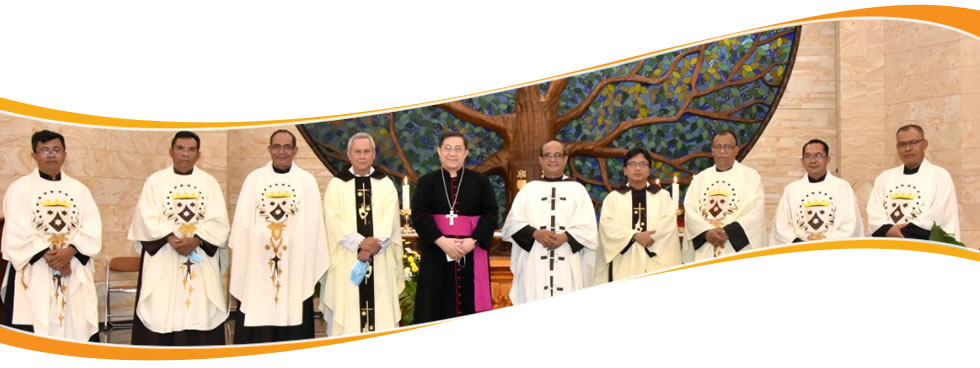
The Elective Chapter of the Carmelite Monastery of Antequera, Spain, was held 29 October 2009. The following were elected:
- Prioress: Sr. Liliana M. Campos Rosa, O. Carm.
- 1st Councilor: Sr. Juliana Kavithe Mwololo, O. Carm.
- 2nd Councilor: Sr. Teresa Ngusye Mbuvi, O. Carm.
- Treasurer: Sr. Angelina Ngina Muli, O. Carm.
- Sacristan: Sr. Juliana Kavithe Mwololo, O. Carm.
The Institutum Carmelitanum and the community of St. Albert’s International Centre (CISA) are holding a series of evening lectures under the title, “Carmelites and the Second Vatican Council”, at CISA each month until this coming May. The idea is to let people know about the importance of the Vatican Council for the life and work of the Order.
The first lecture, on the 13th of December, was given by Fr. Claudemir Rozin, O.Carm. (Par) on the theme, “A Church of Communion. The Ecclesiology of the Carmelite Rule in the Light of Vatican II”. The second was given on the 10th of January by the Prior of CISA, Míceál O’Neill, O.Carm., on the theme, “The Church in the World. The Commitment of Carmelites to Justice and Peace”. In the coming months further lectures will be given by Carmelites on the universal call to holiness, on the members of the Order who took part in the Council and on the liturgy. As part of the programme a book will be launched on the life and witness, and contribution to the Vatican Council of the Carmelite bishop, Donal Lamont (1911-2003).

On the 28th of December, 2012, on the occasion of the celebration of the unification of the two German provinces, in Bamberg, Germany, the Prior General, Fr. Fernando Millán Romeral, O.Carm. received the first copy of the Monasticon Carmelitanum, edited by Edeltraud Kleuting, Third Order Carmelite (Ger), Stephan Panzer, O.Carm., (Ger) and Andreas H. Scholten, O.Carm., (Ger). The work contains 80 articles by 51 authors. It is the first scientific account of the houses and monasteries in Germany and it is offered as a reference work, in which the story of each house and monastery is given in systematic fashion: history, building, significance, sources (archives, literature, documentation) etc. regarding every location where the Carmelites lived. It deals with all the houses of the Carmelite Order in Germany from the beginning right up to the present day. The work is intended for the wider public, but also for researchers as a tool and guide for future investigation. It is divided into three main sections: I. the history of the Provinces of Upper and Lower Germany, II. the houses before the napoleonic secularisation 1802/1803 c.e., (60 articles), III. the new foundations from the 19th century onwards.
The Monasticon Carmelitanum of Germany follows Monasticon Carmelitanum of the Netherlands (Citoc-online 56/2011) as the second volume in a series of Monastica Carmelitana, and with encouragement from the Institutum Carmelitanum in Rome.
Desert Springs in the City: A Concise History of the Carmelites
Written byby Leopold Glueckert, O. Carm.
The 800 year old history of the Carmelite Order written by one of the Order's great storytellers. After many years of study, Fr. Leopold Glueckert has lectured on Carmelite history in various parts of the world and now has recorded that history in a rich and enjoyable storytelling format. The book was serialized in The Sword and is now available for purchase in paperback form.
If purchasing books, enter the Carmelite Media webstore and follow the directions for "International Orders" if ordering from outside the USA.
The book is currently being translated into Spanish.
Order from www.carmelites.info/publications
$24.95 + postage
211 pages
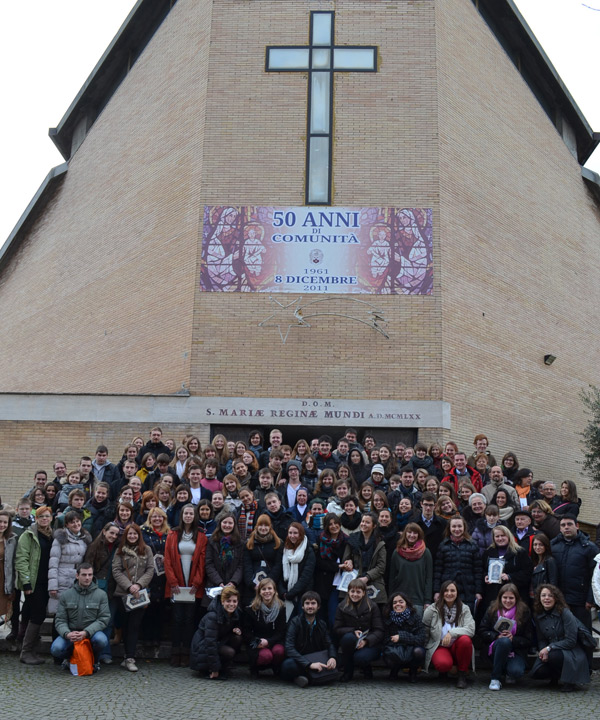
More than forty thousand young people from across Europe arrived in Rome for an experience of prayer and communion organized by the Taizé community (France) from the 28th December to the 2nd January. Our Carmelite brethren from S. Maria in Traspontina, SS. Martino and Silvestro ai Monti and S. Maria Regina Mundi were fully involved in this gathering. About four hundred young people were received into the family homes of these Carmelite parishes. Together with this hospitality, the young people and the Carmelite families participated in the organization of various moments of prayer and sharing in each of these churches as part of the event's programme. On the 1st January there was a meeting in our parish of S. Maria Regina Mundi at Torrespaccata of all the young Carmelite Italians who had participated in the event.