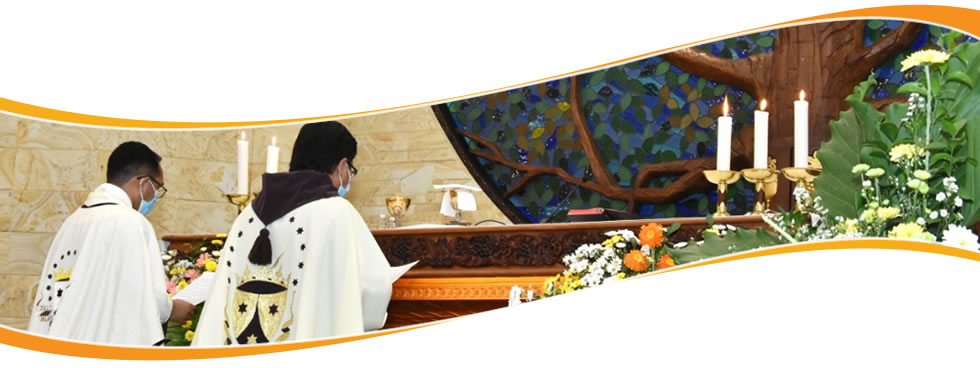
The beginning and the call of the first apostles
Mark 1:14-20
1. Opening prayer
Shaddai, God of the mountain,
who make of our fragile life
the rock of Your dwelling,
direct our minds
to strike the rock of the desert,
so that water may gush out to quench our thirst.
May our poor feelings
cover us as with a mantle in the darkness of the night
and open our hearts to hear the echo of the Silence,
so that the dawn,
which enfolds us with the light of a new day,
may lead us
to taste the holy memory,
together with the remnant ashes of the fire of the pastors of the Absolute
who on our behalf have kept watch near the divine Master.
2. Lectio
After John had been arrested, Jesus came to Galilee proclaiming the gospel of God: "This is the time of fulfillment. The kingdom of God is at hand. Repent, and believe in the gospel." As he passed by the Sea of Galilee, he saw Simon and his brother Andrew casting their nets into the sea; they were fishermen. Jesus said to them, "Come after me, and I will make you fishers of men." Then they abandoned their nets and followed him. He walked along a little farther and saw James, the son of Zebedee, and his brother John. They too were in a boat mending their nets. Then he called them. So they left their father Zebedee in the boat along with the hired men and followed him.
3. A moment of silent prayer
so that the voice of the Word may echo in our hearts.
4. Meditatio
Some questions to assist us in our meditation and prayer.
a) The time has come, the Realm is close at hand. Do we believe that we are in Galilee and that the Gospel of God is being preached to us?
b) Jesus walks along. In which sea are we casting our nets?
c) Follow Me…and immediately they followed Him. Is there urgency in our daily life, or do we go on saying, “Wait a minute”?
d) In their boat they were mending their nets. How many rips are there in our nets? In which boat are we dwelling? Is it our boat or is it that of our roots of the past?
e) He called them: our name is on the lips of our Lord Jesus. Does His voice echo as the voice of one who leads us away from our sea?
5. A key to the reading
for those who wish to go deeper into the text.
This is a literary genre of vocation stories where the condition of life of the person addressed by God is first described, then the call is expressed in symbolic words or actions, and finally comes the abandoning of the activity first described. The call in our text reminds us of the call of Elisha by Elijah (1 Kings 19:19-21) and that of Amos (Am 7:15). The dependence on a typical biblical model does not exclude the substantial historical reality of the Gospel story. The similarity of the calls underscores a clear theological meaning in Mark’s Gospel, which is the missionary practice of the disciples who will be sent in pairs (Mk 6:7). The dynamic of this is in line with the original plan of creation when the Lord, thinking of Adam, said, "It is not good that man should be alone. I will make him a helpmate" (Gen 2:18). In their preaching mission, one will witness to the other, as Scripture says, "…the evidence of two or three witnesses is required" (cf Mt 18:16; Dt 19:15).
v.14. Jesus went to Galilee. There He proclaimed the Gospel from God. Jesus’ preaching begins in Galilee and proclaims the Gospel, "the Good News" of God’s initiative towards His people, and the establishment of the Realm. The Apostles’ preaching will go from Galilee to the ends of the earth and will proclaim the Gospel, "the Good News" of the Christ Word, who has conquered death in order to make God’s glory shine.
v.15. The time is fulfilled, and the kingdom of God is close at hand. Repent, and believe the Gospel. The time of waiting (kairòs) is over. The decisive moment has come: God is about to begin His reign. John the Baptist belonged to the time of preparation and completed his mission. He was apprehended and put to silence. Jesus belongs to the time of the establishment of the reign. It is the present that demands from human beings their collaboration by repenting. The coming of the reign points to this place of freedom where whoever listens to the proclamation can come to Christ or turn from it by refusing the good news. A Realm that is close to all and present to all who desire it. Conversion, faith, and following are three aspects of the same thing, which is the call to all to follow Jesus and the Good News.
v.16. As He was walking along by the Lake of Galilee He saw Simon and Simon's brother Andrew… The Lake of Galilee is the background for the first phase of Jesus’ ministry: a lake that is surrounded by mountains, 208 meters above sea level, 21 km long and 11 km wide. This body of water, in the shape of a cither, was a source of life because of the abundance of fish in it. On the shore of this lake Jesus chooses a life different from the daily life seen on these shores made up of fishermen, boats, nets and fish. Simon and Andrew are two brothers. The solidarity of this affective bond serves as a basis for the new bond of faith that makes brothers of them beyond the ties of family. Two brothers who bear one name.
v.17. Come after Me and I will make you into fishers of people. This following is determined by a clear order. It is not an invitation; it is a command. The creative Word of God that called the light and the other creatures into being now calls His image to take part in the new creation. This act of following does not come from a mere personal decision, but from a meeting with the Person of Jesus who calls. It is an action of grace which allows these disciples to respond to His call. Jesus calls with divine authority as God called the prophets in the Old Testament. It is not the disciples who choose their master as was the custom with rabbis in those days, but the Master who chooses His disciples as repositories, not of a doctrine or teaching, but of God’s inheritance. The call means abandoning one’s family, profession, a complete change of life in order to adhere to a life that does not allow for personal space. The disciples are men of the Realm. The call to become disciples of Jesus is an "eschatological call".
v.18. At once they left their nets and followed Him. The response is immediate. A response that tears even the strongest ties. The verb used to indicate the following is akolouthèin, a biblical term to indicate the action of a servant who goes with his master to render him a service. It is a material following, a literal "going after". When it refers to the disciples, it expresses full participation in the life of Jesus and His cause.
v.19. Going on a little farther, He saw James the son of Zebedee and his brother John. He called them. The verb to call, kalein, is another term typical of following. There is an added element compared to the call of the first two: the figure of the father and of the workers. The father also has a name. The fact that he is deprived of his two sons gives him a unique dignity. He remains alone with the workers who will take the place of the sons. The solitude of those left behind is never a senseless solitude.
Reflection: John had been apprehended and Jesus walks in Galilee: two paths at the service of the one Lord. The time has come. That time that humankind cannot seize and possess is fulfilled and demands a change of direction. The time for a sea and nets to fish elsewhere. Men and women are called so that nothing of who they are may be lost. Their identity remains, what changes is only the object of their actions. No more fish, but men. No more relationship with inferior creatures, but a relationship of equality with creatures of equal dignity. New nets to be mended, the nets of a demanding kind of fishing: they are the nets of preaching that will be cast into the hearts of people during the night of pain and lack of feeling. The words "Follow Me", like a key, opens up new horizons. One does not embark on this venture alone. Bonds are not broken. The brothers become more so. They still share the bitter experience of earning a living, but now they arenot seeking for themselves but giving to others. The sea, symbol of everything that cannot be controlled, is there with the familiar and calm movement of the waters that break on the shore and say, “Go.” Jesus, a man among so many, is the God who approaches the shores of the sea, a God who walks into the life of human beings, a God who sees with human eyes, a God who speaks with new authority, saying “Follow Me.” And those men who were fishermen at once left and followed Him. They leave for another sea, the sea of firm land, the sea of villages, the sea of the temple, the sea of the streets. They leave at the call of a gaze that beckons, a gaze capable of convincing them to leave everything, not just their boats, the sea, the nets, but even their father, their history, their affections, to the very origin of their being. Friends who at night entrusted themselves to the waves of the Sea of Galilee, leave their zone of safety for far away seas. It is an old friendship that leaves not knowing for where, but with hearts bearing the warmth of a voice and a look: “Follow Me.”
6. Oratio – Psalm 86 (85)
All the nations You have made shall come
to bow before You, Lord,
and give honor to Your name.
For You are great and do wondrous deeds;
and You alone are God. Teach me, Lord, Your way
that I may walk in Your truth,
single-hearted and revering Your name.
I will praise You with all my heart,
glorify Your name forever, Lord my God.
7. Contemplatio
Lord, my expectations are fulfilled in Your temple. You, the Living One, who continue to go to the shores of human life, that like a lake in the shape of a cither silently marks the scanning of its hours, pass and see, call… I shall know You when You call me by name and I shall follow You like a wayfarer who picks up his walking stick to go to paths of friendship and of meeting, where the heart crosses into the Absolute of God, to be a living flame in the darkness of human desire, a warmth that spreads where the cold wind of evil destroys and diverts from the horizons of truth and beauty. I know that without You I shall catch nothing in the night of my solitude and delusion. My nets will rip when You tear me away from the bitter waters of my exertions and You will give me to myself, transformed with pardon, received and given with full hands. I shall then proclaim Your name to my brothers and sisters. Amen.
Come and you will see
The call of the first Disciples
John 1:35-42
1. Opening prayer
Good Shepherd, my Father, today You also come down from the eternal mountains and bring with You Your flock and lead it towards green pastures, of fresh grass, of good water. Today You send ahead of You Your dearest or favorite lamb, the Lamb whom You love with an incommensurable love; You give us Your Son Jesus, the Messiah. Behold, He is here! I beg You, help me to recognize Him, to fix my gaze on Him, my desire, my expectation. Make me follow Him, that I do not separate myself from Him, that I enter His house and remain there always. His house, oh Father, are You, yourself. I want to enter in You, I want to live. May the breath of Your Holy Spirit attract me, support me and unite me in love to You and to Your Son, my Lord, today and forever and ever. Amen.
2. Reading
a) To place this passage in its context:
This passage introduces us to the beginning of the evangelical account of John, clearly showing the succession of one day after another in of a whole week. Here we are already on the third day since John the Baptist began to give his witness of Jesus with the invitation to the disciples to follow the Lord, the Lamb of God. The ministry of Jesus begins during these days, with the Word of the Father who descends in the midst of men to meet them and to speak with them and dwell among them.
This place is Bethany, beyond the Jordan, where John baptized. Here the encounter with the Word of God takes place and the new life begins.
b) To help in the reading of the passage:
vv. 35-36: John the Baptist lives a very strong experience of encounter with Jesus, in fact it is precisely here, on the third day, that he recognizes Him fully, that he proclaims Him with his whole strength and shows Him as the true way to follow, as the life to be lived. Here John diminishes himself to the point of disappearing and grows as witness to the light.
vv. 37-39: Having accepted the witness of their master, the disciples of John begin to follow Jesus. After having listened to His voice, they meet the Word and allow themselves to be challenged by it. Jesus looks at them, He knows them and begins His dialogue with them. He takes them with Him, introduces them to the place of His dwelling, and makes them remain with Him. The Evangelist indicates the exact hour of this face to face encounter between Jesus and the first disciples.
vv. 40-42: Immediately, the witness flares up and spreads; Andrew cannot keep silent about what he has seen and heard, what he has experienced and lived, and immediately becomes a missionary, calling his brother Peter to come to encounter Jesus. He, fixing His look on that man, calls him and transforms his life: he was Simon, now he becomes Peter.
c) Text:
John was standing with two of his disciples, and as he watched Jesus walk by, he said, "Behold, the Lamb of God." The two disciples heard what he said and followed Jesus. Jesus turned and saw them following him and said to them, "What are you looking for?" They said to him, "Rabbi" — which translated means Teacher —, "where are you staying?" He said to them, "Come, and you will see." So they went and saw where Jesus was staying, and they stayed with him that day. It was about four in the afternoon. Andrew, the brother of Simon Peter, was one of the two who heard John and followed Jesus. He first found his own brother Simon and told him, "We have found the Messiah" — which is translated Christ —. Then he brought him to Jesus. Jesus looked at him and said, "You are Simon the son of John; you will be called Cephas" — which is translated Peter.
3. A moment of prayerful silence
I remain in silence and allow that these simple, but powerful words, envelope me, take possession of my life. I allow Jesus, who is coming, to fix His look on me, I allow Him to ask me, like He asked them: “What are you looking for?” and I allow Him to take me with Him, to His house. Because, yes, I want to dwell near Him...
4. Some questions
Now, I try to listen more attentively to this passage, by taking every word, every verb, being attentive to the movements, and to the looks. I really try to encounter the Lord in this page, allowing myself to be searched and known by Him.
a) “The next day John stood there again”.
In these words I feel the insistence of the search. I feel the faith of John the Baptist which grows. The days are going by. The experience of the encounter with Jesus is intensified. John does not give up, does not get tired, but rather, he always becomes more sure, more convinced, and enlightened. I place myself in contrast to John the Baptist: Am I one who is there, who remains, or rather, do I withdraw, get tired, or become weak and allow my faith to die out? Do I stand there, or do I sit down, do I wait or I do not wait anymore?
b) “Fixing his look on Jesus”.
Here is a beautiful verb which signifies “to look intensely”, to penetrate with the look” and this is repeated in verse 42, referring to Jesus, who looks at Peter to change his life. Many times in the Gospels it is said that Jesus fixes His look on His disciples (Mt 19:26), or on a particular person (Mk 10:21). He fixes His look to love, to call, to enlighten. His look never leaves us. I know that I can find peace by exchanging this look. How can I pretend not to see? Why continue to turn my look from here to there, fleeing from the Lord’s love which has been given to me and has chosen me?
c) “They followed Jesus”
This expression referred to the disciples. It does not only mean that they began to walk in the same direction with Christ, but much more: that they consecrated themselves to Him, that they committed their life with Him and for Him. He is the one who takes the initiative. He tells me: “You, follow Me”, like with the rich young man (Mt 19:21) and with Peter (Jn 21:22). How do I respond? Do I have the courage, the love, the ardor, to tell Him: “Master, I will follow You wherever You go!” (Mt 8:19), confirming these words with the facts? Or do I also say, like the one in the Gospel: “I will follow You, but first allow me to....” (Lk 9:61)?
d) “What do you search?”
The Lord Jesus pronounces the first words in John’s Gospel and they are a very concrete question, addressed to the disciples who are following Him and to me personally. The Lord fixes His look on me and asks me: “What are you searching for?” It is not easy to respond to this question. I must go deep into my heart and listen to myself. What am I really searching for? My energy, my desires, my dreams, my investments, to what purpose are they aimed?
e) “They remained with Him”
The disciples remain with Jesus, they begin to live with Him, and to have the house in common with Him. Perhaps, they began to feel and experience that the Lord himself is their new house. The verb which John uses here can simply mean to dwell, to stay, but also to dwell in the intense sense of indwelling one in the other. Jesus indwells in the womb of the Father and also offers to us the possibility of indwelling in Him and in all the Trinity. Today, He offers himself here, to me, to live together this indescribable, splendid experience of love. Therefore, what do I decide? Do I also stop like the disciples and remain with Him and in Him? Or do I leave or withdraw from the love and run to seek something else?
f) “And leads them to Jesus”.
Andrew runs to call his brother Simon, because He wants to share with him the infinite gift which He has received. He announces and proclaims the Messiah, the savior, and has the strength to take his brother with him. He becomes a guide. This is a very important passage. I do not know if I am sufficiently open and enlightened to witness to Him, who reveals Himself to me so clearly. Perhaps I am afraid, I am embarrassed, I do not have the strength, I am lazy, or I am indifferent?
5. A key for the reading
a) The Lamb of God:
In v. 36 John announces Jesus as the Lamb of God, repeating the cry which he had already given the day before: “Behold the Lamb of God who takes away the sin of the world”.
The identification of Jesus with the Lamb is overflowing with Biblical references, both from the Old and the New Testament.
The Lamb already is mentioned in the Book of Genesis, in chapter 22, at the moment of the sacrifice of Isaac; God provides a lamb, to be offered as holocaust instead of the son. The lamb descends from heaven and takes upon himself the death of man; the lamb is sacrificed so that the son may live.
In the Book of Exodus, in chapter 12, the Pascal Lamb is offered, a lamb without blemish, perfect; His blood, which will be poured, will save the sons from the exterminator, who goes from house to house, during the night. From that moment, every son of God will remain signed and sealed by that blood of salvation. The way is opened to freedom, the way of exodus, to go to God and to enter into the land promised by Him.
The element of sacrifice, of the slaughter, of the total gift, constantly accompanies the figure of the lamb. The books of Leviticus and Numbers continually place before us this holy presence of the lamb. He is offered every day in the daily holocaust. He is sacrificed in all the sacrifices of expiation, of reparation, of sanctification.
The Prophets also speak about a lamb prepared for the sacrifice: a mute sheep, sheared without opening its mouth, like a tame and meek lamb led to the slaughter (Is 53:7; Jer 11:19). The Lamb sacrificed on the altar every day.
In the Gospel, it is John the Baptist who announces and identifies Jesus as the true Lamb of God, who takes upon himself the sin of man and cancels it by the shedding of His precious and pure blood. In fact, He is the Lamb sacrificed in the place of Isaac. He is the Lamb roasted in the fire on the Pascal night. He is the perennial sacrifice to the Father, offered for us. He is the suffering servant, who does not rebel himself, does not recriminate, but surrenders himself silently out of love for us.
Saint Peter says this openly: “You have been liberated from the futile way of your life thanks to the precious blood of Christ, like the lamb, without blemish and spotless”. (I Pt 1:19).
The Apocalypse reveals openly all things concerning the Lamb. He is the one who can open the seals of history, of the life of every man, of the hidden heart, of truth (Ap 7:1-12; 8:1); He is the one who obtained victory, the one sitting on the throne (Rev 5, 6). He is the king, worthy of honor, praise, glory, adoration (Rev 5:12). He is the spouse who invites us to His wedding banquet (Rev 19:7). He is the lamp (Rev 23), the temple (Rev 21-22), the place of our eternal dwelling. He is the Shepherd (Rev 7:17) whom we shall follow wherever He goes (Rev 14:4).
b) To see:
Expressions concerning seeing are repeated five times. The first one is John, who already has the eye accustomed to see at a depth and recognize the Lord who passes by. He had to render witness to the light and for this reason has the eyes enlightened from within. In fact, near the Jordan River, he sees the Spirit coming down on Jesus (Mt 3:16); he recognizes Him as the Lamb of God (Jn 1:29) and continued to fix His look (v. 36) on Him to indicate Him to His disciples. If John sees in this way, if he is capable of penetrating beyond appearances, it means that he had already been joined by the loving look of Jesus. He had been enlightened before in the same way we are. In v. 38 it is said that Jesus sees the disciples who follow Him and the Evangelist uses a very beautiful verb, which means “to fix the look on someone, to look penetratingly and intensely”. The Lord truly does this with us. He turns towards us, gets close to us, takes to heart our presence, our life, our path following Him, and looks at us, for a long time, above all, with love, intensely involving himself. His look never leaves us alone. His eyes are fixed within us. They are designed within us as Saint John of the Cross sings in his Spiritual Canticle.
And then the Lord invites us, in turn, to open the eyes, to begin to see in a true way. He says: “Come and see”. Every day He repeats this to us without getting tired of addressing this tender and strong invitation, overflowing with promises and with gifts. “They saw where He was dwelling” John points out, using a different verb which indicates seeing profoundly, which goes beyond superficiality. It enters in understanding, knowledge, and in the faith of what one sees. The disciples – and we with them – saw that afternoon where Jesus dwelt. They understood and knew that His true dwelling place is not a place or a space.
Lastly, we have the same verb as in the beginning. Jesus fixes His look on Simon (v. 42) and with that light, with that encounter of eyes, of souls, He calls him by name and changes his life and makes him a new man. The eyes of the Lord are also open in this same way on us and they wash us from the ugliness of our darkness, enlightening us with love. With those eyes He is calling us, making a new creation of us. He is saying: “May there be light”, and there was light.
c) To remain – to dwell
This is another very important verb, very strong, and another precious pearl of the Gospel of John. It is repeated three times, with two different meanings: to dwell and to remain. The disciples immediately ask Jesus where He dwells, where is His house, and He invites them to go, to enter, and to remain: “They remained with Him that day” (v. 39). It is not a physical, temporary remaining. The disciples are not only guests passing by who will leave soon. No, the Lord makes space for us in His interior place, in His relationship with the Father, and there He accepts us for always. He says: “Like You Father, are in Me and I in You, may these also be in us... I in them and You in Me...” (Jn 17:21-23). He allows us to enter and He also enters. He allows us to knock and He himself knocks. He makes us dwell in Him and puts His dwelling place in us together with the Father (Jn 14:23). Our call to be disciples of Christ and to announce Him to our brothers and sisters has its origin, its foundation, its vitality, in this reality of the reciprocal dwelling of the Lord in us and we in Him. Our true and lasting happiness springs from the realization of our remaining in Him. We have seen where He dwells, we have known the place of His presence and we have decided to remain with Him, today and always.
“Remain in Me and I in You... The one who remains in Me and I in him bears much fruit... If you remain in Me and My words remain in you, ask for anything that you want and it will be given to you... Remain in My love” (Jn 15).
No, I will not go with anybody else, I will not go anywhere else but only with You, Oh Lord, my dwelling, my place of salvation! Allow Me, I pray, that I may remain here, near You, always, Amen.
6. A moment of prayer: Psalm 34
Refrain: Your face, Lord, I seek, do not hide Your face from me.
I seek Yahweh and He answers me,
frees me from all my fears.
Fix your gaze on Yahweh and your face will grow bright,
you will never hang your head in shame.
A pauper calls out and Yahweh hears,
saves him from all his troubles.
The angel of Yahweh encamps around those who fear Him,
and rescues them.
Taste and see that Yahweh is good.
How blessed are those who take refuge in Him.
Fear Yahweh, you his holy ones;
those who fear Him lack for nothing.
Young lions may go needy and hungry,
but those who seek Yahweh lack nothing good.
Come, my children, listen to me,
I will teach you the fear of Yahweh.
The eyes of Yahweh are on the upright,
his ear turned to their cry.
They cry in anguish and Yahweh hears,
and rescues them from all their troubles.
Yahweh is near to the broken-hearted,
he helps those whose spirit is crushed.
Though hardships without number beset the upright,
Yahweh brings rescue from them all.
7. Final Prayer
Father, I thank You for having given me the presence of Your Son Jesus in the luminous words of this Gospel; thank You for having made me listen to His voice, for having opened my eyes to recognize Him; thank You for having placed me on the way to follow Him and to enter into His house, Thank You because I can dwell with Him, in Him and because He dwells in You, You are in me. Thank You for having, once more, called me, making my life new. Make of me, I beg You, an instrument of Your love; that I may never stop announcing Christ who comes; that I may not be embarrassed, that I do not close myself, do not give up, but always become happier, to lead to Him, to You, the brothers and sisters whom You, every day, make me encounter. Amen.
Immersed in Christ, aware of the gift received,
sent into the world
Mark 1:7-11
1. Opening prayer
Holy Spirit, You who breathed on the waters of creation and guided the steps of Moses in the desert, come today upon us and immerse us in You, so that our every step and thought may be directed towards Christ as we listen to His Word.
Dwell within us, Spirit of the Father, and guide us to the truth of ourselves and to the knowledge of the Son of God who redeems us and makes us one with Him, so that the Father may be well pleased with us too. Amen.
2. The Gospel
a) A key to the reading:
Even Christ, in His human journey, had to gradually grow in the knowledge of His identity and of the task, in human history, entrusted to Him by the Father.
The baptism in the Jordan marks this growing in awareness and launches Jesus beyond the borders of His land, Galilee, into a universal mission and into a dimension where He shares the human condition, until then unimaginable for Him and for His prophets: it is God himself who "descends" to be by the side of human beings, even though aware of their weaknesses, to allow them to "climb" to the Father and give them access to communion with Him. The "pleasure" of the Father that Jesus hears in the Spirit will go with Him always on His earthly journey, making Him constantly aware of the joyful love of Him who sent Him into the world.
b) The text:
This is what John the Baptist proclaimed: "One mightier than I is coming after me. I am not worthy to stoop and loosen the thongs of his sandals. I have baptized you with water; he will baptize you with the Holy Spirit." It happened in those days that Jesus came from Nazareth of Galilee and was baptized in the Jordan by John. On coming up out of the water he saw the heavens being torn open and the Spirit, like a dove, descending upon him. And a voice came from the heavens, "You are my beloved Son; with you I am well pleased."
3. A time of silence,
interior as well as exterior, to open our hearts and allow space for the Word of God to enter into us.
4. The Word given to us:
* The baptism: purification rites by means of bathing or ablutions were quite common as a daily practice among the Jews at the time of Jesus (cf Mk 7:1-4), as well as among the Essenes of Qumran.
The word baptism indicates a bath, a complete immersion in water, and comes from the verb baptizo, rarely used in the Greek Old Testament: to immerse or submerge , producing a permanent change. We find this in 2Kings 5:14: the healing of Naaman, which comes about by means of a series of baths in the Jordan at the command of Elisha. It is from this event that the positive use of the word comes in later times.
* The baptism of John: is characteristic of this practice (so much so that it becomes known by his name) (cf Mk 1:4). John works in an unnamed place along the Jordan and baptizes in the flowing water of the river, not in specified places and in waters prepared for the rite. The conversion and penance demanded by him (Mk 1:4) are more on the moral than on the ritual level (cf Lk 3:8) and the rite, which signified such an existential change (bath and confession of sins), took place only once in a lifetime. Moreover, John clearly says that his baptism is only the preparation for a more radical purifying event, directly connected with the final judgment of God: "baptism in the spirit" and "in fire" (cf Mk 1:7-8, Mt 1:2-3).
The people of Judea and Jerusalem greatly welcomed John’s preaching, so much so that large crowds went to him to be baptized (Mk 1:5) as Joseph Flavius also narrates.
* Jesus and John at the Jordan: John knows quite well that he is not the Messiah and is inferior to him, yet he is called to prepare for His now imminent coming (Mk 1:7-8). All the Gospels speak of this awareness, emphasized by the use of the verb in the past for his baptism and in the future for the baptism of the Messiah. This reflects the care that the first Christian communities took to show that Christian baptism was superior to John’s baptism, as also Jesus, the Christ, was superior to John the Baptist (cf Mt 3:14; Jn 1:26-34).
* Baptism in the Spirit: it is the eschatological baptism promised by the prophets (cf Joel 3:1-5), connected with the fire of the judgment or under the form of sprinkling (cf Ez 36:25). Jesus receives this baptism soon after and His baptism will be the source and model of the baptism of the Christians. Thus the Christian community is founded on the gift of the Holy Spirit.
* Jesus came from Nazareth: Jesus stands out among the great crowd of Jewish penitents (cf Mk1:5) because He comes from an area where only echoes of the penitential preaching of the Baptist had reached in Galilee (Mk 1:9). For Mark this is an important place: Jesus begins His activities there and is well received. After Easter, it is there that the disciples meet Him (16:7) and understand Him fully and it is from there that they will leave for their mission (16:20). In the light of what Mark says immediately after the voice from heaven, Jesus is not only "stronger" than John, but has a nature far superior to that of John. And yet He went down among those who admitted being sinners, without being afraid of suffering any diminution of His dignity (cf Phil 2:6-7). He is "the light that shines in the darkness" (cf Jn 1:5).
The second Gospel does not report the reasons for which Jesus goes to receive the baptism of penance, even though the event is one of the most historically reliable among those narrated in the Gospels. What primarily interests the Evangelist is the divine revelation that comes after the baptism of Jesus.
* He saw the heavens torn apart: this is not a kind of special revelation for Jesus alone. The heavens, literally, "rip themselves open", in answer to Isaiah’s invocation: "If you would tear the heavens open and come down" (Is 63:19b). Thus, after a time of separation, a completely new phase begins in the communication between God and humankind. This new relationship is confirmed and becomes definitive with the redemptive death of Jesus, when the veil of the Temple was "torn" (cf Mk 15:38) as though a hand from heaven had struck it. The Easter of the death and resurrection is the "baptism wished for" by Jesus (cf Lk 12:50).
* The Spirit descending on Him: Jesus "ascends" from the water of the river and immediately after, the heavens open and the Spirit "descends" and rests on Him. From now on the period of waiting for the Spirit is over and the direct way that unites God with humankind is opened. Mark shows that Jesus is the only possessor of the Spirit who consecrates Him Messiah, makes Him fully aware of being God-Son, and dwells in Him and sustains Him in the mission willed by the Father.
According to Mark, the Spirit comes to Jesus like a dove. We meet the dove in the story of Noah and the dove is also connected to the waters and the work of God in the world (cf Gen 8:8-12). Elsewhere, the dove is used as a reminder of fidelity and permanence, and for its faithfulness in returning to the place from which it departed (cf Ct 2:14; Jn 1:33-34). The Spirit rests permanently on Jesus and takes possession of Him. In this passage we could also see a reference to the "breathing of the spirit of God over the waters" of creation (Gen 1:2). With Jesus, a "new creation" really begins (cf Mt 19:38; 2Cor 5:17; Gal 6:15).
* A voice came from heaven: with the coming of Jesus, communication between God and humankind is restored. It is not a matter of what the rabbis called "the daughter of the voice", an incomplete substitution of the prophetic word, but a matter of direct communication between Father and Son.
* Came…saw descending…was heard: we must admire the condescension of the Trinity that "stoops down" towards humankind, descends to the Jordan in Jesus to be baptized like so many sinners, descends upon Jesus in the Spirit for the sake of His self-awareness and His mission and descends in the voice of the Father to confirm His son-ship.
* You are My Son, My Beloved; My favor rests on You: Mark may have deliberately wanted to recall several passages of the Old Testament in order to emphasize, at least by allusion, the importance of the many nuances of these divine words.
First of all, we recall Isaiah 42:1 " Here is My servant whom I uphold, My chosen one in whom My soul delights. I have endowed Him with My spirit that He may bring true justice to the nations". It is JHWH whom introduces His faithful servant. Here, however, the title of "servant" is not used but that of "son", weaving the prophetic text with a psalm of royal and messianic investiture: "He has told Me, ‘You are My son, today I have become your father’" (Ps 2:7). The Evangelist (as the other synoptic) allows the nature of the human-divine identity of Jesus to appear.
* You are My Son, My Beloved: In the light of the Paschal faith, Mark could not have meant this revelation to be that God was adopting the man Jesus. The voice from heaven is a confirmation of a special relationship already in existence between Jesus and the Father. The title Son of God is attributed to Jesus in the very first verse of Mark and again at the end of the passion when the centurion says, "In truth this man was a son of God" (Mk 1:1; 15:39). However, this title recurs in various forms and frequently (cf 3:11; 5:7; 9:7; 14:61). For Mark, the title "Son of God" is especially relevant for an understanding of the person of Jesus and for a full profession of faith. It is so important that eventually it was the proper name given to Jesus by Christians by which they meant to proclaim the essential elements of their own faith in Him (cf Rom 1:4): the Messiah king, the eschatological savior, the man who had a special relationship with the divine, the one risen from the dead, the second person of the Trinity.
The fact that the voice from heaven calls Him "chosen" and "beloved" (as will be repeated at the Transfiguration in 5:7 and 12:6) emphasizes the completely unique relationship of the Father with Jesus, so special that it overshadows the other relationships between human beings and God. Jacob, like Jesus, is the "only and chosen" son (cf Gen 22:2) and he is not spared the agony of a violent death (cf Heb 5:7).
* My favor rests on You: these words emphasize once more the messianic election of Jesus, fruit of the Father’s benevolence, that thus shows His absolute preference for the Son in whom He finds joy and satisfaction (cf Is 42:1). While Jesus, obedient to the Father, begins His mission of bringing humanity back to the Father (cf Mk 1:38).
5. A few questions
to give our reflection and actions direction:
a) Like us, Jesus lives on a stage in life. He goes from the "hidden life" to His "public life". We are passing from the Christmas season to "ordinary" time. These are the times for us to realize our mission which consists in our daily commitment (often hard and usually dry) to express in our life an awareness that God the Son is with us as our brother and savior, by using the gifts received in baptism.
Am I aware of the mission entrusted to me by the Father?
Am I able to express this mission in my everyday life or do I limit myself to special occasions?
b) Our baptism made us "children of God in the Son". God is also well pleased with us and we too are His "chosen" (cf 1Jn 2, 7, 3, 2:21, etc.).
Am I aware of the love with which the Father looks at me and relates to me?
Am I able to respond to this love with the simplicity and docility of Jesus?
c) Our passage contains a manifestation of the Trinity in action. The Spirit descends upon Jesus, the Father speaks to His Son and thus opens a new way of communicating with us human beings.
How is my prayer?
To whom do I usually pray?
6. Psalm 20
Let us pray this Psalm, aware of being chosen by the Father and that the Father is by our side always with great tenderness of heart.
The Lord answer you in the day of trouble!
The name of the God of Jacob protect you!
May He send you help from the sanctuary,
and give you support from Zion!
May He remember all your offerings,
and regard with favor your burnt sacrifices!
May He grant you your heart's desire,
and fulfill all your plans!
May we shout for joy over your victory,
and in the name of our God set up our banners!
May the Lord fulfill all your petitions!
Now I know that the Lord will help His anointed;
he will answer him from His holy heaven
with mighty victories by His right hand.
Some boast of chariots, and some of horses;
but we boast of the name of the Lord our God.
They will collapse and fall;
but we shall rise and stand upright.
Give victory to the king, O Lord;
answer us when we call.
7. Closing prayer
The liturgical context is excellent for an understanding and for praying this Gospel. We, therefore, take up the preface to convey our prayer to God:
Father, in Christ’s baptism in the Jordan, You worked signs and wonders
to manifest the mystery of the new washing (our baptism).
Your voice was heard from heaven
to awaken faith in the presence among us
of the Word made man.
Your Spirit was seen as a dove resting upon Him
and consecrated Your Servant
with priestly, prophetic and royal anointing,
so that all would recognize Him as the Messiah,
sent to bring to the poor
the good news of salvation.
Grant that we may thank and glorify You
for this priceless gift,
for having sent to us Your Son, our brother and teacher.
Let Your kind gaze rest upon us
and grant that we may bring You joy in all our actions,
Forever and ever.
Accompanied by John Keating, O.Carm., Councillor General for Europe and Delegate for Formation, the Prior General, Fernando Millán Romeral, O.Carm., participated in the bi-annual assembly of the Union of Superiors General (U.S.G.), which took place in Rome from the 23rd to 25th November on the theme “Passing on the Faith”.
The principle objective of the assembly was to prepare a possible contribution from the Consecrated Life to the forthcoming Synod of Bishops which will take place in October of 2012 on the theme “The New Evangelization for the passing on the Christian faith”. In this regard, with the evangelical experience of the Consecrated Life, various suggestions that might contribute to the theme of the Synod were studied. During the assembly the Superiors General of the Mendicant Orders met to consider the theme from their perspective. Next May the Mendicant Generals will meet again to further study the theme with the help of some experts.
Key: S=Solemnity, F=Feast, M=Memorial, m=Optional Memorial, C=Commemoration, x=Not observed
| Date | Feast | O.Carm | O.C.D | ||
January | |||||
| 03 January | m | m | |||
| 08 January | F | m | |||
| 09 January | F | m | |||
| 20 January | M | m | |||
| 27 January | m | m | |||
| 29 January | m | x | |||
February | |||||
| 01 February | m | m | |||
| 19 March | F | F | |||
March | |||||
| 20 March | m | m | |||
| 01 April | M | m | |||
| 17 April | M | m | |||
| 18 April | x | x | |||
| 23 April | x | m | |||
| 05 May | m | m | |||
| 08 May | m | m | |||
| 09 May | M | x | |||
| 16 May | M | m | |||
| 22 May | m | m | |||
| 25 May | F | M | |||
| 29 May | x | x | |||
| 07 June | m | M | |||
| 12 June | m | x | |||
| 12 June | x | m | |||
| 14 June | M | x | |||
| 14 June | x | m | |||
| 04 July | m | x | |||
| 09 July | m | x | |||
| 13 July | m | m | |||
| 13 July | x | x | |||
| 16 July | S | S | |||
| 17 July | m | m | |||
| 20 July | S | F | |||
| 23 July | x | M | |||
| 24 July | M | x | |||
| 24 July | x | x | |||
| 24 July | x | m | |||
| 26 July | M | M | |||
| 27 July | M | m | |||
| 28 July | x | m | |||
| 07 August | F | M | |||
| 09 August | m | M | |||
| 12 August | m | m | |||
| 16 August | x | m | |||
| 17 August | m | x | |||
| 18 August | x | m | |||
| 25 August | m | m | |||
| 26 August | m | m | |||
| 01 September | m | M | |||
| 12 September | m | M | |||
| 17 September | F | F | |||
| 01 October | F | F | |||
| 15 October | F | S | |||
| 30 October | x | x | |||
| 05 November | m | x | |||
| 06 November | x | m | |||
| 06 November | x | m | |||
| 08 November | m | M | |||
| 13 November | x | x | |||
| 14 November | F | F | |||
| 15 November | C | C | |||
| 19 November | m | M | |||
| 29 November | m | M | |||
| 05 December | m | x | |||
| 11 December | x | m | |||
| 14 December | F | S | |||
| 16 December | x | x |
The Commission charged with the oversight of the Domus Carmelitana met in Rome on 4 November. Members of the Order present were Kevin Alban (Bursar General), James Des Lauriers (Aus), Giovanni Grosso (Curia) and Míceál O’Neill (CISA).
Reports were received from the architect and engineer who are directing the works in the Domus and the commission also conducted a detailed site inspection. The operating results for the year so far were discussed and the commission noted that the overall occupation rate had increased to 57%, compared with 54% last year, and that there were some months in 2012 already fully booked.
for more info about Domus Carmelitana please click here.
The General Finance Commission of the Order met in the Curia on 7 and 8 November. Present were Kevin Alban (Bursar General), Michael Kissane (SEL), Antonio Monteiro (Lus.), Manuel Bonilla (Cat.), James Des Lauriers (Aus), Jeff Cull (Lay consultant), Míceál O’Neill (CISA), Mark McBride (TOR).
The main order of business was the examination of the budgets for the Curia community, the General Council, CISA and other bodies under the General for 2012. In addition, the Commission began planning for the next meeting of all the bursars from provinces, general commissariats, provincial commissariats, delegations and missions. Other topics discussed included fund raising around the world, the sale of property and the financial elements of a canonical visitation.
Liturgical years B - Starts on 27 Nov, 2011 and ends on Dec 1, 2012
The Church provides a three-year circle for Sunday readings starting with the season of Advent, four weeks before Christmas day. Each liturgical year, the Church centers on one of the synoptic Gospels (Year A – Matthew, Year B – Mark, Year C – Luke). John is read in each year in the major seasons of Christmas, Lent, and Easter. Therefore, this year, each theme of Sunday and festival's readings is based on the the Gospel of Mark.
Description | Gospel | Theme |
First Sunday of Advent Year B | Mark 13:33-37 | Stay awake because you don’t know when the time will come |
Second Sunday of Advent Year B | Mark 1:1-8 | Prepare the way for the Lord, make his paths straight - John the Baptist |
Third Sunday of Advent Year B | John 1:6-8.19-28 | Baptism with water - Baptism with the fire of Holy Spirit |
Fourth Sunday of Advent Year B | Luke 1:26-38 | The Incarnation - Hail Mary full of grace, the Lord is with Thee |
Nativity of Our Lord - Birth of Jesus | Luke 2:15-20 | The shepherds found Mary and Joseph and baby Jesus |
Mother of God – Theotokos – Mary’s Solemnity | Luke 2:16-21 | Mary treasured these things and pondered them in her heart |
Epiphany of the Lord | Matthew 2:1-12 | Three wise men saw his star and came to pay homage to the King |
Second Sunday in ordinary time B | John 1:35-42 | We have found the Messiah |
Third Sunday in ordinary time | Mark 1:14-20 | Repent and believe the Good News |
Fourth Sunday in ordinary time | Mark 1:21-28 | He taught with authority in the Synagogues |
5th Sunday in ordinary time | Mark 1:29-39 | He cured many who suffered from diseases |
6th Sunday in ordinary time | Mark 1:40-45 | Of course I want to cure you |
7th Sunday in ordinary time | Mark 2:1-12 | Get up, pick up your mat and walk |
8th Sunday in ordinary time | Mark 2:18-22 | New wine, fresh skins |
First Sunday of Lent | Mark 1:12-15 | Jesus was tempted by Satan |
Second Sunday of Lent | Mark 9:2-10 | The transfiguration - This is my Son, my beloved. |
Third Sunday of Lent | John 2:13-25 | Destroy this temple, and in three days I will raise it up |
Fourth Sunday of Lent | John 3:14-21 | God loved the world so much |
Fifth Sunday of Lent | John 12:20-30 | Unless a wheat grain falls to the ground and dies |
Passion (Palm)Sunday | Mark 11:1-10 | Blessed is He who comes in the name of the Lord |
Easter Sunday | John 20:1-9 | He must rise from the dead |
2nd Sunday of Easter – Divine Mercy Sunday | John 20:19-31 | If you forgive the sins of any, they are forgiven them; if you retain the sins of any, they are retained |
Third Sunday of Easter | St Luke 24: 35 - 48 | Thus it is written, that the Messiah is to suffer and to rise from the dead on the third day |
Fourth Sunday of Easter | John 10: 11 - 18 | The Lord is my Shepherd |
Fifth Sunday of Easter | John 15:1-8 | I am the true vine |
Sixth Sunday of Easter | John 15:9-17 | Love one another as I have loved you |
The Ascension of the Lord | Mark 16:15-20 | Go into all the world and proclaim the good news to the whole creation |
Pentecost Sunday | John 15:26-27 16:12-15 | The Spirit of truth who comes from the Father, he will testify on my behalf |
Trinity Sunday | Matthew 28:1620 | Make disciples of all nations, baptizing them in the name of the Father and of the Son and of the Holy Spirit |
The Body and Blood of Christ | Mark 14:12-16 16:22-26 | This is my body, this is my blood |
12th Sunday in ordinary time | Mark 4:35-41 | Who can this be? Even the wind and the sea obey him. |
SS Peter and Paul, Apostles | Matthew 16: 13-19 | You are Peter; and upon this rock I will build my church, and the gates of hell shall not prevail against it |
13th Sunday in ordinary time | Mark 5:21-43 | Little girl, I tell you: get up. |
14th Sunday in ordinary time | Mark 6:1-6 | Prophets are not without honor, except in their hometown, and among their own kin, and in their own house. |
15th Sunday in ordinary time | Mark 6:7-13 | He called the twelve and began to send them out two by two, and gave them authority over the unclean spirits |
16th Sunday in ordinary time | Mark 6:30-34 | He had compassion and began to teach them many things |
17th Sunday in ordinary time | John 6:1-15 | Feeding of the five thousand |
The Transfiguration of the Lord | Matthew 17:1-9 | Transfiguration - His face shone like the sun |
18th Sunday in ordinary time | John 6:24-35 | What must we do, to do the Work of God? |
19th Sunday in ordinary time | Juan 6:41-51 | I am the bread of life |
20th Sunday in ordinary time | John 6:51-59 | Those who eat my flesh and drink my blood have eternal life, and I will raise them up on the last day |
21st Sunday in ordinary time | John 6:61-70 | You are the Christ, the Son of God |
22nd Sunday in ordinary time | Mark 7:1-8, 14-15, 21-23 | This people honour me with their lips, but their hearts are far from me |
23rd Sunday in ordinary time | Mark 7:31-37 | Then looking up to heaven, he sighed and said to him, "Ephphatha," that is, "Be opened." |
24th Sunday in ordinary time | John 3:13-17 | Triumph of the Cross - And just as Moses lifted up the serpent in the wilderness, so must the Son of Man be lifted up |
25th Sunday in ordinary time | Mark 9:29-36 | The Son of Man is to be betrayed into human hands, and they will kill him, and three days after being killed, he will rise again. |
26th Sunday in ordinary time | Mark 9:37-42, 44, 46-47 | The reality of Hell |
27th Sunday in ordinary time | Mark 10:2-16 | Divorce - Therefore what God has joined together, let no one separate |
28th Sunday in ordinary time | Mark 10:17-30 | You lack one thing; go, sell what you own, and give the money to the poor, and you will have treasure in heaven; then come, follow me. |
29th Sunday in ordinary time | Mark 10:35-45 | For the Son of man also has not come to be served, but to serve, and to give his life as redemption for many |
30th Sunday in ordinary time | Mark 10:46-52 | What do you want me to do for you? |
31st Sunday in ordinary time | Mark 15:33-39, 16:1-6 | The commemoration of all the faithful - "My God, my God, why have you forsaken me?" departed |
32nd Sunday in ordinary time | John 2:13-22 | Zeal for your house will consume me. |
33rd Sunday in ordinary time | Mark 13:24-32 | Heaven and earth shall pass away, but my word shall not pass away |
34th Sunday in ordinary time | John 8:33-37 | So if the Son makes you free, you will be free indeed |
The liturgical year begins with First Sunday of Advent, which starts four Sundays before Christmas (December 25). In this Liturgical year which begins on the 27 of November, 2011, Circle B, the Church meditates on the Gospel of Mark and uses it for most of Sunday readings (St. Mattthew for Circle A and St. Luke for Circle C). St. John, who appears several times in the Liturgy of the Word of almost all three years, is offered in a special way during the time of the Lord's Passion.
YEAR A -MEDITATING ON THE GOSPEL OF MArk*
Mark the Evangelist
Mark the Evangelist is mentioned some eight times in the New Testament. He is the cousin of Barnabas (Col. 4:10). When the Apostle Paul writes his letter to the Colossians from his prison in Rome, he mentions that Mark is there with him (Col. 4:10). He also mentions in his letter to Philemon that Mark is one of his fellow workers (Phiemon 24). Peter addressed him as "my son Mark" (1 Peter 5:13). It is very likely that Peter was the one who brought Mark to conversion and raised him up in the faith. Mark was an associate of Peter and likely wrote his gospel in Rome where Peter was based. Mark wrote it in Greek. It was likely written for Gentile readers in general, and for the Christians at Rome in particular. The gospel is usually dated between 65 and 75 AD, sometime shortly after Peter's martyrdom in Rome in 64 AD
The Gospel according to Mark
Among the four gospels, Mark's account is unique in many ways. It is the shortest account and seems to be the earliest. Both Luke and Matthew use much of Mark's text. Luke’s account contains over half of the verses in Mark’s account (some 350 verses out of a total 660 verses in Mark). Unlike Luke and Matthew who begin their accounts with the events surrounding the birth of the Messiah, Mark begins his account with Jesus' public ministry and the mission of John the Baptist. Mark leaves no doubt as to who Jesus was. In the very first sentence of his account he proclaims that Jesus is the "Christ, the Son of God" (Mark 1:1). Jesus was not simply a man among men, but one who caused great wonder, amazement, and awe upon those who encountered him. "They were astonished at his teaching" (Mk 1:22); "they were all amazed" (Mk 1:27); "they were utterly astounded" (Mk 6:51); "the disciples were amazed at his words" (Mk 10:24), etc.
Jesus in the Gospel of Mark
Mark stresses Jesus as "Teacher" and as the "Servant of God". Jesus is regularly addressed as "Teacher" by his disciples (Mk 4:38 ) and by those who seek his help (Mk 5:35). He also uses the Hebrew form of teacher, "Rabbi" (Mk 9:5). Ironically Mark gives little of Jesus' teaching compared with Luke and Matthew. Mark mainly stresses what Jesus did. He depicts Jesus' ceaseless activity and his power over sickness, disease, death, and the work of evil spirits.
Mark also displays both Jesus' divinity and his humanity. For example, Mark tells us that Jesus is "the carpenter" (Mk 6:3). Matthew softens it a bit by saying that Jesus is the "carpenter's son" (Matt. 13:55). Mark even tells us about Jesus' emotions. Jesus was moved with "compassion" (Mk 6:34); he "sighed" (Mk 7:34; 8:12); he "marveled" at the unbelief of his own townsfolk (Mk 6:6); he "looked" upon the rich young man and "loved him" (Mk 10:21). Mark also adds vivid details that the other gospel writers leave out. For example, he describes Jesus' tenderness as he took the little children "in his arms and blessed them, laying his hands upon them" (Mk 10:16). On another occasion Mark describes Jesus "asleep on a cushion" in the stern of the boat as the apostles feared for their lives when caught in the storm at sea (Mk 4:38).
Themes of Gospel of Mark on each Sunday in Liturgical Year B
THE MEANING OF THE LITURGICAL YEAR
• The Liturgical Year celebrates the Mystery of Christ
By preaching the Church “announces” “the whole mystery of Christ” (CD 12) and with the Liturgy it “celebrates it presenting the sacred memory (SC 102). In such a way it makes present today “the unfathomable treasure of Christ” (Eph 3, 8 ff; cf. 1, 18; 2, 7): his signs of salvation, with which the faithful come into contact in order to draw from it the grace of salvation. The Liturgical Year which has its “source” and its “summit” in the Paschal Mystery is articulated into five “periods of time” which have a special relationship with the diverse moments of the Mystery of Christ (SC 10; LG 11). Therefore, they follow a progressive order: Advent and Christmas; Lent and the Passover or Easter; Ordinary Time.
• Time of Advent and of Christmas
Advent is a time of preparation with a twofold characteristic: it recalls the first coming of the Son of God in humility and pre- announces the second coming in glory: it is a time of active waiting, of expectation, of desire, of prayer, of evangelization, of joy. Christmas is a time of joyful contemplation of the Mystery of the Incarnation of the Son of God and of his first manifestations, who has come for our salvation “man among men”. During this time Mary is particularly celebrated as “Mother of God”.
• Time of Lent and of Passover or Easter
Lent is a time of preparation the purpose of which is to guide to a more intense and gradual participation in the Paschal Mystery. During this time the catechumens are accompanied through the various degrees of Christian initiation, and the faithful through the living memory of Baptism and Penance. The Passover or Easter is the summit of the Liturgical Year, from which all the other parts draw their efficacy of salvation, it is the fulfilment of the redemption of humanity and of perfect glorification of God: it is the destruction of sin and of death, communication of resurrection and of life.
• Ordinary Time
During this long period of time, which has a first stage between Christmas Time and Lent, and develops more extensively from Pentecost to the following Advent, is a global celebration of the mystery of Christ, which is taken up again and deepened in many of its particular aspects.
Already, we can say that Sundays – “The Day of the Lord” – are the “Weekly Passover or Easter” and therefore, a living grafting into the central nucleus of the mystery of Christ throughout the whole year; but then the Weeks (33 and 34) develop through an intense and continued recourse to the Bible the deepening of small cycles of the mystery of Christ, offering these to the meditation of the faithful in order that this may become a stimulus to the action in the Church and in the world.
LITURGICAL COLORS
Liturgies celebrated during the different seasons of the liturgical year have distinctive music and specific readings, prayers, and rituals. All of these work together to reflect the spirit of the particular season. The colors of the vestments that the priest wears during the liturgy also help express the character of the mysteries being celebrated.
![]() | White, the color of joy and victory, is used for the seasons of Easter and Christmas. It is also used for the feasts of Our Lord, for feasts of Mary, the angels, and for saints who are not martyrs. Gold may also be used on solemn occasions.
|
![]() | Red (the color of blood) is used on days when we celebrate the passion of Jesus on Passion Sunday and Good Friday. It is also used for the birthday feasts of the apostles and evangelists and for the celebrations of martyrs. Red (the color of fire) recalls the Holy Spirit and is used on Pentecost and for the sacrament of Confirmation.
|
![]() | Green, seen everywhere in plants and trees, symbolizes life and hope and is used during Ordinary Time.
|
![]() | The colors violet or purple in Advent help us to remember that we are preparing for the coming of Christ. Lent, the season of penance and renewal, also uses the colors violet or purple.
|
![]() | Rose may be used on the Third Sunday of Advent, Gaudete Sunday, and on the Fourth Sunday of Lent, Laetare Sunday. It expresses the joy of anticipation for Christmas and Easter, respectively. |
More...
- Domenica, 27 Novembre, 2011
- Lunedì, 28 Novembre, 2011
- Martedì, 29 Novembre, 2011
- Mercoledì, 30 Novembre, 2011
- Venerdì, 2 Dicembre, 2011
- Sabato, 3 Dicembre, 2011
- Domenica, 4 Dicembre, 2011
- Lunedì, 5 Dicembre, 2011
- Martedì, 6 Dicembre, 2011
- Mercoledì, 7 Dicembre, 2011
- Giovedì, 8 Dicembre, 2011
- Venerdì, 9 Dicembre, 2011
- Sabato, 10 Dicembre, 2011
- Domenica, 11 Dicembre, 2011
- Lunedì, 12 Dicembre, 2011
- Martedì, 13 Dicembre, 2011
- Mercoledì, 14 Dicembre, 2011
- Giovedì, 15 Dicembre, 2011
- Sabato, 17 Dicembre, 2011
- Domenica, 18 Dicembre, 2011
- Lunedì, 19 Dicembre, 2011
- Martedì, 20 Dicembre, 2011
- Mercoledì, 21 Dicembre, 2011
- Giovedì, 22 Dicembre, 2011
- Venerdì, 23 Dicembre, 2011
- Sabato, 24 Dicembre, 2011
- Domenica, 25 Dicembre, 2011
- Lunedì, 26 Dicembre, 2011
- Martedì, 27 Dicembre, 2011
- Mercoledì, 28 Dicembre, 2011
- Giovedì, 29 Dicembre, 2011
- Venerdì, 30 Dicembre, 2011
- Sabato, 31 Dicembre, 2011
General Intention: Peace among All Peoples. That all peoples may grow in harmony and peace through mutual understanding and respect.
Missionary Intention: That children and young people may be messengers of the Gospel and that they may be respected and preserved from all violence and exploitation.
- Sunday, November 27, 2011
- Monday, November 28, 2011
- Tuesday, November 29, 2011
- Wednesday, November 30, 2011
- Thursday, December 1, 2011
- Friday, December 2, 2011
- Saturday, December 3, 2011
- Sunday, December 4, 2011
- Monday, December 5, 2011
- Tuesday, December 6, 2011
- Wednesday, December 7, 2011
- Thursday, December 8, 2011
- Friday, December 9, 2011
- Saturday, December 10, 2011
- Sunday, December 11, 2011
- Monday, December 12, 2011
- Tuesday, December 13, 2011
- Wednesday, December 14, 2011
- Thursday, December 15, 2011
- Friday, December 16, 2011
- Saturday, December 17, 2011
- Sunday, December 18, 2011
- Monday, December 19, 2011
- Tuesday, December 20, 2011
- Wednesday, December 21, 2011
- Thursday, December 22, 2011
- Friday, December 23, 2011
- Saturday, December 24, 2011
- Sunday, December 25, 2011
- Monday, December 26, 2011
- Tuesday, December 27, 2011
- Wednesday, December 28, 2011
- Thursday, December 29, 2011
- Friday, December 30, 2011
- Saturday, December 31, 2011