
The mission of the twelve
Mark 6:7-13
1. Opening prayer
Father, grant that we may see in Your Son the face of Your love, the Word of salvation and mercy, so that we may follow Him with generous heart and proclaim Him in word and deed to our brothers and sisters who look for the Kingdom and His justice. Pour out Your Spirit upon us that we may listen attentively and that our witness may be authentic and free, even in difficult times and in times when we do not understand. Who lives and reigns forever and ever.
2. Reading
a) The context:
After the calling ("institution" in the text) of the twelve (Mk 3:13-19), Jesus teaches and heals as part of their schooling. Now the time has come for their first public practice: as a first experience, they have to go and proclaim. Two by two, they go among the people with tasks, which in Mark seem to be rather simple: a generic proclamation to conversion and various types of warnings against evil. Jesus does not let the violent refusal of Himself in Nazareth frighten Him, a fact first recalled by Mark: Mk 6:1-6. He does not suspend His mission, because our closed minds cannot block Him.
The other two Synoptic Gospels (Mt 10:1-42; Lk 9:1-10) recount with greater precision the tasks and challenges the twelve will meet. However, in all the Gospels it is important to note that the mission comes from Jesus and only after they have learned from Him the manner and the content. The number "twelve", which is also the number of the tribes of Israel, is so often repeated in connection with the foundation of the new community, even to the glories of the Apocalypse, signifying continuity and the surpassing of the preceding saving economy. The sending "two by two" must be understood according to the Jewish mentality that accepts any witness only if it is brought by a "community" ( a minimum of two) and not by one person. “Two” also appears in other instructions from Jesus (Mt 18:19-20).
b) The text:
Jesus summoned the Twelve and began to send them out two by two and gave them authority over unclean spirits. He instructed them to take nothing for the journey but a walking stick— no food, no sack, no money in their belts. They were, however, to wear sandals but not a second tunic. He said to them, “Wherever you enter a house, stay there until you leave. Whatever place does not welcome you or listen to you, leave there and shake the dust off your feet in testimony against them.” So they went off and preached repentance. The Twelve drove out many demons, and they anointed with oil many who were sick and cured them.
3. A moment of silent prayer
to re-read the text with our heart and to recognize in the words and structure, the presence of the mystery of the living God.
4. Some questions
to see the important points in the text and begin to assimilate them
a) In Mark, why is the driving out of the unclean spirits so important?
b) What is the meaning of this insistence on poverty of means?
c) What is the content of this first proclamation?
d) Why does Jesus place poverty and courage and freedom together?
e) Why does the proclamation have to be itinerant and not stable?
f) What do the other Synoptic Gospels explain better?
5. A deepening of the reading
"He began to send them out two by two"
The mission of the disciples does not come from personal enthusiasm or from a desire for greatness. It begins when Jesus thinks that they are ready to speak, based on what they have heard and assimilated. According to Mark, until then they had seen many miracles and heard some teachings, important among the teachings being the theme of the seed that grows in several ways. They have also witnessed some arguments between Jesus and the leaders.
They were to model themselves on Jesus' practice as healer, His call to conversion, His availability to move among the people, and His itinerant preaching. They are certainly not mature yet. Under Jesus' supervision they will learn and better themselves: they will come up with the right words and the proper gestures. They will experience the enthusiasm that comes from great success, but in the end, they will have to go beyond even their focus on miracles in order to announce the death and resurrection of the Savior.
"He gave them authority over the unclean spirits"
This concerns "exousia" which Jesus practiced too: they are therefore empowered and authorized to use the same power. For Mark, it almost seems that this is the main exercise at this time; in fact, he concentrates on this aspect of Jesus as "thaumaturge" and one who drives out evil spirits.
We need to understand that "unclean spirits" meant many things: mental illnesses, forms of epilepsy, destructive spiritual forces, every form of psychological disorder, physical malfunctions, etc.
Power is exercised in walking among these sufferings, accepting the challenge to faith in God provided by these challenges, accepting to live in solidarity, accepting the dignity of each human being. We must not identify "unclean" with sexual or legal impurity. It is a matter of "purity" as God sees it, that is, love, solidarity, justice, mercy, collaboration, welcoming, etc. That is why the twelve will have to call "to conversion" from these prejudices, perverse and "unclean" forms to live as children of God.
"Nothing for their journey, except a staff…"
Their mission must be an itinerant one, not sedentary; that is, the mission must constantly stimulate the going, new encounters, detachment from results, interior and exterior freedom. Hence the recommendation, found in all the Synoptic Gospels, to practice material poverty in dress and food, in security and guarantees. It was probably also a matter of the shortness of the experience: as a first exercise, it was not supposed to last long, and so, they had to travel light, free, focused more on the importance of the proclamation than on the consolidation of results.
When this text was written, the situation of the community of disciples was a lot more developed and consolidated. Thus, the memory of these recommendations not only served to recall this first joyful and adventurous experience, but also to confront the present style of life and customs with those of the time of Jesus, now so long ago. Thus, the text aims at remembering and at a new missionary impetus, less fearful of the demands of comfort and security.
"When you leave, shake off the dust…"
The Lord's recommendations bring together two aspects, which only appear to be in contradiction. On the one hand, the disciples must be completely available to meet the people, without thinking of gain or survival. They must seek out sick people - that is, those sick for personal or social reasons, from the oppression of the law or from human evil - and free them, pour the oil of consolation on them, heal their wounds and interior hurts. But, on the other hand, they must also avoid accepting any form of hypocrisy and irresponsible do-gooders.
Besides charity and care for the suffering, they must also have the courage to unmask hypocrisy, react to closed minds and accept personal failure. Where they are not received, they must leave without regrets or weakness. Rejection or hypocrisy render proclamation and witness sterile. He asks for a clear and unequivocal break, a thing that Jesus Himself, perhaps, had not experienced much. He always tried to go back and dialogue. He suffered from the closed minds of the Pharisees and the scribes. He challenged their tenacious and insidious teachings. Yet now He imposes on His disciples the direction not to waste time on those who will not receive them. Probably, in this recommendation there is also an adaptation to the situation of the community: they must not regret the break with the Israelite community. There had been a closed attitude and a ferocious and aggressive refusal: well, Jesus had foreseen this too. There was no need to grieve. They must go to other people and they must not waste time trying to win back what could not be won back.
6. Psalm 85
Prayer for justice and peace
Show us Thy steadfast love,
O Lord, and grant us Thy salvation.
Let me hear what God the Lord will speak,
for He will speak peace to His people, to His saints,
to those who turn to Him in their hearts.
Surely His salvation is at hand for those who fear Him,
that glory may dwell in our land.
Steadfast love and faithfulness will meet;
righteousness and peace will kiss.
Faithfulness will spring up from the ground,
and righteousness will look down from the sky.
Yea, the Lord will give what is good,
and our land will yield its increase.
Righteousness will go before Him,
and make His footsteps a way.
7. Closing prayer
Lord our God, keep Your Son’s disciples from the easy ways of popularity, of cheap glory, and lead them to the ways of the poor and scourged of the earth, so that they may recognize in their faces the face of the Master and Redeemer. Give them eyes to see possible ways of peace and solidarity; ears to hear the requests for meaning and salvation of so many people who grope in the dark; enrich their hearts with generous fidelity and a sensitiveness and understanding so that they may walk along the way and be true and sincere witnesses to the glory that shines in the crucified resurrected and victorious One. Who lives and reigns gloriously with You, Father, forever and ever. Amen.
In Nazareth, where there was no faith,
Jesus could work no miracles!
Everybody’s Mission: to recreate the community
Mark 6:1-6
1. Opening prayer
Lord Jesus, send Your Spirit to help us to read the Scriptures with the same mind that you read them to the disciples on the way to Emmaus. In the light of the Word, written in the Bible, You helped them to discover the presence of God in the disturbing events of Your sentence and death. Thus, the cross that seemed to be the end of all hope became for them the source of life and of resurrection.
Create in us silence so that we may listen to Your voice in Creation and in the Scriptures, in events and in people, above all in the poor and suffering. May Your word guide us so that we, too, like the two disciples on the way to Emmaus, may experience the force of Your resurrection and witness to others that You are alive in our midst as source of fraternity, justice and peace. We ask this of You, Jesus, son of Mary, who revealed the Father to us and sent us Your Spirit. Amen.
2. Reading
a) A key to the reading:
On this 14th Sunday of Ordinary Time, the Church presents to us the rejection of Jesus on the part of the people of Nazareth. Passing through Nazareth was painful for Jesus. What was His first community is now no longer such. Something has changed. Those who first accepted Him now reject Him. As we will see later, this experience of rejection led Jesus to go ahead and to change His way of acting.
Has something changed in your relationship with your family or with your friends, since you began to participate in the community? Has participation in the community helped you to accept and to have greater trust in people, especially in the simplest and poorest people?
b) A division of the text to help in the reading:
Mark 6:1: Jesus arrives in Nazareth, His community of origin
Mark 6:2-3: The reaction of the people of Nazareth to Jesus
Mark 6:4: The way in which Jesus accepts the criticism
Mark 6:5-6: The lack of faith prevents Him from working the miracle
c) The text:
Jesus departed from there and came to his native place, accompanied by his disciples. When the sabbath came he began to teach in the synagogue, and many who heard him were astonished. They said, “Where did this man get all this? What kind of wisdom has been given him? What mighty deeds are wrought by his hands! Is he not the carpenter, the son of Mary, and the brother of James and Joses and Judas and Simon? And are not his sisters here with us?” And they took offense at him. Jesus said to them, “A prophet is not without honor except in his native place and among his own kin and in his own house.” So he was not able to perform any mighty deed there, apart from curing a few sick people by laying his hands on them. He was amazed at their lack of faith.
3. A moment of prayerful silence
that the Word of God may penetrate and enlighten our life.
4. Some questions
to help us in our personal reflection.
a) Which part of this text did you like the most and what impressed you most? Why?
b) What is the attitude of Nazareth toward Jesus? Why do they not believe in Him?
c) Because of the lack of faith of the people, Jesus cannot work many miracles in Nazareth. Why is faith so important? Would it be that Jesus cannot work miracles without the faith of people?
d) What are the elements that characterize the mission of the disciples?
e) Which point of the mission of the apostles has greatest importance for us today? Why?
5. For those who wish to go more deeply into the theme
a) Context of yesterday and of today:
i) Throughout the pages of his Gospel, Mark indicates that the presence and actions of Jesus constitute a growing source of joy for some and a reason for rejection by others. The conflict grows and the mystery of God appears which envelop the person of Jesus. With chapter 6 of the narrative we find ourselves in a curve. The people of Nazareth close themselves up before Jesus (Mk 6:1-6). And Jesus, before this closing up of the people of His community, opens Himself to the people of another community. He directs Himself toward the people of Galilee and sends His disciples on mission, teaching them how the relationship should be with people, so that it will be a true community relationship, which does not exclude, as it had happened among the people of Nazareth (Mk 6:7-13).
ii) When Mark wrote his Gospel, the Christian communities lived in a difficult situation, without horizons. Humanly speaking there was no future for them. The description of the conflict which Jesus faces in Nazareth and in sending out the disciples, which extends the mission, makes it creative. For those who believe in Jesus there can be no situation without a horizon.
b) Commentary on the text
Mark 6:1-3. Reactions of the people of Nazareth to Jesus
It is always good to go back to our own land. After a long absence, Jesus also goes back and, as usual on Saturday, He goes to a meeting of the community. Jesus was not the coordinator, but just the same, He speaks. This is a sign that the people could participate and express their opinion. But the people did not like the words pronounced by Jesus. They were scandalized. Jesus, who was known to them since He was a child, how is it that now He is so different? The people of Capernaum had accepted the teaching of Jesus (Mark 1:22), but the people of Nazareth remained scandalized and had not accepted it. What was the reason for this rejection? “Is this not the carpenter, surely, the son of Mary?” They did not accept God’s mystery present in such a common person, one like themselves! In order to be able to speak of God, He would have to be different from them!
The expression “brothers of Jesus” causes many polemics between Catholics and Protestants. Basing themselves on this and in other texts, the Protestants say that Jesus had more brothers and sisters and that Mary had more children! We Catholics say that Mary did not have other children. What are we to think about this? In the first place, the two positions, that of Catholics and that of the Protestants, take arguments from the Bible and from the ancient Tradition from their respective Churches. For this reason, it is not appropriate to discuss these questions using rational arguments, which are the fruit of our own ideas. It is a question of deep convictions which have something to do with faith and the sentiment of the people.
The argument supported by ideas alone does not bring about a conviction of faith, the roots of which are found in the heart! It only irritates and disturbs! But even if I do not agree with the opinion of another, I must always respect it. In the second place, instead of discussing the texts, all of us, Catholics and Protestants, should unite much more to fight in the defense of life, created by God, a life which is so transfigured by poverty, injustice, the lack of faith. We should remember other words of Jesus: “I have come so that they may have life and have it in abundance” (Jn 10:10). “So that all may be one, so that the world may believe it was You who sent Me” (Jn 17:21). “You must not stop him. Anyone who is not against us is for us” (Mk 9:39-40).
Mark 6:4-6b. Reactions of Jesus to the attitude of the people of Nazareth
Jesus knows very well that “the saint of the house does not work miracles.” And He asserts, “A prophet is despised only in his own country, among his own relations and in his own house!” In fact, where faith is not accepted, people can do nothing. Prejudice prevents it. Jesus, even if He wanted, can do nothing and remains surprised by their lack of faith.
c) Information on the Gospel of Mark:
This year the Liturgy presents the Gospel of Mark to us in a particular way. Because of this it is worthwhile to give some information which will help us to uncover the message which Mark wants to communicate to us.
· The design of the face of God on the wall of the Gospel of Mark
Jesus dies approximately in the year 33. When Mark writes his Gospel about the year 70, the Christian communities lived already dispersed in the Roman Empire. Some say that Mark writes for the community of Italy. Others say that he does it for those of Syria. It is difficult to know it with certainty. Nevertheless, one thing is certain. The problems were not lacking: the Roman Empire persecuted the Christians, the propaganda of the Empire infiltrated the communities, the Jews from Palestine rebelled against the Roman invasion, there were internal tensions due to diverse tendencies, doctrines and leaders…
Mark writes his Gospel to help the communities find a response to their problems and concerns. He collects various episodes and parables of Jesus and joins them together as bricks on a wall. The bricks were already ancient and known. They came from the community, where they were transmitted orally in meetings and celebrations. The design formed by the bricks was new. It came from Mark, from his experience of Jesus. He wanted the community, reading what Jesus did and said, to find a response to these questions: “Who is Jesus for us and who are we for Jesus? How can we be His disciples? How can we proclaim the Good News of God that He has revealed? How can we travel on the path that He traced?
· Three keys to understanding the division of the Gospel of Mark
1st Key: The Gospel of Mark was written to be read and listened to in community. When a book is read alone, one can always turn back, to join one thing to another, but when one is in community and a person is reading the Gospel to us, it is not possible to say, “Stop! Read that again! I did not understand well!” As we shall see, a book written to be listened to in community celebrations has a different way of dividing the theme from a book written to be read by one alone.
2nd Key: The Gospel of Mark is a narrative. A narrative is like a river. Going through the river in a boat, one is not aware of the divisions in the water. The river has no divisions! It is constituted by one flow alone, from the beginning to the end. In the river, the divisions, are made beginning from the bank of the river. For example it is said: “ What a beautiful part which goes from that house up to the curve where there is a palm, three curves after that.” But in the water no divisions can be seen. Mark’s narrative runs like a river. Its divisions, those who listen, find them on the margin, that is to say, in the places through which Jesus passed by, in the geography, in the persons whom He meets, along the roads He travels. These indications on the margin help those who listen to not get lost in the midst of so many words and actions of Jesus and by Jesus. The geographic framework helps the reader to walk with Jesus, step after step, from Galilee to Jerusalem, from the lake to Calvary.
3rd Key: the Gospel of Mark was written so as to be read in one sitting. This is what the Jews did with the brief books of the Old Testament. Some scholars affirm that the Gospel of Mark was written to be read completely in the course of the night of the long Paschal vigil. Or, in order to not get the people who listened tired, the reading had to be divided and to have some pauses. Besides, when a narrative is long, as that of the Gospel of Mark, its reading has to be interrupted quite often. In certain moments there is need for a pause, otherwise the listeners would be lost. These pauses were foreseen by the author of the narrative himself . These pauses were marked by short summaries, between two long readings. Practically, the same thing that happens in television. Every day, at the beginning of the news some scenes of the preceding transmission are repeated. When they end, some scenes of the next day are presented. These summaries are like the hinges which collect what has been read and open to what will follow. They allow one to stop and to begin anew, without interrupting or disturbing the sequence of the narrative. They help those who listen to place themselves in the river of the narrative which flows. In the Gospel of Mark there are diverse summaries of this type, or pauses, which allow us to discover and follow the thread of the Good News of God which Jesus has revealed to us and that Mark tells us. In the whole, there is a question of seven blocks or longer readings, intermingled with short summaries or hinges, where it is possible to make a pause.
· A division of the Gospel of Mark
Below we give a possible division of the Gospel of Mark. Others divide it in a different way. The importance of a division is that it opens one of the many windows inside the text, and that it helps us to discover the direction of the road which Jesus opened for us toward the Father and the brothers and sisters.
Mark 1:1-13 Beginning of the Good News
Prepare the announcement
1st Reading
Mark 1:14-15 pause, summary, hinge
Mark 1:16-3:16 The Good News grows
The conflict becomes present
2nd Reading
Mark 3:7-12 pause, summary, hinge
Mark 3:13-6:6 The conflict grows
The Mystery appears
3rd Reading
Mark 6:7-13 pause, summary, hinge
Mark 6:14-8:21 The Mystery grows
It is not understood
4th Reading
Mark 8:22-26 pause, summary, hinge
Mark 8:27-10:45 They continue not to understand
The dark light of the Cross appears
5th Reading
Mark 10:46-52 pause, summary, hinge
Mark 11:1-13:32 The dark light of the Cross grows
Rupture and death appear
6th Reading
Mark 13:33-37 pause, summary, hinge
Mark 14:1-15:39 Rupture and death grow
Victory over death appears
7th Reading
Mark 15:40-41 pause, summary, hinge
Mark 15:42-16:20 The victory over death increases
The Good News reappears
8th Reading
Mark 16:9-20
In this division the titles are important. They indicate the path of the Spirit, of inspiration, which the Gospel follows from the beginning until the end. When an artist has an inspiration, he tries to express it in a work of art. A poem or an image which is produced encloses in itself this inspiration. Inspiration is like an electric force which runs invisibly through the wires and lights the lamp in our houses. In the same way, inspiration runs invisibly through the letters of the poem or the form of the image to reveal in us a light similar or almost similar to that which shone in the soul of the artist. This is the reason why artistic works attract and shake people so much. The same thing happens when we read and meditate on the Gospel of Mark. The same Spirit or Inspiration which impelled Mark to write the text continues to be present in the words of his Gospel. Through our attentive and prayerful reading, this Spirit acts and begins to act in us. And thus, little by little, we discover the face of God who has revealed Himself in Jesus and which Mark communicates to us in his book.
6. Prayer of Psalm 145
Always give thanks for everything!
I shall praise You to the heights,
God my King,
I shall bless Your name for ever and ever.
Day after day I shall bless You,
I shall praise Your name for ever and ever.
Great is Yahweh and worthy of all praise,
His greatness beyond all reckoning.
Each age will praise Your deeds to the next,
proclaiming Your mighty works.
Your renown is the splendor of your glory,
I will ponder the story of Your wonders.
They will speak of Your awesome power,
and I shall recount Your greatness.
They will bring out the memory of Your great generosity,
and joyfully acclaim Your saving justice.
Yahweh is tenderness and pity,
slow to anger, full of faithful love.
Yahweh is generous to all,
His tenderness embraces all His creatures.
All Your creatures shall thank You,
Yahweh, and Your faithful shall bless You.
They shall speak of the glory of Your kingship
and tell of Your might,
making known Your mighty deeds to the children of Adam,
the glory and majesty of Your kingship.
Your kingship is a kingship for ever,
Your reign lasts from age to age.
Yahweh is trustworthy in all His words,
and upright in all His deeds.
Yahweh supports all who stumble,
lifts up those who are bowed down.
All look to You in hope
and You feed them with the food of the season.
And, with generous hand,
You satisfy the desires of every living creature.
Upright in all that He does,
Yahweh acts only in faithful love.
He is close to all who call upon Him,
all who call on Him from the heart.
He fulfills the desires of all who fear Him,
He hears their cry and He saves them.
Yahweh guards all who love Him,
but all the wicked He destroys.
My mouth shall always praise Yahweh,
let every creature bless His holy name for ever and ever.
7. Final Prayer
Lord Jesus, we thank for the word that has enabled us to understand better the will of the Father. May Your Spirit enlighten our actions and grant us the strength to practice what Your Word has revealed to us. May we, like Mary, Your mother, not only listen to but also practice the Word. You who live and reign with the Father in the unity of the Holy Spirit forever and ever. Amen.
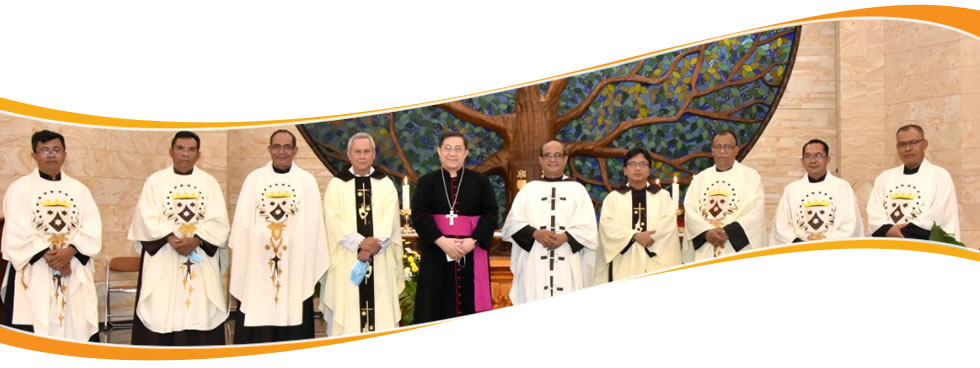
During the Provincial Chapter of the Provincial Chapter of the American Province of Saint Elias held on 5-8 June 2012 were elected:
- Prior Provincial: Fr. Mario Esposito, O.Carm.
- First Councilor: Br. Robert Chiulli, O.Carm.
- Second Councilor: Fr. Lucian Beltzner , O.Carm.
- Third Councilor: Fr. Michael Kissane, O.Carm.
- Fourth Councilor: Fr. Raymond Maher , O.Carm.
The last Provincial Chapter of the Upper German Province, before the unification with the Lower German Province, scheduled for the 1st of January, 2013, took place in Springiersbach, Germany, from the 28th of May to the 1st of June just gone by. In view of the forthcoming unification no elections were held.
Lectio Divina
General Intention: Christ, Present in the Eucharist. That believers may recognize in the Eucharist the living presence of the Risen One who accompanies them in daily life.
Missionary Intention: European Christians. That Christians in Europe may rediscover their true identity and participate with greater enthusiasm in the proclamation of the Gospel.
- Ipad/Iphone: download ebook
- Kindle: download ebook
- PDF: download PDF
- Friday, June 1, 2012
- Saturday, June 2, 2012
- Sunday, June 3, 2012
- Monday, June 4, 2012
- Tuesday, June 5, 2012
- Wednesday, June 6, 2012
- Thursday, June 7, 2012
- Friday, June 8, 2012
- Saturday, June 9, 2012
- Sunday, June 10, 2012
- Monday, June 11, 2012
- Tuesday, June 12, 2012
- Wednesday, June 13, 2012
- Thursday, June 14, 2012
- Friday, June 15, 2012
- Saturday, June 16, 2012
- Sunday, June 17, 2012
- Monday, June 18, 2012
- Tuesday, June 19, 2012
- Wednesday, June 20, 2012
- Thursday, June 21, 2012
- Friday, June 22, 2012
- Saturday, June 23, 2012
- Sunday, June 24, 2012
- Monday, June 25, 2012
- Tuesday, June 26, 2012
- Wednesday, June 27, 2012
- Thursday, June 28, 2012
- Friday, June 29, 2012
- Saturday, June 30, 2012
More...
On Thursday the 17th of May the final evening in a series of evenings under the title, The Beauty of Carmel ... paintings, music and poetry”, took place at St. Albert’s International Centre (CISA) in Rome.
The first evening was led by Fr. Emanuele Boaga, O.Carm., on the topic,”Our Lady of Mount Carmel, Iconography”. The second was led by Federico Truffi, of the London University, who presented the musical compositions of Bartolino da Padova, a Carmelite composer of the 14th century. The final evening was dedicated to, “Adolescentia” a poem by Baptist of Mantua. The presentation was given by Andrea Severi, of the University of Bologna. All three evenings were well attended, with a high degree of satisfaction. It is envisaged that there will be a continuation of these events, organised by the Institutum Carmelitanum and the community of the International Centre (CISA).
The Parables of the Kingdom of God The Kingdom is like a seed
Mark 4:26-34
1. Opening Prayer
Lord Jesus, send us Your Spirit to open the Scriptures for us in the same way that You opened them for the disciples on the road to Emmaus. With the light of the Word, written in the Bible, You helped them to discover the presence of God in the terrible events of your condemnation and crucifixion. Thus, the cross, that seemed to be the end of all hope, could be seen by them as the source of life and resurrection.
Create in us the silence that will enable us to listen to Your voice in creation and in Scripture, in the events of life and in other people, especially in the poor and the suffering. May Your Word direct us so that we, too, just like the disciples on the road to Emmaus, may experience the power of Your resurrection and be witnesses for others of the truth that You are alive and that You live in our midst, as the source of fraternity, peace and justice. We ask this of You, Jesus, Son of Mary, who have revealed the Father to us and have sent us Your Holy Spirit. Amen.
2. Reading
a) A division of the text that will help our understanding
Mk 4:26-29: The parable of the seed that springs up on its own
Mk 4:30-32: The parable of the grain of mustard
Mk 4:33-34: The conclusion regarding parables.
b) The text: Mk 4:26-34
Jesus said to the crowds: “This is how it is with the kingdom of God; it is as if a man were to scatter seed on the land and would sleep and rise night and day and through it all the seed would sprout and grow, he knows not how. Of its own accord the land yields fruit, first the blade, then the ear, then the full grain in the ear. And when the grain is ripe, he wields the sickle at once, for the harvest has come.” He said, “To what shall we compare the kingdom of God, or what parable can we use for it? It is like a mustard seed that, when it is sown in the ground, is the smallest of all the seeds on the earth. But once it is sown, it springs up and becomes the largest of plants and puts forth large branches, so that the birds of the sky can dwell in its shade.” With many such parables he spoke the word to them as they were able to understand it. Without parables he did not speak to them, but to his own disciples he explained everything in private.
3. A Moment of Prayerful Silence
- so that the Word of God may enter and enlighten our lives.
4. Questions
a) Why do both parables use growth as a theme for the kingdom of God?
b) In one parable, the result is ripe grain (food), and in the other it is shade for birds. How do these tie together?
c) What does Jesus mean by “the kingdom of God” in these parables, what would the listeners of the time mean by it, and what do we mean by it?
5. For those who want to look more deeply at the theme
a) For a better understanding
Why Jesus taught through parables: Jesus recounted many parables. All of them are taken from the life of the people. He helped people to discover the things of God in everyday life in this way, as life becomes more transparent, because the extraordinary things of God are hidden in the ordinary and common things of everyday life. The people could understand the things of life. The parables provide the key that opens that life and finds the signs of God in it.
Through the parables, Jesus helped the people to see the mysterious presence of the Kingdom in the things of life. A parable is a comparison. Jesus used the known and obvious things of life to help to explain the invisible and unknown things of the Kingdom of God. For example, the people of Galilee understood when someone talked about seeds, land, rain, sunshine, salt, flowers, fish, harvest, etc. Jesus used all these things that the people knew very well, in His parables, to help to explain the mystery of the Kingdom.
The parable of the sower is a portrait of a farmer’s life. At that time, it was hard to make a living from farming. The land was full of stones. There were many rough plants, not much rain, and a strong sun. In addition, the people, in order to take shortcuts, often walked across the land and trampled on the plants (Mk 2:23). Despite all that, every year the farmer would plant, trusting in the power of the seed and in the generosity of nature.
A parable doesn’t say everything, but induces a person to think and make discoveries, beginning with the experience the listeners have of the seed. This is not a neatly packaged doctrine that arrives all ready to be taught and embellished. The parable does not provide water in a bottle, but rather, leads people to the source. It also has depth. The deeper you penetrate it, the more you discover, and after, there is even more yet to discover and learn from it. A farmer, listening, would say, “Seed in the ground, I know what that is, but Jesus is saying that this has something to do with the kingdom of God! What could that be?” It’s not difficult to imagine the long conversations that might follow with the crowd. The parable moves with the people and gets them to listen to nature and to think about life.
b) Commentary on the text
It is wonderful to see Jesus, again and again, looking at life and at what’s happening around Him, for things and images that might help the people to detect and to experience the presence of the Kingdom. In today’s Gospel, again, He tells two short stories about things that happen every day in our lives: the story of the seed that grows all on its own, and the story of the tiny mustard that grows to be so big.
The story of the seed that grows all on its own
The farmer who plants the seed knows the process: first the seed, then the green shoot, the leaf, the ear and the grain. The farmer knows how to wait and will not cut the stalk before it is time, but he does not know from where the power comes for the soil, the rain, the sun and the seed to make a seed turn into fruit. That’s what the kingdom of God is like. It’s a process. There are stages and points of growth. It takes time and happens in time. The fruit comes at the right time but no one can explain its mysterious power. No one is its master. Only God!
The story of the tiny mustard seed that turns into something very big
The mustard seed is small, but it grows, to the point where the birds can make their nests in its branches. That’s what the Kingdom is like. It begins as something very small. Then it grows and spreads its branches. The parable does not say who the birds are. The answer to that question will come later in the Gospel. The text suggests that it refers to the pagans who will not be able to get into the community and be sharers in the Kingdom.
Jesus explained the parable to His disciples
In the house, when they were on their own with Jesus, the disciples want to know what the parable means. They do not understand it. Jesus is astonished by their failure to understand (Mk 4:13) and at that point responds in a way that is difficult and mysterious. He says to His disciples, "To you has been given the secret of the kingdom of God, but for those outside, everything comes in parables; in order that 'they may indeed look, but not perceive, and may indeed listen, but not understand; so that they may not turn again and be forgiven.'" (Mk 4:11-12) This makes the people wonder, “What use is the parable then? Is it to make things clear or to hide them?” Perhaps Jesus uses parables so that people will go on living in ignorance and not become converted? Certainly not! Today’s Gospel says that “with many such parables He spoke the word to them, as they were able to hear it” (Mk4:33).
The parable reveals and hides at the same time! It reveals, to those who have become attuned, who accept Jesus, the Servant Messiah. It hides, from those who insist on seeing Him as Messiah who is a mighty king. These see the images of the parable but they do not grasp their meaning. In a parable, the listener has to move to the frame of reference of the storyteller. Without that, the understanding cannot begin. If a story is told as concrete instruction, then there is argument and debate by those opposed. With a parable, if there is animosity towards the idea, as many had to the new ideas of Jesus, the person goes away confused or disinterested rather than angry.
6. Prayer - Psalm 96
Tell of His salvation from day to day
O sing to the Lord a new song;
sing to the Lord, all the earth.
Sing to the Lord, bless His name;
tell of His salvation from day to day.
Declare His glory among the nations,
His marvelous works among all the peoples.
For great is the Lord, and greatly to be praised;
He is to be revered above all gods.
For all the gods of the peoples are idols,
but the Lord made the heavens.
Honor and majesty are before Him;
strength and beauty are in His sanctuary.
Ascribe to the Lord, O families of the peoples,
ascribe to the Lord glory and strength.
Ascribe to the Lord the glory due His name;
bring an offering, and come into His courts.
Worship the Lord in holy splendor;
tremble before Him, all the earth.
Say among the nations, "The Lord is king!
The world is firmly established;
it shall never be moved.
He will judge the peoples with equity."
Let the heavens be glad,
and let the earth rejoice;
let the sea roar, and all that fills it;
let the field exult, and everything in it.
Then shall all the trees of the forest sing for joy
before the Lord; for He is coming,
for He is coming to judge the earth.
He will judge the world with righteousness,
and the peoples with His truth.
7. Closing Prayer
Lord Jesus, we give You thanks for Your word that has helped us to see more clearly what is the will of the Father. Let your Spirit enlighten our actions and give us the strength to be able to do what Your word has allowed us to see. Let us, like Mary your Mother, not just listen to Your Word, but also to put it into practice. You live and reign with the Father, in the unity of the Holy Spirit, forever and ever. Amen