



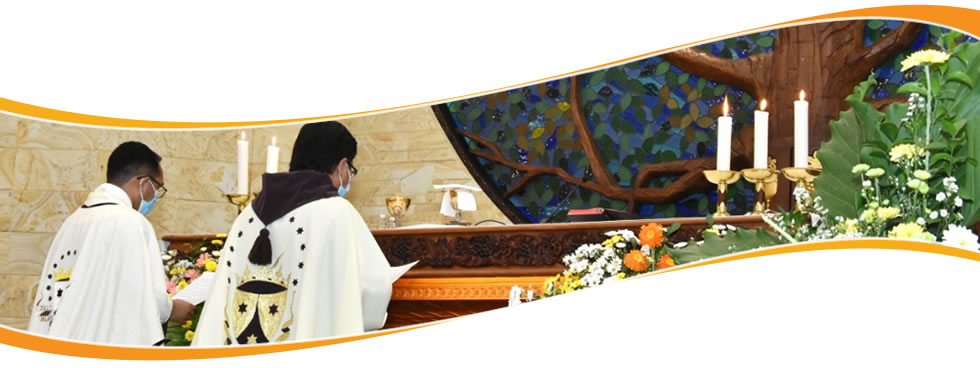


The Elective Chapter of the Carmelite Monastery of Zaragoza, Spain, was held 16 May 2014. The following were elected:
- Prioress: Sr. Elena-María Samper Samper, O.Carm.
- 1st Councilor: Sr. María de la Cinta Sosa, O.Carm.
- 2nd Councilor: Sr. Esperanza Escolano, O.Carm.
- 3rd Councilor: Sr Elena Marco, O.Carm.
- 4th Couniclor: Sr. M. Pilar Bort, O.Carm.
- Director of Novices: Sr. Ana Wairimu, O.Carm.
- Treasurer: Sr. Esperanza Escolano, O.Carm.
- Sacristan: Sr. Eva Alina, O.Carm.
On the 13th May, 2014, the Prior General, Fr. Fernando Millán Romeral, O.Carm. and the Councillor General for Europe, John Keating, O.Carm. attended the Assembly of the French Delegation which took place at Notre Dame de Lumières, Nantes. The occasion marking 25 years since the re-foundation in France afforded each member of the communities of Nantes and Angers an opportunity to reflect on this experience and to look towards the future. The three young French friars, Fr. Yves de Sainte Marie, Bros. Martin de la Croix and Elie presented the situation of Carmel in France now while the two friars who have served from beginning, Frs. Gianfranco Tuveri (Ita) and Jordi Prunera (Cat), together with the present Delegate, Fr. Klaus Schenkelberger (Ger) and Fr. Terence Cyr (PCM) contributed from their experience of many years in the French Delegation. Other celebrations have marked this 25th anniversary both in Nantes and in Angers. Bro. Martin will be ordained for priestly ministry in Nantes on the 31st May 2014.
The Prior General in closing the Assembly thanked the members for their service to the Order and acknowledged with gratitude the presence of Frs. Pascal Sawadogo (Bet/BF) and Andreas Dedy Purnawan (Indo). Many others have worked in the Delegation over the years and the General Council wishes to also acknowledge their important contribution to the restoration of the Carmelite Order in France.
Announcement at the Dutch Provincial Chapter of a new reality within the Province
The Prior General and his Council are pleased to announce that in response to a formal request made by the Dutch Province on the 14th April 2014, regarding the women associated with the Province over a period of thirty years, and with their unanimous assent of the women themselves, the Prior General and his council agreed to the erection of a sodalitium of the Third Order in the communities of Boxmeer, Zenderen, Nijmegen and Almelo. At the end of the Provincial Chapter held at Denekamp, in The Netherlands, from the 7th to 11th May 2014, Fr. Fernando Millán Romeral, O.Carm, announced that the General Council had accepted the request, thus establishing for this group a sodalitum of the Third Order in conformity with the Code of Canon Law 312:3 and the Third Order Rule, n. 56. In doing so, the group becomes formally part of the Carmelite Family.
The Elective Chapter of the Carmelite Monastery of Granada, Spain, was held 10 May 2014. The following were elected:
- Prioress: Sr. M. Lourdes Santos Álvarez, O.Carm.
- 1st Councilor: Sr. M. Dolores Montes Márquez, O.Carm.
- 2nd Councilor: Sr Cherrie Marie Vazquez Ramos, O.Carm.
- Treasurer: Sr. M. Dolores Montes Márquez, O.Carm.
- Sacristan: Sr. Cherrie Marie Vazquez Ramos, O.Carm.
During the Provincial Chapter of the Dutch Province held on 7-11 May 2014 were elected:
- Prior Provincial: Fr. Jan Brouns, O.Carm.
- First Councilor: Fr. Ben Wolbers, O.Carm.
- Second Councilor: Fr. Tjeu Timmermans, O.Carm.
- Third Councilor: Fr. Cees Bartels, O.Carm.
- Fourth Councilor: Fr. Falco Thuis, O.Carm.
During the Provincial Chapter of the British Province held on 25-28 February and 5-9 May 2014 were elected:
- Prior Provincial: Fr. Antony Lester, O.Carm.
- First Councilor: Fr. Kevin Melody, O.Carm.
- Second Councilor: Fr. Damian Cassidy, O.Carm.
- Third Councilor: Fr. Francis Kemsley, O.Carm.
- Fourth Councilor: Br. Paul Jenkins, O.Carm.
More...
From the 29th of April to the 1st of May, 2014, the first chapter of the new Province of Aragon, Castile and Valencia, took place at S. Andres de Salamanca, in Salamanca. The new province came into being by decree of the Prior General on the 15th of October, 2013. It is the result of the union of the ancient Provinces of Aragon and Valencia and the Province of Castile. The new Province of Aragon, Castile and Valencia, which has taken St. John of the Cross as its patron, now has houses in Spain, Puerto Rico, the Dominican Republic and Argentina.
The history of these provinces goes back to the year 1281, when the “Provincie of “Aragonia seu Hispania” was set up in Spain, from which gradually the other Spanish provinces emerged. The “exclaustration” and the suppression of religious order which took place in 1835 was followed by the restoration of Carmelite life in Spain, in 1890. Spanish Carmelite life continued to flourish, and in 1906 the Province of Aragon and Valencia, and the Province of Betica came into being. The Province of Aragon and Valencia experienced considerable growth throughout the 20th century to the point where it saw the establishment of two new jurisdictions in Spain, the Commissariat of Catalonia in 1932 and the Commissariat of Castile in 1948, both of which later became provinces. We commend this new development of Carmel in Spain to the care of Mary our Mother and Sister.
During the Provincial Chapter the following were elected:
- Prior Provincial: Fr. Luis Gallardo Ganuza, O.Carm.
- First Councillor: Fr. Salvador Villota Herrero, O.Carm.
- Second Councillor: Fr. Desiderio García Martínez, O.Carm.
- Third Councillor: Fr. Matías Tejerina Espeso O.Carm.
- Fourth Councillor: Fr. Vicente Aranda Guillén, O.Carm.
- Commissary Provincial of the Antilles: Fr. Jorge Rafael Betancourt Ramírez, O.Carm.
On the Road to Emmaus
Looking for the key to an understanding of the Scriptures
Luke 24:13-35
1. Opening prayer
Lord Jesus, send Your Spirit to help us to read the Scriptures with the same mind that You read them to the disciples on the way to Emmaus. In the light of the Word, written in the Bible, You helped them to discover the presence of God in the disturbing events of Your sentence and death. Thus, the cross that seemed to be the end of all hope became for them the source of life and of resurrection.
Create silence in us so that we may listen to Your voice in Creation and in the Scriptures, in events and in people, above all in the poor and suffering. May Your word guide us so that we too, like the two disciples on the way to Emmaus, may experience the force of Your resurrection and witness to others that You are alive in our midst as source of fraternity, justice and peace. We ask this of You, Jesus, son of Mary, who revealed the Father to us and sent us Your Spirit. Amen.
2. Reading
a) A key to guide the reading:
Let us read the text where Luke presents Jesus as interpreting the Scriptures. As we read, let us seek to discover the various steps taken by Jesus in the process of this interpretation, from the moment He meets the two disciples on the way to Emmaus, to the time the disciples meet with the community in Jerusalem.
b) A division of the text to assist a careful reading:
Lk 24:13-24: Jesus tries to find out what it is that is making the two disciples distressed.
Lk 24:25-27: Jesus sheds the light of Scripture on the situation of the two disciples.
Lk 24:28-32: Jesus shares the bread and celebrates with the disciples.
Lk 24:33-35: The two disciples go to Jerusalem and share their experience of the resurrection with the community.
c) The text:
13-24: Now that very same day, two of them were on their way to a village called Emmaus, seven miles from Jerusalem, and they were talking together about all that had happened. And it happened that as they were talking together and discussing it, Jesus Himself came up and walked by their side; but their eyes were prevented from recognizing Him. He said to them, 'What are all these things that you are discussing as you walk along?' They stopped, their faces downcast. Then one of them, called Cleopas, answered Him, 'You must be the only person staying in Jerusalem who does not know the things that have been happening there these last few days.' He asked, 'What things?' They answered, 'All about Jesus of Nazareth, who showed Himself a prophet powerful in action and speech before God and the whole people; and how our chief priests and our leaders handed Him over to be sentenced to death, and had Him crucified. Our own hope had been that He would be the one to set Israel free. And this is not all: two whole days have now gone by since it all happened; and some women from our group have astounded us: they went to the tomb in the early morning, and when they could not find the body, they came back to tell us they had seen a vision of angels who declared He was alive. Some of our friends went to the tomb and found everything exactly as the women had reported, but of Him they saw nothing.'
25-27: Then He said to them, 'You foolish men! So slow to believe all that the prophets have said! Was it not necessary that the Christ should suffer before entering into His glory?' Then, starting with Moses and going through all the prophets, He explained to them the passages throughout the scriptures that were about Himself.
28-32: When they drew near to the village to which they were going, He made as if to go on; but they pressed Him to stay with them saying, 'It is nearly evening, and the day is almost over.' So He went in to stay with them. Now while He was with them at table, He took the bread and said the blessing; then He broke it and handed it to them. And their eyes were opened and they recognized Him; but He had vanished from their sight. Then they said to each other, 'Did not our hearts burn within us as He talked to us on the road and explained the scriptures to us?'
33-35: They set out that instant and returned to Jerusalem. There they found the Eleven assembled together with their companions, 34 who said to them, 'The Lord has indeed risen and has appeared to Simon.' 35 Then they told their story of what had happened on the way and how they had recognized Him at the breaking of bread.
3. A moment of prayerful silence
so that the Word of God may enter into us and enlighten our life.
4. Some questions
to help us in our personal reflection.
a) What part did you like best in this text? Why?
b) What steps did Jesus take in interpreting the Scriptures from the time He met the two friends on the road up to the time the disciples went to the community in Jerusalem?
c) In what type of situation does Jesus meet the two disciples?
d) What are the similarities and the differences between our present situation and that of the two disciples? What factors create a crisis of faith in our day and are the cause of sadness?
e) What was the effect of Jesus’ reading of the Bible on the life of the two disciples?
f) Which points in the interpretation made by Jesus are a critique of our way of reading the Bible, and which are a confirmation?
5. A key to the reading
for those who wish to go deeper into the text.
a) The context in which Luke is writing:
* Luke is writing in about the year 85 for the Greek community of Asia Minor, who were living in difficult circumstances, due to factors both external and internal. Internally, there were divergent tendencies that made life together difficult: ex-Pharisees who wanted to impose the law of Moses (Acts 15:1); those who followed John the Baptist more and who had not even heard of the Holy Spirit (Acts 19:1-6); Jews who used the name of Jesus to drive out demons (Acts 19:13); and those who said they were followers of Peter, others of Paul, others of Apollo, and others of Christ (1Cor 1:12). Externally, persecution by the Roma Empire was growing (Rev 1:9-10; 2:3, 10, 13; 6:9-10; 12:16) plus the insidious infiltration of the dominant ideology of the Empire and of the official religion, much the same way communism today infiltrates all aspects of our life (Rev 2:14, 20; 13:14-16).
* Luke is writing to these communities that he may give them a sure direction in the midst of their difficulties and so that they may find the strength and light in living out their faith in Jesus. Luke writes a two volume work: the Gospel and Acts, and he has the same general aim, "to learn how well founded the teaching is that you have received" (Lk 1:4). One of his specific aims is to show, through the beautiful story of the two disciples on the way to Emmaus, how the community ought to read and interpret the Bible. In reality, those walking the streets of Emmaus were the communities (and all of us). Each of us is and all of us together are companions of Cleophas (Lk 24:18). With him we walk the streets of life, seeking a word of support and of guidance in the Word of God.
* The way Luke narrates the meeting of Jesus with the disciples on the way to Emmaus, tells us how the communities of his time used the Bible and practiced what we today call Lectio Divina or Prayerful Reading of the Bible. They used three steps in interpreting the Bible:
b) The steps or aspects used in the process of interpreting the Scriptures:
First step: Start from facts (Lk 24:13-24):
Jesus meets the two friends who are experiencing feelings of fear and dispersion, of lack of trust and dismay. They were fleeing. The force of death, the cross, had killed in them all hope. Jesus approaches them and walks with them. He listens to their conversation and says: "What matters are you discussing as you walk along?" The prevailing ideology prevents them from understanding and having a critical conscience. "Our own hope had been that he would be the one to set Israel free, but…" (Lk 24:21). What do those who suffer talk about today? What matters today put our faith in a state of crisis?
The first step is this: to approach people, listen to reality, problems; be capable of asking questions that help to look at reality more critically.
Second step: Make use of the Bible (Lk 24:25-27)
Jesus uses the Bible, not in order to give lessons on the Bible, but to shed light on the problem worrying the two friends, and thus shed light on the situation they were experiencing. With the help of the Bible, Jesus leads the two disciples into God’s plan and shows them that God has not allowed history to go astray. Jesus does not use the Bible as an expert who knows everything, but as a companion who wishes to help his friends to remember things they had forgotten, namely, Moses and the Prophets. Jesus does not give his friends the feeling of being ignorant, but seeks to create an ambient within which they can remember and thus arouse their memory.
The second step is this: with the help of the Bible, to shed light on the situation and transform the cross, symbol of death, into a symbol of life and of hope. In this manner, that which prevents us from seeing, becomes light and strength along our way.
Third step: Celebrating and sharing in community (Lk 24,28-32)
The Bible alone does not open their eyes but makes their hearts burn! (Lk 24:32). What opens the eyes of the friends and allows them to discover the presence of Jesus is the sharing of the bread, the communitarian gesture, the celebration. As soon as they recognize Jesus, He disappears. And they then experience the resurrection, they are reborn and walk on their own. Jesus does not take over His friends’ journey. He is not paternalistic. Now that they are risen, the disciples can walk on their own two feet.
The third step is this: we must know how to create a prayerful and fraternal atmosphere where the Spirit is free to act. It is the Spirit who allows us to discover and experience the Word of God in our lives and leads us to understand the meaning of Jesus’ words (Jn 14:26; 16:13). It is especially at this point of the celebration that the practice of basic ecclesial communities, sustained by the margins of the world, help us religious once more to come across and drink from the ancient well of Tradition.
Aim: To rise and go towards Jerusalem (Lk 24:33-35)
Everything has changed in the two disciples. They themselves rise, regain courage and go back to Jerusalem, where the forces of death that killed Jesus are still at work, but where also there are the forces of life in the sharing of the experience of the resurrection. Courage in place of fear. Return in place of flight. Faith in place of its absence. Hope in place of despair. A critical conscience in place of fatalism before power. Freedom in place of oppression. In a word, life in place of death! And in place of the news of the death of Jesus, the Good News of his Resurrection!
This is the aim of reading the Bible: to experience the presence of Jesus and of His Spirit in our midst. It is the Spirit who opens our eyes to the Bible and to reality and draws us to share the experience of the Resurrection, as it is true even to this day, in community meetings.
c) The new way of Jesus: a prayerful reading of the Bible:
* Often, it is not possible to understand whether the use of the OT in the Gospels comes from Jesus or an explanation given by early Christians who sought to express their faith in Jesus in this way. However, what cannot be denied is the frequent and constant use of the Bible by Jesus. A simple reading of the Gospels shows us that Jesus found His bearings in the Scriptures in the performance of His mission and in instructing His disciples and the crowd.
* At the root of Jesus’ reading of the Bible is his experience of God as Father. His intimate relationship with the Father gives Jesus a new criterion, which places Him in direct contact with the author of the Bible. Jesus looks for meaning at the very source. He does not go from the writings to their root, but from the root to the writings. The comparison of the photo, as described in the Lectio Divina of Easter Sunday, helps us to shed light on this topic. As by a miracle, the photo of the harsh face was lit up and acquired traits of great tenderness. The words, born of the lived experience of the son, transformed everything, without changing anything (see Lectio Divina for Easter Sunday).
* Thus, looking through the photos of the Old Testament, people in the time of Jesus, formed an idea of a very distant God, harsh, difficult to contact, whose name could not even be mouthed. But Jesus’ words and actions, born of His experience as Son, without changing even one word (Mt 5:18-19), transformed the whole meaning of the Old Testament. The God who seemed to be so distant and harsh acquires the features of a Father full of tenderness, always present, ready to welcome and liberate! This Good News of God, communicated by Jesus, is the new key to a re-reading of the whole of the Old Testament. The New Testament is a re-reading of the Old Testament done in the light of the new experience of God, revealed by Jesus. This different way of shedding light on life in the light of the Word of God, creates many conflicts for Him, because it renders the small of this world critical, while it makes the great uncomfortable.
* When interpreting the Bible to the people, Jesus revealed the traits of God’s face, the experience that He experienced of God as Father. To reveal God as Father was the source and aim of the Good News of Jesus. By His attitude, Jesus manifests God’s love for His disciples. He reveals the Father and incarnates His love! Jesus was able to say, "To have seen Me is to have seen the Father" (Jn 14:9). Hence, the Father’s Spirit was also with Jesus (Lk 4:18) and went with Him everywhere, from the incarnation (Lk 1:35) to the beginning of his mission (Lk 4:14), even to the end, his death and resurrection (Acts 1:8).
* Jesus, interpreter, educator and master, was a meaningful person in the life of His disciples. He influenced their lives forever. To interpret the Bible does not mean just to teach truth for the other to live by. The content that Jesus wished to convey was not limited to words, but included actions and His way of relating to people. The content is never separate from the person who communicates it. The goodness and love that emerge from His words are part of the content. They are His nature. Good content without goodness is like spilt milk.
6. Psalm 23 (22)
God is our inheritance forever
The Lord is my Shepherd;
I shall not want.
He makes me lie down in green pastures.
He leads me beside still waters;
He restores my soul.
He leads me in paths of righteousness for His name's sake.
Even though I walk through the valley of the shadow of death,
I fear no evil;
for Thou art with me;
Thy rod and Thy staff, they comfort me.
Thou preparest a table before me
in the presence of my enemies;
Thou anointest my head with oil, my cup overflows.
Surely goodness and mercy shall follow me all the days of my life;
and I shall dwell in the house of the Lord for ever.
7. Final Prayer
Lord Jesus, we thank You for the word that has enabled us to understand better the will of the Father. May Your Spirit enlighten our actions and grant us the strength to practice what Your Word has revealed to us. May we, like Mary, Your mother, not only listen to but also practice the Word. You who live and reign with the Father in the unity of the Holy Spirit forever and ever. Amen.