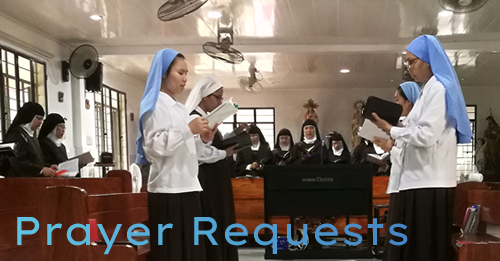




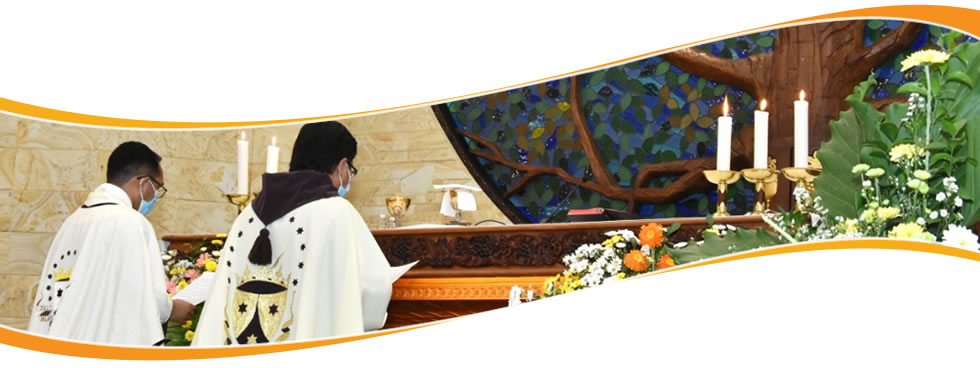


The Elective Chapter of the Carmelite Monastery of Roxas, Philippines, was held 10 November 2014. The following were elected:
- Prioress: Sr. M. Ana Abrogar, O.Carm.
- 1st Councilor: Sr. M. Catalina Elum, O.Carm.
- 2nd Councilor: Sr. M. Linda García, O.Carm.
- 3rd Councilor: Sr M. Juliana Fermano, O.Carm.
- 4th Couniclor: Sr. M. Rosalita Méndez, O.Carm.
- Director of Novices: Sr. M. Juliana Fermano, O.Carm.
- Treasurer: Sr. M. Rosalita Méndez, O.Carm.
- Sacristan: Sr. M. Elena Santamaría, O.Carm.
Carolyn Humphreys
In her brief twenty-six years, Elizabeth encapsulated the Carmelite attributes of reflective prayer, living in the present moment, loving God wholeheartedly and serving others with simplicity. She described her vision of a Carmelite as one "who has beheld the Crucified, who has seen him offering himself to the Father as a victim for souls and, meditating in the light of this great vision of Christ's charity, has understood the passion of love that filled his soul and has willed to give herself as he did." Her words were meant for each one of us. With the help of grace, we, too, can live in intimacy with God and in service to others. Elizabeth wanted everyone to be aware of the Trinitarian dwelling place — the "little heaven" within each person's soul, where our intimacy with God grows. She encourages us to quietly radiate the Trinitarian presence wherever we may be.
During childhood, Elizabeth's family moved frequently. She lived in the world most of her life and was comfortable with people of every class and circumstance. She lived simply and honestly, without concern about being the best or looking good. She treasured her friends and wrote or visited them often. Her warmth was authentic and came from her deep prayer life. There were no pious platitudes or "saintly" behaviors in her speech or demeanor. She exemplified the joy of being an authentic, beloved son or daughter of the Triune God of love.
The expression "praise of glory" was particularly dear to Elizabeth. It was the name she wanted in heaven. She found this phrase in St Paul's letter to the Ephesians and took it to heart. She glorified God by being aware of, and grateful for, his many blessings. She felt his glorified presence predominately in the center of her soul and found much peace in this presence. God's presence within her was a blessed refuge to which she escaped when she was out of sorts for one reason or another. We should do likewise when we are restless, tense, stressed or upset. At this still point, we can tell God our inmost secrets or that which bothers us. The indwelling three and the universal presence of God are the principal reasons why each Christian is a "praise of glory."
Elizabeth liked to dwell upon God finding rest in her soul. "I have found my heaven on earth," she said, "since heaven is God, and God is in my soul." She encourages us to reflect on that part of Mary's life between the annunciation and the nativity. This gives us concrete evidence in our understanding of the indwelling presence of God. Elizabeth's concept of God was eminently personal. He gently led her to an honest acceptance of herself. She loved and trusted God because she had the ability to love and trust herself and others. Her warmth and attentiveness to the joys and sufferings of people she met assisted her in experiencing the wonder of God within herself and within others. Her personal concept of God was contrary to the Jansenistic belief in God that was popular at the time. Elizabeth was neither overly concerned with the state of her soul, nor saw God as harsh and severely judgmental. When writing about God, her language was simple and affectionate. Love was experienced as a childlike, humble growing in God: "We shall not be purified by looking at our miseries, but by gazing on him who is all purity and holiness" she wrote. Her focus was quiet attention to an intimate God within her soul, rather than concentration on a distant God who is far away in heaven. She envisioned each incident and circumstance of life as a sacrament, which brought God to an individual and assisted an individual to become more aware of God's indwelling presence. "Every happening, every event, every suffering as also every joy, is a sacrament that gives God to the soul," she tells us. Without visions or miracles, in unsung daily activities, she located the pearl of great price. She found Jesus in rain or shine, pain or joy.
Even though reading the Bible personally was rare in her day, Elizabeth had an intense love for scripture. She shows us we need not be scholars to understand scripture. As she prayerfully and reflectively read the gospel, she grew in God's love. She loved scripture in a personal compassionate way, rather than in an academic theological way. She was quite intuitive about the teachings of St. Paul and saw a universality in the mysteries of Christ. Her response to God's word was manifest by a deep friendship with Jesus. She did not preach the gospel with words; she lived it with her life.
In Carmel, Elizabeth used two biblical texts as guides: "to pray . . . in secret" (Matt. 6:6) and ". . . on judgment day people will be held accountable for every unguarded word they speak . . . "(Matt. 12:36). The first quote identifies the heartbeat of Carmel: Prayer in secret. This type of prayer sustains our intimacy with God and keeps it alive and well. Our love for God is equally an ultimate encounter and an unfathomable mystery experienced primarily in prayer. "Prayer is a rest, a relaxation . . . We must look at him all the time; we must keep silent, it is so simple," Elizabeth wrote. The last words take us from the first quote to the second. Noting the popularity of talk shows, cell phones, e-mail and the commonness of rumors and gossip, we easily see its validity. Many of us find it hard to keep silent before God and with others. Yet this is necessary for spiritual growth. A good way to measure how silent we are before God is to measure how silent we are when we listen to others.
The good news Elizabeth shares with us radiates from the beauty of the kingdom of God within her and within each one of us. Experiencing this beauty liberates us from making idols of material goods and getting too involved with worldly pursuits. It repeatedly brings us back to our still point, nourishes life at a deep level, and sees humanity as the family of God. Elizabeth saw each person as a house of the triune God. At the hearth of our house of God, our faith burns like a great fire of love. Our faith brings others closer to the warmth of God's love and lightens the darkness of the world.
Elizabeth remained strong willed. Once her mind was made up, she could be unyielding. She used this trait to her advantage through loving loyalty to, and perseverance in, her Carmelite life. Her deep love helped her cope with the monotony and irritants in Carmel. She counsels us about pride. It cannot be destroyed with one bold stroke of a sword. Rather, we must die to it every day. We struggle with our egos and clash with others because of our pride. Our arrogance uses others for our own advantage. Elizabeth overcame her ego by seeing God in others. She advises us to go to his infinity and find each other there. What a lovely, thought provoking idea! We must go out of ourselves before we can plunge into the depths of God within ourselves. We become more open and receptive to his love through this often-repeated act. The deepest reality of our own being is the being of God. No words are said at this sacred place within. There is nothing save a union with the indwelling three in one.
Because Elizabeth wants to help us be aware of the intricate workings of God in our souls and in our lives, she is a true soul friend for our time. Elizabeth saw herself as a helpmate to all who wish to walk on the road of loving prayer. She teaches us to let go of what holds us back on this road. We take her hand, and with her, rest in the simple, silent presence of God as he rests in us. Because we have faithfully practiced daily prayer for a long time, we can let go of our work at prayer. Our reflective prayer is changed into silence. God has taken over. We retire to this place of quietness regularly. During this precious time we dwell in the peace of Christ. Our little haven is a refuge, an abiding place, where we find protection against the wiles of the world and ourselves. Our sacred meeting place with God surrounds us with stillness and deep silence, and here within we listen to the Word.
Elizabeth encourages us to live our Christian vocation to the full, by living every aspect of our day generously and with ardor. She challenges us to plunge deeper into our spiritual life, thus broadening our understanding of other aspects of our lives and the workings of the mysteries of God therein. She truly lived her faith by showing us it is only through faith that we can begin to grasp this paradox: God, who is transcendent, who is above and beyond anything we understand, loves us personally, and cares for the smallest details in our lives.
While in Carmel, Elizabeth penned her Act of Oblation. It shows her spiritual maturity and passion for God. She passes these words on to us: "O Eternal Word, Word of my God. I want to spend my life in listening to you, to become wholly teachable that I may learn all from you. Then, through all nights, all voids, all helplessness, I want to gaze on you always and remain in your great light . . . O my Three, my all, my Beatitude, infinite Solitude, immensity in which I lose myself, I surrender myself to you as your prey. Bury yourself in me that I may bury myself in you until I depart to contemplate in your light the abyss of your greatness."
Carolyn Humphreys, O.C.D.S., is a secular discalced Carmelite. She is the author of From Ash to Fire, an Odyssey in Prayer: A Contemporary Journey through the Interior Castle of Teresa of Avila (New City press). Her articles have appeared in Carmelite Digest and Review for Religious. Her last article in HPR appeared in July 1999. Her website is www. catholic-forum.com/members/contemplative.
On the 5th of November, Pope Francis appointed João José da Costa, O.Carm. to be the Coadjutor bishop of the Archdiocese of Aracaju (Brazil). Bishop João Costa, who up to now has been the Bishop of Iguatu, is a member of the province of Pernambuco (Brazil), where he was the Prior Provincial from 1998 to 2004. In union with the whole Carmelite Order and the Carmelite Family, we send him our congratulations and best wishes, as we unite in prayer for his ministry.
Fr. Fernando Millán, O.Carm. and Marco Blanquer
From December 2012 to December 2013 the Carmelite Youth in Spain (JUCAR) held a series of activities to mark the 25th Anniversary of its foundation. This celebration served as a point of reference for our origins, for studying our present, and for looking to the future.
Throughout the year, various activities took place that involved both former and current members of JUCAR. The activities organized to mark the 25th anniversary covered different levels. Thus, from a communal and experiential point of view, they organized a prayer service, and a prayer concert led by the music group “Karmel.” In addition, during this jubilee year, on the 16th of each month, a prayer to our Mother, the Virgin of Carmel, was offered, taking into consideration the liturgical year. On the other hand, on an audiovisual level, a traveling photo exhibition and a commemorative video were made that compiled the past and present of JUCAR. A blog was also created to serve as a channel of communication between the members of the different groups (http://25aniversariojucarbetica.blogspot.com.es). A logo, badges and t-shirts were designed to commemorate this special occasion. The 25th anniversary was marked with a closing Mass held in the monastery of Osuna, Seville, Spain on December 7, 2013.
It is important to remember that back in November or December 1987, the “post-confirmation” group of the parish and the school in Misterios laid out their future: After confirmation, what could they do? After much reflection and many inquiries, they came to be called “JUCAR” (Carmelite Youth). The name itself was not new. Apparently, there had already been Carmelite groups in Colombia and Venezuela with that name. In Italy, after the huge momentum that had led to the beatification of Father Titus Brandsma in 1985, the “Gioventù Carmelitana” was established with great drive. They were also inspired by a youth group that was then in the house of the Carmelites of Castile (in Pintor Ribera) called “Mount Carmel Group” and run by Fr. Matthias Tejerina.
The aim was the catechetical process and maturity in faith that did not end at Confirmation, but would instead follow a longer path that had a youthful air and was inspired by the charism and spirituality of Carmel. It was also intended that this group, and those who came after them, would be connected with other Carmelite youth groups throughout Spain, and even other countries. From the beginning, the JUCAR groups clearly had a Carmelite identity: in their symbols, their parties, their spirituality etc.
During the last 25 years, JUCAR gradually took shape and spread to all communities where youth ministry was present, especially in the schools and in some parishes. Currently, the movement is found in many parts of Spain. Cities such as Alicante, Antequera, Elda, Jerez, Madrid, Malaga, Murcia, Onda, Orihuela Osuna Quart de Poblet, Valladolid and Villarreal now have JUCAR youth groups. Previously, groups also existed in other cities like Seville and Zaragoza.
Today, JUCAR is a large family comprised of members of different ages, with children aged between 9 and 10 years being the youngest members. This movement has a clear catechetical spirit and an important experiential component, and its purpose is simply to serve as a means of transmission of the Word of God to today’s youth.
JUCAR not only grew in its faith formation but also in its community bonds, human development and social skills. Our movement gathers every Sunday for Mass and catechesis. Throughout the years, we organized camps and summer activities for young people in different geographic areas of Spain.
Also worth noting is the role that social justice plays in JUCAR. One of the proposed objectives of this movement is to show young people the social reality of our world and teach them not to remain indifferent to injustice. That is why each year, the various groups collaborate on projects of the Carmelite Order, either by organizing different fundraising activities or directly participating in these projects.
In the last few years, JUCAR has actively participated in the two great youth meetings held at the level of the Order: the pilgrimage of hope for European youth (Rome 2010), and the Carmelite meeting during WYD (Madrid 2011).
After 25 years, I think we can say, with great humility but also with healthy pride, that JUCAR has done a great service and has been a means for many young people to receive the Word of God and to be a little closer to Him. JUCAR has sown much and with great generosity. One does not always see the fruits of one’s labours, neither directly nor immediately. It has been, in its 25 years of existence, a good example that the Carmelite charism is still alive and is still successful, a true gift from God to the Church.
These 25 years are only a small milestone, one step in a long journey. We must look to the past to give thanks to God and to all who have made this possible, and also to look to the future with haste to get back on track. Young people do not hold back, nor do they stop.
This last 22nd to the 25th of October, in Leavenworth (Kansas, U.S.A.) a commemoration of the arrival 150 years ago of the first German Carmelites (Cyril Knoll and Xavier Huber) in North America was celebrated. This was the first step in what would lead to the establishment of the Province of the Most Pure Heart of Mary (PCM). The celebrations included a variety of events. The participants were welcomed by the Pastor of Leavenworth, Fr. David McEvoy, O.Carm. on the banks of the river Missouri, where the Prior Provincial, Fr. William Harry, O.Carm. blessed a commemorative plaque and the Mayor of the city delivered an address in which he thanked the Carmelites for the work they have done throughout these years. A carriage parade began from there, recalling the journey of the first Carmelites, and moved to the Church of the Immaculate Conception, where all were welcomed by the archbishop, Joseph F. Naumann who led the celebration of the Thanksgiving Eucharist.
On the 23rd, the participants travelled to Scipio (KS) where they were given a presentation of the history and presence of Carmel in America by the Priors General, Falco Thuis, O.Carm., (who was not able to be present on account of ill health, but sent a video recording of his address), Fr. Joseph Chalmers, O.Carm., and Fr. Fernando Millán Romeral, O.Carm., who led the solemn celebration of the Eucharist. In the small local cemetery, the participants held a very moving moment of prayer by the graves of Carmelites who have been buried there during these 150 years.
The programme included important talks by the theologian, Joseph Schmidt, FSC, on Carmelite Spirituality for the 21st century, and the well-known journalist, and CNN’s Vatican expert, John Allen, whose spoke about the challenges that Pope Frances has been presenting to the Church and to the Carmelite Order in our time. Along with all that there was a concert given by the famous choral group called the Chanticleer.
In addition to the Prior General, the celebration was attended also by the Prior Provincial and the members of the General Curia who belong to this province, (Frs. Raul Maravi and Carl Markelz), the bishop emeritus of Sicuani, (Peru) Michael LaFay, O.Carm., the Prior Provincial of the North American Province of St. Elias, Mario Esposito, O.Carm., Bro. Günter Benker and Fr. Tobias Kraus, of the German province representing the “mother province” in the absence of the Prior Provincial who was indisposed, along with numerous Carmelites from various parts, all of whom enjoyed this wonderful celebration.
foto: https://www.flickr.com/photos/carmelites/with/15459909179/
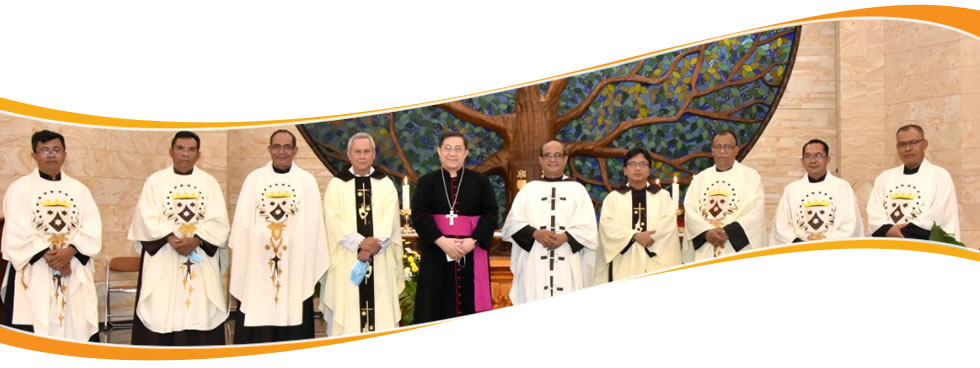
The Elective Chapter of the Carmelite Monastery of Monción, Dominican Republic, was held 23 October 2014. The following were elected:
- Prioress: Sr. M. Josefina Luna, O.Carm.
- 1st Councilor: Sr. M. Consuelo Rivera, O.Carm.
- 2nd Councilor: Sr. M. Rosanna Serrata, O.Carm.
- 3rd Councilor: Sr. Cruz M. Núñez, O.Carm.
- 4th Couniclor: Sr. M. Susana Collado, O.Carm.
- Director of Novices: Sr. M. Consuelo Rivera, O.Carm.
- Treasurer: Sr. Fátima M. Amaro, O.Carm.
The Elective Chapter of the Carmelite Monastery of La Vega, Dominican Republic, was held 22 October 2014. The following were elected:
- Prioress: Sr. Ana María Arroyo, O.Carm.
- 1st Councilor: Sr. M. Cecilia Morini, O.Carm.
- 2nd Councilor: Sr. M. de los Ángeles Márquez, O.Carm.
- 3rd Councilor: Sr. M. del Carmen Ferreira, O.Carm.
- 4th Couniclor: Sr. M. Lillian Ferreira, O.Carm.
- Director of Novices: Sr. M. Lillian Ferreira, O.Carm.
- Treasurer: Sr. M. del Carmen Ferreira, O.Carm.
More...
Fr. John Welch, O.Carm.
CARMELITE ON GOING FORMATION COURSE
The Spirituality of St. Teresa of Avila
THE CASTLE JOURNEY
Teresa’s Castle
At the age of 62, Teresa of Avila presented a summary of her life of prayer. She imaged her spiritual journey as the journey from the outside of a crystal, global castle to the center room where the King lived. Outside it was dark, cold, and noisy. The King at the center of the castle invites the soul, the individual, into a deep union. As the soul moves through the castle the dark gives way to light, the cold to warmth, and the noisy creatures become less distracting.
The journey to the center of the castle moves through seven suites of rooms, or seven mansions, or seven dwelling places. These are seven stages in the soul’s relationship with God. All the rooms on the outersurface of the castle are the first dwelling places, perhaps “a million” or so. The next layer of rooms represents the second dwelling places and so forth, until the soul reaches the center. Teresa said it is like a palmetto with its enfolding leaves.
We will ask four questions of this work:
- What is Teresa’s image for our spiritual journey?
- What is the problem we encounter on the journey?
- What is Teresa’s “solution” for overcoming the problem?
- What is the goal of the journey?
Image: from the periphery to the center
Teresa’s image pictures a journey from the periphery of our life to its center. In this image God is not “somewhere else” but God is “always already there”. St. Augustine prayed, “You were inside, but I was outside. You were with me, but I was not with you.”
One of the most difficult transitions for Christians is to move from moralism to Christian morality. Moralism holds that if I am good, I am rewarded; if I am bad, I am punished. It is the morality of a child, but then applied to God. I believe that if I am good, I earn God’s love. If I sin God then withdraws love.
Christian morality holds that I am loved before I do anything good or bad. I cannot earn God’s love. I cannot win it. I cannot barter for it. I do not have to appease God to be loved. I am loved into life and God continues to love me throughout my life. I cannot turn the love away. I may not believe it, I may turn my back on it, but God does not walk away. God is “always already there”.
Problem: we do not know ourselves
The problem, said St. Teresa, is that we “lack self-knowledge.” She said, I cannot know you, God, unless I know myself.; but, I cannot know myself unless I know You.We believe God is mediated through God’s creation. We are the first part of God’s creation we meet. Karl Rahner one time asked if we knew what God says to us in prayer. We know what we say in prayer. What does God say to us? Rahner’s answer is, we are what God says to us in prayer. In hearing the word that we are, we begin to hear more clearly the God who speaks us. However, Teresa taught, we cannot know ourselves unless we know God. Only in a relationship with God do we come to see ourselves, and the world, with clarity.
Teresa said she was “at sea” the first 18 years of her life in the Incarnation.When she was with the things of God, she wanted to be with the things of the world. When she was with the things of the world, she wanted to be with the things of God.
By the “world”, I think Teresa meant she was continuing to be involvedin the news of Avila through conversations in the parlor and other means of communication. By “things of God” she meant she was working hard to be seen as an observant religious in the convent.
One day when a statue of the beaten Christ, the “Ecce Homo”, was brought into the convent, Teresa fell to her knees and said she would not get up until she was healed. The encounter with the beaten Lord did heal her. She got up free from her ambivalence, and not long after, began to plan a reform of Carmel.
What happened?
Teresa does not say what exactly was healed, but we may guess what happened from knowing our own needs. Perhaps our deepest question is, are we loved? Are we essentially good? Do we have worth? What is our value? Teresa realized she had been asking society around her, and religious life, to validate her, to give her worth. She had been trying to be a valued member of society, as well as being seen as a very good religious. She sought her worth outside.
In encountering the beaten Christ perhaps she realized that this suffering was borne out of love for her. She did not have to ask the world around if she was loveable and of worth. She learned that she had immense worth and dignity because she was already loved by God. Her worth came from the God who was at the core of her life.
Solution: prayer and reflection
“The door to the castle is prayer and reflection,” Teresa wrote. What keeps us on the periphery of life are many preoccupations and concerns. She mentions “pastimes, business affairs, pleasures and worldly buying and selling”. In other words, rather than having one center in our life, we have many centers, each calling for her attention. The many concerns, the many centers fragments us. What frees us from our dissipated and fragmented life outside the castle, on the periphery of our life, is prayer.
In Teresa’s castle story, the call is coming from the King at the center. In prayer, it is God who speaks first, and initiates the relationship.God called us into life, and continues to call us more deeply into our lives. We, on our part, are essentially listeners for God’s call. The Rule of Carmel stresses the silence needed to hear God’s call. The Carmelite is to be an expectancy, a listener for God’s approach. All our words in prayer are an effort to say the one word, which is God’s.
In this engagement with the Mystery at the core of our lives, all other lesser loves are put into order. The many centers keeping us on the margins of our life are now oriented around the one center. Identity and validation now come from the center of our life. Other loves and interests find their proper place in our lives. The invitation from the center of the castle disengages us from the periphery and allows us to continue to journey.
The only terminal problem, in Teresa’s estimation, is to stop praying. When we stop praying, we stop listening, and when we stop listening it is very hard to hear the gentle whistle of the shepherd. One theologian summarized Teresa’s message: a faithful and perduring attentiveness to our depths and center is the best cooperation we can give to God who is reorienting our life.
Goal: union with God
The goal of the journey is union with God in love. As the soul listens more deeply and responds more generously the relationship with the Mystery at the core of our life deepens. We believe God is always calling us into a fuller humanity, a wider freedom, and a more intimate union. On this journey to the center of one’s life, the self is born as God is met. The more Teresa could say “God “ in her life, the more she could say “Teresa”.
Carmelite understanding of the journey speaks about transformation. In the Rule of Carmel the Carmelite is obliged to put on the armor of God, or rather to be available so that God can clothe the Carmelite in virtue. And the Constitutions state: “Contemplation is the inner journey of Carmelites, arising out of the free initiative of God who touches and transforms us leading us towards unity in love with him…”.
Prior General Fernando Millan,O.Carm
- Carmelite Culture, Identity and The Need for Balance
- The Identity of the Carmelite Formator
- Prayer, Spiritual Direction Silence, taking care of the interior life, the foundation for ongoing formation.
- The Role and Responsibility of The Formator in The Journey of Vocation
please click here to download
On the 14th and 15th of October last, the official opening of the 5th Centenary of the birth of St. Teresa of Jesus took place. On the 14th, in the birthplace of the saint, solemn vespers were celebrated, at which Fr. Saverio Canninstrà O.C.D. presided accompanied by the bishop of Avila, Jesus Garcia Burillo, and Fr. Fernando Millán Romeral, O.Carm. and this was followed by the Eucharist which marked the closing of the novena.
The Prior of Avila, Fr. David Jimenez, O.C.D. noted at the end of the Eucharist, that “the Saint from her place in heaven is sure to be rejoicing, because just as in 1567 she received a visit from Fr. Rubeo, today the two Carmelite generals are present.”
On the 15th, a solemn Eucharist was celebrated, led by Don Ricardo Blázquez, President of the Bishops’ Conference of Spain, along with several bishops and priests. The beautiful message sent by Pope Francis to the Bishop of Ávila was read as part of this celebration. Following the Eucharist there was a procession in which the statue of St. Teresa was carried through the streets of the city.
In addition, on the 15th of October, in the Monastery of the Incarnation in Alba de Tormes, (the eighth of Teresa’s foundations, and the place where she is buried) Fr. Desiderio Garcia, O.Carm., opened the solemn novena in honour of St. Teresa. The Carmelite community of the novitiate in San Andrés and the student community of the Discalced Carmelites of Salamanca, were given the job of carrying the statue and relics of St. Teresa in procession through the town of Alba de Tormes at the end of the solemn eucharist led by the bishop of Salamanca and attended by a large congregation of the faithful.
Pope Francis granted the grace of a “Teresian Jubilee Year”, for all the dioceses of Spain, beginning on the 15th of October 2014 and ending on the 15th of October, 2015, with a view to celebrating this 5th Centenary in the most solemn manner.
With great joy and hope we present the first electronic newsletter for the Lay Carmelites. This initiative is the result of our first meeting with the new General Commission for the Carmelite Laity and Youth of our Order. Reflection on this international group has led to the desire to strengthen two aspects during this sexennium: spiritual formation and communications.
We are sure that this newsletter will be a good way to learn more about our charism and spirituality, as well as the various projects of the laity and youth in different parts of the world. In this issue we highlight the figure of St. Albert of Jerusalem, the Latin Patriarch of the Holy Land who gave us the Carmelite Rule and whose eighth centenary of death we are celebrating this year. We appreciate your suggestions and contributions for future editions of this E-Bulletin. Any news regarding lay Carmelites and Carmelite Youth, please send to us at (This email address is being protected from spambots. You need JavaScript enabled to view it.).
Please click here to download the E-bulletin