



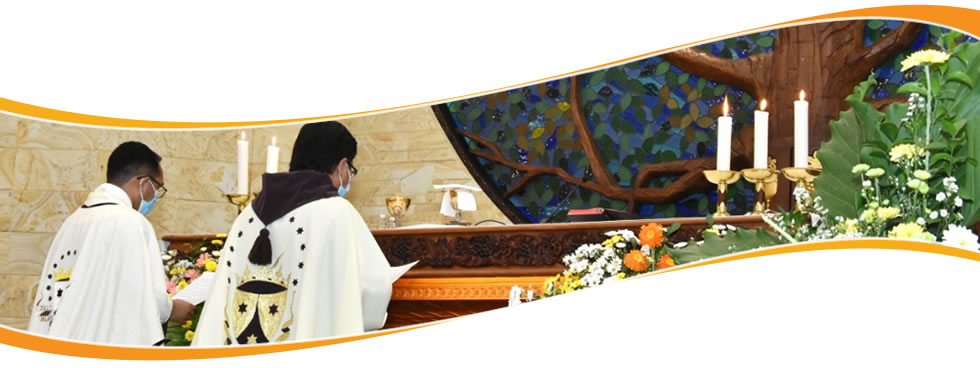


Is there a relation between Carmelite Liturgy and Carmelite Spirituality? In order to find an answer to this question, it is necessary to go back to the early days of the Order, to a time between 1206 and 1214, when Albert Avogrado, Patriarch of Jerusalem, proposed a way of life to a group of hermits. The hermits were living on Mount Carmel in Palestine, near the fountain of Elijah, and they had requested St. Albert to prepare a rule of life for them. The way of life which Albert wrote out for the hermits has inspired many people, religious and lay, male and female. Throughout the centuries and down to the present time, it has led them to an intimate contact with God. Not only was Albert Avogadro Patriarch of Jerusalem, he was also a member of the Canons Regular who lived according to the Augustinian Rule. As such, he was familiar with religious life.
From ancient times, there were two churches in Jerusalem, both erected on sacred sites: The Basilica of the Martyrs at Golgotha and the Anastasis Rotunda which was built over the tomb of Jesus, and was therefore also sometimes called the Church of the Holy Sepulchre or the Church of the Resurrection.[i] In this church the liturgical services were conducted by the Canons Regular of St. Augustine, who originated in France and had accompanied the crusaders.[ii] Their rite was originally Roman, the rite which was in use in almost all Western European regions. It is understandable that the presence of sacred sites, especially the Tomb from which Christ arose, should exert a strong influence on the liturgy of the canons. For this reason, the liturgy of the Holy Sepulchre did not celebrate the tomb of Christ as the place of burial, but as the place of resurrection. “From this tomb the Lord arose,” as we read in a liturgical manuscript used by the Canons Regular of St. Augustine in the Church of the Holy Sepulchre,[iii]
Around this tomb, a number of liturgical customs originated which later developed into a special Liturgy: the Holy Sepulchre Liturgy, and later, into the Resurrection Liturgy of the Carmelites. One of these customs was that every Saturday, in preparation for Sunday, the day of the Resurrection of the Lord, a solemn procession to the chapel of the Resurrection took place, where, on Sundays, the High Mass was solemnly celebrated in honour of the Resurrection.[iv] Throughout the entire period from Easter to Advent, the night between Saturday and Sunday was, to all intents and purposes, controlled by the commemoration of the Resurrection. Furthermore – and this was very special – on the last Sunday of the liturgical year, namely the Sunday before Advent, the Resurrection of the Lord was again solemnly celebrated as a great feast, just like Easter Sunday.
It was this liturgy that the Carmelites adopted and took along with them when they were obliged to flee from the Holy Land. In imitation of the Liturgy of the Holy Sepulchre, the early Carmelites attributed a special significance to Sunday by solemnly commemorating on that day the Resurrection of the Lord in Holy Mass and in the Liturgy of the Hours. Furthermore, during most of the ecclesiastical year, the Resurrection of the Lord was commemorated each day at the Conventual Mass and the Divine Office, and on the last Sunday of the Ecclesiastical Year the Carmelites solemnly commemorated the Resurrection of Jesus, just as in the liturgy of the Holy Sepulchre.[v] On this Sunday, all of the texts of the Liturgy of the Hours and of the Solemn Mass were taken integrally from the formularies of Easter Sunday. It was a sort of second Easter, but now celebrated at the end of the Ecclesiastical Year.
About the year 1312, this liturgy was described and reintroduced into the Order by the famous Carmelite, Sibert de Beka, by means of an Ordinal, a sort of ceremonial for the celebration of liturgical rites. Since that time and for many centuries afterwards, the Liturgy of the Holy Sepulchre, also called the Resurrection Liturgy, was the way in which the Carmelites celebrated the Liturgy of the Hours and the Eucharist. Nevertheless, down the centuries, this Liturgy underwent many adaptations. Due to many excesses, the Council of Trent, held in the sixteenth century, felt the necessity to reform drastically the Liturgy of the Holy Sepulchre. Even so, the remembrance of the Resurrection Liturgy continued in the Liturgy of the Hours of the Carmelites until the second Vatican Council in the twentieth century.
After this Council, the Carmelites abandoned their own Liturgy and adopted the Roman Liturgy. In doing so, they renounced a part of their proper spiritual patrimony, that patrimony which had inspired the Carmelites throughout the centuries and had influenced their spirituality. Nevertheless, it is gratifying to note that, in recent years, there is within the Order an increasing interest in the Resurrection Liturgy. At the Liturgical Seminar held in Rome in July 2008, Carmelite liturgists verified that, in many parts of the Order, the Resurrection Liturgy had become the common property of all members and was seen as a part of the spirituality and identity of Carmel, with special emphasis on eschatological aspects[vi]. Before analyzing this bond with the spirituality of Carmel, it is necessary to explain how the veneration of the Holy Cross developed throughout the centuries.
[i] Louis van Tongeren, Exaltatio crucis. Het feest van Kruisverheffing en de zingeving van het kruis in het Westen tijdens de vroege middeleeuwen; Een liturgisch-historische studie (Tilburg: University Press, 1995) 27.
[ii] Postquam igitur (Godefridus Bullionis) regnum obtinuit (an. 1099) paucis diebus interpositis, sicut vir religiosus erat, in his quae ad decorem domus Dei habebant respectum, solicitudinis suae coepti offerre primitias. Nam protinus in ecclesia Dominici Sepulcri et Templo Domini canonicos instituitY ordinem et institutionem servans, quas magnae et amplissimae, a piiss principibus fundatae ultra montes servant ecclesiae. So we are told, at the end of the twelfth century, in the Historia Hierosolymitana by a certain William, archbishop of Tyrium. Cf. Analecta Ordinis Carmelitarum, 1 (1909-10) 64.
[iii] ms. Barberini Lat. 659 (Rome: Biblioteca Vaticana) fol. 80.
[iv] Edmund Caruana, The Ordinal of Sibert de Beka with special reference to Marian Liturgical Themes. An historical-liturgical-theological investigation. (Rome: Anselmianum, 1976) 7-8.
[v] James Boyce, “The Liturgy of the Carmelites,” Carmelus, 43 (1996) 9.
[vi] Eschatology is a part of theology concerned with what are believed to be the final events in history, or the ultimate destiny of humanity, commonly referred as last things: death, resurrection, heaven.
During the Provincial Chapter of the Maltese Province held on 6-10 April 2015 were elected:
- Prior Provincial: Fr. Alexander Vella, O.Carm.
- First Councilor: Fr. Charles Mallia, O.Carm.
- Second Councilor: Fr. Maurice Abela, O.Carm.
- Third Councilor: Fr. Anthony Cilia, O.Carm.
- Fourth Councilor: Fr. Alexander Scerri, O.Carm.
Second International Meeting Of The Carmelite Laity In Asia-Australia-Oceania
The Second International Meeting of the Carmelite Laity in Asia-Australia-Oceania was held at the Carmelite Missionary Center of Spirituality in Tagaytay City, Philippines, on March 18-21, 2015. The gathering had very rich discussions and sharing based on the theme of the congress: “Living The Way Of Carmel For The New Evangelization”. There were over 130 delegates, from several countries in the region, representing different TOC communities and Lay Carmelite groups. Among the main participants were Fr. Benny Phang, O.Carm., Councilor General of Asia-Australia-Oceania; Fr. Raúl Maraví, O.Carm., Councilor General for the Carmelite Laity; Fr. Christian Buenafé, O.Carm., Prior Provincial of the Philippines and Fr. Joseph Hung, O.Carm., Webmaster of the Carmelite Curia; together with other Carmelite religious and lay leaders. The congress ended with a brief tour of some historical churches in the area.
Christus resurrexit!
Resurrexit vere! AlleluIa!
In Pascha Domini
A.D. 2015
Fernando Prior Generalis
Domusque Generalis Communitas
*Image: Marko Ivan Rupnik, Discesa agli inferi e Resurrezione, Cappella Collegio San Stanislao, Lubiana
The Elective Chapter of the Carmelite Hermits of Monteluro, Italy, was held 30 March 2015. The following were elected:
- Prioress: Sr. M. Morena Ciullo, O.Carm.
- Director of Novices: Sr. Teresa M. Lonardoni, O.Carm.
- Treasurer: Sr. Maria Faroldi, O.Carm.
The Elective Chapter of the Carmelite Monastery of Onteniente, Spain, was held. The following were elected:
- Prioress: Sr. M. Magdalena Pla Tortosa, O.Carm.
- 1st Councilor: Sr. M. Jesús Barahona Berzal, O.Carm.
- 2nd Councilor: Sr. M. Concepción Micó Guerola, O.Carm.
- Director of Novices: Sr. M. Magdalena Pla Tortosa, O.Carm.
- Treasurer: Sr. M. Lourdes Font Font, O.Carm.
- Sacristan: Sr. M. Margarita Medina Armas, O.Carm.
More...
Pope's prayer intentions for April 2015
Universal: Creation - That people may learn to respect creation and care for it as a gift of God.
Evangelization: Persecuted Christians - That persecuted Christians may feel the consoling presence of the Risen Lord and the solidarity of all the Church.
Lectio Divina April - abril - aprile 2015
| Ipad-Iphone | Kindle | ||
| English | download ebook | download ebook | download PDF |
| Español | descargar eBook | descargar ebook | download PDF |
| Italiano | download eBook | download eBook | download PDF |
- Wednesday, April 1, 2015
- Thursday, April 2, 2015
- Friday, April 3, 2015
- Saturday, April 4, 2015
- Sunday, April 5, 2015
- Monday, April 6, 2015
- Tuesday, April 7, 2015
- Wednesday, April 8, 2015
- Thursday, April 9, 2015
- Friday, April 10, 2015
- Saturday, April 11, 2015
- Sunday, April 12, 2015
- Monday, April 13, 2015
- Tuesday, April 14, 2015
- Wednesday, April 15, 2015
- Thursday, April 16, 2015
- Friday, April 17, 2015
- Saturday, April 18, 2015
- Sunday, April 19, 2015
- Monday, April 20, 2015
- Tuesday, April 21, 2015
- Wednesday, April 22, 2015
- Thursday, April 23, 2015
- Friday, April 24, 2015
- Saturday, April 25, 2015
- Sunday, April 26, 2015
- Monday, April 27, 2015
- Tuesday, April 28, 2015
- Wednesday, April 29, 2015
- Thursday, April 30, 2015
Journey to the Foot of the Cross:
Bishop Ricken Offers 10 Things to Remember For Lent
Bishop David L. Ricken of Green Bay, Wisconsin, former chairman of the Committee on Evangelization and Catechesis of the U.S. Conference of Catholic Bishops (USCCB), offers “10 Things to Remember for Lent”:
- Remember the formula. The Church does a good job capturing certain truths with easy-to-remember lists and formulas: 10 Commandments, 7 sacraments, 3 persons in the Trinity. For Lent, the Church gives us almost a slogan—Prayer, Fasting and Almsgiving—as the three things we need to work on during the season.
- It’s a time of prayer. Lent is essentially an act of prayer spread out over 40 days. As we pray, we go on a journey, one that hopefully brings us closer to Christ and leaves us changed by the encounter with him.
- It’s a time to fast. With the fasts of Ash Wednesday and Good Friday, meatless Fridays, and our personal disciplines interspersed, Lent is the only time many Catholics these days actually fast. And maybe that’s why it gets all the attention. “What are you giving up for Lent? Hotdogs? Beer? Jelly beans?” It’s almost a game for some of us, but fasting is actually a form of penance, which helps us turn away from sin and toward Christ.
- It’s a time to work on discipline. The 40 days of Lent are also a good, set time to work on personal discipline in general. Instead of giving something up, it can be doing something positive. “I’m going to exercise more. I’m going to pray more. I’m going to be nicer to my family, friends and coworkers.”
- It’s about dying to yourself. The more serious side of Lenten discipline is that it’s about more than self-control – it’s about finding aspects of yourself that are less than Christ-like and letting them die. The suffering and death of Christ are foremost on our minds during Lent, and we join in these mysteries by suffering, dying with Christ and being resurrected in a purified form.
- Don’t do too much. It’s tempting to make Lent some ambitious period of personal reinvention, but it’s best to keep it simple and focused. There’s a reason the Church works on these mysteries year after year. We spend our entire lives growing closer to God. Don’t try to cram it all in one Lent. That’s a recipe for failure.
- Lent reminds us of our weakness. Of course, even when we set simple goals for ourselves during Lent, we still have trouble keeping them. When we fast, we realize we’re all just one meal away from hunger. In both cases, Lent shows us our weakness. This can be painful, but recognizing how helpless we are makes us seek God’s help with renewed urgency and sincerity.
- Be patient with yourself. When we’re confronted with our own weakness during Lent, the temptation is to get angry and frustrated. “What a bad person I am!” But that’s the wrong lesson. God is calling us to be patient and to see ourselves as he does, with unconditional love.
- Reach out in charity. As we experience weakness and suffering during Lent, we should be renewed in our compassion for those who are hungry, suffering or otherwise in need. The third part of the Lenten formula is almsgiving. It’s about more than throwing a few extra dollars in the collection plate; it’s about reaching out to others and helping them without question as a way of sharing the experience of God’s unconditional love.
- Learn to love like Christ. Giving of ourselves in the midst of our suffering and self-denial brings us closer to loving like Christ, who suffered and poured himself out unconditionally on cross for all of us. Lent is a journey through the desert to the foot of the cross on Good Friday, as we seek him out, ask his help, join in his suffering, and learn to love like him.
The Elective Chapter of the Carmelite Monastery of Camaná, Peru, was held 13 March 2015. The following were elected:
- Prioress: Sr. Ana María de Jesús Quispe Castro, O.Carm.
- 1st Councilor: Sr. M. Eucaristía Solsona Granel, O.Carm.
- 2nd Councilor: Sr. Gabriela de Jesús Ramos Mamani, O.Carm.
- 3rd Councilor: Sr. M. Trinidad Huamani Condo, O.Carm.
- 4th Couniclor: Sr. M. Hilda Condori Marca , O.Carm.
- Director of Novices: Sr. Gabriela de Jesús Ramos Mamani, O.Carm.
- Treasurer: Sr. M. Eucaristía Solsona Granel, O.Carm.
- Sacristan: Sr. Gabriela de Jesús Ramos Mamani, O.Carm.
Thank you for the martyrs you give to the Church…. (Pope Francis)
[Letter from the Prior General to the whole Carmelite Family on the occasion of the beatification of the martyrs of the provinces of Betica and Castille.]
On 29 November 2013, during the general assembly of the USG (Union of General Superiors), held in the so-called “Synod Hall”, there was a meeting between the general superiors of various male orders and congregations with Pope Francis. This was without doubt an historic encounter, during which the generals were able to ask the Holy Father about various topics and questions relating to the religious life, all without a pre-determined agenda. Pope Francis emphasised repeatedly in this meeting that what he hopes to find in the religious life is a “witness”. The Pope stressed that witness is a very serious thing because it implies great responsibility and honesty. When one lives in a profound way, with joy and coherence, despite inevitable human failings, religious consecration becomes a prophetic sign for the whole Church. At the end of the meeting and after having announced that 2015 would be the Year of Consecrated Life, the Pope concluded with words of affectionate gratitude:
Thank you for what you do, for your spirit of faith and of service. Thank you for your witness, for the martyrs you continually give to the Church and also for the humiliations that you must face: it is the Way of the Cross. Heartfelt thanks.[1]
Now just a few weeks before that meeting, on 13 October 2013, 522 martyrs of Spain of the 20th century were beatified in Tarragona in a celebration presided over by Cardinal Angelo Amato. Nineteen of these were Carmelites: nine from the province of Castille (Alberto Maria Marco Alemán and companions) and ten from the province of Betica (Carmelo Moyano and companions).
These two groups join the sixteen Carmelites of the province of Catalonia (a general commissariat in 1936[2]) together with an enclosed nun from the monastery of Vich, who were beatified in Rome in October 2007. This was the first group of Spanish Carmelites, of four groups who suffered the same fate, in whom the Church solemnly and officially recognized a witness to authentic faith by beatifying them. For me, this was a particularly emotional occasion because it was the occasion of my first public act as prior general after my election at the General Chapter held a month earlier in Sassone. In order to mark this beatification, I published an official letter, Perseverantes in caritate, which was sent to the whole Order and to the Carmelite Family.
Now we are a year on from the 2013 beatification, in a certain sense I would like to reprise my reflection from 2007, taking up again the message of hope which our Carmelite martyrs send to us. Since it was impossible for me to write a letter in 2013 due to the proximity of the general chapter and the 14 provincial chapters over which I presided from January to June the following year, I do not want to miss an opportunity which is so important for our Carmelite Family of sharing with it some brief reflections. These may help us to deepen the meaning of this beatification which doubtlessly is a reason for a healthy pride in witness of our brothers and sisters. I have taken the liberty, therefore, of using Pope Francis’ phrase as the title of this letter. I would like to organise my ideas around the three theological virtues, faith, hope and charity.
- Faith. The first thing I would like to stress is that the martyrs are, above and beyond all other considerations, “witnesses” to the faith, to Christian life and to the Gospel. These martyrs (and here it suffices to read the shocking accounts of their death) were not fanatical suicides nor radical defenders of some ideology or other, but simply believers.[3] This is to say, people who faithfully believed, who lived their faith with authenticity and who even in terrible times of persecution and faced with death, were able to witness to their faith, sealing it with their own blood. It is significant that witnesses to their deaths insist on one thing: they all died forgiving or even blessing their murderers. In his homily during the Mass of Thanksgiving for the beatification in 2007, Cardinal Bertone, Pope Benedict’s Secretary of State, insisted strongly on this point:
These martyrs have not been presented to the People of God to be venerated for their political significance nor as part of a struggle against who knows what, but to offer their very existence as a witness to their love of Christ. They were also fully aware of their membership of the Church. That’s why at the moment of death the martyrs all agreed to address those who were killing them in words of forgiveness and mercy.[4]
The Spanish Bishops’ Conference also insisted on this idea in their message sent in 2013 regarding the beatification we are marking now:
The martyrs died forgiving. This is why they are martyrs of Christ, who when he was on the Cross, forgave those who were persecuting him. In celebrating their memory and welcoming their intercession, the Church desires to be a sower of humanity and reconciliation […] There is no greater spiritual freedom than that of those who forgive the one who takes their life. This is a freedom which is born of hope in Glory.[5]
In some cases, this feature of forgiveness takes on a dramatic and emotional hue. Even today, many years after those tragic times, the example of these Carmelites moves us. They faced a firing squad, after receiving summary judgements without the least legal guarantees and guilty of the only “crime” of being religious… they were able to forgive their own murderers and died as a blessing for all. We can say that these men and women were able to give flesh to Peter’s recommendation to make real our basic vocation: to bless!
Finally, all of you, have unity of spirit, sympathy, love for one another, a tender heart, and a humble mind. Do not repay evil for evil or abuse for abuse; but, on the contrary, repay with a blessing. It is for this that you were called—that you might inherit a blessing.(1 Peter 3:8-9)
What has been said here perhaps explains a very surprising fact that when one reads the witnesses’ statements those Carmelites who were faced with death maintained a constant attitude of calm. They tried to communicate this, as far as they could, to those who were accompanying them. We can imagine that their interior richness (their faith, life of prayer, a deep spirituality lived for years) flowered at that dramatic and terrible moment. Even more surprising is the silence in which those men suffered humiliations, insults and even torture. In today’s world, inundated as we are by empty words, noise, tension, superficial and hasty opinions, Carmelites are called to an inner depth and not to let themselves be taken in by the shallowness which reigns everywhere. Recalling the words of the poet Antonio Machado (1875-1939), they are called to distinguish voices from echoes or even, taking a liberty, the Voice from the echoes.
This was not a cowardly silence, or even less a complicit one. That silence contained a calm declaration and a heart-felt prayer. In a certain sense these Carmelites were heroically putting into practice that which chapter 21 of the Carmelite Rule asks of us: to live a “theologal” (or “God-directed”) silence, to avoid, even on dramatic occasions, the triumph of vain words and the loss of meaning. That silence, as the Rule reminds us, quoting Isaiah, is the silence that favours justice.
Just as Dietrich Bonhoeffer (1906-1945) asked of his pastors during the Nazi persecution, the silence of our brothers and sisters made the only possible word ring out: the Word of God, who also remained silent faced with the Cross:
All that we can say regarding our faith seems therefore to be without meaning and empty with respect to the reality we are experiencing. It is a reality after which we believe in an ineffable mystery […] In this there is really something authentic, as long as a single word, the name of Jesus Christ, is not absent in us.[6]
A controversial author like Jean-Paul Sartre (1905-1980) in a little-known play from his youth (which he himself eliminated from the “canon” of his works), called Bariona, ou le fils du tonnerre speaks of a silence which raises itself to heaven and caresses the stars like a huge tree whose crown is rocked by the wind.[7] Our martyrs’ silence is still for us today a silent music and a resonant solitude to use the famous expressions of John of the Cross. It continues to move us, inspire us, emote us and invite us to a deeper and more sincere prayer for all of history’s victims. That silence was a true profession of faith.
It is well-known that this beatification took place at the end of the year of faith, called by Pope Benedict XVI at the end of his pontificate. In the Motu proprio that announced this event, Porta fidei, the Pope recalled the close bond between martyrdom and faith:
By faith, the martyrs gave their lives, bearing witness to the truth of the Gospel that had transformed them and made them capable of attaining to the greatest gift of love: the forgiveness of their persecutors. (“Porta fidei”, n. 13)
Anchored firmly in a solid faith and thus serene, tolerant, open, compassionate… the Carmelite of the 21st century is called on to imitate the example of our martyrs. These lived in more difficult times than ours and they were able to look beyond their circumstances and to contemplate, in the noblest and most beautiful sense of the world, the signs of God’s presence which never abandons us.
- Charity. In the light of the above, the martyrs call on us today, inviting us to be witnesses to and artificers of reconciliation. In a world broken by violence and by divisions of all sorts (family, social, political, economic, racial…), the believer, following Jesus Christ and witnessing to his Word, cannot be but a person of reconciliation and forgiveness. It would be a nonsense (and a scandal) to manipulate tendentiously these beatifications (whether in an approving or disapproving way) and to transform them into a “weapon” to use against those who think differently or against certain political opinions. All this would be a real distortion of the deepest sense of what we are celebrating. If these martyrs died forgiving, we too must live forgiving and sowing reconciliation. There is no other way. This is the Gospel for which the martyrs gave their life. We cannot manipulate their witness in a contrary sense.
Even within Spanish society, although much time has passed since those sad and deplorable days, there are wounds which are not yet healed, bitter divisions fomented deliberately, and so on. The same could be said of other countries and other circumstances: the very serious economic crisis that we are suffering in the whole world deepens divisions and creates great social tensions. We really hope that this beatification will be remembered as an invitation to harmony, to reconciliation and to a common effort to build a more just and more fraternal society. Moreover, we believers, Carmelite religious, cannot remain unmoved when faced with the social situation around us and we must redouble our efforts to help the needy and to be near those who suffer most from the impact of this crisis. Pope Francis has stressed this point very forcibly in the whole of his pontificate; this is why we cannot remain oblivious to his call.
Some of the murdered Carmelites in the time they spent in prison before their execution, comforted those who were desperate and shared the little they had with the neediest, especially when they were fathers of families. May this example of the martyrs who could show such charity in such a dramatic moment (far more dramatic than our times) inspire us to carry out the same mission. May they intercede from heaven so that Carmel in Spain can rise to the challenge of the current conditions.
Cardinal Vidal i Barraquer (1868-1943), archbishop of Tarragona during the Spanish war and an eyewitness to the events recalled here, in a wonderful text asked the Lord insistently to grant Spaniards a real spirit of harmony and reconciliation. We also make this prayer our own today:
May Our Divine Redeemer, through the intercession of so many of our brothers who are martyrs and confessors, grant us the grace of perfect reconciliation, so that with the fire of true, Christian, fraternal love and overcoming the spirit of hate, of vendetta and of discord, all Spaniards will be able to consecrate themselves to the great work of spiritual and material reconstruction, with a single heart and a single mind.[8]
- Hope. To conclude, it seems opportune to stress that the martyrdom of our brothers and sisters must become a sign of hope for us. From the human perspective, the death of those 56 Carmelites (including three cloistered nuns who were also murdered) was a real tragedy for the order in Spain. It was intent on rebuilding after the difficult years of the restoration of the religious life. Gradually the former houses were given back and new houses were founded, along with new ministries (parishes, schools, social services etc.) at the service of the local Church and the People of God. In a few months, it all fell apart. The scenario at national and international level was desolate. In post-war Spain, many Carmelite houses were in a terrible state. The long period after the war was marked by a deep famine which only served to devastate further a country already destroyed by death and hatred. At the same time, the central European provinces of the order were suffering the consequences of a cruel war that would last over five years and involve the whole world. In that contest, there were several Carmelites who died bearing witness to their faith. Two of these martyrs, blessed Titus Brandsma and blessed Hilary Januszewski have been solemnly and officially recognized by the Church.[9]
As soon as the war was over the official gazette of the order, the Analecta Ordinis Carmelitarum, published a letter from the prior general, Fr. Hilary Doswald (1887-1951), written in 1942 from the United States, where he had taken refuge during the war. In this letter, Doswald sent a message to the whole order entitled Incrementum in which he indicated that despite the very evident destruction in some provinces in terms of human loss and material devastation, the order would have to face up to the work of reconstruction with determination.[10] This is why he asked all the members of the order to work tirelessly, enthusiastically and generously to encourage vocations. The prior general mentioned an anecdote regarding Pope Benedict XV who in 1919 at the end of the First World War, received the members of the Carmelite General Chapter and challenged them with the clear message: Incrementum! Incrementum! Incrementum! This challenge made an impression in what we would call today the “collective unconscious” of the order and the Carmelites of that period worked ceaselessly to increase numbers in order to serve the people of God better.
Beyond the anecdotal, we can admire the contrast between the desolation evident everywhere (especially in Spain where the 56 Carmelites were murdered) and the order’s enthusiasm in facing up to its future. Their starting point was not defeatism nor pessimism, which would have been quite understandable, but from trust in the Lord of Life. At the end of the Second World War in only a few years the order grew very significantly (numerous vocations, new missions, intellectual and spiritual endeavours and so on). Once again, Tertullian’s phrase semen est sanguis Christianorum (“the blood of Christians is seed”) is borne out.[11]
In the light of the foregoing, I too am sure that these martyrs’ witness in giving up their life as a testimony to their faith helps us today, in very different circumstances, to be living witnesses to the faith, charity and hope that they showed up to the end. In fact, in the majority of Carmelite locations, everyone works ceaselessly, enthusiastically and creatively. However, our presence in Europe seems to be threatened by the prevailing materialism and relativism; by the lack of vocations; by difficulties of understanding our identity, (which cause us to search for the meaning of our consecration in other spiritualties); by tiredness and defeatism in aging provinces; by the lack of personnel which limits our service to the local Church and many other threats. In this context, our brothers and sisters’ witness must fill us with hope: our Carmelite religious life does have a value and a meaning. It is worthwhile to continue to work and to sow generously and creatively, with the joy of serving impartially men and women in our time.
Yet again, I would defer to Pope Francis who writes so clearly, directly and personally, when he questions religious about our attitude:
I ask myself and I ask you: is this lamp still alight in monasteries? In your monasteries, are you waiting for God’s tomorrow?[12]
Carmel and the consecrated life in general must always be a sign of hope for men and women of our age. Carmelites through their life, in the midst of the fatigue and contradictions of every age, look to the future, to definitive Life and to the ultimate meaning of existence. When so many of our brothers fall prey to desperation and lack of confidence; when it’s easier to let oneself be carried away by a repetitive existence, bound by only limited horizons, by the small pleasure of the daily and immediate, by the cult of the individual and a presumed independence that sometimes is just a cover for egoism, then at those times Carmelites prove themselves to be people of hope. With great humility, not believing themselves to be better than others, considering themselves to be part of the world with whom they share their hopes, joys and sufferings, Carmelites must make their life into a continual witness to this hope which enlightens us and gives meaning to our journey. The martyrs were able to do this in very special and dramatic circumstances. Generally we need to be able to do the same in our daily life and this requires fidelity, courage and the power to believe and to hope.
All the above does not distance us from reality and does not exonerate us from the questions men and women ask in the world. It does not make us unfeeling (indeed the very opposite!) to the sufferings and the desperation of the “other”. This is not a hope that distracts nor a way of avoiding earthly engagement.
All the above also means that there is a contradiction and in a certain sense a counter-witness, when we consecrated men and women allow ourselves to be carried away by defeatism and apocalyptic ideas which are lacking any hope; when we let ourselves be contaminated by the irritation and negativity of the “culture of the disposable”, as Pope Francis has called it.
*****
To summarise then, the beatification of our brothers and sisters is a call to perseverance. Perseverance in vocation, in hope, in the joy of following the Lord, even to martyrdom if it is necessary. In today’s world, implicitly or explicitly, we tend to reject long-term commitments and lapse into a culture of the temporary, the relative and the unstable. The witness of believers, who with all their weaknesses and human limitations, who sets out on a journey and commit to following the Master to the end, is without doubt a witness which moves us and which has the flavour of something genuine and the authenticity of absolute value.
There are still circumstances in which our Carmelite brothers and sisters have to face various dangers, threats or situations of extreme poverty and which I can personally vouch for. However, generally we can say that we are called to offer witness in more tranquil circumstances and less violent than those of Alberto María Marco Alemán, O. Carm., Carmelo Moyano, O. Carm., Angel María Prat Hostench, O.Carm., and their companions. For this reason, we must not neglect the call to “daily martyrdom”, to the offering of our life to an everyday simplicity of journeying in fraternal and pastoral service.
Precisely in these years when in Carmel we are living a series of important and significant celebrations (centenaries, anniversaries, fusion of provinces and so on) we must not lose sight of the fact that basically it is in daily life that we are saved, that we live our vocation, where we make real what we believe, profess and preach.
*****
I would like to conclude this letter by entrusting to our martyrs the various projects in which the order is currently engaged and in a special way our missions. As you know, the theme of the General Chapter held in Sassone in September 2013, shortly before the beatification, was mission. The order has grown considerably in recent years and we are now in many countries where just a few years ago we never dreamt of their being a Carmelite presence. This was the reason why the various superiors who met at Niagara Falls in September 2011 at the General Congregation asked that the theme of the General Chapter be that of mission.
To this, we should add the constant invitation of Pope Francis to the whole Church that it become a “constantly out-going Church”; a missionary Church which is looking out to the edges, both geographically and existentially, to bring the Good News of salvation.
Carmel cannot remain unmoved faced with this call. Certainly our involvement in the Church’s’ missions must reflect our charism and identity. This is what the Church herself asks of us: to be Carmelites, to live our charism with authenticity and joy, to give the treasure of our spirituality to the whole Church.
So the martyrs lived and consecrated themselves to this mission and its extreme consequences with an exemplary and admirable fidelity. May these new blessed of Carmel help us in this difficult but fascinating task, inspiring us to live our charism with faithfulness and creativity.
May Mary, Star of the Sea, the Mother and Sister of Carmelites show us the road to follow.
Fernando Millán Romeral O. Carm.
Prior General
Rome, 13 October 2014
(First anniversary of the beatification of the martyrs)
[1] The original Italian can be found in Civiltà cattolica (1/2014) 3-17. Translations in various languages appeared at the same time.
[2] At the outbreak of the Civil War in 1936, there were only two provinces (Arago-Valentina and Betica) and a General Commissariat (Catalonia). In 1948 the General Commissariat of Castille was created which became a province in 1984. Catalonia became a province in 1950. In 2014 the provinces of Castille and Arago-Valentina were unified into the province of Arago, Castille and Valencia. However, the various groups of martyrs are still associated with the provinces that existed when they were beatified.
[3] For this reason, the Holy See is very cautious about those causes of religious who are linked to political organisations, even when exemplary faith has been demonstrated. This is to avoid any possible confusion or misunderstanding both regarding the final meaning of their death and the current interpretation of it.
[4] The original Italian text of the homily is in Osservatore Romano, 29-30 October, p.7.
[5] Plenary Session of the Spanish Bishops’ Conference, Los martires del siglo XX en España, firmes y valientes testigos de la fe, n. 12.
[6] See Dietrich Bonhoeffer, The Way To Freedom: Letters, Lectures and Notes, 1935-39. From the Collected Works of Dietrich Bonhoeffer, Volume 2. Edited and introduced by Edwin H. Robertson. Translated by Edwin H. Robertson and John Bowden. London: Collins, 1966.
[7] Jean-Paul Sartre, Bariona, ou le fils du tonnerre (1940). There is no English translation of this work. It was published in French in 1970.
[8] Cardinal Vidal i Barraquer intervened on various occasions on the side of peace and reconciliation during the Spanish Civil War. He was archbishop of Tarragona, the diocese where the beatification was celebrated and so his witness is particularly meaningful.
[9] Both were beatified by Pope John Paul II: the first in Rome on 3 November 1985, the second in Warsaw on 13 June 1999.
[10] The original English text of 1942 appeared in Analecta Ordinis Carmelitarum 13 (1946-1948) 120-122.
[11] Tertullian, Apologeticus, 50:13.
[12] Celebration of Vespers with the Camaldolese Benedictine Community, Address of Pope Francis to the Camaldolese Benedictine Nuns, Monastery of St Anthony the Abbot – Rome, Thursday, 21 November 2013. http://w2.vatican.va/content/francesco/en/speeches/2013/november/documents/papa-francesco_20131121_monache-aventino.html. Accessed 12 March 2015.