



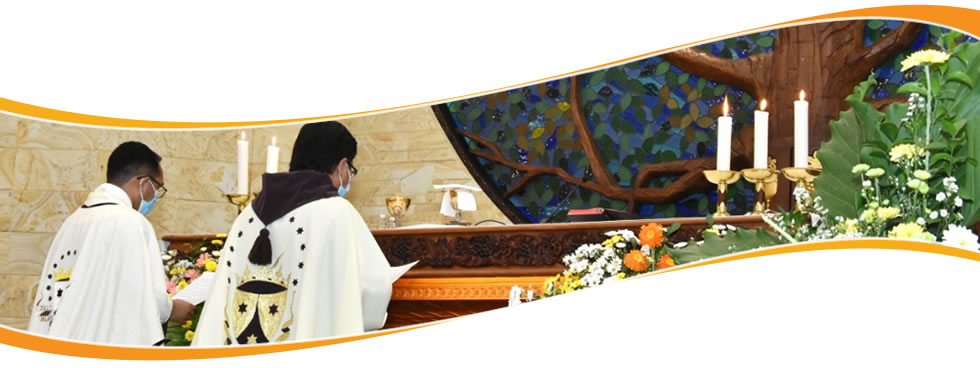


Provincial Chapter of the Province of Australia and East Timor
During the Provincial Chapter of the Province of Australia and East Timor held on 22-26 April 2013 were elected:
- Prior Provincial: Fr. Denis Andrew, O.Carm.
- First Councilor: Fr. Paul Cahill, O.Carm.
- Second Councilor: Fr. Hugh Brown, O.Carm.
- Third Councilor: Br. Sean Keefe, O.Carm.
- Fourth Councilor: Fr. James Des Lauriers, O.Carm.
News from the Province of Australia and East Timor
The Province of Australia and Timor Leste held its Chapter at Santa Teresa Spirituality Centre in Ormiston, Brisbane, from 22-26 April. With its modern facilities, extensive grounds and wonderful view of the bay, Santa Teresa provided an ideal setting for the Chapter.
During the Chapter Fr Denis Andrew was re-elected Prior Provincial. Fr Paul Cahill, Fr Hugh Brown, Br Sean Keefe and Fr Jim Des Lauriers were elected to the Provincial Council.
Fr Fernando Millán Romeral (Prior General) and Fr Albertus Herwanta (General Councillor) joined the twenty five members of the Chapter. Also present were Fr Augusto Da Costa Galhos, Br Angelino Dos Santos and Br Martinho Da Costa, members of the Timor Leste Region of the Province. Br Agostinho Exposto and Br Camilo Felix, two East Timorese Carmelites in simple vows, also attended the Chapter at the invitation of the Preparatory Commission.
Present for the first three days of the Chapter were seventeen invited guests from the Lay Carmelite National Council, the various Commissions and ministries of the Province and members of the Provincial Office staff.
One of the most significant decisions of the Chapter was to formulate a five year development plan for the Province. This plan will involve finance, facilities and strategies for the ongoing development of the Province through consultation with members of the Province, Provincial Commissions, agencies and ministries.
The Opening Liturgy of the Chapter was held in the Chapel of the Discalced Carmelite Nuns, next door to the Spirituality Centre. The liturgy included a welcome from the Prioress of the Monastery, and prayer for the success of the Chapter. A special Chapter candle, a book of the Gospels, images of Our Lady and the Prophet Elijah, the Carmelite Rule, the Constitutions, Provincial Statutes and a Tais (traditional woven cloth from Timor Leste) led the procession of Chapter members and guests from the Chapel to the Chapter Hall.
You can download a copy of the Prior General's address here:  Prior Generals Address 2013 Provincial Chapter
German Province
On the 1st of January 2013, the provinces of Upper and Lower Germany, after many years of intense cooperation, especially in the field of formation, and after a processof preparation that involved numerous meetings, were united into one German Province. This decision was the result of the desire of the German Carmelites to respond to the needs of the present times and to unify their resources in order to better live the Carmelite charism and therefore to act in a more effective way.
It is not the first time that this kind of unification has happened. Indeed, it is the third time that these provinces have been united in a history that goes back several centuries. It is always a question of responding to the demands of the times. On this occasion too, the desire is to be attentive to what is happening and to the changes that are taking places at this point in history. In the most ancient Constitutions of the Order that have come down to us (1281) the Province of Germany was in eighth place among the ten provinces then existing. Following the erection of the first German province in 1265, two divisions (1291 and 1318) and two unifications (1312 and 1327) took place. A third division took place in 1348, which lasted to the suppression of both provinces at the time of the Napoleonic secularisation at the beginning of the 19th century.
Before the secularisation the Province of Lower Germany stretched from the Rhine to Belgium and Holland. The Province of Upper Germany covered a vast area that included not only southern Germany, but also Bohemia, Austria, Hungary and Poland. This enormous territory was reduced in 1411 with the establishment of the Province of Bohemia, made up of the houses of Bohemia, Poland, Prussia, Saxonia and Thuringia.In 1440 the houses remaining in Bohemia, Poland and Hungary passed over once more to the Province of Upper Germany. The houses in Saxonia became a separate province and, in 1462 the Province of Poland and Bohemia was re-established.
In the 16th century, during the Lutheran Reform, the province of Lower Germany, which had its principal house in Cologne, suffered very little in comparison to its sister province which lost fourteen of its existing sixteen houses. By their adherence to the Reform of Touraine in the following century,both provinces saw a kind of rebirth. In 1803 the suppression of religious orders by the emperor Napoleon meant that the house in Straubing, belonging to the Upper German province was the only house to remain and in it the remaining friars were allowed to live. When, in 1841 King Louis I of Bavaria gave permission for the house to be re-opened, one lone Carmelite was found there. Yet, in 1864, it was two Carmelites from Straubing that set out for North America, and these two laid the foundations for what would become the Province of the Most Pure Heart of Mary.(PCM). Sometime later, Carmelites from the Netherlands went to Germany to help their German brothers and this cooperation in 1879 gave rise to the German-Dutch province. In 1922 the Upper German Province was erected again through the unification of the General Commissariat of Austria and the Vicariate of Bavaria.
The sixteen flourishing houses of the Lower German Province that had disappeared without trace during the Napoleonic suppression in 1803 and the subsequent years, found a future when in 1924, the Dutch province, with the support of Blessed Titus Brandsma, took back the ancient house in Mainz. In the years that followed other foundations were made that led first to the Provincial Commissariat and then in 1969 to the Lower German Province which came back to life.
In addition to all their work in the houses and in the parishes under their care, and in retreat houses, in teaching and in the various institutions, both provinces had a strong commitment to missions. The foundation by the Upper German province in Brazil (1951) and India (1882) bore fruit in the establishment of the Province of St. Thomas of the Siro-Malabar Rite (2007) and the General Commissariat of Paraná (2012), Since the year 2001 the Lower German province is involved in the new foundation in the Cameroon.
At the time of unification 100 friars belong to the new united province. At the moment there are 71 solemnly professed Carmelites and two simply professed, in eight canonically erected houses. In the two houses in Cameroon, there are thirteen solemnly professed friars and fourteen simply professed. The Carmelite presence in Germany also includes two monasteries of Carmelite nuns, one of which is in the Province of Upper Germany, erected first in 1948, in Schlüsselau, and then transferred in 1969 to Erlangen, the other, in the Province of Lower Germany, erected first in Duisburg in 1961 and transferred to Essen in 2002.
for more information about the Provincce
Deutsche Provinz der Karmeliten
Provinzverwaltung
Knöcklein 13
96049 Bamberg
Tel. 0951 / 509866-0
Fax 0951 / 509866-29
This email address is being protected from spambots. You need JavaScript enabled to view it.
http://www.karmeliten.de/
Lay Carmel and the wider Carmelite Family
from the website of The British Province of Carmelites
'Lay Carmel' is the largest branch of the Carmelite Family. The following additional information is offered to help place Lay Carmel within the broader picture of the Carmelite Family.
Carmel's roots in the Laity
The Carmelite Family originated with a group of hermits living on Mount Carmel. It is likely that these were largely lay men (i.e. unordained men who were not priests), who dedicated their lives to the service of God and neighbour. Since its foundations, therefore, Carmel's spirituality has struck a chord with lay people. Although Carmel is best known for its 'religious' (friars, nuns, sisters and hermits), in fact the most numerous and widespread branch of the Carmelite Family is 'Lay Carmel'.
What is meant by 'Lay Carmel'?
The term 'Lay Carmel' can refer to any lay person connected with the Carmelite Family, but more usually it refers to the Third Order Secular (usually known as the 'Third Order' or 'Secular Order').
In the Ancient Observance of the Carmelite Order (O.Carm.) the term 'Lay Carmelites' usually refers to the members of the Third Order Secular (also referred to as Secular Carmelites or Tertiaries) who have formally made profession of promises. However, 'Lay Carmel' is also used by the Ancient Observance as a catchall term that incorporates the laity of the wider Carmelite Family, such as the Brown Scapular Confraternity and members of Secular Institutes (described below). In the Teresian or Discalced Carmelite Order (O.C.D.) the term 'Lay Carmelite' is usually more restricted to mean only professed members of the 'Secular Order' (a term used by them in preference to 'Third Order'). The term 'Lay Carmel' is somewhat problematic when describing the Secular/Third Orders because there are a number of ordained ministers (deacons, priests and bishops) who are not lay people but who are professed members of the Secular/Third Orders.
The origins of Lay Carmel
In the Middle Ages the Carmelite hermits became a mendicant order of friars (religious brothers), but lay people continued to be inspired by 'Carmel' and wanted to be associated with the Order in some way. Confraternities (brotherhoods) of the laity became established alongside convents of friars that gave people a link to the religious brothers. Often members of these confraternities were distinguished by making promises to live the Carmelite way of life according to their own circumstances, and wearing a reduced version of the Carmelite habit.
The Carmelite Third Order (Secular)
In the Middle Ages there was no formal 'Third Order' as such within Carmel; instead most communities of Carmelite friars had lay people associated with them who shared something of their spirit and way of life, sometimes in a structured way, but there was no organised system for lay membership of the Order across Carmel as a whole.
The seventeenth century has been called the 'Golden Age' of the Carmelite Third Order, because it was in this period that it became organised for the first time.
In the 1600s the Reform of Touraine (a movement for renewal within the Carmelite Order) was such a successful and inspiring movement that many lay people were once again attracted to the Carmelite way of life. In the 1630s the Carmelite Prior General Fr. Theodore Straccio (sometimes written Strazio or Stratius) decided to organise groups of lay people who were inspired by Carmelite spirituality. Fr. Straccio followed the model of the Francisan Third Order and composed a separate Rule specifically for Carmelite tertiaries. His 1627 Rule of Life for the Carmelite Third Order Secular became extremely influential. In 1678 a later Carmelite Prior General, Emilio Giacomellli (sometimes spelt Jacomelli), produced a revised Rule of Life for the Third Order. A year later a set of Statutes to interpret the Third Order Rule was compiled by the Procurator (legal expert) of the Order, Ferdinand Tartaglia. This Rule/Statutes was adopted by the Discalced Secular Order (which did not exist in the early years of St. Teresa's reform). The first known English translation of the 1678/9 Rule/Statutes appeared in Ireland about 1845, and another Rule - that of John Baptist Bettini - became popular in Italy, Germany and Holland after its publication in 1849. Different Third Order Rules by different people appeared in different languages in different provinces in the nineteenth century, suggesting that in fact there were different Third Orders. The latest legislation of the Third Order (T.O.C.) issued in 2003 still speaks of Third Orders in the plural, recognising the diversity of Lay Carmelite life to this day.
Today most of the Third Order - like the rest of the Carmelite Family - looks to the Rule of Saint Albert as its primary 'Rule', and the Rule for the Third Order issued in 2003 is effectively regarded as a set of Constitutions that interpret Albert's Rule for contemporary life.
Today tens of thousands of lay men and women worldwide are professed members of the Carmelite Third Order Secular. They live in their own homes, often raising families and having their own occupations, but they receive formation in Carmelite spirituality and - when possible - participate in regular meetings of Lay Carmelite communities. They try to live the Carmelite charism of prayer, community-building and service in whatever circumstances they find themselves.
In the Ancient Observance the abbreviation 'T.O.C.' refers to 'Third Order Carmelite'. In the Discalced tradition the abbreviation 'O.C.D.S.' refers to the 'Secular Order of Discalced Carmelites'.
One of the branches of the Third Order is known as the Donum Dei Missionary Workers ('Travilleuses Missionnaire' in French). They have residential communities in various parts of the world, and had a presence in the British Province at Aylesford Priory until 2008.
Carmelite Spirituality Groups
Carmelite Spirituality Group (CSGs) have developed in the British Province of Carmelites since the late 1990s. Originally they were communities of Lay Carmelites in new locations who did not have enough members to constitute a formal 'Chapter' of the Third Order. However, from 2006 a new form of Spirituality Group has developed that seeks to offer an experience of 'Carmel' in a contemporary and inclusive way. For more information about Carmelite Spirituality Groups in Britain, click here.
Carmelite Secular Institutes
Secular Institutes offer a formal belonging to the Carmelite Order for laity that is distinct from, but similar to, the Third Order.
In Britain there is a Carmelite Secular Institute known as The Leaven (The Institute of Our Lady of Mount Carmel) for single people who wish to live a consecrated life in their own homes and workplaces. Founded in 1949 and formally affiliated to the Carmelite Order in 1965, it offers a deep experience of Carmelite spirituality to its members, who profess the evangelical counsels of poverty, chastity and obedience.
There is also a Secular Institute present in Britain known as 'Notre Dame de Vie' (Our Lady of Life) that is associated with the Discalced Carmelite Order. For further information click here.

A painting depicting friars and members of the Third Order
at the National Shrine of St. Thérèse at Darien, Illinois, U.S.A.
The Wider Lay Carmelite Family
Through profession - that is a public statement of Carmelite identity and belonging - members of the Third/Secular Orders and Secular Institutes are formally part of the Carmelite Order.
However, the 'Carmelite Family' also extends a sense of belonging to other lay individuals and groups, often associated with Carmelite-served parishes and chaplaincies, or inspired by a particular Carmelite devotion or saint. These are sometimes called the 'wider' or 'extended' Carmelite Family. Such people are not canonically (legally) part of the Carmelite Order, and make no public profession of promises or vows, but nevertheless receive from and contribute to our spirituality.
Carmelite Scapular Confraternity
Lay people and clergy who want less formal affiliation to the Order but who are attracted by devotion to Our Lady of Mount Carmel can join the Carmelite Scapular Confraternity. Millions of people around the world wear the small brown cloth around their shoulders known as the Carmelite Brown Scapular. This sacramental - one of the most popular across the Church - is a miniature version of the Carmelite habit. It is a symbol of belonging to the wider Carmelite Family, and of pledging oneself to the protection of Our Lady and the service of her son Jesus Christ.

Young People and Carmel
Many young people are associated with the Carmelite Order in a number of ways, often outside of formally constituted groups. As such these young people form part of the 'wider Carmelite Family'.
Devotion to Our Lady of Mount Carmel
Our Lady of Mount Carmel is the title given to the Blessed Virgin Mary in her role as patroness of the Carmelite Order. The first Carmelites were Christian hermits living on Mount Carmel in the Holy Land during the late 12th and early to mid 13th centuries. They built a chapel in the midst of their hermitages which they dedicated to the Blessed Virgin, whom they conceived of in chivalric terms as the "Lady of the place."
St. Simon Stock
Saint Simon Stock, an Englishman who lived in the 13th century, was an early prior general of the Carmelite religious order. Little is known about his life with any historical certainty. The Blessed Virgin Mary is traditionally said to have appeared to him and given him the Carmelite habit, the Brown Scapular, with a promise that those who die wearing it will be saved. Thus, popular devotion to Saint Simon Stock is usually associated with devotion to Our Lady of Mount Carmel.
Carmelites: People in search of God.... From the Desert to the Garden of God.
History of the Carmelites....
Carmelites: People in search of God.... From the Desert to the Garden of God.
Second Asia-Australia-Oceania Carmelite Student friars gathering
The second Asia-Australia-Oceania Carmelite student friars gathering in this sexennium was held in Malang (Indonesia) from the 4th to 10th April , 2013.
Fr. Lucianus Simon Rande, O.Carm., Provincial Councillor of the Indonesian Province was the main celebrant of the opening Mass. On behalf of Fr. Ignatius Joko Purnomo, O.Carm., Indonesian Provincial, he gave an address of welcome and officially opened the gathering. An address from Fr. Prior General was read by Fr. Albertus Herwanta, the General Councillor for Asia-Australia-Oceania.
Sixty-six Carmelite student friars and formators from India, Vietnam, Philippines, Indonesia and East Timor joined the gathering where they prayed and meditated together. They also listened to Fr. Rico Ponce, O.Carm. (Phil) and Fr. Benny Phang, O.Carm. (Indo). Fr. Rico talked about three things: The mission of animating Carmelite life today within the sphere of formation; The Asian spiritual context and Carmelite spirituality - challenge and response; Following Christ in the context of globalization. Fr. Benny talked about theology of the body.
On April 7th the participants visited the following Carmelite communities: the house for the elderly, the provincial house, Saint Albert High School, the Carmelite Nuns and the novitiate house. On April 9th they visited the Safari Park of East Java. They also enjoyed creative performances, and Indian, Vietnamese, Philippine, Timorese and Indonesian food prepared by the participants.
Gratitude was also expressed to all who supported this gathering, especially to the Provincial of Indonesia for his willingness to fraternally host this gathering, and to Fr. Crispinus Ginting, O.Carm. and his team who worked hard to prepare and organize everything.
Citoc Magazine III no.1 2013
Carmelite Curia
The cover of this issue of CITOC-magazine shows a very beautiful photo of the first Carmelite Church in the entire American continent in Olinda, Brazil, founded by the Portuguese Carmelites in 1580 and rededicated again on August 5, 2012. The celebrations are an opportunity for the Carmelites to give thanks for the restoration and the return of this marvelous church that from 1877 was in the hands of the Brazilian state, and from today will be the office of the Prior Provincial.
The information on the reality of the Carmelite life in Latin America is rounded off with an article on the Third Congress of ALACAR (the Latin American Association of the Carmelites), an important initiative for the development and exchange among all members of the Carmelite Family in Latin America.
The article from the Prior General recalls the 70th anniversary of the martyrdoms of Blessed Titus Brandsma and Saint Teresa Benedicta of the Cross (Edith Stein). The life of Blessed Titus is an example of the close relationship between the mystical life and commitment to the world in favor of human dignity. Today, the Carmelite NGO has also adopted this plan. An article about the activities regarding these relevant issues of justice and peace is presented by Carmelite NGO.
Next, we present three events in the field of formation in the Order: the course on permanent formation in the Holy Land on the theme: “Returning to the Sources”; the beginning of the common novitiate in Salamanca, Spain; and the regional meeting of Asia-Australia-Oceania formators which took place in Thrissur, India.
A number of meetings in recent months, which express the internationality of the Order, such as the Fifth International Congress of Lay Carmelites, the triennial meeting of bursars in Sassone and the Congress of Fr. Lorenzo van den Eerenbeemt, O. Carm., the cofounder with the Blessed M. Crocifissa Curcio of the Congregation of the Carmelite Missionary Sisters of St. Teresa of the Child Jesus, will also be mentioned.
Another article in this magazine regards the founder of the Carmelite Sisters of the Aged and Infirm, the Servant of God, Mother Mary Angeline Teresa, O. Carm. (Bridget Teresa McCrory), whose decree on the heroic virtues was promulgated. The challenges arising from historic moments of change always demand new responses as shown in the presentations on the unification of the two provinces of Upper and Lower Germany and the canonical erection of the new General Commissariat of Paraná in Brazil.
In addition to these articles, as well as other information, there is a selection of news highlights, some of which were published in CITOC-online.
We wish you all happy reading of these pages of the new issue of CITOC-magazine.
The general councils of O.Carm. and O.C.D on Mount Carmel
Fr. Fernando Millán Romeral, O.Carm. Prior General
Throughout the six years that the term of the General leadership lasts there are moments that are difficult, joyful, sad, emotional, moments in which one feels an extraordinary pride in our Carmelite family, and so on. At the end of last year, (from 29th November to 4th December 2010) we had one of those very intense, profound and joyful moments, in the meeting of the two General Councils, O.Carm and O.C.D., for a week at the Stella Maris de Monte Carmelo (Haifa, Israel). The meeting gave us a chance to think together, pray and meditate together, and to look at mission and the meaning and importance of Carmel for the Church and the society of today.
The first two days were devoted to a reflection on consecrated life in today’s world, led by Fr. Gabino Uribarri, S.J., the Dean of the Faculty of Theology of the Pontifical University of Comillas in Madrid. Fr. Uribarri has written a number of works on religious life, and his talks helped us to grow in our awareness of the ecclesial dimension of this life, as well as the responsibility it has in the area of evangelisation. Along with the talks, which were always very solid theologically and inspirational at the same time, we had some very interesting sharing of opinions in which we were able to see how we live out these dimensions in each branch of Carmel, as well as the difficulties we encounter in this area.
This first part ended with a visit to the ruins of the first Carmelite foundation. This was a particularly intense moment in which we went through the ruins of the first chapel, the prior’s cell close to the entrance (juxta introitum loci), the spring of Elijah and so on. We sang the Flos Carmeli together, and were very mindful of our sisters and brothers in both branches of Carmel throughout the world.
In the days that followed, the members of both councils visited places of Carmelite interest, and some of the other significant places in the Holy Land. As we went around we had Fr. Francisco Negral and Fr. Renato Rosso, both O.C.D. as our guides. Both were excellent guides who with genuine professional ability and spiritual insight, helped to get a real taste of the spirituality of the different places. Moreover, in each different place we had a Lectio divina, directed by Fr. Desiderio Garcia, O.Carm. who helped us to recapture and re-live the words of the Lord, right there in those places where they were pronounced for the first time.
It was also a great pleasure to visit the four monasteries of Discalced Carmelite women in the Holy Land (Mount Carmel, Nazareth, Bethlehem and the Our Father) where we were able to spend time with the nuns and enjoy their hospitality.
The last day was devoted entirely to the writing of a message for the Order and to the study and evaluation of other joint activities and areas of common endeavour. We looked again at some of the topics that have been studied in the meetings of the two councils, which take place in Rome twice a year.
All that remains is for us to sincerely thank the Carmelite communities at Mount Carmel and throughout the Holy Land for the wonderful hospitality they gave us, and also the Carmelite Sisters in Stella Maris, who, as they always do, made us feel so much at home by the simplicity, pleasantness and fraternal spirit of their hospitality.
During the week that we were in Mount Carmel, we received some bad news. Fifteen kilometres from Stella Maris, on one of the hills that form part of the Mount Carmel chain, there was a fire that burned many acres of forest, and, even more sadly, caused the death of 43 people who were passengers in a coach. Even though neither Stella Maris, nor the Wadi es Siah nor the Muhraqa were affected by the fire, the flames could be seen from miles away. We could not help but recall the words of Amos in the Bible speaking about the destruction of this highly symbolic place: and the top of Carmel dries up … (Amos 1,2). Without getting into visionary interpretations or anything so strange, we might perhaps see a sign in this, something that alerts us, a even warning. Carmel, the biblical place of beauty, synonymous with all that is fertile and the generosity of nature, is on fire on account of human neglect. Perhaps we as Carmelites may have a word to say to this world of ours that is taking giant steps towards the destruction of our environment, our waters, and nature itself. Together, we commend all the victims of the forest fire to the one God whom Elijah adored in these same places.
Meeting of newly solemnly professed friars of Europe
The Prior General, Fr. Fernando Millán Romeral, O.Carm., together with the Councillor General for Europe, Fr. John Keating, O.Carm. met with the European friars who made solemn vows within the last ten years. This meeting took place at San Andres, the Carmelite University Residence and European Novitiate in Salamanca, Spain from the 4th to the 7th April 2013. This is also the place where St. John of the Cross was a student. Of the forty possible participants thirty-three friars were present for what was entitled "A Dialogue in Hope regarding the future of the Order in Europe." The Prior General spoke about three things with the group: "Hope for the future", "The situation of the Order in Europe" and "A vision for the future." Together in groups and in assembly friars from Arago-Valentina, Betica, Britain, the French Delegation, Germany, Ireland, Italy, Malta, the Neapolitan Province, Netherlands and Poland addressed a wide range of issues among themselves and with the Prior General searching to find common paths for hope regarding the future of the Order in Europe. The final text of their common reflection (in English, Italian and Spanish) can be found on the Order's website at:
http://ocarm.org/en/content/ocarm/anchored-hope-heb-618-19
A very warm welcome was extended to all by the community at San Andres, and the gathering also included a guided tour of the city of Salamanca and Eucharist celebrated by the Prior General at the tomb of St. Teresa of Jesus at Alba de Tormes.