



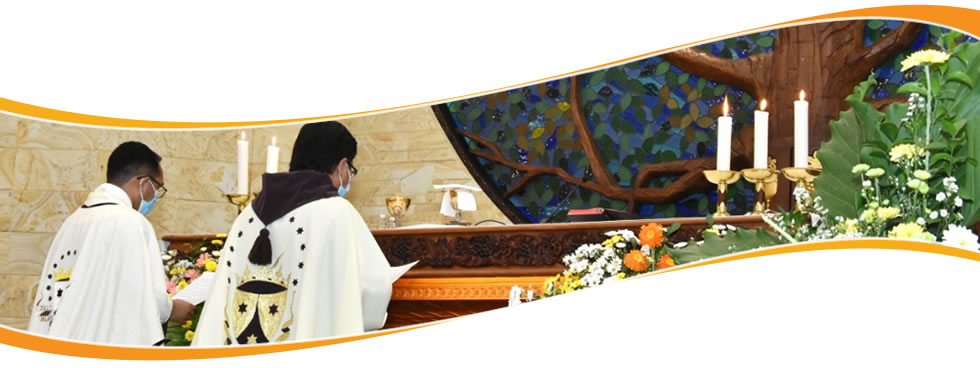


Solitude and Carmelite Spirituality
John Coates
Solitude is not the same as isolation. The latter is an unhealthy withdrawal from human society; a turning in on oneself that is only too often a trait of neurosis. Solitude, in contrast, is a healthy turning toward one's beloved."Solitude, when it is healthy, will bring us closer to our Lord Jesus Christ and not lead us away from Him. If one finds it difficult to live with others, one will surely find it difficult to live alone. Solitude is not intended to be empty and void, but alive and filled with activity; the activity of loving and communicating with Jesus be it a prayer of thanksgiving or just enjoying God. Contemplative prayer and solitude should be restful and not fill us with boredom and anxiety.
Solitude should give us an opportunity to make advances in prayer but, in order for this to happen, we must free our mind of anxiety and learn to put aside all of our worry. Learning to be with God does not happen over night. This period of communication strikes fear even into the hearts of priest and religious. In our society we are taught to abhor solitude. Television, radio and other distractions make it very difficult for us to appreciate being alone.
"Silence and solitude does not refer only to the lessening of decibels.” It is almost impossible for us here at Carmel, to commune with the Indwelling Spirit unless we withdraw from the hustle and bustle of the world. This does not always mean that we must physically withdraw. Often this is not possible, but we can withdraw ourselves spiritually. A divided attention is an exhausting attention. If we drain our psychic energies by the endless multiplicities of images and sounds, many of them garish and deafening, we cannot retain the inner stamina necessary or prayer.
Prayer is so necessary for us to grow in virtue. It is impossible for one to practice prayer on a regular basis even though the prayer may be one of distraction, without a noticeable growth in virtue. “The divine presence is bound to transform one from sin to virtue and eventually from common goodness to heroic sanctity.” Often there are those whose period of.solitude are constantly 'interpupted cecause of the inordinate interest in the business of others. We should not meddle in things that do not concern us. If we can avoid the needless interfering in the lives of others we can and will avoid many distractions. Our inner peace is unsettled by gossip and our prayer life suffers. When we are trying to direct the actions of others our own affairs go unattended. So we must avoid letting the faults of others distress us. We should learn not to focus our attention on their petty faults. "The safe path for the soul that practices prayer will not be to bother about anything or anyone and to pay attention to itself and pleasing God." This does not mean we are not to be concerned about others.
The spiritual experience that one has in solitude, of course, varies from person to person, but you and realize "that God treats each of us differently." Though He has several times entered into me, he has never made His coming apparent to my sight, hearing, or touch. It was not by His motions that He was recognized by me, nor could I tell by any of my senses that He had penetrated to the depths of my being. Only by the movement of my heart was I enabled to recognize His presence, I know the might of His power by the sudden departure of vices and strong restraint put upon all carnal affections: and it is by God's mercy and grace that we discover and are convinced of our secret fault. How can we but admire the depths of the wisdom of God? The goodness and kindness of so loving a God we are aware of co& we have perceived in some degree the loveliness of his beauty, and have been filled with amazement at the magnitude of his greatness.
The earliest Carmelites
The earliest Carmelites were to imitate the Jesus who was in the habit of going aside to pray, to be alone with God, his Abba.
Keith J. Egan
The Solitude of Carmelite Prayer
Keith J. Egan
So I say now that all of us who wear this holy habit of Carmel are called to prayer and contemplation. This call explains our origin; we are descendants of men who felt this call, of those holy fathers on Mount Carmel who in such great solitude and contempt for the world sought this treasure, this precious pearl of contemplation. (IC.5. I .2)'
Carmelite Spirituality is a richly woven tapestry whose warp and woof change over time to accent now one hue, then another. This Carmelite tapestry, like Joseph's coat, is multicolored with rich fibers running this way and that. Some fibers arc so integral to an authentic Carmelite charism that, were they eliminated, the tapestry would no longer be true to the Carmelite tradition. Unthinkable is Carmelite life without Mary. What would Carmelites do without the inspiration of Elijah) Carmel's various ministries, whether preaching, teaching, or the all important ministry of the contemplative life, are crucial to the variations that occur in Carmel's spiritual tapestry. Even more incomprehensible is Carmelite life without solitude. Solitude lay at the heart of the original charism of Carmel and has been restored whenever new life has been breathed into Carmelite spirituality. When great figures in Carmel's tradition have articulated their understanding of Carmel's way of life, they have inevitably retrieved solitude as crucial to the authenticity of Carmelite prayer. The quotation from Teresa of Jesus at the heading of this essay shows how strong was Teresa's conviction that the recovery of solitude was crucial to her reform of the Carmelite Order.
Carmel's staying power in the church's religious traditions may well rest on its insistence that solitude has a unique place in its way of life and prayer. At the very heart of human existence is the challenge to be a person and at the same time to be in relationship with others. That is the paradox of solitude and community. Two modern philosophical systems put the emphasis at opposite ends of the spectrum. Marxism comes down on the side of community, while existentialism favors the autonomy or freedom of the person. Keeping the poles of this paradox, solitude and community, in creative tension, is the challenge of every human person, of the human community, and is a special concern of the Carmelite tradition. Were there space in this essay, one might inquire in what way the paradox of solitude and community reflects the three persons and one nature of the Trinity and the unity of two natures in one person of the Incarnation. Or one might explore how celibacy can create within one a holy solitude. These explorations must wait for another day.
In Carmelite spirituality solitude is in creative tension with com-munity and with the ministries undertaken by community. l suggest that a crucial factor in the attraction of so many religious seekers to the Carmelite charism is its ongoing struggle to live creatively this paradox of solitude and community. From the beginning Carmel gave a special place to solitude but always as a solitude within community. Living the dynamic of solitude within community is Carmel's mission in the church, its perennial challenge, its key to ongoing reform and its way of challenging its members to stand in mindfulness before the living God even as some Carmelites serve the apostolic needs of God's people. Solitude, shaped variously in differing eras, has been a decisive factor in the life of prayer for anyone who is called to pray within or with the Carmelite family. One way to track the evolution of Carmelite prayer is to trace how solitude was configured at different moments in Carmel's history, especially by classic figures in its tradition like the three Carmelite doctors of the church, Teresa, John and Therese.
Solitude in the Carmelite Tradition
The solitude of the original Carmelites was integral to their “allegiance to Jesus Christ.”' This phrase from the prologue to the Formula of Life sees Carmelite life as an imitation of Christ and as an “...obedience to His way of life depicted in the Gospels, remembered in the tradition.....” The earliest Carmelites were to imitate the Jesus who was in the habit of going aside to pray, to be alone with God, his Abba (Luke 5:16).' The Carmelite charism thus focuses on a central issue of human existence and at the same time imitates a habit of Jesus whom Carmelites by their rule were pledged to follow. From their first location on Mount Carmel the Carmelites had inherited a desert spirituality which prized solitude. The desert dweller Abba Moses once said: The man who flees and lives in solitude is like a bunch of grapes ripened by the sun, but he who remains amongst men is like an unripe grape.
The first Carmelites were conscious that they had settled in a land made holy by the presence of Jesus, who often sought solitude, and in a land made sacred by the monks of the deserts whose very name, monk, means to be alone. A modern interpreter of Carmel's prayer, Kilian J. Healy, has written that “...the tradition of Carmel has always been to live a life of solitude, silence and mortification in order to be continually occupied with God....To be occupied with God (vacare Deo); this is the spirit of the Order....”' This solitude is for the sake of being alone with God so as to experience the transforming power of God's love. The thesis of this essay is that Carmelite prayer has grown and matured creatively whenever solitude has been nurtured. Solitude here does not mean the completely eremitic life where one lives totally alone. The Carmelites have never espoused a life divorced from community; in fact, in 1247 they expanded the communal aspects of their life so as to identify with the fraternity of the friars. Carmelite solitude has always been for the sake of inner solitude, a habit of deep inner mindfulness of the presence of a loving God. Physical solitude is for the sake of solitude of the heart or, as John of the Cross would say, for the sake of poverty of spirit, an emptiness to be filled by God's love. Carmelite prayer depends on the retrieval of a solitude that is faithful to the original charism of Carmel and at the same time is shaped by the signs of the times. Without discernment in each age, Carmelite prayer would not be ecclesial and contemporary. In every era the Holy Spirit shapes the life of the church and its religious communities according to a design that can be seen as an ongoing epiclesis. This is a calling on the Holy Spirit to weave the threads of the Carmelite tapestry according to God's will.
Carmelite solitude has been and is lived in various manifestations, that is, in one way by cloistered Carmelite nuns, in another by apostolic Carmelite sisters, then again by the friars and in other ways by lay Carmelites and by anyone who turns to Carmel for inspiration. As Saint Paul taught, every charism is for the sake of the whole community (1 Cor 12). Cannel's paradox of solitude and community is a gift to be shared with all who seek to live attentively in God's presence.
It is impossible to report in a brief essay the whole story of Carmel's retrievals of solitude during the eight hundred years of the order's existence. I shall indicate only some special moments in that history that illustrate the connection between solitude and Cannel's life of prayer. These moments reveal how Carmelites have lived according to the aphorism vacarr Deo, being open to God's presence, “continually occupied with God: as Kilian Healy translates the phrase: John of the Cross's Spanish for vacare Deo has been translated into English as 'free for God” (SC.7.6). Solitude makes one free for the guidance of the Holy impossible for the Latins in the Holy Land. By 1238 some of the Carmelites were migrating to the West and found themselves in places like Cyprus, Sicily, England and France. When they got to Europe, the hermits of Mount Carmel encountered the phenomenon of the friars. The friars were everywhere and were attracting recruits in extraordinary numbers. Dominic and Francis had turned traditional religious life on its head. In place of the stability of the monks, the friars were mobile and international. Along with the personal poverty of the monks, the friars adopted corporate poverty. The friars streamlined the monastic liturgical hours. Perhaps most revolutionary of all, the friars began to evangelize the expanding urban centers of Europe. To prepare for this ministry the friars entered the universities so that they might prepare their members to bring the gospel to the large numbers of poorly instructed Christians in Europe. With their move into the universities the friars became student orders, with each of their foundations a feeder for specialized student houses in various provinces.
The first Carmelite foundations in Europe were eremitic, but it soon became evident that this lifestyle was out of sync with the taste of the friars' patrons and with the sensibilities of young recruits eager to throw in their lot with the enormously popular mendicant orders. In 1247 the Carmelite Formula of Life became an official Rule, and the Carmelite hermits slipped into the ranks of the friars. The Carmelites quickly acted like friars and turned with haste to make foundations in cities like London, Cambridge, Oxford, Paris and Bologna. The papally approved revision of the Formula of Life entailed only slight verbal changes in the text but the implications for solitude and prayer were telling. The changes not only allowed the Carmelites to settle in non eremitic sites (towns), but the time of silence was shortened. The Carmelites now gathered in a common refectory and recited the canonical hours. While the once eremitic Carmelites now lived the more communal life of the mendicants, they had a legacy of solitude that had to be woven into the newly shaped Carmelite tapestry if the Carmelites were to remain faithful to their original charism. The Carmelite historian, Father Joachim Smet, believes that the transition from an eremitic to a mendicant order was more gradual and less abrupt than l have described this change. Father Smet's interpretation extends the eremitic character of the Carmelites beyond 1247 and therefore puts additional emphasis on solitude after this date.”
The demands prompted by Carmelite participation in the evangelization of Europe's towns altered the way solitude could be lived. This ecclesial call to evangelization recast the more simple paradox of solitude and community into a tension between solitude and ministerial community, a community called upon to serve the neighbor through preaching, teaching and spiritual guidance. The stillness, quiet and solitude experienced on Mount Carmel were no longer possible. Hence it was inevitable that the prayer of the Carmelite friars would also be altered.
The change from hermits to friars, an alteration of the original Carmelite charism, did not occur without opposition. First of all, the Carmelites encountered the general opposition to friars that was mounted during the second half of the thirteenth century by bishops and secular clergy who saw the friars as intruders into their ministry of evangelization. Within the Carmelite Order, Nicholas the Frenchman, prior general from 1266 to1271, scolded his brothers in no uncertain terms for fleeing to the cities instead of remaining faithful to solitude: ''You who flee solitude and spurn the consolations it has to offer, would you hear how the Lord has shown by his words the high esteem in which he holds it [solitude]?” Nicholas proceeded to eulogize solitude as practiced from Abraham to Jesus, and he reminded his brothers that their predecessors had, though rarely, preached what they had reaped in solitude with the sickle of contemplation:” However, neither external nor internal opposition deterred this recently minted mendicant order from a commitment to evangelization.
At the very time they were undergoing opposition, certainly by 1281, probably earlier as their Constitutions could have dated from 1247, the Carmelites were telling their young members that the order had a long tradition of being “true lovers of solitude for the sake of contemplation.” That significant statement about solitude in the prologue of their Constitutions was retained in the Constitutions for centuries. Here is the longer context of this quote from the rubrica prima, a charter for young Carmelites contained in the Constitutions:
Since some of the younger brothers in our order seek when and how our order began but in truth do not know how to respond, we wish to answer them with the following written words: bearing witness to the truth, we say that from the time of the prophets Elijah and Elisha who dwelt devotedly on Mount Carmel, holy fathers of the Old and New Testament praiseworthily lived there in ever continual holy penitence on that same mountain as lovers of solitude for the sake of contemplation.
As early as 1281, if not three decades earlier, the Carmelites had composed a mission statement for the young that gave pride of place to solitude, a solitude for the sake of contemplation. The Carmelites were also becoming more and more conscious of what was implied by their having been founded on Elijah's mountain. To look toward Elijah and Elisha for their inspiration was to become aware of the prophetic dimensions of their solitude and prayer.
Carmelite Spirituality
from http://www.carmelite.com
Carmelite spirituality is Christian spirituality – not an idiosyncratic or esoteric spirituality. As such, contrary to some popular misconceptions, it is not reserved to a select group within the Church or to a spiritually elite, but is accessible to all whom the Spirit calls to follow this way. As a Christian spirituality, Carmelite spirituality is a way of following Jesus Christ and walking the path of the gospel.
Carmelite spirituality is characterised by an intense thirst for an immediate and direct experience of God. Reduced to its most fundamental expression, Carmelite spirituality is centred on prayer, understood as loving friendship with God, and contemplation as the free gift of God. Hence, Carmelite spirituality is focused on attention to one’s relationship with Jesus. This is expressed in various ways in the major sources of Carmelite spirituality, such as the Rule of St. Albert, the writings of the founders of Discalced Carmel Sts. Teresa and John of the Cross, and indeed in the writings of all our Carmelite saints.
In the Rule of St. Albert, the Christian character of Carmelite spirituality is clearly expressed as living ‘a life of allegiance to Jesus Christ’. This involves a gradual and progressive conversion and transformation – a putting on of the mind and heart of Jesus. Sts. Teresa and John of the Cross, speak of prayer and contemplation as ‘friendship with God’ and ‘union with God’ respectively. Prayer and contemplation, as a relationship with God, in and through loving friendship with Jesus Christ, is not a technique or one of the many daily activities, but embracing of one’s whole life. For the Carmelite then there is no experience in one’s life that is outside the ambit of relationship with God.
Together with prayer and contemplation, Carmelite spirituality emphasises the doctrine of the Divine Indwelling. Both Sts. Teresa and John of the Cross teach us that God, the Blessed Trinity, dwells within the human person. Hence, one need not go out of self in search for God but enter progressively ever deeper within oneself to be with God who dwells at the very centre of our being. St. Teresa speaks of this journey within as an itinerary through a castle with seven mansions. St. John of the Cross hymns this reality: “What more do you want, O soul! And what else do you search for outside, when within yourself you possess your riches, delights, satisfactions, fullness and kingdom – your Beloved whom you desire and seek? Be joyful and gladdened in your interior recollection with Him, for you have Him so close to you. Desire Him there, adore Him there. Do not go in pursuit of Him outside yourself. You will only become distracted and wearied thereby, and you shall not find Him, or enjoy Him more securely, or sooner, or more intimately than by seeking Him within you.” (S.C. 1:8) Interiority and recollection, then, are at the very heart of Carmelite spirituality.
In order to foster and facilitate relationship with God, through prayer and contemplation, Carmelite spirituality proposes certain means, both personal and communal, namely meditation on the word of God, liturgy, silence and solitude, and asceticism. The Rule of St. Albert urges an unceasing pondering of the Law of the Lord in Scripture and the strengthening of one’s heart with holy thoughts, so that the word of God may abound in one’s heart and lips, and guide all one’s actions. The Rule also exhorts Carmelites to come together daily for the celebration of the sacred liturgy.
Carmelite spirituality proposes silence and solitude as necessary pre-requisites for prayer and contemplation. Silence refers not only to external noise but also to the stilling of one’s internal noises. Silence is the condition for listening attentively to the still small voice of God. Solitude provides the ambience where one may be alone so as to focus more attentively on the Beloved. Solitude then is not primarily separation or isolation from others, but a place of privileged encounter with the Beloved.
Asceticism is the means of freeing self from the tyranny of self-will, simplifying one’s life, and preserving all of one’s energy for journeying to God. For St. John of the Cross, the main expression of asceticism involves a radical detachment from inordinate or disordered desires and appetites. Detachment is a way of prioritising God above all creatures. As such, it witnesses to the primacy and all sufficiency of God. Asceticism is not only at the service of a deeper life with God, but it is also geared to the demands of the apostolic ministry.
Although Carmelite spirituality highly esteems prayer and contemplation these are always in service of the apostolate. Hence, integral to Carmelite spirituality is apostolic service to the Church. This aspect is particularly highlighted by St. Teresa. For St. Teresa, while prayer and contemplation are paramount, they are not ends in themselves but are orientated to the support, welfare, and apostolic fruitfulness of all those engaged in the work of spreading the gospel of Jesus Christ. Carmelite spirituality, then, is not simply about self salvation, but a way of co-operating with God in bringing about God’s reign on earth.
Finally Carmelite spirituality teaches that authentic prayer and contemplation is accompanied by and promotes growth in the human and theological virtues. This leads to a flowering in the Carmelite of the two-fold gospel commandment of love of God and love of neighbour.
from http://www.carmelite.com
Carmelite Contemplation in XIV-XVI Centuries
Leopold Glueckert, O.Carm.
The second Seminar on Contemplation in Carmel took place January 17-19, 2013 at Rome’s Centro Sant’Alberto. Members of the international Institutum Carmelitanum were joined by invited guests, scholars, and others for a series of stimulating presentations.
One of the first difficulties was defining or explaining “contemplation” since our earliest authors do not generally use that word. Describing contemplation, the soul of Carmel, requires latitude as well as precision. We need to view all of these samples of thoughtful writing through the prism of faith, as we reflect on our own experience. We must listen to them all, without attempting to judge which might be the most accurate, or the most perceptive. The understanding of contemplation has developed and evolved over the centuries that we looked at in this seminar.
It’s a difficult balancing act to describe our Carmelite ethos as being active contemplatives, or contemplatives in action. We continue to ask ourselves in every generation whether our ministry is actually a stimulus for our prayer. Or is it rather a distraction from our prayer, and therefore something to avoid? The contrast between these two mixtures, these two styles of intense prayer, is a source of never-ending discussion and argument. Sometimes I think we argue about this issue so vigorously that we begin to lose the balance we want to attain.
As we look back with nostalgia at our eremitical roots, we need to honestly ask whether eremitic prayer is the only way to touch the face of God. We could follow some of our extremely active people, like Gerard of Bologna or Baptist of Mantua, who were busy about many things. They were extremely holy individuals, worthy of our imitation, even if we can’t always keep up with their frantic pace. Let’s remember the sometimes neglected end of chapter 10 of the Rule, which tells us to watch in our prayer day and night, unless engaged in some other activity. And let’s not forget that the same Rule tells us to work.
The seminar’s keynote address was given by Professor Gert Melville, who traced the passage from the Medieval to the Early Modern era. He stressed that Carmelite identity continued to evolve during these busy centuries. At the end of the beautiful 13th century, our foundational age, we were just getting settled in Europe amid all the bumps in the road. That golden time was immediately followed by the 14th and 15th centuries, when everything fell apart! There were endless wars, the cynical time of the Avignon Papacy followed immediately by the horrid Western Schism, and the Bubonic Plague in the middle of it all. If the Plague killed half of the population of Europe, then it killed an even larger percentage of the Carmelite population. In spite of all that trouble, we still had the great universities, the writings of some of our earliest scholars, the development of our prayer and spirituality, and several great saints.
Professor Melville pointed out that there were some contradictory currents within our own ranks. We see an interchange between decline, distraction, and debauchery on one hand, and renewal, growth, and spiritual vitality on the other. During the 14th century, we had several vigorous reform congregations coming into existence, as well as the robust presence of John Soreth, our tireless reforming general. As Professor Melville pointed out, Soreth managed to generate a reformed section of the Order without letting it split from the parent body. And even the separate congregations, which were only nominally under Soreth’s control, still served as a strong example for the other communities, and never did break away on their own.
During the 14th century, we observe a general decline in the observance of poverty, the quality of community, and the fervor of prayer. Yet during the same identical period, we see a growth in the “myth” of Carmelite identity. About 1380, Felip Ribot composed his Book of the First Monks, comprising what we might call the “fable” of Carmelite origins. It’s not exactly an un-true story, but is valued more for its teaching function instead. It is clearly NOT history, but something far more important. Ribot’s writing is a clear glimpse of what Carmelites think of themselves. After the Bible and the Rule, Ribot’s book was the Carmelites’ most popular spiritual reading until the time of Teresa.
Simon Nolan gave a stimulating presentation on Gerard of Bologna. While he was a very busy prior general, Gerard also appreciated contemplation as something associated with the beatific vision. However, as Simon pointed out, he had very little to say about contemplation directly, using that vocabulary. He shares that characteristic with our next several thinkers. Mario Alfarano pointed out that Michele Aiguani did not specifically name contemplation either. He associated contemplative activity with the Holy Trinity, and the meditation on the scriptures as a manifestation and a “magnet” for gazing upon God’s presence.
Carlo Cicconetti showed that John Baconthorpe concentrates on God’s presence, again without calling it contemplation. He uses Mary’s life as the paragon of Carmelite living and the model of the Carmelite Rule. We remember that Mary was above all a woman of prayer and a Christocentric witness to everything Jesus stood for. We appreciate the reality that Mary in the gospels was anything but a chatterbox. She speaks very little, but we know that she was always there in the background. She always tried to support Jesus’ teaching, encouraging people to listen to him. Her statement “Do whatever he tells you” at Cana, where she proved that she was truly a Jewish mother, also bears witness to her single mindedness in following her son’s teaching. Although she speaks very rarely, one of the most eloquent things which we have on record is the Magnificat. This sort of “ministry” is a profession of faith which any of us would be proud to imitate.
Paul Chandler spoke about John of Hildesheim, author of the popular Legend of the Three Kings, a wonderful reflection on the mystery of the Incarnation. John is heavily focused on scripture, and gathers stories, visions, and ruminations on the mystery of God’s dealings with the human race. His approach of gazing with rapt attention reminds us of Moses and Elijah, as they experienced the highest vision of God in their respective lives, and also on the Mount of the Transfiguration. John speaks of the mystical activity of the soul, which dovetails nicely with Ribot’s search for the meaning of Carmel, not as history in the strict sense. In the long run, having that understanding is far more important than having tiny historical details that don’t matter.
Emanuele Boaga talked about Jean de Beetz, someone completely new to me. Beetz was the first of several compatriots who encouraged the practice of simple activities which might later lead to contemplation. He speaks of how to sanctify a feast. What a wonderful connection! Carmelites rarely speak about adding the element of joy to our spiritual activity, but we understand it instinctively. We’re not strangers to the happiness and wonder of what God does for those who love him. Outsiders look at us, and that is often what they see. Joy is what attracts more people to the Carmelite life than our finest vocation literature. Beetz concentrates on little things, pious practices which might prepare us for contemplation at a later time. He emphasizes a liturgical spirituality, following the feasts of the year, and using their fruits to help those in need. He also speaks of meditation, as distinct from contemplation, though one helps prepare for the other. Jean de Beetz uses common things which we don’t normally consider to be spiritual, as means to an end. Practical, comfortable spirituality helps us prepare for something much deeper by using contemplation “as an adverb.”
Giovanni Grosso spoke of the very pastoral Bartolomeo Fanti, a great example of this “adverbial” approach. Fanti liked using common practices like the rosary or devotional prayers as stepping stones. He promoted these familiar devices among unsophisticated people, knowing that many of them would never advance any farther. He counted on the likelihood that a small percentage could actually proceed beyond mere prayerfulness to a true state of contemplation. What I said about using contemplation as an adverb means that we do basic things, like walking, driving, washing dishes, or saying the rosary “contemplatively” or “in a contemplative manner.” We try to reach beyond the common as far as God allows us to go.
Then Johan Bergström-Allen presented several English writers, including Richard Misyn, an extraordinary person who began as a hermit and ended as a bishop. It was especially ironic that Richard supported enclosure and anchorites at a time when the second mitigation of the Rule in 1432 set the Carmelites free from such restrictions. But of course the Rule does not forbid enclosure, any more than it forbids abstinence from meat. After 1432, the enforcement restricted meat to certain days, and tightened up on the purposefulness of leaving the cloister. Once the strictness was relaxed, a person leaving the house really did have to have a valid reason, and had to go with a companion.
Edeltraud Klueting spoke of the prolific Battista Spagnoli, who does not speak of contemplation in so many words either, but everything he writes has a strong Marian and contemplative dimension. I very much like the three phases that he uses: the prophetic/Elian stance, the Carmelite/Marian condition, and the eremitical/contemplative approach. They seem to function as stages of development. Maybe not all of them are within the grasp of everyone, but they are useful signposts.
Hein Blommesteijn and Jos Huls combined forces to introduce Jan van Paeschen, another wonderful discovery. Paeschen has a very detailed program of how to approach contemplation in a very natural, and indeed very poetic way. His idea of a 365 day pilgrimage, including his Way of the Cross, is positively eloquent in the way it takes devotional practices long popular in the Church anyway, and puts them into a broader contemplative context with a truly awesome terminus. Finally, Elizabeth Hense talked about François Amelry whose Dialogue of the Soul of 7 days so beautifully mirrors the Song of Songs. It’s hard to not just fall in love with him and his work. Like Paeschen, he promotes the increasing loss of self, and the gradual merging lovingly into God, where the self is almost lost.
For Carmelites today, it’s valuable to look back with gratitude, but also to realize that the God who loves us so dearly is calling us into the future. It is our mission to study and appreciate the growth in our understanding of contemplation. Then, hopefully, if we appreciate the reality that we aren’t living in a world where all the golden ages are in the past, and the present times are running out of energy, the promises of the future will be the best times yet. We must remember that we are still climbing the mountain, and going beyond our ancestors. Our spirituality is not a unitary vision, and shouldn’t be. Each age, including ours, has its own contribution to make. Our past saints demonstrated that they could balance contemplation and activity, and do a good job of it. As we continue, let’s remember that our spiritual vision is developmental. If it’s not getting better, then we need to reevaluate our part in the story.
Asia-Oceania Carmelite Students Gathering
Br. Joni Pasalli, O.Carm.
From the 5th to the 9th of April 2013, an Asia-Oceania Carmelite students gathering was held in Malang, Indonesia. This gathering was attended by about 40 Carmelite students (3 from the Philippines, 4 from India, 8 from Timor Leste, 3 from Vietnam, and 22 from Indonesia) and 12 formators (2 from the Philippines, 2 from India, 2 from Timor Leste, 1 from Vietnam, and 5 from Indonesia). This gathering was also attended by the General Councilor for Asia-Australia-Oceania, Very. Rev. Father Albertus Herwanta, O.Carm.
The participants were invited to reflect on the Carmelite’s journey in the culture of where they live, especially in Asia with its variety of cultures. We discussed the cultural diversity in relation to the life of faith in our countries, the challenge to religious life, and the hopes and challenges for Carmelites in the future. This lively gathering was full of fraternity, study, prayer, recreation, relaxed and funny games.
On Friday 5th April, the gathering officially began with a Eucharistic celebration led by Father Simon Rande, O.Carm representing the Prior Provincial of Indonesia, Fr. Albertus Herwanta and the formators of each participating country. The celebration was enlivened by Bataknese Tortor dance performed by the Postulants of Hermanas Carmelitas and also by a beautiful choral presentation by the students of St. Albert Senior High School, Malang. After the Eucharistic celebration, the participants enjoyed a variety of lively and funny team games. In the afternoon, the participants presented the cultural uniqueness and the challenges for the Carmelite’s journey today. The presentation was very interesting, because it was embellished with photographs, so that all of us could understand each other very well. After dinner, the participants enjoyed recreation together.
The second day began with a Eucharistic celebration led by Fr. Francis Xavior Chinh Nguyen, O. Carm from Vietnam. After breakfast, the participants heard a conference given by Fr. Dr. Rico Ponce, O. Carm. The conference was divided into three sessions. The first session talked about the importance of sharing and strengthening each other in the community. The second session talked about the impact of globalization for the religious life. The third session talked about the cultural context in Asia, the challenge and the response of the Carmelites today. After dinner, the participants prayed together in front of the cross of Christ led by Fr. Benny Phang, O.Carm. After that, everyone watched the award winner - Indonesian film entitled Laskar Pelangi (rainbow troops).
The third day began with a Eucharistic celebration at which Fr. Noel Rosa, O. Carm. from the Philippines presided. After breakfast, the participants and formators visited some Carmelite Communities in Malang. Some of the Carmelite communities that we visited were the house for the elderly (Prophet Elijah Community), the Provincialate (St. Albert Community) and the formation house (Blessed John St. Samson community). After that we went to Batu. In Batu we visited the Carmelite nuns and the Carmelite Novitiate. Sister Rosa O.Carm, the prioress of the Carmelites nuns talked about the daily life of the nuns, translated by Fr. Benny. The sharing was interesting and strengthened us in our vocation. Then the brothers from the India Province performed a dance.
The next visit was to the Novitiate. We were welcomed by the Carmelite novices. We visited the chapel, enjoyed the beauty of the garden and the fish pond. The visit ended with lunch. This was a very special lunch. All of us enjoyed the menu. Then we returned to Malang. In the afternoon, we held a cooking competition in which the participants cooked the specialties from their different countries. At 7 pm, we had a dinner, enjoying the foods from the different countries. That was followed by a session featuring performances from each country. India, the Philippines, Timor Leste, and Indonesia offered dances while Flores sang songs of devotion to the Virgin Mary. Vietnam illustrated a civil war story that ended with the appearance of the Blessed Mother. The event was concluded by all dancing together.
The fourth day began with a Eucharistic celebration at which Fr. Augusto Gallos, O. Carm from Timor Leste presided. After having breakfast, the participants attended a conference given by Fr. Dr. Benny Phang, O. Carm. He presented the Theology of the Body from Blessed John Paul II. The conference was divided into three sessions. He invited participants to find traces of the divine in the human body, especially in human sexuality. His conference, starting from the first human experience in the Garden of Eden before the fall into sin, went on to talk about human experiences after the fall, and finally the meaning of Christian celibacy. After dinner, the participants and formators had a period of Adoration of the Blessed Sacrament led by Fr. Benny. He invited us to submit our whole self including our sexuality to God, so that He might change it into a true love offering for each other. After the prayer, we spent some time together in the recreation room. At the same time, the formators gathered to discuss the next meeting of the formators. They agreed that the next meeting of formators would be in the Philippines.
The fifth day was the last day of the gathering. Morning Prayer was led by the brothers from India. After breakfast, all of us went to Safari Park where the animals roam freely in the wild. In that place we learned about tropical environments and had some time for relaxation. At 4.30 pm, we arrived in Malang. The closing Mass was held at 6.00 pm at which Fr. Albert Herwanta, O. Carm. presided. He was accompanied by the formators of each country. In his homily, he said that the meeting was very important for the Carmelites for today and for the future. Furthermore, he said that this unity will help the brothers to work together in the future. The Mass was lively. The singing was performed by the Carmelite brothers from Indonesia. The gifts for the offertory were brought by Br. Dimas, O. Carm. He danced the Balinese dance. In addition, the closing Mass was attended by other members of the Carmelite family: Carmelitae Sancti Eliae (CSE), and The Daughters of Carmel (Putri Karmel), Carmelite novices and some Carmelite priests in Malang. After the Eucharistic celebration, the participants and the people had dinner together. At 8.30 pm, we continued with special performances from each group. The event concluded with a prayer in front of the dining room. As an expression of togetherness and joy, we set off fireworks. Overall, this gathering took place in an atmosphere of fulsome brotherhood, openness of heart, relaxation and funny moments. All the participants enjoyed the many events of this gathering.
Br. Joni Pasalli O. Carm (Indonesian Province)
The Year of Faith and The Anniversary of The Council
Fernando Millán Romeral, O.Carm. Prior General
On the 11th of October, 2011, in the Apostolic Letter, Porta Fidei, Pope Benedict XVI invoked the Year of Faith, which would begin on the 11th of October 2012, (the fiftieth anniversary of the opening of the II Vatican Council and twenty years after the publication of the Catechism of the Catholic Church) and end on the solemnity of Jesus Christ the King, on the 24th of November, 2013. Pope Benedict XVI called on all of us to deepen our experience of faith and revive our conversion to the Lord, and similarly, to intensify our witness to charity.
Throughout this Year of Faith, a number of things have happened in terms of celebrations, courses, conferences and meetings, and now we are approaching the later stages of the year with the hope that it did really work to achieve the objectives set out at the beginning. We will end the year with a new Pope, who since he became Pope has been calling us on to renew our faith and to live it out in joy, hope and generosity towards the most needy.
Carmel too joined in the joy of this Year of Faith and in some of our provinces and missions a variety of events were organised and a number of publications were made. On the level of the General leadership of the Order I would like to highlight the series of lectures given at St. Albert’s International Centre in Rome (CISA) under the title, Carmelites and the II Vatican Council, in which the contribution of Carmelites to this most important event in the life of the Church was examined from a number of perspectives, while at the same time examining the effect of the Council on the life of the Order in areas such as the canonical, the pastoral and the liturgical.
In this regard I would like to take the opportunity that the publication of Citoc Magazine offers in order to pay tribute to those brothers of ours who now fifty years ago added their grain of sand to the unfolding of the great council assembly. Even though a number of Carmelite bishops took part in different sessions of the Council (they can be seen in the photograph that accompanies this article, taken in the grounds of St. Albert’s College), I will limit my remarks to three Carmelites who stood out in this regard. Firstly, the then Prior General, Fr. Kilian Healy is worthy of mention. On a number of occasions he called on Carmelites all around the world to pray for the Council and to adopt in their own lives the objectives of the Council, even though he himself, in an interview in CITOC (No. 3, July-September 2007) said that the Council went too far and surprised many of those who were taking part in it, and they did not really know where that major event was going to end up.
Secondly, I would like to mention the great Carmelite theologian, Bartolomé F.M. Xiberta, whose cause for beatification is underway. He was a member of the Preparatory Theological Commission of Vatican II, and also a consultor for the Spanish bishops. Xiberta played an active part in the writing of some sections of Lumen gentium and in the debates on some of the more cogent issues. Moreover, something of perhaps even greater importance, the main idea of his doctoral thesis (Clavis Ecclesiae, Rome 1921) would seem to have been indirectly taken up in chapter 11 of Lumen gentium and it was one of the ideas that inspired the renewal of sacramental theology in the 20th century. The great German theologian, Karl Rahner, in a beautiful letter written in June 1963, thanked Fr. Xiberta for his contribution to theology and told him that he was sending him the first volumes of his celebrated Schriften zur Theologie (Theological Investigations).
Finally, I wish to say a word about the conribution of Bishop Donal Lamont, the Carmelite bishop of Umtali (now Mutare) in the then called Southern Rhodesia (now Zimbabwe). Lamont had made a name for himself by his 1959 pastoral letter, Purchased People. In that letter the young Irish bishop, based on a solid traditional theology, defended the equality of all humans and condemned in very forthright terms the racist policies of the colonial government. This criticism of the so-called apartheid system would lead much later to his deportation from Zimbabwe and the loss of his citizenship. Lamont too made an important intervention in the Council, in the writing of the document on the mission of the Church. The Roman Curia had put together a somewhat scanty draft document de missionibus that did not find acceptance among the Council Fathers, especially those who worked in mission territories. In an historic session, held on the 7th of November, 1964, various participants expressed the need to withdraw the draft and to write an entirely new document. Lamont made a devastating speech in the hall in which he compared the thirteen thesis in the draft to the “dry bones” of the prophet Ezequiel. In the end the draft was withdrawn and the following year the new decree Ad gentes was approved, a document that was thought by none less than Karl Barth to be the best of the Council document, as we learn from Congar’s, Journal du Concile.
Fifty years have passed since the opening of the Second Vatican Council, but its message is still very alive. Perhaps there is still much in it for us to discover and to develop. This Year of Faith may be a splendid opportunity for that, at all levels of life, personal individual, community, provincial and also as an Order. May Our Lady of Mount Carmel enlighten us so that our faith may continue to be a living faith, that will find its expression in generosity, service, joy and hope.
Fernando Millán Romeral, O.Carm., Prior General
400 Years of Life in Praise of God and of Our Blessed Mother - - Nuestra Señora De Las Maravillas
monastery of Nuestra Señora de las Maravillas
The nuns of the Carmelite community of the monastery of Nuestra Señora de las Maravillas in Madrid are celebrating the 4th centenary of the monastery to thank God for the wonders he has done in this community over four hundred years of existence.
The celebrations began on the 3rd of February of this year with a Mass celebrated by the Prior General, Fernando Millán Romeral, O.Carm. The concelebrants included, the Priors Provincial of the province of Castille and Aragon and Valencia, along with a number of Carmelite friars from the communities in Madrid. The President of the Mater Unitatis Federation , the Superiors General of the two Spanish congregations of Carmelite Sisters (The Sisters of Our Lady of Mount Carmel and the Carmelite Sisters of the Sacred Heart of Jesus) members of the Arch-confraternity of Our Lady of Maravillas and a sizeable group of lay Carmelites, relatives and friends that regularly worship in our church also took part in the celebration.
This Madrid community came into being in a house on Calle Fuencarral, under the patronage of Doña. Juana de Barahona. The Carmelite friars learned of the desire of six young women from Madrid who wanted to consecrate themselves to God as Carmelites and responded positively.
An important date in the life of the community was the day in 1627 when the statue of Our Lady of Maravillas was donated. Tradition has it that one day, as a few sisters were walking in the convent garden, they found a small image of the infant Jesus lying in the middle of a bunch of “maravillas”, somewhat like daisies. The nuns picked up the Infant, brought it into choir and made a little altar for it. They began to refer to it as the Child of the Maravillas. That was in 1620. Seven years later, in 1627, Divine Providence bestowed a statue of the Blessed Virgin on the monastery. Devotion to this image of the Blessed Virgin, with a reputation for granting favours, spread more and more and many people came to venerate it. Seeing this situation the authorities decided that the statue should be venerated in a church. The sisters handed over the image of the Infant of Maravillas, found some years earlier. Faithful to the tradition the statue is still there, resting on a bunch of flowers held up by the Blessed Virgin. Ever since that time this Blessed Virgin has been linked to our community. The Blessed Virgin of Maravillas granted many favours. Indeed, King Philip IV, out of gratitude for the cure he had received through her intercession, donated the money to build the church for the monastery.
The group remained under the guidance of the Carmelite Friars up to 1627. After that, out of a desire to be recognised as consecrated religious, on the 15th of August, 1627, they put themselves under the care of the Ordinary. On the 10th of January, 1630, the Prioress, Isabel de la Santίsima Trinidad, and the Sub-prioress, Isabel de San Antonio, made their profession in the hands of the visitator, Dr. Xedels, the delegate of Cardinal Zapata, in accordance with the primitive rule of St. Albert, in the Carmelites of the Ancient Observance. On the 14th of same month and year, the remaining seven sisters made their profession in the hands of the Prioress, in the presence of the visitator, thus becoming a real Carmelite community in accordance with the norms of the Church and the Constitutions of the Carmelite Order.
The history of the monastery is linked to the revolt of the 2nd of May 1808 in the War of Independence against the French. Under the walls of the monastery there was an insurrection by the people. The sisters were exemplary in the care they gave to the stricken and wounded from both sides. The community had further difficulties, when they had to move house on successive occasions, having to rely on the hospitality of other communities, and seeing themselves as the victims of deceit, sale of their land, and religious persecutions. In 1902 a couple by the name of Calderón Gonsalvez, through the powerful intercession of the Blessed Virgin of Maravillas, built a new monastery on their own land, in the heart of Salamanca, a suburb of Madrid. It was opened in 1904, and from that time the nuns have left their house only once and that was during the Spanish Civil War.
The community grew so much that the time came to think about a new foundation in the Dominican Republic. Providence provided through the kindness of Dña Maria Grullón, the widow of Llomport, a native of Santo Domingo, who entered as a postulant in 1953. Her desire to found a monastery in her own country was warmly received by the community and by Fr. Alfonso M. Lopez Sendin, the General Commissary of the Carmelites of the province of Castille. The Archbishop gave his approval on the 2nd of December, 1953 leading to the foundation of a monastery of cloistered sisters in San José de las Matas, in the diocese of Santiago de los Caballeros. In 1974 there were already 30 nuns in the community, some of who moved on to the foundations of La Vega and Santo Domingo, in the Dominican Republic.
Fr. Fidel M.ª Fernández Limcaco, a Filippino Carmelite, visited the community in Madrid where he expressed his desire to have a foundation of Carmelite nuns in the Philippines. The first expedition included six nuns, who had Sr. Maria Trinidad del Sagrado Corazón de Jesus Cuesta as their prioress. They set out on the 3rd of October, 1958. On the 30th of May, 1964 they moved into a new monastery, still under construction, in the outskirts of Dumaguete. The Chapel was not opened until the 19th of November 1977.
The community of Dumaguete grew and in 1990 a new foundation was made in Roxas City,, in the Diocese of Capiz, made up exclusively of Filippino sisters. Later, in 2009, six Filippino nuns moved out to form a new community in Bohol, in the Diocese of Tagbilaran.
To commemorate this centenary the community has published a book, that contains a summary of the history of the monastery from the beginning. A series of conferences, an organ concert and a triduum of thanksgiving will complete the programme of events, which will be closed by the Archbishop of Madrid, Cardinal Antonio Maria Rouco Varela.
NATALE 2013
CHRISTUS NATUS EST NOBIS!
VENITE ADOREMUS!
NATALE HILARE ET ANNUM FAUSTUM
25.XII.2013
FERNANDO PRIOR GENERALIS
ET DOMUSQUE GENERALIS COMMUNITAS
IMAGE: Jörg Ratgeb (1480-1526), Karmeliterkloster Frankfurt, Germania
Back to the Sources - O.Carm. and O.C.D. Project for Wadi ‘ain es-Siah
the O.Carm. and O.C.D. Commission of Wadi
Perhaps for many the name “Wadi Es Siah” quickens their heartbeat, for others it is just a foreign expression like many others. For those who for many years have visited and walked through the valley on Mount Carmel near Haifa, called Wadi Es Siah, it is a mystical place imbued with memories, ever old and ever new.
Certainly for all Carmelites, this natural ravine, with so many historical and archeological remains, is a constant reminder to us of our origins and the cradle of our childhood. We do not wish to go over all the historical and archeological data that make this place so unique for Carmelites. However, somewhat caught up in the emotion of all that is happening, we would like to share some of what the two Father Generals, O.Carm. and O.C.D. hope to able to achieve together. This is an ambitious project of conservation, care and restoration of the archeological and natural ruins, and of the surroundings, in the place where the first Carmelite hermits really lived.
For us, as for many, walking through the Wadi Es Siah is not just a recognition of something that happened in the past and an expression of interest in culture generally, but a way of sensing and knowing with the heart, slaking a thirst by drinking from the well that refreshes every day the spirituality of simple Carmelites.
I do not know which is more contagious, our belonging to the Holy Land, or our birth in this place, but this combination or this double track, leads us one way or another to our sacred goal. We leave it to you to discover for yourselves and to experience this journey.
Getting more to the practical side of things in relation to this project in the Wadi Es Siah we begin with the desire and the determination of the two General Superiors not to abandon this place that is so dear. This desire found expression in the establishment of a joint commission made up of O.Carm. and O.C.D. friars, who by working together endeavour to find the best way to study and then to concretise the common desires as to how to preserve, maintain, visit and protect this Carmelite heritage in terms of its historical, archeological and naturalistic dimensions. The members of this Commission at the moment are, Fr. Raul Maravi, O.Carm., Councillor General, Fr. José Colón, Fr. Francisco Nigral and Bro. Fausto Spinelli, all three members of the O.C.D. Israel Delegation.
Unfortunately, we are forced to act on two fronts by the urgency of the situation: safety and the strictly archeological and architectural restoration. In particular, work will have to be done, in line with the Israeli Department of Antiquities, to restore the ancient buildings, particularly the Church, as a beginning. As we already indicated, however, before beginning any of this work, we have to ensure that this important Carmelite site is safeguarded against intruders and from damage either to persons or to property.
While this precautionary and cleaning work is being set up, we will not stop with these measures, but will put together a comprehensive plan that will involve the whole area and all the essential components, both archaeological and naturalistic. This will allow Carmelite pilgrims and other local people to visit the place. We must not forget that this site has a specific and religious interest not only for Carmelites but also for Jews and Moslems, not forgetting the many families, school groups and tourists who also visit the place.
We already realise that the road ahead for this project will not be very smooth and it will not be easy to bring to completion. This will be so, not only from the financial point of view, but also because it will not be possible to do everything at once, but a series of units will be required so that as finances become available and all the permissions are obtained from the local authorities, the work can go ahead in suitable stages. We know already that the Mayor’s Office, the Department for Israeli Antiquities and the National Park Authority which is responsible for the location will make demands on our time, our patience and our money. However, just as everything that is worthwhile demands effort and dedication a lot will have to be done to make this project a reality and to help it to endure.
We wonder should we write more. We may bore you by listing all the elements of architectural restoration that we hope to carry out, or by pointing out the routes that will allow people to visit the site, or by describing the resting areas from which there are a number of amazing views. Just making a list of all these would be dry and uninteresting, while explaining all the desires we have and the solutions that we still have to agree with the authorities would not be professional or very serious. So, for the moment all we can do is leave you with the curiosity and agree to stay in touch, to update you on how the project is proceeding. By just reading the article about the elements that are on the site at the moment, and by looking at the photos of the whole area, you will be able to get a good idea of what it is like right now and imagine how it might develop in the future.
Even though the joint commission of the two Carmelite families, under the guidance of the two Generals, will be the ones to work more directly in the development of the project and its completion, there will always be a need for the collaboration of many other people, not only the professionals who will deal with the bureaucratic aspects but all those who will help in making this work known to the Carmelite families spread throughout the world.
As in the case of every major undertaking all have to make their own contribution, and everyone with their own small brick, so here too we ask all those who are interested to help a little, by bring their own bucket, or their own capacity to the task. We ask you first of all for prayer and then to send your offering to Rome, to the Bursars General, Fr. Kevin Alban, O.Carm. and Fr. Attilio Ghisleri, O.C.D. who will be the first to deal with these gifts and offerings to make sure that they get to their destination, directly and in time for the execution of the various phases of the project.
Very soon a joint campaign from the two Carmelite families will be launched, to collect funds, in order that all the provinces, houses and monasteries may be able to help us directly.
We promise to keep you informed, but you also should feel free to ask us for regular information about what is happening, and the difficulties we have to meet along the way.
Fraternally,
The Commission