19 March Solemnity
The Carmelites' Promotion of Devotion to St. Joseph
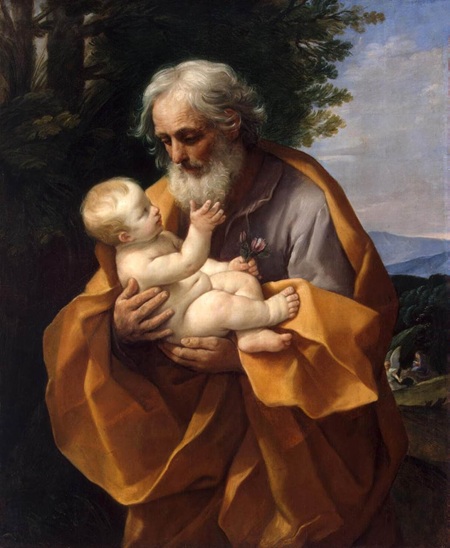
From the 17th century to the present day, there have been countless Carmelite churches and monasteries dedicated to St. Joseph. The credit for this widespread devotion is due above all to St. Teresa of Jesus, whose fervent words are well known:
“I took the glorious St. Joseph as my advocate and patron ... I saw clearly that his help was always greater than what I could have hoped for ... If my word could carry weight, I would gladly dwell at length on recounting in detail the graces that this glorious Saint has bestowed upon me and others... People of prayer must be especially devoted to him, for I do not know how one can think of the Queen of Angels and all she suffered with the Child Jesus, without thanking St. Joseph, who was such a great help to them. Whoever has no teacher from whom to learn how to pray should take this glorious Saint as a guide and will not go wrong. May it please the Lord that I have not erred in venturing to speak of him” (Life, VI, 6,7,8).
St. Teresa identified with this typically Carmelite devotion, living it both through word and example. Feeling so moved by such an exalted love of predilection, she did everything possible to spread his veneration, and of the 17 houses she founded as many as 12 were dedicated to Saint Joseph.
Among her writings, she left the following: “Although you have many holy intercessors, be especially devoted to St. Joseph, who has great influence with God.”
Consequently, in the Teresian Carmel, a profound orientation towards Joseph developed.
The teachings of St. Teresa are reflected in the work on St. Joseph by Jerónimo Gracián and, after him, many other authors of the Reform as well. The preachers of the 17th century, following in the footsteps of Teresa of Avila, were often apostles and promoters of devotion to St. Joseph. Subsequently, there was a vast output of writings intended to illustrate the life and “glories” of Saint Joseph, and to develop a theological framework for them.
St. Joseph as father, protector, patron, and guardian of our Lord Jesus is the subject of the spiritual experiences of numerous glorious and luminous figures, of whom it is practically impossible to provide a list here in CITOC. But we select one: Thérèse of Lisieux who was also a devotee of the Holy Patriarch, fully understood Teresa’s spirit:
“I prayed also to St. Joseph to watch over me; ever since my childhood I had a devotion to him that blended with my love for Our Lady ... I was so well protected that it seemed impossible to me to be afraid” (Ms. A, 158).
In the OCARM branch of the Order, there are already 15th-century writings focusing on the figure of St. Joseph, such as those by the theologian Andrea Horuken in 1451 and the magnificent poems by Mantovano in Fastorum libri XII and in Parthenice I. In the 16th–18th centuries, there was no shortage of notable preachers and writers with a Josephine orientation. Raffaele “the Bavarian,” who published a History of St. Joseph in Naples in 1723, had a significant influence on devotion to the saint in the modern era within the convents and monasteries of the OCARMs.
Read more ...