María del Carmen Molina Cobos
Observer Delegate, Carmelite NGO
The COP31 climate conference concluded without reaching the consensus required to adopt its central political decision, an outcome that reflects both the depth of divisions over climate action and the growing frustration of many countries with the way international climate negotiations are conducted.
The closing session extended far beyond the official schedule. Although COP31 was due to conclude on 20 November, negotiations continued for two additional days amid formal objections, national interventions and repeated attempts to build consensus. The prolonged negotiations highlighted deep disagreements over fossil fuels, climate finance and the governance of the climate regime. Nevertheless, the Turkish Presidency sought to advance a compromise package built around accelerated electrification, methane reductions, carbon capture technologies and a flexible framework that would allow each country to define its own pathway for the energy transition.
A number of Parties, however, concluded that the final outcome fell far short of what climate science requires and ultimately blocked its adoption.
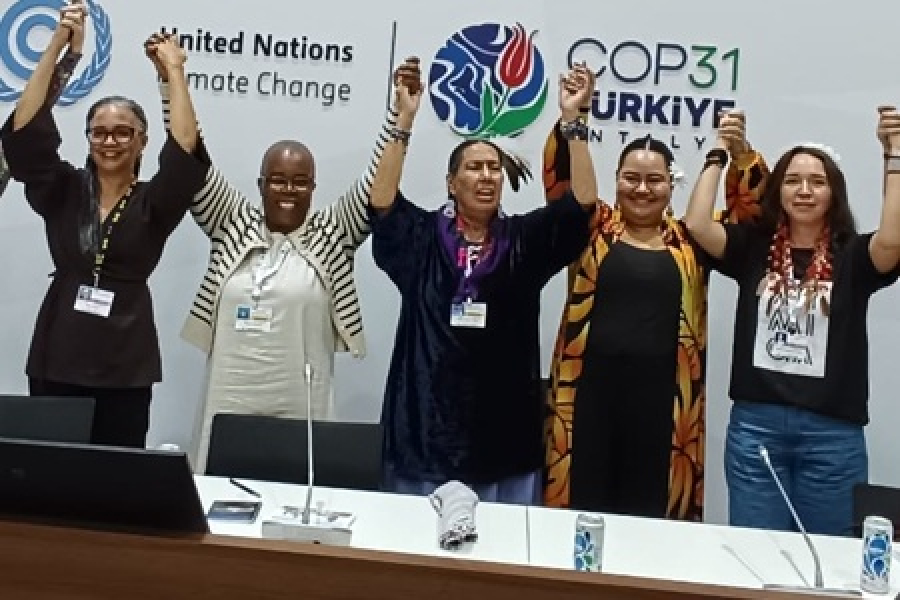
Most of the debate focused on fossil fuels, climate finance, adaptation, loss and damage, electrification, carbon capture and the governance of the process itself. Although issues such as just transition remained present throughout the negotiations, they largely faded into the background during the final political battle over the closing text. Likewise, special policies addressing the needs of persons with disabilities received virtually no attention. Indigenous Peoples were highly visible throughout COP31 but were almost absent from the final plenary discussions.
The European Union Calls the Text “Unacceptable”
The European Union delivered one of the strongest interventions of the day. Brussels argued that the draft texts failed to reflect either the scientific evidence or the magnitude of the climate emergency. The EU’s principal criticism concerned the absence of clear references to the phase-out of fossil fuels and what it regarded as a weakening of language agreed previously in Dubai.
European negotiators argued that they could not support a decision that would amount to “greenwashing fossil fuels,” and described it as inconceivable that a climate decision of such significance would fail to explicitly refer to a transition away from oil, coal and gas. For the EU, the proposal did not close the gap between current commitments and pathways compatible with the 1.5°C goal.
The United Kingdom Joins the Opposition
The United Kingdom echoed most of the European Union’s concerns. London criticized the lack of ambition in the text, the absence of clear signals for accelerating decarbonization and the inadequacy of the proposed financial mechanisms.
British negotiators identified three particularly problematic areas: climate finance, emissions reductions and the protection of the integrity of the multilateral system. They later rejected several technical texts related to climate science, arguing that these could weaken the role of the IPCC and dilute the conclusions of the Global Stocktake.
Panama Leads the Opposition Through the Lens of Climate Justice
If Europe brought the most technical criticism, Panama provided the most powerful political and moral intervention of the session.
The Panamanian delegation recalled that it had submitted eight principles weeks earlier that it considered essential for any acceptable agreement and argued that these principles had not been adequately reflected in the final outcome.
At the same time, Panama avoided directly blaming the COP Presidency. In fact, it explicitly stressed that its disagreement was not primarily procedural.
“The disagreement runs much deeper,” the delegation stated.
Panama’s critique focused on four main concerns:
- The text repeats previous commitments without generating real progress.
- It places excessive emphasis on carbon capture and storage.
- It weakens language previously agreed by Parties.
- It promotes electrification without adequately ensuring the expansion of renewable energy.
Panama insisted that the world remains on a trajectory toward accelerated warming, a prospect it considered incompatible with the survival of many vulnerable countries.
The delegation also denounced the lack of support for developing countries and defended the principle of sovereign equality, stressing that Panama’s position carries exactly the same weight as that of any other Party and that it could not accept pressure to withdraw its objection.
Ultimately, Panama lodged a formal objection to the adoption of the text and concluded with a phrase that became one of the most quoted remarks of the day:
“The atmosphere does not negotiate, and science does not negotiate.”
Small Island States Join the Rejection
The Marshall Islands, Vanuatu, Timor-Leste and Belize aligned themselves with Panama’s position.
The Marshall Islands argued that the text would prolong the fossil fuel era while failing to provide sufficient financing for countries most exposed to climate impacts.
Vanuatu was particularly outspoken, condemning the text’s silence on fossil fuels, its excessive reliance on carbon capture technologies and its lack of concrete progress on adaptation. Its delegation maintained that consensus cannot be achieved at the expense of the survival of entire peoples.
Timor-Leste argued that adaptation had been reduced to future processes and meetings rather than concrete outcomes and effective financing. Belize also announced that it could not join the consensus.
Norway likewise joined those opposing the adoption of the text, creating an unusual alliance of vulnerable countries, European states and some developed economies.
Saudi Arabia and Russia Defend the Compromise
Facing the critics was a bloc of countries that defended the package put forward by the Presidency.
Saudi Arabia insisted that the priority should be the effective implementation of existing agreements and improved access to finance for developing countries, although it offered little detail as to how this should be achieved. The Saudi delegation rejected accusations of greenwashing directed at carbon capture and storage technologies, noting that such technologies appear in many IPCC-assessed scenarios.
Russia went even further. Moscow argued that millions of people still lack access to electricity and that an excessively rapid reduction in fossil fuels could trigger energy crises and increase poverty.
Russian negotiators rejected any additional language concerning fossil fuel phase-out and defended maintaining the balance achieved in Dubai. They also argued that some climate policies are increasingly being used as instruments of trade and geopolitics and called for greater attention to the development needs of Africa and other commodity-exporting regions.
The Arab Group and Oil-Producing Countries Defend the Agreement
Qatar, Oman, Iraq and other members of the Arab Group supported the Saudi position.
Arab delegations defended the freedom of each state to determine its own energy transition pathway and argued that electrification, methane reduction and carbon capture technologies should remain among the tools recognized under the climate process.
Oman explicitly defended the compatibility of environmental ambition and energy security, while Qatar warned against climate measures that might become restrictions on international trade.
Iraq criticized the introduction of new language that could stigmatize specific economic sectors, while Venezuela supported the compromise package, arguing that it adequately reflected principles of equity and differing national circumstances.
Peru Turns Procedure into a Political Issue
Beyond substantive climate policy, one of the most striking developments of COP31 was the intensity of criticism directed at the negotiating process itself.
The strongest intervention came from Peru, speaking on behalf of AILAC, the Independent Association of Latin America and the Caribbean.
The Peruvian delegation accused several Parties of abandoning negotiations when the most difficult issues emerged and argued that negotiation is not a diplomatic courtesy but an obligation under international law.
Peru called for greater transparency, questioned the practices used during the final hours of negotiations and proposed a review of fundamental aspects of the decision-making process.
Most notably, it explicitly raised the need to discuss consensus and voting rules, one of the most sensitive issues within the international climate regime. According to Peru, the current model risks producing recurring deadlocks at a time when climate urgency demands more effective responses.
The intervention carried particular significance because it challenged not only the content of the agreement but also the governance of the COP process itself. Peru argued that the crisis is beginning to affect the credibility of the negotiations and that meaningful reforms will be needed in the future, including greater transparency, more open consultations and a review of the mechanisms used to reach collective decisions.
Procedural criticism also emerged from interventions by Ghana, Indonesia, Timor-Leste and Ukraine, highlighting growing concern about the internal functioning of climate negotiations.
Widespread Disappointment Without Abandoning Multilateralism
Between those rejecting the final outcome and those supporting it stood a large group of countries expressing profound disappointment while remaining committed to the process.
The African position was particularly significant. Ghana, speaking on behalf of the African Group, acknowledged some progress but argued that the text failed to meet the continent’s actual needs. African delegations criticized developed countries for failing to reduce emissions at the pace required by science and lamented the inadequacy of finance for adaptation and loss and damage.
African representatives emphasized that the continent bears disproportionate climate impacts despite having contributed only a small share of historical emissions. Nevertheless, they defended keeping multilateral negotiations alive.
India reiterated the need to recognize historical responsibility and equity as fundamental principles of the climate regime. Brazil criticized the absence of effective mechanisms to accelerate implementation. The Philippines condemned the repeated failure to fulfill financial commitments while vulnerable countries continue to accumulate debt and costs.
Egypt urged Parties to avoid blaming one another, warning that finger-pointing only hardens positions and erodes trust. Canada expressed deep disappointment with the level of ambition on mitigation, while Japan called on all Parties to prevent COP31 from ending in total paralysis.
Fiji, Nepal, Indonesia, Bhutan and others adopted a similar tone: deeply dissatisfied, yet convinced that multilateralism remains the only framework capable of delivering collective solutions.
The Holy See Calls for More Ambition, Solidarity and Courage
The intervention of the Holy See stood out for placing the debate on an ethical plane.
The Vatican delegation openly acknowledged that the climate crisis affects millions of people and devastates entire communities and that the international response remains below what science demands. It argued that the gap between available knowledge and political action continues to widen.
The Holy See reminded delegates that what is at stake is not merely emissions targets or political mechanisms, but the concrete lives and human dignity of millions of people affected by climate disruption.
The Vatican called for new forms of solidarity, deeper social and economic transformations and a cultural renewal capable of sustaining climate action over the long term. It further emphasized that climate action cannot rely exclusively on political commitments but requires a transformation of conscience and a deeper understanding of the interdependence that binds the human family together.
At the same time, it reaffirmed the importance of remaining within the multilateral framework and maintaining all available pathways for adaptation.
Its final message captured the mood of many participants:
“We possess the scientific knowledge and the means required. What we now need is the courage and political will to put them into practice. Future generations cannot wait.”
The statement resonated in a plenary that ended without an agreement but revealed something even deeper: a growing dispute not only over how to fight climate change, but also over how the international response itself should be governed.